Riley Gaines Lawsuit 2026: NCAA Dismissal, Appeal, and What Comes Next
Quick Answer
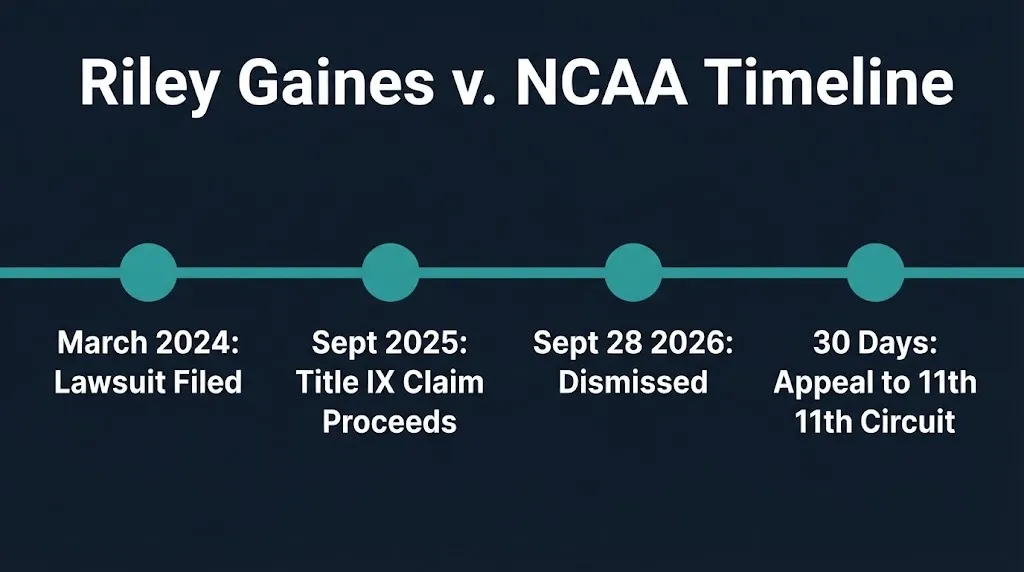
- Riley Gaines’ Title IX lawsuit against the NCAA was dismissed on September 28, 2026, by a federal judge.
- The judge ruled the NCAA is not subject to Title IX because it does not receive federal financial assistance.
- Gaines and her co-plaintiffs plan to appeal to the U.S. Court of Appeals for the 11th Circuit within 30 days.
The Riley Gaines lawsuit against the NCAA is a Title IX case filed in March 2024 by former University of Kentucky swimmer Riley Gaines and more than a dozen other female college athletes . It challenges NCAA policies that allowed transgender women to compete in women’s sports, centered on the 2022 NCAA Division I Women’s Swimming and Diving Championships where Lia Thomas competed .
On September 28, 2026, U.S. District Judge Tiffany R. Johnson granted the NCAA’s motion for summary judgment, dismissing the remaining Title IX claims . The ruling turned on whether the NCAA qualifies as a recipient of federal financial assistance, a prerequisite for Title IX liability .
This article covers why the case was dismissed, what the appeal means, the legal theories at stake, and what happens next in 2026.
The Facts
| Item | What to Know |
|---|---|
| Case Name | Gaines v. National Collegiate Athletic Association |
| Court | U.S. District Court, Northern District of Georgia |
| Case Number | 1:24-cv-01109-TRJ |
| Filed | March 2024 |
| Status | Dismissed September 28, 2026 |
| Key Ruling | NCAA is not a Title IX recipient |
| Next Step | Appeal to 11th Circuit within 30 days |
| Settlement | None. No payout exists. |
Why Was the Riley Gaines Lawsuit Dismissed?
The Riley Gaines lawsuit was dismissed because Judge Johnson found there was no evidence the NCAA ever received federal funds .
The case hinged on one legal question: Is the NCAA a “recipient” of federal financial assistance under Title IX? If yes, the NCAA must comply with Title IX’s nondiscrimination rules. If no, the lawsuit cannot proceed .
Judge Johnson ruled the NCAA does not qualify. She found that the NCAA and the Defense Department maintained separate funding streams for research. Both contributed money to Indiana University, but the department’s money went to the university and other research participants, not to the NCAA .
“Here, there is no evidence that the NCAA ever received, or could have received, federal funds,” Johnson wrote. “Thus, Plaintiffs’ Title IX claims cannot proceed” .
The judge also rejected arguments that the NCAA indirectly received federal funding, controlled entities that received the money, or became a federal-funding recipient through reimbursements for employee travel expenses .
The ruling did not decide whether the NCAA’s former transgender-athlete policy constituted sex discrimination .
What Was the Riley Gaines Lawsuit About?
The Riley Gaines lawsuit challenged NCAA policies that allowed transgender women to compete in women’s sports .
The lawsuit stemmed from the 2022 NCAA Division I Women’s Swimming and Diving Championships at Georgia Tech. During that meet, trans swimmer Lia Thomas became the first openly transgender athlete to win an NCAA Division I championship, winning the 500-yard freestyle and tying Gaines for fifth in the 200-yard freestyle .
Gaines and her co-plaintiffs alleged the NCAA violated their Title IX rights by permitting biological males to enter women’s events and share private locker rooms . Gaines has said she and other female swimmers were required to share a locker room with Thomas during the championships .
The lawsuit named athletes from multiple sports, including swimmers Kylee Alons, Reka Gyorgy, Kaitlynn Wheeler and Grace Countie, former San Jose State volleyball player Brooke Slusser and former Roanoke College swimmer Lily Mullens .
Key Takeaway: The Riley Gaines lawsuit was dismissed because the NCAA does not receive federal funds and therefore is not subject to Title IX. The ruling did not address whether the NCAA’s transgender policy was discriminatory.
What Did the Court Decide in September 2025?
In September 2025, Judge Johnson allowed the Title IX claims against the NCAA to proceed temporarily . This was a procedural win for Gaines, not a final ruling on the merits.
The court found the plaintiffs had plausibly alleged the NCAA received federal assistance through a concussion-research partnership with the Department of Defense . The judge authorized a 90-day discovery period limited to the NCAA’s relationship with the Defense Department .
The court’s September 2025 decision followed the framework of the Supreme Court’s 1999 ruling in NCAA v. Smith. In that case, the high court held the NCAA was not subject to Title IX merely because it collected dues from member institutions that received federal funds .
The Smith ruling left open whether other forms of assistance, such as direct grants or formal partnerships, could trigger Title IX coverage . Gaines’ legal team argued the Defense Department partnership was different.
After discovery, Judge Johnson found no evidence the NCAA actually received federal funds through that partnership .
What Is the Riley Gaines Act?
The Riley Gaines Act is a federal bill introduced in the U.S. House of Representatives on February 4, 2026 . It is not the same as the lawsuit, though they share a name and a cause.
The bill would authorize civil actions against colleges and athletic associations that negligently or recklessly permit a biologically male student athlete to compete in women’s competitions, resulting in physical injury to a female athlete . It includes damages for loss of scholarship or professional opportunity, plus attorney’s fees for prevailing plaintiffs .
Georgia also passed a state law called the Riley Gaines Act in 2025. That law bars Georgia’s public universities from hosting or participating in competitions where biologically male athletes compete against women or use women’s facilities .
The Georgia law mooted the claims against Georgia Tech and the University System of Georgia, leaving only the NCAA as a defendant .
What Happens Next in the Riley Gaines Lawsuit?
Gaines and her co-plaintiffs plan to appeal to the U.S. Court of Appeals for the 11th Circuit . They have 30 days from the September 28 ruling to file a notice of appeal .
“This momentary setback will not deter me or other women athletes in the least,” Gaines said in a statement. “Rest assured, we will be appealing this decision” .
ICONS co-founder Kim Jones said the organization believes Judge Johnson erred and predicted the appeals court would conclude the NCAA is covered by Title IX . “We will not give up our fight for women and girls’ rights in sports,” Jones said .
The appeal will focus on the same legal question: Is the NCAA a recipient of federal financial assistance? The 11th Circuit’s ruling could create binding precedent in Georgia, Florida, and Alabama .
There is no settlement. There is no payout. This is a civil rights case seeking damages and policy changes, not a class action settlement fund .
Reality Check: No one will contact you offering money from the Riley Gaines lawsuit. This is a Title IX case against the NCAA, not a consumer settlement with a claims process. Anyone asking for payment to “join” this case is running a scam.
What Happens Next?
Within 30 days of September 28, 2026: Gaines and co-plaintiffs file a notice of appeal with the 11th Circuit.
Expected late 2026 to early 2027: Briefing schedule in the 11th Circuit.
Expected mid to late 2027: Oral argument and ruling on whether the NCAA is a Title IX recipient.
Ongoing: The NCAA’s current policy, changed in February 2025 following an executive order, prohibits athletes assigned male at birth from competing on women’s teams .
Frequently Asked Questions
Was the Riley Gaines lawsuit dismissed?
Yes. A federal judge dismissed the lawsuit on September 28, 2026, ruling the NCAA is not subject to Title IX because it does not receive federal funds .
What was the Riley Gaines lawsuit about?
It was a Title IX case challenging NCAA policies that allowed transgender women to compete in women’s sports, centered on the 2022 NCAA Swimming Championships .
Is there a settlement in the Riley Gaines lawsuit?
No. There is no settlement, no payout, and no claims process. The case was dismissed and is headed to appeal .
Who are the plaintiffs in the Riley Gaines lawsuit?
Riley Gaines and more than a dozen current and former female college athletes, including swimmers and volleyball players from multiple universities .
What is the Riley Gaines Act?
It is a federal bill introduced in February 2026 that would allow female athletes to sue colleges and athletic associations for injuries caused by competing against biological males .
What happens if Gaines wins the appeal?
The case would return to the district court for further proceedings on whether the NCAA’s former policy violated Title IX .
Does the Riley Gaines lawsuit affect current NCAA policy?
No. The NCAA changed its policy in February 2025, prohibiting athletes assigned male at birth from competing on women’s teams .
How long does the appeal take?
Appeals to the 11th Circuit typically take 12 to 18 months from the notice of appeal to a ruling.
The Riley Gaines lawsuit is now in the appeal phase. If you are following this case, watch for the notice of appeal to be filed within 30 days of the September 28, 2026 dismissal. The 11th Circuit’s ruling will determine whether the NCAA can be held accountable under Title IX for its former policies.