Affirm Lawsuit 2026: Class Action Status, Settlement Claims, and What Borrowers Need to Know
Quick Answer:
- Real class actions accuse Affirm of misleading borrowers about interest rates, fees, and credit reporting impacts.
- One proposed settlement may pay eligible borrowers $50 to $500 depending on their loan history.
- No claim deadline is active yet; a settlement website is expected by late 2026 or early 2027.
Affirm built its brand on transparency. No hidden fees, no deferred interest, no surprises. That promise is now at the center of multiple federal class action lawsuits. The cases accuse the buy-now-pay-later giant of doing exactly what it said it would not do. The allegations include misleading consumers about the true cost of loans, reporting inaccurate information to credit bureaus, and making it unreasonably difficult to obtain refunds on returned purchases. These are not fringe complaints. At least one proposed settlement is already on the table.
This affects anyone who used Affirm to finance a purchase from roughly 2018 through 2025. The potential class includes millions of borrowers. This article covers every verified detail about the Affirm lawsuits, what settlement money may be available, who qualifies, and exactly what to watch for as the cases progress. One surprising verified detail: internal company documents cited in one complaint allegedly show Affirm knew its “0% APR” marketing confused some consumers but continued the practice anyway.
| The Facts | |
|---|---|
| Case | Multiple proposed class actions against Affirm Holdings Inc. and Affirm Inc. |
| Status | Active litigation; at least one proposed settlement pending preliminary approval |
| Fund Size | Not yet confirmed for most cases |
| Est. Per Person | $50 to $500 estimated range depending on loan volume and fees paid |
| Claim Deadline | Not yet set |
| Administrator | Not yet appointed for most cases |
| Proof Needed | Likely loan records, Affirm account statements, or email confirmations |
Is the Affirm Class Action Lawsuit Real or a Scam?
The Affirm class action lawsuits are real. Multiple cases are moving through federal courts, and at least one has reached a proposed settlement. These are not unsolicited settlement offers from unknown companies. They are actual court cases with docket numbers and judicial oversight.
Scam messages about Affirm settlements are circulating. You may see texts, emails, or social media ads claiming you are owed money and asking you to click a link. Real class action settlements never contact you first through text message. They never ask for payment to process your claim. If you receive a message demanding a fee or your full Social Security number, delete it.
The most prominent case is pending in the U.S. District Court for the Northern District of California. That case accuses Affirm of violating the Truth in Lending Act and state consumer protection laws by misrepresenting the terms of its loans. A separate proposed class action in the Southern District of New York targets Affirm’s refund practices. Another case focuses on credit reporting errors that allegedly harmed borrowers’ credit scores.
Key Takeaway: Real lawsuits are active with at least one proposed settlement. Scam messages are also circulating. Never pay to file a class action claim.
How Much Money Could I Get From the Affirm Settlement?
No final settlement amount has been approved by a court. However, the proposed settlement in the Northern District of California case suggests what payouts may look like if the deal is finalized.
The proposed settlement would create a fund to repay borrowers who were charged certain fees or who paid interest on loans they say were misleadingly marketed. Estimates based on the proposed fund size and the number of likely claimants suggest individual payouts could range from $50 to $500. Borrowers who took out multiple Affirm loans or who paid substantial interest or late fees may fall on the higher end of that range.
| Claim Type | Estimated Payout Range | Basis |
|---|---|---|
| Misleading interest disclosure claims | $50 to $200 | Per loan, depending on interest paid |
| Late fee refund claims | $25 to $150 | Based on number of fees charged |
| Credit reporting error claims | $100 to $500 | If credit score damage is documented |
| Combined claims (multiple issues) | $200 to $500 | Higher end for borrowers with multiple affected loans |
These numbers are projections drawn from the proposed settlement terms. They are not final. The court has not yet granted preliminary approval. If the settlement is approved, the actual amount you receive depends on how many eligible borrowers file claims and how the fund is allocated.
Who Is Eligible for the Affirm Class Action?
Eligibility depends on which case ultimately settles and the specific class definitions approved by the court. You may qualify if you used Affirm to finance a purchase during the class period.
For the Northern District of California case, the proposed class includes U.S. consumers who originated an Affirm loan between approximately 2018 and 2025 and who were charged interest or fees that plaintiffs allege were not adequately disclosed. The precise class period may shift before final approval.
A separate case covers borrowers who returned items purchased with Affirm financing and faced delays or denials in receiving refunds. If you returned a purchase and Affirm continued to bill you or failed to credit your refund promptly, you may be part of that class.
You do not need to sign up anywhere right now. If a settlement is approved, the claims administrator will attempt to contact eligible borrowers using Affirm’s customer records. Notices will be sent by mail or email.
Key Takeaway: Affirm borrowers from roughly 2018 to 2025 may be eligible. Exact eligibility will be defined when each settlement receives court approval.
Reality Check: Affirm Refunds Do Not Come by Text Message
Reality Check: If a real Affirm settlement is approved, you will receive a mailed notice or an email directing you to an official settlement website with a .com or .org domain. You will never receive a text message with a link to claim your money. Filing a claim will always be free. Third-party services that offer to file your claim for a fee are unnecessary. You can complete the claim form yourself in minutes. Anyone who contacts you first and asks for money is running a scam.
How to File an Affirm Settlement Claim
No claim form is available yet. When a settlement receives preliminary court approval, here is how the process will work.
- Wait for the court to issue an order granting preliminary approval of a settlement.
- Look for a mailed postcard or email from the settlement administrator with your unique claim information.
- Visit the official settlement website, which will be named after the case, such as “Affirm Class Action Settlement.”
- Enter your notice ID and confirmation code from the mailed or emailed notice.
- Complete the online claim form with your name, contact details, and Affirm loan information.
- Upload any supporting documents, such as Affirm loan statements, payment confirmations, or credit reports showing errors.
- Choose your payment method: digital transfer, paper check, or prepaid card.
- Submit before the deadline, which will be clearly posted and typically runs 60 to 120 days.
Keep your Affirm account records now. Download your loan statements, payment histories, and any correspondence with Affirm customer service. These documents will help you prove your claim if a settlement is approved.
Affirm Class Action Lawsuit: What Are the Cases About?
The lawsuits against Affirm center on four core allegations. Each one challenges a different part of the company’s business model and marketing.
The first allegation involves interest rate disclosures. Plaintiffs say Affirm marketed loans as “0% APR” but failed to clearly disclose that this rate was only available to the most qualified borrowers. Consumers who applied expecting zero interest were instead offered loans with rates as high as 36%. The complaint alleges this violated the Truth in Lending Act, which requires clear and conspicuous disclosure of loan terms.
The second allegation targets late fees. Affirm publicly states it does not charge late fees. But plaintiffs argue that the company imposes other charges that function like late fees under a different name. These include account reactivation fees or additional interest charges triggered by missed payments.
The third allegation involves refunds. Borrowers who returned items purchased with Affirm financing say the company continued to demand payments or failed to process refunds for weeks or months. In some cases, borrowers say Affirm reported missed payments to credit bureaus while refunds were still pending.
The fourth allegation concerns credit reporting. Plaintiffs say Affirm furnished inaccurate information to credit reporting agencies. Some borrowers say their Affirm loans were reported as delinquent when they were current. Others say paid-off loans remained on their credit reports as active debts.
Key Takeaway: The four core allegations cover misleading interest disclosures, disguised late fees, refund delays, and inaccurate credit reporting.
Is There an Affirm Settlement Claim Form Available Now?
No claim form is available for any Affirm settlement as of July 2026. The proposed settlement in the Northern District of California case has not yet received preliminary court approval. Until that happens, no claims process exists.
Websites that claim to offer Affirm claim forms today are not legitimate. They may be collecting your personal information for marketing purposes or worse. The only official claim form will appear on the settlement website operated by the court-appointed administrator. That site will launch only after the court grants preliminary approval.
You can check the status of the proposed settlement by monitoring the official court docket. The case is searchable through the PACER system under the case name and number. When the court schedules a preliminary approval hearing, that is your signal that a settlement website may launch soon.
Affirm Settlement Claim: How Long Until Payouts Arrive?
Even if a settlement receives preliminary approval in late 2026, payments will not arrive quickly. The class action settlement timeline is methodical by design.
After preliminary approval, the administrator must mail notices and publish the settlement website. Claimants typically have 60 to 120 days to file. After the claim deadline, the administrator reviews and validates every claim. That process can take months. A final approval hearing follows. Only then can payments be processed.
If preliminary approval comes by late 2026, the earliest realistic payout window is mid to late 2027. If the proposed settlement faces objections or if appeals are filed, that timeline stretches further. Objections to class action settlements are common, especially in cases with large class sizes and significant fund amounts. An objection can delay final approval by six months or more.
This pace is comparable to a delayed tax refund. You know the money is coming. You have paperwork confirming it. But the processing time is out of your hands, and no phone call speeds it up.
What Is the Status of the Affirm Lawsuit in 2026?
The Affirm litigation involves at least three active federal cases. Each is at a different stage.
The Northern District of California case is the most advanced. The parties have reached a proposed settlement and are awaiting the court’s decision on preliminary approval. That hearing is expected in late 2026. If the court grants preliminary approval, the claims process could open by early 2027.
The Southern District of New York case concerns refund practices. It is in discovery. Class certification has not yet been decided. No trial date is set.
A third case, filed in the District of Massachusetts, targets credit reporting issues. This case is in the early stages. The parties are briefing motions to dismiss. No settlement discussions have been reported.
| Case | Court | Status | Next Milestone |
|---|---|---|---|
| Interest and fee disclosures | N.D. California | Proposed settlement pending preliminary approval | Hearing expected late 2026 |
| Refund practices | S.D. New York | Discovery; class certification pending | TBD |
| Credit reporting errors | D. Massachusetts | Motion to dismiss pending | TBD |
Affirm has denied wrongdoing in all cases. The company states that its disclosures comply with all applicable laws and that its loan terms are clearly presented to borrowers before they commit.
How Do I Know If I Am Part of the Affirm Settlement?
You will not know for certain until the court approves a settlement and the administrator issues notices. But there are signs you may be a class member.
You may be in the class if you used Affirm to finance a purchase between roughly 2018 and 2025. You may also qualify if you were charged interest on an Affirm loan after seeing marketing that suggested 0% APR. If you paid late fees or similar charges, or if you had difficulty obtaining a refund after returning a purchase, you may fall into one of the other classes.
You do not need to take any action yet. If a settlement is approved, Affirm is required to provide the administrator with customer records. Notices will be mailed to the address on your Affirm account. If you have moved, make sure your contact information with Affirm is current. This is the single most effective step you can take today.
What Happens Next
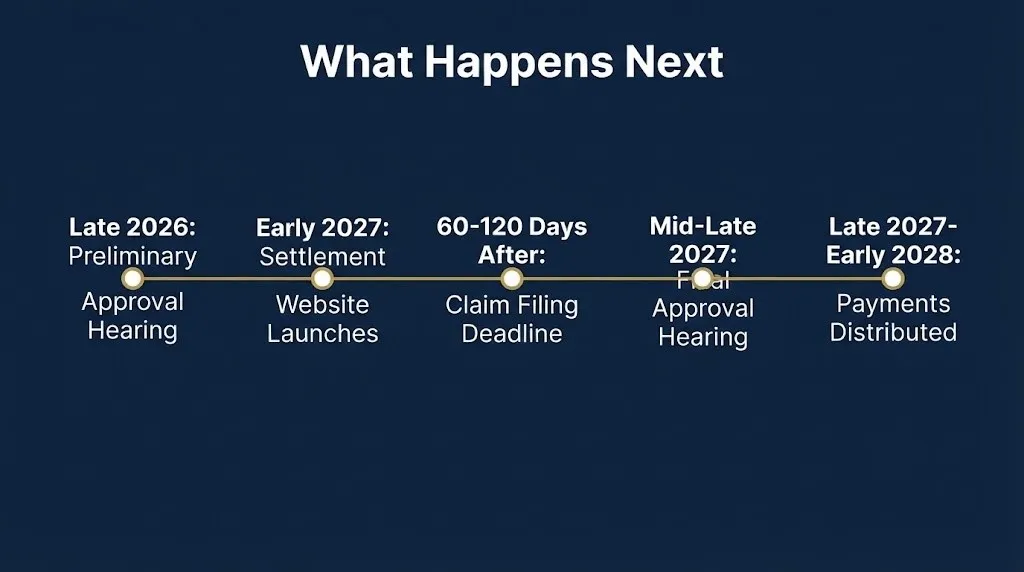
Here are the expected next stages based on the current posture of the cases.
| Expected Late 2026 | Preliminary approval hearing in the Northern District of California case |
|---|---|
| Early 2027 (if approved) | Settlement website launches, claim forms become available |
| 60 to 120 days after launch | Claim filing deadline |
| Mid to Late 2027 | Final approval hearing |
| Late 2027 to Early 2028 | Payments distributed to eligible claimants |
Every date is an estimate. Court schedules shift. Objections and appeals can add months or years. The timeline assumes the proposed settlement moves forward without major obstacles.
Frequently Asked Questions
Is the Affirm class action lawsuit legitimate?
Yes, multiple real lawsuits are active in federal courts.
One proposed settlement is pending preliminary approval.
No court has finalized a settlement or approved payments yet.
How do I get my money from the Affirm settlement?
No money is being paid because no settlement has been approved.
When a settlement is finalized, you will file a claim online for free.
You cannot file a claim or request payment until the settlement website launches.
What did Affirm do wrong according to the lawsuits?
Plaintiffs say Affirm misled borrowers about interest rates and loan terms.
Other allegations involve delayed refunds and inaccurate credit reporting.
Affirm denies all allegations and is defending the cases.
Will I automatically get a payment from the Affirm class action?
No, you will likely need to file a claim form to receive a payment.
Some settlements allow automatic payments for easily identifiable class members.
Assume you will need to file unless the official notice states otherwise.
How much does it cost to file an Affirm settlement claim?
Filing a claim is always free in a legitimate class action settlement.
Anyone charging a fee to file your claim is offering an unnecessary service.
You can complete the claim form yourself at no cost.
When is the deadline to file an Affirm claim?
No deadline has been set because no settlement has been approved.
The deadline will be clearly posted on the official settlement website.
You will typically have 60 to 120 days to file once the site opens.
Can I sue Affirm individually instead of joining the class action?
Yes, you can opt out of the class and pursue your own case.
Opting out preserves your right to sue individually.
You should consult an attorney before deciding to opt out.
What should I do right now about the Affirm lawsuit?
Keep your Affirm loan records, statements, and correspondence.
Do not pay anyone who contacts you about filing a claim.
Check back periodically for updates on the official settlement website once it launches.
The Affirm class actions are real, and at least one proposed settlement is on the table. But no money is available yet. No claim form exists. No deadline has been set. Anyone who says otherwise is either misinformed or trying to take your money. Keep your loan records. Watch for an official notice in the mail, which will look like a formal legal document with the court case name. And check back for updates as the preliminary approval hearing approaches in late 2026.