How to Negotiate Debt Settlement on Your Own 2026: A Step-by-Step Guide
Quick Answer
- You can negotiate debt settlement yourself without paying a debt settlement company any fees.
- Creditors may accept 40 to 60 percent of the balance, but many refuse to settle at all.
- The best time to negotiate is after an account is delinquent but before a lawsuit is filed.
If you have fallen behind on debt and want to settle for less than you owe, you do not need to pay a company to do it for you. You can negotiate directly with your creditors. The process is free, legal, and often more effective than going through a third party.
Debt settlement is not guaranteed. Creditors do not have to accept your offer. Some will refuse outright. Others will settle for a fraction of the balance. Your success depends on the creditor, the age of the debt, and your negotiation approach.
This article explains how to negotiate debt settlement on your own in 2026, step by step, with realistic expectations and no false promises.
The Facts
| Detail | Verified Information |
|---|---|
| Direct Negotiation | Legal and free |
| Typical Settlement Range | 40 to 60 percent of balance |
| Best Time to Negotiate | After delinquency, before lawsuit |
| Written Agreement | Essential before paying |
| Tax Consequence | Forgiven debt over $600 may be taxable |
| Statute of Limitations | Varies by state, 3 to 10 years |
| No Government Filing | Not a court process |
Is It Legal to Negotiate Debt Settlement on Your Own?
Yes, it is legal to negotiate debt settlement on your own. No law requires you to use a debt settlement company or a lawyer. You have the right to contact your creditors directly.
The Fair Debt Collection Practices Act gives you certain rights when dealing with debt collectors. You can demand written verification of the debt. You can tell a collector to stop calling. You can negotiate without harassment.
Creditors are not required to negotiate with you. But they are allowed to. Most major credit card issuers have hardship programs and settlement departments.
You do not need a license, a certification, or a law degree to negotiate your own debt. You need information, patience, and a willingness to advocate for yourself.
Key Takeaway: Direct debt settlement negotiation is legal, free, and protected by federal debt collection laws.
How Much Can You Save by Negotiating Debt Settlement Yourself?
You may save 40 to 60 percent of your debt by negotiating yourself, but results vary. Some creditors settle for less. Some refuse to settle at all.
The savings depend on several factors.
- Age of the debt: older debts often settle for less.
- Creditor policies: some settle, some do not.
- Your financial situation: hardship may lead to better offers.
- Whether the debt has been sold to a debt buyer: debt buyers often settle for less.
- Whether a lawsuit has been filed: lawsuits change the negotiation dynamic.
By negotiating yourself, you also save the 15 to 25 percent fee a settlement company would charge. That is real money staying in your pocket.
Key Takeaway: Typical settlements are 40 to 60 percent of the balance, and doing it yourself saves the settlement company fee.
When Is the Best Time to Negotiate Debt Settlement?
The best time to negotiate debt settlement is after your account is delinquent but before a lawsuit is filed.
Creditors rarely settle current accounts. If you are making on-time payments, they have no incentive to accept less than the full balance. Delinquency signals risk, which makes settlement more attractive to the creditor.
But waiting too long is dangerous. If the creditor files a lawsuit, the negotiation dynamic changes. The creditor now has leverage. They can obtain a judgment, garnish wages, or levy bank accounts.
The sweet spot is usually 90 to 180 days past due. The account is delinquent enough to trigger settlement offers, but the lawsuit risk is still manageable.
Key Takeaway: Negotiate after delinquency but before a lawsuit. The sweet spot is usually 90 to 180 days past due.
How to Negotiate Debt Settlement on Your Own Step by Step
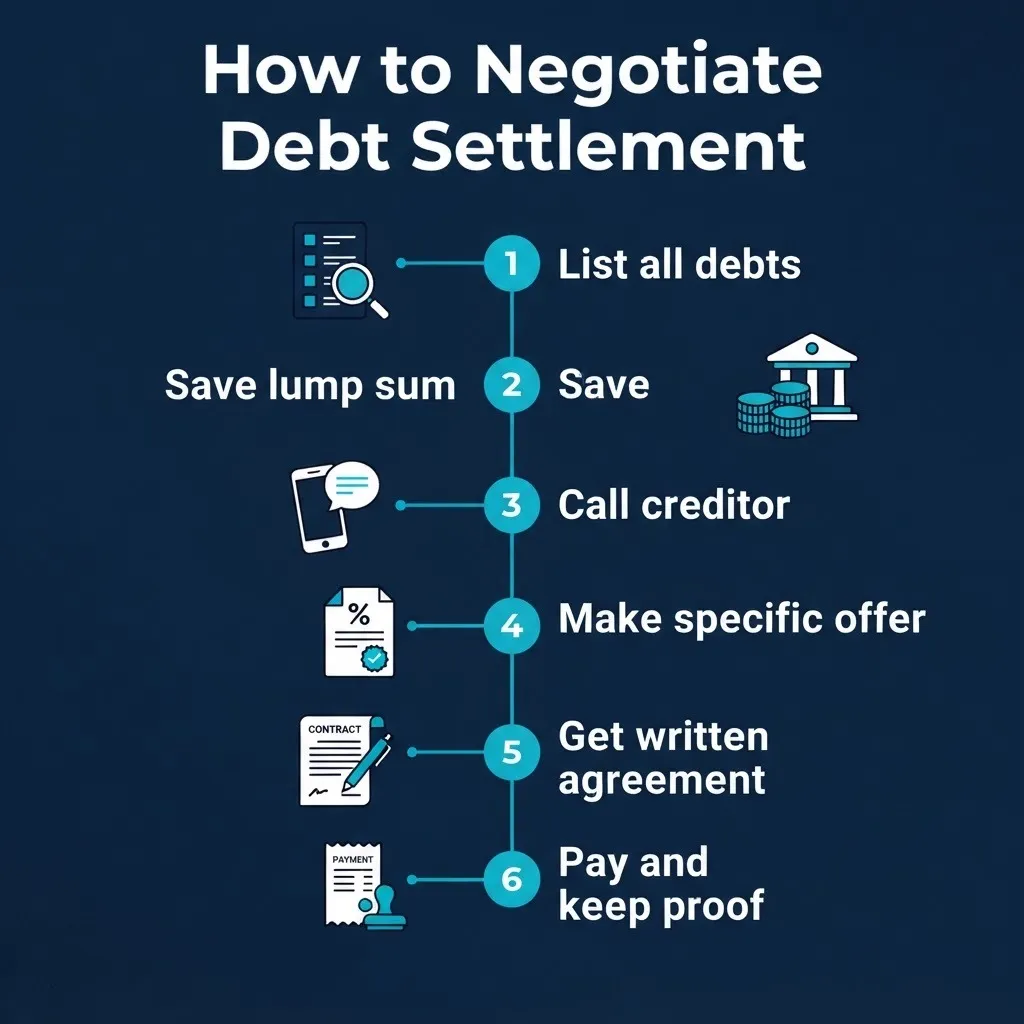
Negotiating debt settlement yourself requires preparation and discipline. Follow these steps.
- List every debt, including the creditor, balance, and account number.
- Decide which debts you want to settle and how much you can offer.
- Save money in a separate account so you can pay settlements in lump sums.
- Call the creditor and state your financial hardship clearly.
- Make a specific offer, usually 30 to 40 percent of the balance to start.
- Negotiate the amount and insist on a written agreement before paying.
- Pay the agreed amount and keep the settlement letter forever.
Do not make a payment without a written agreement that states the debt is settled in full. Verbal promises are not enforceable.
Key Takeaway: Preparation, a lump sum, and a written agreement are the foundation of successful DIY debt settlement.
What Should You Say When Negotiating Debt Settlement?
When you call a creditor to negotiate, what you say matters. Be direct, honest, and firm.
State your hardship clearly. You lost your job. You had a medical emergency. Your income dropped. Creditors hear this every day, but it still matters because it explains why you cannot pay in full.
Then make a specific offer. Say: “I can offer $3,000 to settle this $8,000 balance in full. I need a written settlement agreement before I pay.”
Do not overexplain. Do not beg. Do not reveal that you have more money than you are offering. Do not agree to a payment plan unless you can afford it.
If the first representative says no, ask to speak with a supervisor. Settlement authority often sits at a higher level.
Key Takeaway: State your hardship, make a specific offer, and insist on a written agreement.
What Is a Good Settlement Offer Percentage?
A good settlement offer percentage is 30 to 40 percent of the balance as a starting point. You can go up from there if needed.
If you owe $10,000, start by offering $3,000 to $4,000. The creditor may counter at $6,000 or $7,000. You negotiate toward the middle.
Some creditors will settle for as little as 25 percent, especially for old debts purchased by debt buyers. Original creditors may want 50 to 60 percent.
The older the debt, the lower the percentage you can offer. A debt that is four years old and near the statute of limitations may settle for very little.
Key Takeaway: Start at 30 to 40 percent and negotiate upward. Old debts settle for less than new ones.
Should You Use a Debt Settlement Company Instead?
You probably should not use a debt settlement company. Most financial experts advise against it.
The reasons are simple. Settlement companies charge high fees, often 15 to 25 percent of the enrolled debt. Those fees reduce your savings. The companies cannot do anything you cannot do yourself.
The Federal Trade Commission has repeatedly warned about deceptive practices in the debt settlement industry. Some companies promise results they cannot deliver. Some fail to settle any debts after months of collecting fees.
If you need help, a nonprofit credit counseling agency is a better option. They charge little or nothing and offer debt management plans without the credit damage of settlement.
Key Takeaway: Debt settlement companies charge high fees for work you can do yourself. Nonprofit credit counseling is a safer alternative.
Reality Check: Not Every Creditor Will Settle
Not every creditor will settle. Some creditors have policies against settling with consumers directly. Others will only settle after the account is charged off. Some will never settle and will instead file lawsuits. The debt settlement industry sells certainty. The reality is uncertainty. You may negotiate one debt successfully and fail completely on another. Do not count on settlement as a guaranteed strategy. Have a backup plan, including the possibility of bankruptcy if your debts are overwhelming.
Can You Negotiate a Settlement After a Lawsuit Is Filed?
You can negotiate a settlement after a lawsuit is filed, but your leverage is reduced. The creditor already has the court involved.
Once a lawsuit is filed, the creditor has more options. They can obtain a judgment, garnish wages, or levy bank accounts. They are less motivated to settle for a steep discount.
But settlement is still possible. Creditors often prefer a settlement to the cost and uncertainty of continued litigation. The settlement amount may be higher than it would have been before the lawsuit, but it is often still less than the full balance plus fees and interest.
If you have been sued, do not ignore it. Respond to the lawsuit and contact the creditor or their attorney about settlement.
Key Takeaway: Settlement is still possible after a lawsuit, but expect to pay more and act quickly.
What Are the Tax Consequences of Debt Settlement?
Debt settlement can create taxable income. The IRS generally treats forgiven debt over $600 as income unless you qualify for an exception.
When a creditor settles for less than the full balance, the forgiven amount may be reported on Form 1099-C. You may owe income tax on that amount.
For example, if you settle a $10,000 debt for $4,000, the $6,000 forgiven may be taxable. At a 22 percent tax rate, that is $1,320 in taxes.
The insolvency exception can help. If your liabilities exceed your assets at the time of settlement, you may not owe tax on the forgiven debt. This is a fact-specific analysis.
Key Takeaway: Forgiven debt may be taxable. The insolvency exception can reduce or eliminate the tax bill.
What Is the Difference Between Debt Settlement and Debt Collection?
The difference between debt settlement and debt collection is who initiates the process and what they want.
Debt settlement is when you contact the creditor and negotiate to pay less than the full balance. You initiate the process. You make an offer.
Debt collection is when the creditor or a third-party collector contacts you to demand payment. They initiate the process. They want the full balance.
You may negotiate during debt collection. A collection call can become a settlement conversation. The Fair Debt Collection Practices Act gives you rights in these interactions.
Key Takeaway: Settlement is your initiative. Collection is the creditor’s initiative. They can overlap.
How Does the Statute of Limitations Affect Debt Settlement?
The statute of limitations affects debt settlement because it determines whether a creditor can sue you.
Each state sets a time limit for filing a debt collection lawsuit. The limit varies, typically three to ten years depending on the state and the type of debt. Once the statute expires, the creditor cannot sue you.
Debts past the statute of limitations are often called time-barred debts. You may still receive collection calls, but the creditor cannot legally force you to pay through the courts.
Time-barred debts settle for much less because the creditor has no legal leverage. Some debt buyers settle these debts for pennies on the dollar.
Key Takeaway: Debts past the statute of limitations settle for less because creditors lose the right to sue.
What Happens Next After You Negotiate a Settlement
After you negotiate a settlement, the process follows a predictable path.
Day 1: You receive the written settlement agreement.
Day 1 to 3: You review the agreement and confirm the terms.
Day 3 to 7: You pay the agreed amount by cashier’s check or ACH.
Day 7 to 30: The creditor processes the payment and marks the account settled.
Year end: The creditor may issue a Form 1099-C for forgiven debt.
Permanent: You keep the settlement letter as proof the debt is resolved.
These timelines are general. Your specific creditor may move faster or slower.
Frequently Asked Questions
Can I settle debt on my own without a company?
Yes. Direct negotiation is legal and free. No law requires a third party.
How much should I offer to settle a debt?
Start at 30 to 40 percent of the balance. Negotiate upward from there.
Will settling a debt hurt my credit?
Yes. Settled accounts are marked “settled for less than full balance” and stay on your report for seven years.
Can I settle a debt that is in collections?
Yes. Debt collectors often settle for less, especially if the debt is old or near the statute of limitations.
What if the creditor refuses to settle?
You can try again later, offer more money, or explore bankruptcy. Not all creditors settle.
Do I need a written settlement agreement?
Yes. Never pay a settlement without a written agreement stating the debt is settled in full.
Is forgiven debt taxable?
Generally yes for amounts over $600, unless the insolvency exception applies.
How long does a settled debt stay on my credit report?
Seven years from the date of first delinquency.
The most important fact about negotiating debt settlement yourself is that you can do it. You do not need to pay a company. You need a plan, a lump sum, and the patience to negotiate. Get every agreement in writing. Understand the tax consequences. And know that not every creditor will settle. If your debts are overwhelming, talk to a nonprofit credit counselor or a bankruptcy attorney before making any decisions.