Debt Settlement Lawyer Near Me 2026: How to Find One and When It’s Worth It
Quick Answer
- Do you need one? Only if you’re being sued, facing wage garnishment, or dealing with debt collectors who won’t negotiate.
- How much? Attorneys typically charge $150 to $400 per hour, or 15% to 30% of the debt or savings .
- Key warning? Debt settlement companies are not law firms and cannot represent you in court if you’re sued .
You’re searching for a debt settlement lawyer near me because the phone won’t stop ringing. Collection agencies are calling your family, sending letters, and threatening legal action. You’ve heard that hiring an attorney might stop the harassment and reduce what you owe, but you’re not sure who to trust.
The search results are confusing. Debt settlement companies pay for ads that look like law firm listings. Some “attorneys” are just names on a website with no real legal practice behind them. And the fees vary wildly depending on who you call.
This guide cuts through the noise. It explains exactly how to find a legitimate debt settlement attorney in your area, how to verify they’re licensed and in good standing, what they can do that a debt settlement company cannot, and how much the service should realistically cost.
The Facts
| Service Type | Licensed attorney providing debt negotiation and legal defense |
|---|---|
| Licensing | State bar admission required; verify via your state’s bar database |
| Typical Hourly Rate | $150 to $400 per hour |
| Typical Contingency Fee | 15% to 30% of debt or savings |
| What They Can Do | Negotiate, defend lawsuits, stop harassment, file bankruptcy if needed |
| What They Cannot Do | Erase valid debts, guarantee settlements, work outside their licensed state |
Should You Hire an Attorney for Debt Settlement?
You should hire an attorney for debt settlement if you are being sued, facing wage garnishment, or dealing with aggressive collectors who violate your rights. For simple, unsecured debt that hasn’t escalated to legal action, you may be able to negotiate directly with creditors yourself .
The distinction matters because attorneys cost more than debt settlement companies, but they offer something those companies cannot: legal representation. A debt settlement company can negotiate. An attorney can negotiate, defend you in court, file motions, and protect your legal rights .
Here’s when hiring an attorney makes sense:
- You’ve been served with a lawsuit. This is the clearest trigger. A settlement company cannot represent you in court. If you don’t respond to a debt lawsuit, you lose automatically and a judgment gets entered against you .
- Your wages are being garnished. An attorney can file exemptions or negotiate to lift the garnishment.
- Collectors are violating the FDCPA. Threats, harassment, and false statements are illegal. An attorney can sue for damages.
- You have significant assets to protect. Bankruptcy may be a better option than settlement, and only an attorney can advise on that .
If your debt is modest, your creditors are responsive, and no legal action has been filed, you might save money by negotiating yourself. The CFPB offers free guidance on how to do that .
How Much Does a Debt Settlement Lawyer Cost?
A debt settlement lawyer costs $150 to $400 per hour, or $500 to $5,000 as a flat fee, or 15% to 30% of your total debt if they work on contingency . Some attorneys charge based on a percentage of what they save you rather than the total debt .
Here’s the breakdown:
| Fee Structure | Typical Range | When It Makes Sense |
|---|---|---|
| Hourly | $150 to $400 per hour | Complex cases, unknown time commitment |
| Flat Fee | $500 to $5,000+ | Straightforward negotiations with clear scope |
| Contingency | 15% to 30% of debt or savings | When you want fees tied to results |
Location matters. Attorneys in California and New York charge more than attorneys in rural areas. Experience matters too. A lawyer with a track record of successful debt negotiations will charge more than a general practitioner .
Watch for hidden costs. Some attorneys charge separately for court filing fees, summons responses, and travel. Ask for a complete fee schedule before you sign anything.
Reality Check: No legitimate debt settlement attorney will ask you to pay a large upfront fee before they’ve done any work. The FTC and CFPB regulate debt relief fees, and charging before a settlement is reached violates federal rules for debt settlement companies . Attorneys are governed by state bar ethics rules, but the same principle applies: you shouldn’t pay for results that haven’t happened yet.
How Do You Find a Debt Settlement Lawyer Near You?
You find a debt settlement lawyer near you by searching your state bar’s licensing database, contacting your local bar association’s lawyer referral service, and verifying the attorney’s disciplinary history before scheduling a consultation .
Here are the steps:
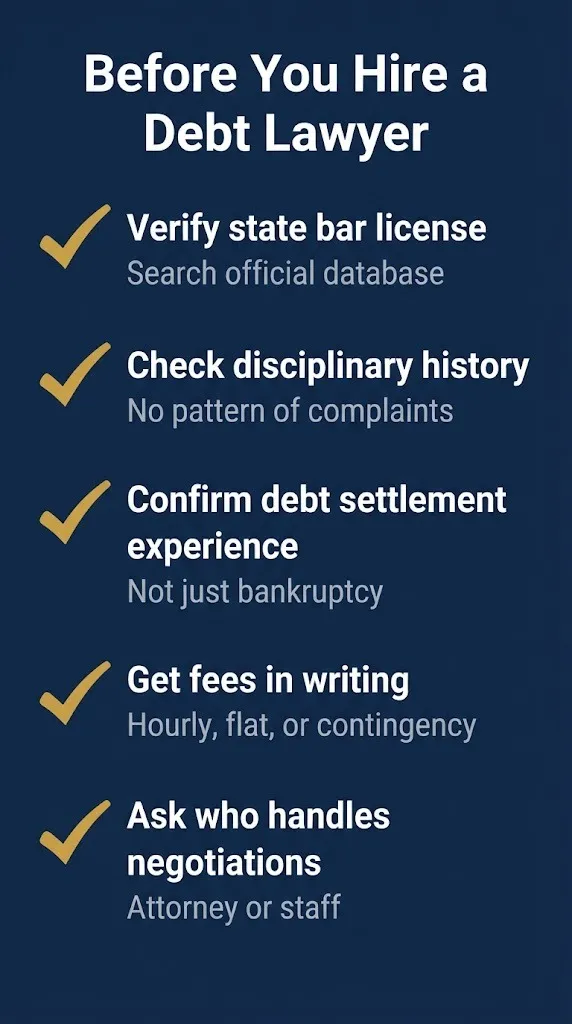
- Search your state bar’s online directory. Every state has a searchable database of licensed attorneys. The search returns name, license status, admission date, and disciplinary history .
- Check the attorney’s disciplinary record. Your state bar lists any public discipline, from minor infractions to disbarment. A clean record is a baseline requirement .
- Contact your local bar association. Many county and city bar associations run lawyer referral services. These services screen attorneys for licensing and insurance, and they refer you to someone who handles your type of case .
- Verify the attorney handles debt settlement. Not all consumer attorneys do debt negotiation. Ask directly whether they negotiate with creditors and defend debt lawsuits .
- Confirm they are licensed in your state. An attorney licensed in another state cannot represent you in your local court without special admission .
- Schedule a consultation. Many debt attorneys offer free or low-cost initial consultations. Use that time to ask about their experience and fee structure .
Do not rely solely on paid advertisements. Debt settlement companies advertise heavily and often use names that sound like law firms. Verify every attorney through official channels before you trust them with your case.
What Can a Debt Settlement Lawyer Do That a Company Cannot?
A debt settlement lawyer can represent you in court, stop wage garnishment, sue debt collectors for harassment, and provide legal advice about bankruptcy. A debt settlement company can only negotiate with creditors, and they cannot represent you if you’re sued .
Here’s what a licensed attorney brings to the table:
- Court representation. If a collector sues you, an attorney can file an answer, assert defenses, and represent you at hearings. A settlement company cannot .
- FDCPA enforcement. If collectors violate the Fair Debt Collection Practices Act by harassing you or making false threats, an attorney can sue them on your behalf. You may recover damages and attorney fees .
- Garnishment defense. If your wages or bank account are garnished, an attorney can file exemptions or negotiate to release the hold.
- Bankruptcy evaluation. Sometimes settlement is the wrong answer and bankruptcy is the right one. Only an attorney can advise on that tradeoff and file the case .
- Legal credibility. Creditors and collection law firms respond differently when a licensed attorney is involved. The negotiation carries more weight .
A debt settlement company’s role is narrower. They collect money from you, hold it in an account, and make lump-sum offers to creditors. They may not disclose that your debt is growing while you wait, that creditors can still sue you, or that forgiven debt may be taxable .
How Do You Verify a Debt Settlement Attorney’s License?
You verify a debt settlement attorney’s license by searching your state bar association’s online database for their name or bar number. The search will show whether they are active, suspended, or disbarred, and it will list any public discipline .
Each state runs its own system. California uses the State Bar of California’s attorney search. New York uses the NY State Unified Court System. Illinois uses the Attorney Registration and Disciplinary Commission (ARDC) .
Some states don’t have fully searchable online databases. New Hampshire and South Dakota require phone calls to the licensing agency. Delaware provides information by email. Oklahoma and Virginia allow attorneys to opt out of public listings .
When you verify, check for three things:
- Active status. A suspended or inactive attorney cannot practice law.
- Discipline history. Even minor discipline matters. Repeated complaints signal a pattern.
- Practice area. Some state bar databases let you filter by specialty, though not all do .
If the attorney claims to be licensed in multiple states, verify each one separately. A lawyer licensed in Texas cannot represent you in a California court without special permission.
What Happens If You Don’t Hire a Lawyer and Get Sued?
If you don’t hire a lawyer and get sued for debt, you will likely lose by default. When you fail to respond to a debt collection lawsuit, the court enters a default judgment against you. That judgment allows the creditor to garnish your wages, freeze your bank account, or place liens on your property .
The default judgment process is mechanical. The creditor files a complaint. You have a limited time, often 20 to 30 days, to file a written answer. If you don’t, the judge grants the judgment without hearing your side .
Once a judgment is entered, it follows you. Judgments can be renewed for years in many states. They accrue interest. They appear on your credit report. And they give the creditor powerful collection tools.
An attorney can change that outcome. They can:
- File an answer disputing the debt or the amount.
- Challenge the creditor’s evidence. Many debt buyers cannot produce the original contract or proof they own the debt.
- Negotiate a settlement that includes dismissal of the lawsuit.
- Assert exemptions if garnishment follows.
The window to act is short. If you receive a summons, contact an attorney immediately. Waiting even a few days can limit your options.
What Are the Alternatives to Hiring a Debt Settlement Lawyer?
The alternatives to hiring a debt settlement lawyer include negotiating with creditors yourself, using a nonprofit credit counselor, filing for bankruptcy, or working with a debt settlement company. Each has tradeoffs in cost, risk, and effectiveness .
DIY negotiation. The CFPB publishes step-by-step guidance. You confirm the debt, calculate what you can afford, and make a proposal. Creditors often negotiate directly with consumers, and you save the attorney fees .
Nonprofit credit counseling. These agencies help you create a debt management plan. They don’t settle debts for less, but they may negotiate lower interest rates. They are generally free or low-cost.
Bankruptcy. If your debt is overwhelming and your income is limited, bankruptcy may discharge debts entirely. An attorney can evaluate whether Chapter 7 or Chapter 13 fits your situation .
Debt settlement company. These companies negotiate lump-sum settlements for a fee. Risks include high fees, credit damage, and the possibility of being sued while you save up the settlement money .
The right choice depends on your specific numbers: total debt, income, assets, and whether you’re facing legal action. A consultation with a consumer attorney can clarify which path fits.
What Happens Next After You Hire a Debt Settlement Lawyer?
After you hire a debt settlement lawyer, the process moves through intake, creditor notification, negotiation, and resolution. The timeline depends on how many debts you have and how cooperative your creditors are.
Expected timeline:
- Week 1: Intake and document gathering. You provide account statements, collection letters, and any lawsuit paperwork.
- Week 2-4: Attorney sends letters of representation to creditors and collectors. Once they have your attorney’s contact information, collectors must stop contacting you directly .
- Month 1-6: Negotiation. The attorney contacts each creditor, disputes invalid debts, and negotiates settlements. This phase varies widely based on creditor responsiveness.
- Month 6-12: Settlement agreements are reached and documented in writing. You approve each settlement before payment.
- Ongoing if sued: If a lawsuit is filed during the process, the attorney files an answer and represents you in court.
Throughout the process, your attorney should keep you informed of offers and progress. If they don’t, that’s a warning sign. Ask for regular updates and confirm you have direct access to the attorney handling your case, not just a paralegal or assistant.
Frequently Asked Questions
Should I hire an attorney for debt settlement?
You should hire an attorney if you’re being sued, facing garnishment, or dealing with collectors who violate your rights. For simple unsecured debts, DIY negotiation may work.
How much does a debt settlement lawyer cost?
Debt settlement lawyers charge $150 to $400 per hour, $500 to $5,000 flat, or 15% to 30% contingency. Fees vary by location and case complexity .
How do I find a debt settlement lawyer near me?
Search your state bar’s online licensing database, contact your local bar association’s referral service, and verify the attorney’s disciplinary history before hiring .
Can a debt settlement lawyer stop wage garnishment?
Yes. An attorney can file exemptions, negotiate with the creditor, or challenge the underlying judgment to stop or reduce wage garnishment.
What’s the difference between a debt settlement lawyer and a debt settlement company?
A lawyer can represent you in court, sue collectors for harassment, and advise on bankruptcy. A debt settlement company can only negotiate, and they cannot represent you if you’re sued .
How do I verify a debt settlement attorney’s license?
Go to your state bar association’s website and search for the attorney by name or bar number. The database shows license status and any public discipline .
What happens if I don’t respond to a debt collection lawsuit?
If you don’t respond, the court enters a default judgment against you. The creditor can then garnish wages, freeze bank accounts, or place liens on property .
Is debt settlement a good idea?
It depends on your situation. Settlement reduces what you owe but damages your credit and may create tax liability on forgiven debt. Bankruptcy may be better for overwhelming debt .
What You Should Do Now
If you’re facing a debt lawsuit, garnishment, or relentless collection calls, contact a licensed consumer attorney in your state. Verify their license through your state bar before you share any personal information.
The single most important step is checking the attorney’s disciplinary record. A clean license and active status are the minimum requirements. Everything else, experience, fees, and communication, comes after that.
For simple debts with no legal action, the CFPB’s free negotiation guide can help you try resolving it yourself. But if a summons arrives, don’t wait. The clock on your response deadline starts the day you’re served.