Compensation Analysis 2026: The Process, the Terms, and the Legal Battles Behind Pay Data
Quick Answer
- What is it? A structured review of how jobs are classified and paid across an organization.
- Why does it matter? It affects hiring, retention, legal exposure, and whether pay gaps exist.
- Key legal rule? Under the Ledbetter Act, each discriminatory paycheck restarts the filing clock .
Compensation analysis is the process organizations use to evaluate whether their pay practices are fair, competitive, and legally defensible. It is not a single calculation. It is a system of data collection, job classification, market comparison, and statistical review that determines how much every position in a company should be worth.
If you’re searching this term, you likely fall into one of three groups. You’re an HR professional trying to run a pay equity audit. You’re a compensation analyst building salary structures. Or you’re an employee who suspects you’re underpaid and wants to understand the framework employers use to justify their decisions.
This article breaks down exactly how compensation analysis works, the key terms and metrics involved, the legal framework that governs pay discrimination claims, and the common defenses employers use when pay gaps are challenged.
The Facts
| Process | Organization-wide review of job classification and pay |
|---|---|
| Core Goals | External competitiveness, internal equity, talent retention |
| Key Metrics | Base pay, total cash compensation, compa-ratio, range penetration |
| Legal Framework | Title VII, Equal Pay Act, Lilly Ledbetter Fair Pay Act of 2009 |
| Filing Deadline | 180 days from each discriminatory paycheck |
| Key Court Case | Ledbetter v. Goodyear (2007), overturned by Congress in 2009 |
What Is Compensation Analysis and Why Does It Matter?
Compensation analysis is an organization-wide review of how jobs are classified and compensated, designed to measure external competitiveness, internal equity, and talent retention . It answers a simple question: are we paying the right people the right amount for the right reasons?
The process matters because pay decisions compound. A starting salary that is 5% too low becomes a lifetime earnings gap. A job classification that undervalues certain roles creates systemic disparities that courts can later find discriminatory.
Here’s what a formal compensation analysis measures:
- External competitiveness: How your pay compares to the market for similar jobs.
- Internal equity: Whether jobs of similar value within your organization are paid similarly.
- Legal compliance: Whether pay differences correlate with protected characteristics like gender, race, or age.
The output is not a single number. It is a framework for making defensible pay decisions and a documentation trail that can protect against or expose legal liability.
What Are the Key Terms in Compensation Analysis?
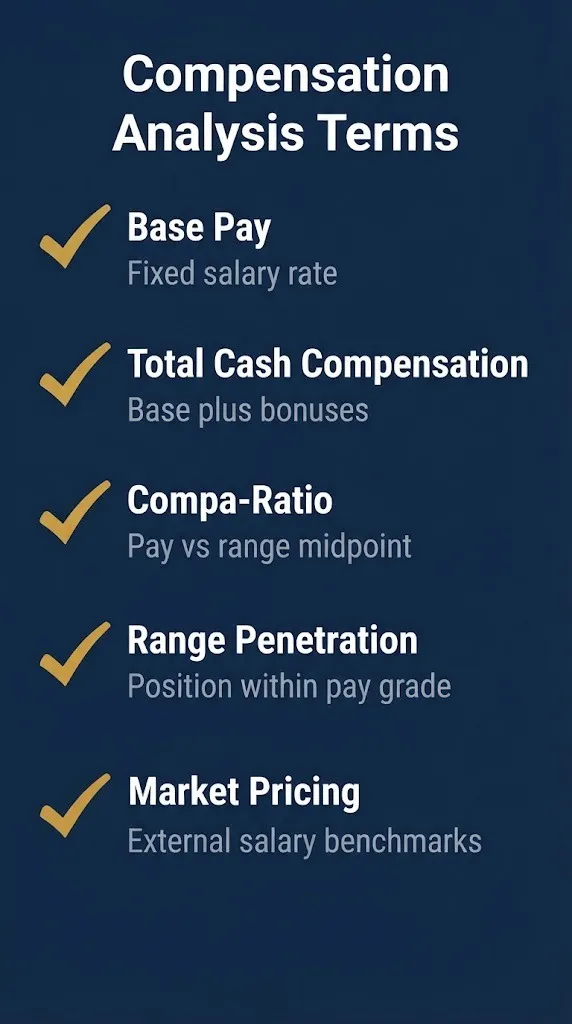
The key terms in compensation analysis include base pay, total cash compensation, compa-ratio, range penetration, percentiles, and market pricing. Understanding these terms is essential for interpreting any pay analysis .
Base pay is the fixed portion of compensation for performing a job’s essential functions. It does not include bonuses, overtime, or benefits. It is typically expressed as an annual value for full-time positions .
Total Cash Compensation (TCC) combines base pay plus short-term incentives like bonuses and commissions as actually paid. This figure shows what employees truly earn, not just their salary .
Compa-ratio measures an employee’s pay relative to the midpoint of the pay range for their job. A compa-ratio of 1.0 means the employee is paid exactly at the midpoint. Below 1.0 means below midpoint, above 1.0 means above .
Range penetration shows where an employee’s pay falls within the minimum and maximum of their pay grade. It is expressed as a percentage .
Percentiles describe how salaries compare to a market sample. The 50th percentile (median) is the most common benchmark. The 25th and 75th percentiles show the middle half of salaries for a job .
Market pricing is the process of matching internal jobs to external survey data to determine competitive pay rates .
How Do You Conduct a Compensation Analysis?
You conduct a compensation analysis by defining the scope, collecting job and pay data, matching jobs to market surveys, analyzing internal equity, and documenting findings. The process follows a structured sequence.
Here are the steps:
- Define the scope. Decide which jobs, locations, and business units to include.
- Gather job data. Collect job descriptions, classifications, and current pay rates.
- Match jobs to market surveys. Use salary survey data to price each job against external benchmarks .
- Analyze internal equity. Compare pay across similar jobs within the organization.
- Run statistical tests. Check for pay gaps correlated with gender, race, or other protected characteristics.
- Review compa-ratios and range penetration. Identify outliers and compression issues .
- Document findings. Create a defensible record of the analysis and any corrective actions.
The analysis should be repeated regularly. Pay structures become outdated as markets shift and jobs evolve.
Key Takeaway: Compensation analysis is a repeatable process, not a one-time project. The legal and competitive risks of stale pay data are too high to ignore.
What Is the Legal Framework for Pay Discrimination?
The legal framework for pay discrimination in the United States includes the Equal Pay Act of 1963, Title VII of the Civil Rights Act of 1964, and the Lilly Ledbetter Fair Pay Act of 2009. Each law addresses different aspects of pay equity.
The Equal Pay Act requires equal pay for substantially equal work performed under similar conditions. It covers gender-based pay differences and allows employers to justify disparities based on seniority, merit, quantity or quality of production, or any factor other than sex .
Title VII prohibits pay discrimination based on race, color, religion, sex, or national origin. Unlike the EPA, Title VII requires proof of discriminatory intent in most cases .
The Lilly Ledbetter Fair Pay Act overturned the Supreme Court’s 2007 decision in Ledbetter v. Goodyear. The Court had ruled that pay discrimination claims must be filed within 180 days of the original pay-setting decision. Congress found that this “significantly impairs statutory protections against discrimination in compensation” .
The Act establishes that an unlawful employment practice occurs each time wages, benefits, or other compensation is paid resulting from a discriminatory decision. Each paycheck restarts the 180-day filing clock .
This matters because pay discrimination is often hidden. Employees may not discover they are underpaid until years after the discriminatory decision was made. The Ledbetter Act gives them a path to challenge ongoing disparities.
What Was the Lilly Ledbetter Case and Why Does It Matter?
The Lilly Ledbetter case was a Supreme Court decision that gutted pay discrimination claims by imposing a strict filing deadline. Congress overturned it with the Lilly Ledbetter Fair Pay Act of 2009 .
Lilly Ledbetter worked as a production supervisor at a Goodyear Tire plant in Alabama for nearly two decades. She discovered she was paid less than her male counterparts for years. A jury awarded her back pay, but the Supreme Court reversed, holding that she had missed the 180-day deadline because she did not file within 180 days of the original discriminatory salary decision .
The Court’s ruling meant that employees who did not discover pay discrimination quickly enough had no legal recourse, even if the discrimination continued.
Congress responded with the Ledbetter Act, finding that the Court’s decision “unduly restricting the time period in which victims of discrimination can challenge and recover for discriminatory compensation decisions” .
The Act does not change the substantive law of pay discrimination. It only changes the deadline. Under the new rule, each discriminatory paycheck is a fresh violation. Employees have 180 days from the most recent paycheck to file a charge .
What Defenses Can Employers Raise in Pay Discrimination Cases?
Employers can raise several defenses in pay discrimination cases, including seniority systems, merit-based pay, performance ratings, red circling, and market forces. The strength of each defense depends on the specific facts and the legal theory being challenged.
Seniority systems justify pay differences when employees receive periodic increases based on tenure. Courts have accepted this defense when the system is applied consistently .
Merit-based pay allows employers to pay more based on performance ratings, provided the ratings are based on a systematic appraisal process .
Red circling occurs when a position is downgraded but the employee’s pay is temporarily frozen at the higher rate. Courts have accepted this as a legitimate material difference .
Market forces are a more contested defense. Employers argue they must pay market rates to attract talent. Courts have accepted this in some cases, particularly when an employer pays a uniform market rate for all employees in a job . But when an employer pays individual employees whatever they were earning previously, courts have found this perpetuates discrimination .
The key distinction is whether the employer is paying market rates for jobs or paying individual employees based on their prior salary history. The first is generally defensible. The second often is not.
What Happens Next in Compensation Analysis Trends?
Compensation analysis in 2026 and beyond will continue to be shaped by pay transparency laws, AI-driven analytics, and heightened legal scrutiny. More states are requiring employers to disclose pay ranges in job postings and to conduct pay equity audits.
Expected trends:
- Pay transparency expansion: More states will require pay range disclosure in job postings and internal equity reporting.
- AI-assisted analysis: Compensation software will increasingly use machine learning to detect pay gaps and flag outliers.
- Increased enforcement: The EEOC and state agencies will continue to prioritize pay discrimination cases.
- Global pay equity: Multinational employers will face pressure to standardize pay analysis across jurisdictions.
The fundamental process of compensation analysis will not change. Organizations will still need to classify jobs, collect market data, and analyze internal equity. What will change is the scrutiny and the technology supporting the work.
Frequently Asked Questions
What is compensation analysis?
Compensation analysis is an organization-wide review of how jobs are classified and compensated, measuring external competitiveness, internal equity, and legal compliance .
What are the key terms in compensation analysis?
Key terms include base pay, total cash compensation, compa-ratio, range penetration, percentiles, and market pricing .
What is the Lilly Ledbetter Fair Pay Act?
The Lilly Ledbetter Fair Pay Act of 2009 is a federal law that overturned a Supreme Court decision limiting the time to file pay discrimination claims. It allows employees to file within 180 days of each discriminatory paycheck .
How long do employees have to file a pay discrimination claim?
Employees have 180 days from the most recent discriminatory paycheck to file a charge with the EEOC. Each paycheck restarts the clock under the Ledbetter Act .
What is the Equal Pay Act?
The Equal Pay Act of 1963 requires equal pay for substantially equal work performed under similar conditions, regardless of gender. Employers can justify differences based on seniority, merit, or factors other than sex .
What is a compa-ratio?
Compa-ratio measures an employee’s pay relative to the midpoint of their pay range. A ratio of 1.0 means pay is exactly at midpoint .
What defenses can employers raise against pay discrimination claims?
Employers can raise defenses including seniority systems, merit-based pay, performance ratings, red circling, and market forces .
Why does compensation analysis matter for employers?
It helps employers identify pay gaps, ensure legal compliance, improve retention, and make defensible pay decisions that can withstand legal scrutiny.
What You Should Do Now
If you’re an employer, run a compensation analysis before a regulator or plaintiff’s attorney does it for you. Document your job classifications, market pricing methodology, and pay decisions. The analysis is your defense.
If you’re an employee who suspects pay discrimination, document your pay and compare it to similarly situated coworkers. The Ledbetter Act gives you 180 days from each discriminatory paycheck to file. That clock is still running.
The single most important date in the legal framework is January 29, 2009. That’s when the Ledbetter Act was signed, changing how pay discrimination claims work forever.