Repatha Lawsuit 2026: The $407 Million Verdict Is Real, But You Can’t Claim a Dime
Quick Answer
- What happened? Amgen was found liable for using illegal bundled rebates to block competition from Regeneron’s Praluent.
- How much? A jury awarded Regeneron $135.6 million in compensatory damages and $271.2 million in punitive damages, totaling $407 million.
- Can you claim? No. This was a corporate antitrust dispute between drugmakers, not a consumer class action.
The Repatha lawsuit is not a consumer case. It’s a corporate war between two pharmaceutical giants. Amgen makes Repatha. Regeneron makes Praluent. Both drugs lower cholesterol. Both hit the market in 2015. And for nearly a decade, they fought over who had the right to sell.
If you’re searching this term, you’re likely a patient wondering if there’s money for you. Maybe you took Repatha. Maybe you heard about a settlement. Maybe you saw a headline and assumed it involved consumers.
Here’s the short answer: no. The Repatha lawsuit was an antitrust and patent dispute between drugmakers. The $407 million verdict went to Regeneron, not to patients. There is no claims process, no settlement fund for consumers, and no deadline you missed.
This article explains exactly what happened, why the verdict was so large, and what the March 2026 settlement actually resolved.
The Facts
| Case | Regeneron Pharmaceuticals, Inc. v. Amgen Inc. |
|---|---|
| Court | U.S. District Court for the District of Delaware |
| Status | Jury verdict May 2025; settled March 2026 |
| Fund Size | $407 million jury award (not a consumer fund) |
| Est. Per Person | Not applicable (corporate litigation) |
| Claim Deadline | None (no consumer claims process) |
| Administrator | Not applicable |
| Proof Needed | Not applicable |
Is the Repatha Lawsuit a Consumer Settlement or a Corporate Dispute?
The Repatha lawsuit is a corporate antitrust dispute, not a consumer settlement. Regeneron sued Amgen, not the other way around. The money went to Regeneron as damages for lost sales, not to patients who took either drug .
The confusion is understandable. Headlines about billion-dollar drug lawsuits often involve consumer harm. But this case was about market competition, not patient injury. The jury found that Amgen violated antitrust laws by bundling rebates on its blockbuster drugs Enbrel and Otezla to force pharmacy benefit managers into giving Repatha exclusive formulary placement .
That practice, the jury found, shut Praluent out of the market. Regeneron lost sales. The damages reflect that loss.
There is no class action component. No consumer claims administrator was appointed. No fund exists for patients. If you took Repatha and experienced side effects, that’s a separate legal question entirely, and no such case is pending.
How Much Money Was the Repatha Lawsuit Verdict?
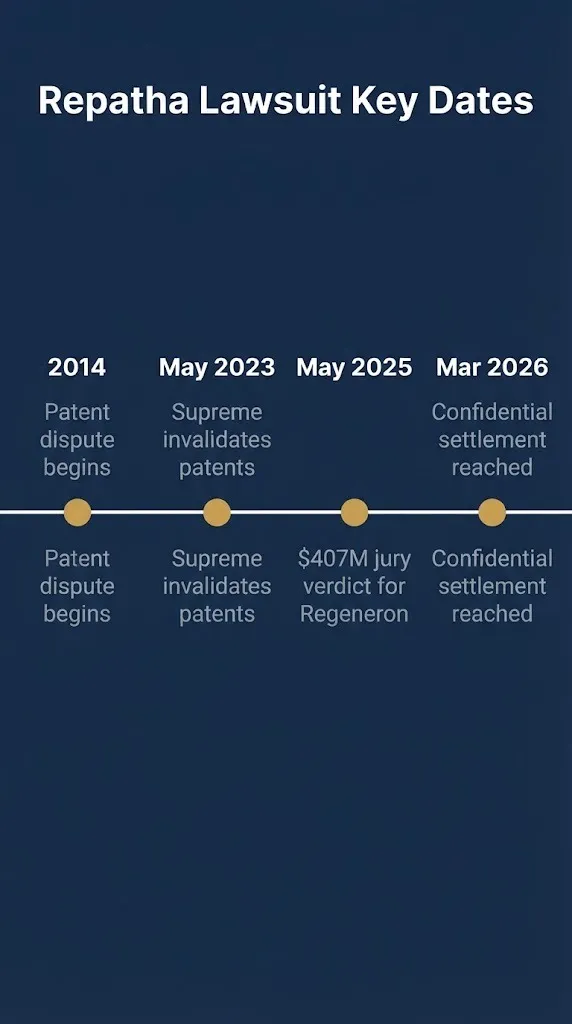
The Repatha lawsuit verdict totaled $407 million. The jury awarded Regeneron $135.6 million in compensatory damages and $271.2 million in punitive damages in May 2025 .
Here’s the breakdown:
| Damage Type | Amount | Purpose |
|---|---|---|
| Compensatory | $135.6 million | Lost sales and market harm |
| Punitive | $271.2 million | Punishment for anticompetitive conduct |
| Total | $407 million | Jury award to Regeneron |
Amgen filed motions to overturn the verdict in July 2025, arguing there was a lack of evidence . Before the court could rule on those motions, the parties settled. The March 2026 settlement was confidential, so the final financial terms may differ from the jury award. But the verdict itself is a matter of public record.
Key Takeaway: The $407 million verdict was a jury award to Regeneron for Amgen’s anticompetitive conduct. No consumer received any portion of that money, and no consumer claims process exists.
Why Did the Jury Find Amgen Liable?
The jury found Amgen liable because it used cross-therapeutic bundled rebates to lock Regeneron’s Praluent out of insurance formularies. Amgen conditioned discounts on its blockbuster drugs Enbrel and Otezla on pharmacy benefit managers giving Repatha exclusive placement .
This practice is known as “bundling.” It’s not always illegal. Drugmakers bundle rebates all the time. But when a monopolist uses bundling to foreclose competition without an equally diverse product line, courts can find it violates the Sherman Act .
Regeneron argued that Amgen’s bundling had no legitimate business justification. The jury agreed. They found Amgen breached antitrust laws and committed tortious interference by using its market power to block Praluent .
The trial evidence showed that Amgen’s executives were worried about competition. One senior executive said “enough is enough” when it came to price competition, according to court filings . The jury saw that as evidence of intent to suppress competition rather than compete on the merits.
What Did the March 2026 Repatha Settlement Resolve?
The March 2026 Repatha settlement resolved the remaining patent disputes between Amgen and Sanofi/Regeneron worldwide. It did not resolve the antitrust verdict directly, but it closed the broader litigation between the companies .
The settlement ended a patent war that started in 2014. Amgen had sued Sanofi/Regeneron, claiming Praluent infringed patents related to Repatha. Sanofi/Regeneron counter-sued. The fight spanned courts in the U.S., Europe, and Australia .
Here’s what the settlement covered:
- Patent disputes: All pending patent litigation and appeals regarding Repatha and Praluent were withdrawn .
- European Patent Office challenges: Both sides withdrew their oppositions and appeals .
- Unified Patent Court (UPC): Appeals and proceedings were withdrawn .
- No public terms: Neither company disclosed the financial terms .
The settlement came after Amgen had gained momentum in European courts. The UPC Court of Appeal found Amgen’s patent valid in November 2025, which would have allowed an infringement case to proceed . Rather than continue fighting, both sides chose to end the dispute.
What Were the Patent Disputes About?
The patent disputes were about whether Praluent infringed Amgen’s patents covering Repatha. Amgen held genus claims on antibodies that target PCSK9, the protein both drugs inhibit. Amgen claimed those broad patents gave it exclusive rights to the entire class of drugs .
The fight went all the way to the U.S. Supreme Court. In May 2023, the Court affirmed a Federal Circuit ruling that Amgen’s genus claims were invalid for lack of enablement . That meant Amgen couldn’t claim exclusive rights over the entire class of PCSK9 antibodies.
Despite that loss, Amgen continued pursuing patent claims in Europe and other jurisdictions. The European Patent Office ruled in Amgen’s favor on one key patent in April 2024. The UPC Court of Appeal affirmed that decision in November 2025 .
The March 2026 settlement ended those proceedings without a final resolution. Both sides walked away.
Can You File a Claim for the Repatha Lawsuit?
No, you cannot file a claim for the Repatha lawsuit. There is no consumer claims process, no settlement fund for patients, and no deadline anyone missed. The money went to Regeneron as compensation for Amgen’s anticompetitive conduct .
If you took Repatha and experienced side effects, the Repatha lawsuit does not address that. It was about market competition, not patient safety. There is no pending class action over Repatha side effects.
If you took Praluent and believe you were harmed by being denied access to it, the Repatha lawsuit also does not provide a direct remedy. The damages went to Regeneron, not to patients who couldn’t get Praluent.
Reality Check: No one will text or call you about a Repatha settlement payout. No consumer fund exists. Any website claiming otherwise is running a scam. Report suspicious messages to the FTC.
What Side Effects Do Repatha Users Report?
Repatha users report side effects including muscle pain, joint pain, back pain, shortness of breath, and cold or flu-like symptoms. These are patient-reported experiences, not court findings .
The FDA-approved label for Repatha lists common side effects including nasopharyngitis, upper respiratory tract infection, influenza, back pain, and injection site reactions. More serious side effects like muscle breakdown are rare.
User reviews on Drugs.com show a range of experiences. Some users report significant cholesterol reduction with minimal side effects. Others describe debilitating muscle pain, joint inflammation, and breathing difficulties that persisted after stopping the drug .
Those reports are anecdotal. They are not evidence that Repatha caused those symptoms, and they are not part of the Repatha lawsuit. If you believe you suffered a serious side effect from Repatha, consult a doctor and consider speaking with a product liability attorney.
What Happens Next With the Repatha Litigation?
Nothing happens next with the Repatha litigation. The March 2026 settlement ended all pending disputes between Amgen and Sanofi/Regeneron. No further court proceedings are scheduled .
Expected timeline:
- Permanent: All patent disputes worldwide resolved.
- Ongoing: Both companies continue selling their respective drugs.
- No further deadlines: No claims process, no appeals pending.
The antitrust verdict that produced the $407 million award may have been resolved as part of the broader settlement. The terms were confidential, so the final resolution is not public.
For patients, the practical outcome is simple: both drugs remain available. The formulary battles that limited access to Praluent may have ended, but that’s a market question, not a legal one.
Frequently Asked Questions
Is the Repatha lawsuit a class action?
No, the Repatha lawsuit was not a class action. It was a corporate antitrust and patent dispute between Amgen and Regeneron/Sanofi .
How much was the Repatha lawsuit settlement?
The jury awarded $407 million to Regeneron in May 2025. The March 2026 settlement terms were confidential .
Can I file a claim for Repatha lawsuit money?
No, there is no consumer claims process. The lawsuit was between drug companies, not consumers .
What did Amgen do wrong in the Repatha lawsuit?
A jury found Amgen used illegal bundled rebates on Enbrel and Otezla to force pharmacy benefit managers into giving Repatha exclusive formulary placement, blocking Praluent from competing .
Did Amgen settle the Repatha lawsuit?
Yes. Amgen and Sanofi/Regeneron settled all remaining disputes in March 2026. The terms were confidential .
What is Repatha used for?
Repatha (evolocumab) is a PCSK9 inhibitor used to lower LDL cholesterol in patients with familial hypercholesterolemia or established cardiovascular disease .
What are the side effects of Repatha?
Reported side effects include muscle pain, joint pain, back pain, and cold or flu-like symptoms. These are patient reports, not court findings .
Is there a Repatha side effect lawsuit?
No Repatha side effect class action is pending. The Repatha lawsuit was about antitrust and patents, not patient injuries.
What You Should Do Now
The Repatha lawsuit is closed. No consumer money exists. No claims process exists. The $407 million verdict went to Regeneron, not to patients.
If you’re a patient concerned about Repatha side effects, talk to your doctor. If you believe you have a product liability claim, consult an attorney. But don’t expect anything from this lawsuit. It was never about you.
The single most important date was May 2025. That’s when the jury returned its $407 million verdict. Everything after that was cleanup.