Dexcom G7 Lawsuit 2026: FDA Warning, Recalls, and Who May Qualify for Compensation
Quick Answer
- Is it legit? Yes. Dexcom faces verified lawsuits over G7 sensor accuracy and alarm failures, with FDA warning letters and Class I recalls documented.
- How much could you get? Not yet determined. No settlement fund exists; individual injury claims may be worth more than refund class actions.
- Most important deadline: No claim deadline yet. Personal injury claims are subject to state statutes of limitations, typically 2 to 4 years.
If you used a Dexcom G7 and something went wrong, you’re probably trying to figure out whether you have a case and what it’s worth. The answer depends on which type of lawsuit you’re looking at.
The Dexcom G7 lawsuit landscape in 2026 includes two very different tracks. One is a consumer class action seeking refunds for people who bought the device. The other is individual personal injury and wrongful death lawsuits for people harmed when the G7 gave bad readings or failed to sound alerts.
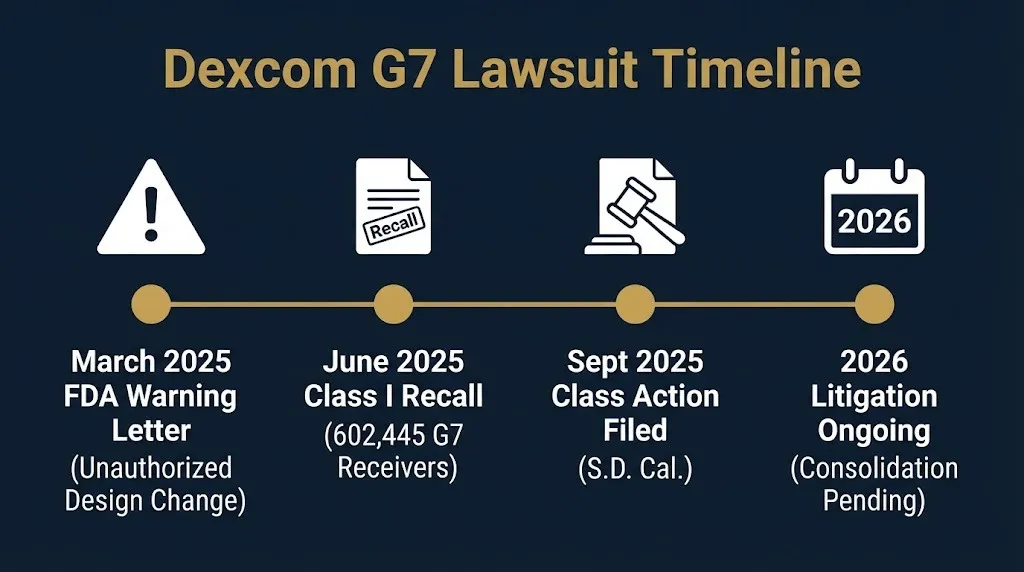
The FDA has documented serious problems with the G7. A March 2025 warning letter said Dexcom made unauthorized design changes that made the sensors less accurate. A June 2025 Class I recall covered over 600,000 G7 receivers with faulty speakers that could silence critical alarms.
This article breaks down what the lawsuits allege, who may qualify for each type of claim, and what verified evidence you need before talking to a lawyer.
The Facts
| Case Type | Consumer class action and personal injury/wrongful death lawsuits |
|---|---|
| Court | S.D. Cal. (consolidated federal consumer cases); individual suits in various jurisdictions |
| Case Numbers | Levens v. Dexcom (3:25-cv-02565); Grisoli v. DexCom (3:25-cv-03488); multiple securities cases |
| Status | Active litigation; no settlement announced; consolidation motions pending |
| Fund Size | Not yet confirmed |
| Est. Per Person | Not yet determined; injury claims may range widely |
| Claim Deadline | No claim deadline yet; state statutes of limitations apply to injury claims |
| Administrator | Not yet appointed |
| Proof Needed | Medical records, device data, Dexcom complaint records |
Is the Dexcom G7 Lawsuit Real or a Scam?
The Dexcom G7 lawsuits are real, filed in federal courts and documented through FDA warning letters and Class I recalls. These are not scams.
Wisner Baum filed a class action in the Southern District of California on behalf of consumers who bought G6 and G7 devices. The complaint alleges the devices were manufactured with unapproved materials, making them adulterated and misbranded under federal law .
A separate consumer class action, Grisoli v. DexCom, alleges G7 defects, failed alerts, and misleading marketing. The case is pending in the Central District of California .
The FDA’s March 2025 warning letter is a key document. It stated that Dexcom changed a sensor coating without FDA approval, and that sensors with the new coating performed worse on “every accuracy metric” .
If you see an ad promising “Dexcom G7 settlement money now,” that’s not legitimate. No settlement fund exists, and no claim process has been established.
How Much Money Could You Get from a Dexcom G7 Lawsuit?
No settlement amounts have been announced, so any dollar figure you see online is speculation. The value of your claim depends on which type of lawsuit applies to you.
For consumer refund claims, the class actions seek refunds for the purchase price of the devices. If the class prevails or settles, individual payouts would likely be modest, reflecting the cost of the device.
For personal injury claims, potential values are higher but entirely case-specific. Based on comparable medical device litigation, injury attorneys estimate:
| Injury Type | Potential Range (Speculative) |
|---|---|
| Hospitalization | $100,000 to $500,000 |
| Permanent injury | $500,000 to $2 million |
| Wrongful death | $2 million to $5 million+ |
These figures are estimates from injury law firms, not verified settlement amounts. No global settlement exists, and actual outcomes depend on the specific facts of each case .
Not yet determined: Whether any class action settlement will be reached, and what individual injury claims may be worth.
Who May Qualify for a Dexcom G7 Lawsuit?
You may qualify for a Dexcom G7 personal injury lawsuit if you used the device, it malfunctioned or gave inaccurate readings, and you suffered a documented injury as a result.
Here are the specific criteria injury attorneys evaluate:
- Device use: You used a Dexcom G7 CGM (not a different model or brand)
- Malfunction: The device gave inaccurate readings, failed to alert, or stopped working
- Injury: You suffered a measurable harm, such as severe hypoglycemia, diabetic ketoacidosis, seizure, or hospitalization
- Documentation: Medical records link the injury to the device failure
- Timeline: Your claim falls within your state’s statute of limitations
For consumer refund claims, you may qualify if you purchased a G6 or G7 device that was marketed as accurate but allegedly did not perform as advertised .
Key Takeaway: The Dexcom G7 lawsuits are real and documented by FDA warnings and Class I recalls, but no settlement exists yet, so any payout amount you see online is speculation.
What Did the FDA Warning Letter Say About the Dexcom G7?
The FDA’s March 4, 2025 warning letter stated that Dexcom made unauthorized changes to a sensor component without getting required premarket clearance, making the devices adulterated under federal law.
The FDA inspection found that Dexcom replaced a material used in the sensor’s resistance layer with a different material. The agency said Dexcom’s clinical studies showed the new material had “significantly greater variability” than the FDA-approved version .
The warning letter specifically said the changes could cause “larger inaccuracies” that “cause higher risks for users who rely on the sensors to dose insulin or make other diabetes treatment decisions” .
Dexcom has said it is responding to the FDA’s concerns. A warning letter is not a verdict and does not prove any individual injury. But it provides a concrete regulatory record that plaintiffs use to argue Dexcom knew about accuracy problems.
What Was the Dexcom G7 Recall About?
The June 2025 Dexcom G7 recall was a Class I recall covering 602,445 G7 receivers and 36,824 G6 receivers because a speaker defect could silence high and low blood sugar alarms .
The FDA classified this as Class I, its most serious recall category, meaning the defect could cause serious harm or death. The problem was a foam spacer around the speaker that could degrade and prevent the alarm from sounding.
A silent alarm means you might sleep through a dangerous low blood sugar event. The FDA’s concern was that users could miss alerts for severe hypoglycemia or hyperglycemia, leading to seizures, loss of consciousness, or death .
A separate April 2026 Class II recall covered the G7 watchOS app because a bug could cause the app to crash or stop syncing data .
A Canadian recall in June 2026 covered two G7 sensor lots that were supposed to be destroyed but were stolen and sold through unauthorized channels. Risks included inaccurate readings and missed detection of dangerous glucose levels .
Reality Check
No one is texting you about Dexcom settlement money first, and there is no claim form to fill out for a settlement that doesn’t exist yet. The “Dexcom claim form” you see on injury attorney websites is a free case evaluation, not a settlement claim. Filing a case evaluation is free. Never pay anyone upfront to “process” a Dexcom claim. If you have a serious injury, the evidence that matters is your medical records and device data, not a website form.
How Do You File a Dexcom G7 Lawsuit?
Filing a Dexcom G7 lawsuit starts with contacting a product liability attorney who handles medical device cases. Most take these cases on contingency, meaning you pay nothing upfront.
Here are the steps:
- Find a qualified attorney. Look for firms with experience in CGM or medical device litigation.
- Share your story. Explain when the device failed, what injury you suffered, and what medical treatment you received.
- Gather evidence. Your attorney will help collect medical records, device data, pharmacy records, and Dexcom complaint records.
- Case evaluation. The attorney determines whether your case meets the legal threshold for a product liability claim.
- File the complaint. Your attorney files a formal lawsuit in the appropriate court.
- Litigation. The case enters discovery, depositions, and potentially settlement negotiations or trial.
For consumer refund class actions, you don’t need to take action now. If a class settles, you would receive notice and an opportunity to file a claim or opt out.
What Evidence Do You Need for a Dexcom G7 Claim?
The strongest Dexcom G7 claims have three types of evidence: proof you used the device, proof it failed, and proof the failure caused your injury.
Here’s what to gather:
| Evidence Type | Where to Find It | Importance |
|---|---|---|
| Prescription records | Doctor’s office or pharmacy | Essential |
| G7 app data/screenshots | Smartphone or Dexcom Clarity account | Very helpful |
| ER/hospital records | Medical records department | Essential for injury claims |
| Dexcom complaint records | Dexcom customer service, email records | Strongly supports claim |
| Insurance billing | Insurance company | Supports timeline |
Start gathering this evidence now. Medical records can take weeks to obtain, and app data can be lost if you switch phones or delete the app .
What Happens Next
Pending: Motions to consolidate five related federal class actions in the Southern District of California remain before the court .
Ongoing 2026: Individual personal injury and wrongful death lawsuits proceed separately from the class actions.
No timeline set: Trial dates or settlement negotiations have not been scheduled for the class actions.
State statutes of limitations: Personal injury claims generally must be filed within 2 to 4 years of the injury, depending on your state.
Frequently Asked Questions
Is there a Dexcom G7 settlement?
No. No settlement has been announced, and no claim process exists. The lawsuits remain in active litigation.
How much is the Dexcom G7 lawsuit worth?
No amount is verified. Consumer refund class actions seek purchase price refunds. Personal injury claims may be worth more, but values depend on injury severity and documentation.
Who qualifies for a Dexcom G7 lawsuit?
You may qualify if you used a G7, it malfunctioned or gave bad readings, and you suffered a documented injury like severe hypoglycemia, DKA, or hospitalization.
What did the FDA say about the Dexcom G7?
The FDA’s March 2025 warning letter said Dexcom made unauthorized design changes that made the sensors less accurate, calling the devices “adulterated” under federal law.
Was there a Dexcom G7 recall?
Yes. A June 2025 Class I recall covered 602,445 G7 receivers with faulty speakers that could silence critical blood sugar alarms.
Can I join a Dexcom G7 class action?
Consumer refund class actions are pending. If a class settles, you would receive notice. Personal injury claims are filed individually, not through the class.
How long do I have to file a Dexcom G7 lawsuit?
State statutes of limitations typically give you 2 to 4 years from the injury, or 1 to 3 years from death for wrongful death claims.
Do I need a lawyer to file a Dexcom G7 claim?
For a personal injury claim, yes. These cases require medical records, expert analysis, and litigation experience. For a class action refund, no action is needed now.