Patent Litigation vs Prosecution 2026: The Difference, Costs, and Why It Matters for Your IP
Quick Answer
- Patent prosecution means filing and negotiating with the patent office to get a patent granted; litigation means suing or defending in federal court after grant.
- Prosecution typically costs $10,000 to $30,000 or more; litigation routinely runs into the millions per side.
- Prosecution happens before a patent exists; litigation can only happen after the patent is granted.
What Is Patent Prosecution?
Patent prosecution is the process of obtaining a patent from the United States Patent and Trademark Office. It starts when you file an application and ends when the patent is granted or the application is abandoned.
The term “prosecution” confuses people because in criminal law it means the government pursuing a case. In patent law, it means the back-and-forth between you (or your attorney) and a patent examiner. There’s no opposing party. No judge. No jury.
The examiner reviews your application and issues what’s called an office action. That document raises objections or rejections to some or all of your claims. Your attorney responds by arguing against the rejections, amending the claims, or both. This cycle can repeat multiple times.
Only a USPTO-registered patent attorney or patent agent can handle prosecution. Registration requires passing the patent bar exam. Not every lawyer is registered. A regular attorney without that registration cannot file or prosecute a patent application.
The outcome of successful prosecution is a granted patent, typically lasting twenty years from the filing date for utility patents.
What Is Patent Litigation?
Patent litigation is the federal court process of resolving disputes over a patent that already exists. It happens after grant, not before.
The most common form is an infringement lawsuit. The patent holder sues someone who is allegedly making, using, selling, or importing a product that falls within the patent’s claims without authorization. But litigation can also be defensive: a party accused of infringement can file a declaratory judgment action asking the court to declare the patent invalid or not infringed.
Patent cases go to federal district court, not state court. Appeals go to the Court of Appeals for the Federal Circuit, which has exclusive jurisdiction over patent appeals nationwide.
Litigation is adversarial. Two sides. Each with counsel. Technical experts. Discovery. Claim construction hearings where the judge interprets what the patent claims actually mean. Trials that can last weeks.
And it’s expensive. Very expensive. More on that below.
What’s the Difference Between Patent Litigation and Prosecution?
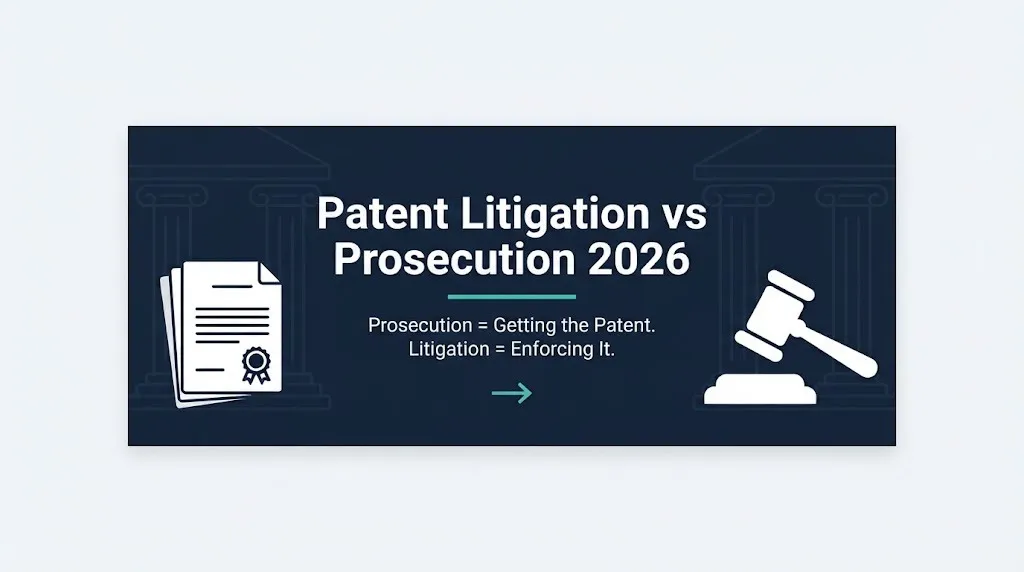
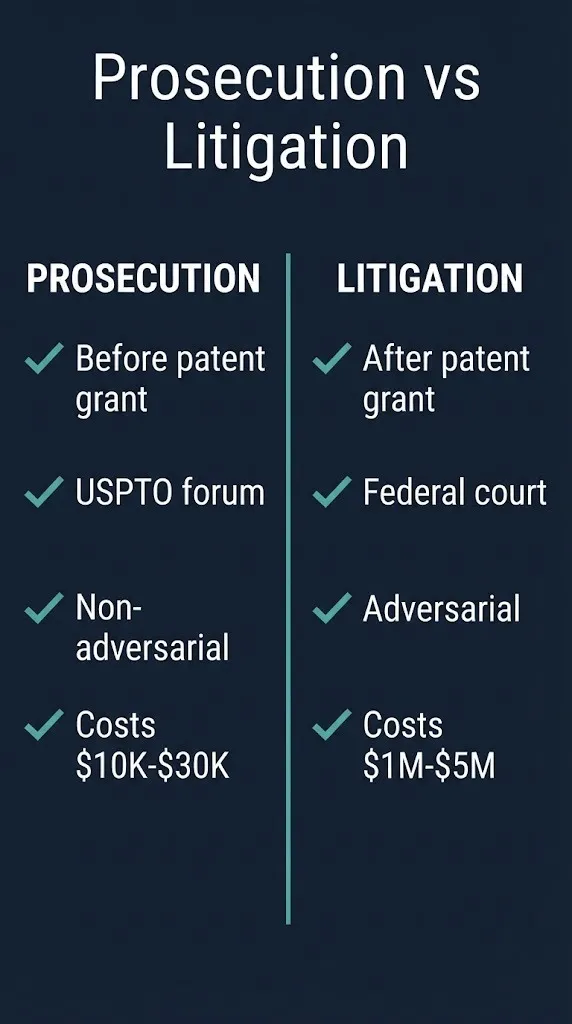
The difference comes down to timing, forum, and purpose. Prosecution creates patent rights. Litigation enforces or challenges those rights after they exist.
| Aspect | Patent Prosecution | Patent Litigation |
|---|---|---|
| Purpose | Obtain patent rights | Enforce or challenge rights |
| Timing | Before grant | After grant |
| Forum | USPTO (administrative) | Federal district court |
| Nature | Non-adversarial | Adversarial |
| Who’s involved | Applicant, attorney, examiner | Patent holder, accused infringer, judge, jury |
| Outcome | Patent issued or rejected | Damages, injunction, or invalidation |
You can’t litigate a patent that hasn’t been granted. And you don’t prosecute a patent after it’s been issued (though post-grant proceedings like inter partes review exist, they’re a different animal).
The practical takeaway: prosecution is about securing your rights. Litigation is about what happens when someone violates them, or when someone claims your patent shouldn’t have been granted in the first place.
How Much Does Patent Prosecution Cost?
Patent prosecution typically costs between $10,000 and $30,000 or more, depending on the complexity of the invention, the number of claims, and how many office actions you have to respond to.
The costs break down into two categories:
USPTO fees: Filing fees, search fees, examination fees, and issue fees. These vary based on entity size. Small entities pay reduced rates. Micro entities pay even less.
Attorney fees: Drafting the application, filing it, responding to office actions, and handling appeals if needed. A simple mechanical invention costs less. A complex software or biotech patent costs more.
The cost scales with complexity. More claims mean more examination. More office actions mean more responses. If the examiner rejects your application multiple times, you pay for each response.
Prosecution is generally planned and budgeted. You know roughly what you’re spending and when. That’s one reason companies treat it as a portfolio management exercise rather than a crisis response.
How Much Does Patent Litigation Cost?
Patent litigation commonly costs between $1 million and $5 million per side through trial, and complex cases can exceed that range significantly.
The cost drivers are different from prosecution:
- Discovery: Document production, depositions, interrogatories. This is often the biggest expense.
- Expert witnesses: Technical experts for infringement and validity. Damages experts. Each costs hundreds per hour.
- Claim construction: The hearing where the judge interprets the patent claims. This can make or break a case.
- Trial preparation: Mock trials, exhibit preparation, witness prep. Months of work compressed into weeks.
Industry surveys put the median cost through trial at several million dollars for high-stakes cases. Cases with less at stake cost less, but even a modest patent case can burn through $500,000 before summary judgment.
Key Takeaway: Prosecution is a planned investment in securing your rights; litigation is an unpredictable expense that can dwarf what you spent to get the patent in the first place.
Who Handles Patent Prosecution vs Litigation?
Patent prosecution requires a USPTO-registered patent attorney or patent agent. Patent litigation requires an attorney admitted to practice in the relevant federal court, who may or may not also be patent-registered.
The skill sets are different. Prosecutors need technical fluency and precise claim drafting ability. They work with inventors to capture the invention and navigate the examiner’s rejections.
Litigators need trial advocacy and evidentiary practice experience. They manage discovery, depose witnesses, argue claim construction, and present cases to judges and juries.
Some attorneys do both. Many don’t. A firm that prosecuted your patent may not be the best choice to litigate its validity, partly because of skill differences and partly to avoid conflicts.
If you’re hiring for prosecution, look for USPTO registration and experience in your technology area. If you’re hiring for litigation, look for trial experience and a track record in patent cases.
Why Prosecution Strategy Matters for Future Litigation
What you do during prosecution can help or hurt you in litigation years later. The prosecution history becomes evidence. Every argument you made to get the patent allowed can be used against you when you try to enforce it.
This is called prosecution history estoppel. If you narrowed your claims during prosecution to overcome a prior art rejection, you may not be able to recapture that scope later through the doctrine of equivalents.
The Unified Patent Court has made this even more critical in Europe. Every amendment made during EPO prosecution becomes part of the record that competitors scrutinize before the UPC. A broad claim that looks commercially attractive may create a single point of failure, because a successful central revocation can knock it out across multiple participating countries.
Strategic prosecution means drafting claims with future enforcement in mind. It means asking questions like:
- Are our claims simple enough for a lay jury to understand?
- What questions would an expert face in a deposition to poke holes in these claims?
- Are we creating unnecessary estoppel with the arguments we’re making?
- Does the specification support claim flexibility if the market evolves?
A poorly drafted patent is harder to defend. A well-drafted one with a clean prosecution history is a stronger asset.
When Does Patent Prosecution End and Litigation Begin?
Prosecution ends when the patent is granted (or the application is abandoned). Litigation begins when someone disputes that patent, typically through infringement or a validity challenge.
There’s no overlap in the normal course. You don’t litigate while prosecuting. But post-grant proceedings at the Patent Trial and Appeal Board, like inter partes review, sit somewhere in between. They’re administrative challenges to granted patents, not district court litigation, but they’re adversarial.
The typical sequence looks like this:
- Prosecution: File application, respond to office actions, get patent granted.
- Commercial use: Make or license the patented product.
- Dispute arises: A competitor infringes, or someone challenges validity.
- Litigation or post-grant challenge: Federal court or PTAB.
- Resolution: Settlement, verdict, or invalidation.
Most patent disputes settle. Approximately 97 percent of patent actions resolve before trial. But the ones that go to verdict can change markets and produce massive damages awards.
Reality Check: Having a patent doesn’t automatically mean you can enforce it profitably. Litigation costs millions, and even winning plaintiffs often spend years and significant resources to recover. A patent is a right to exclude, not a guarantee of payment. And if you’re accused of infringement, having your own patent doesn’t automatically protect you. It just gives you a counterclaim.
How Has Patent Litigation Changed in 2026?
Patent litigation volume held roughly steady in early 2026, with a notable shift in who’s filing. Non-practicing entities (often called patent trolls) added 495 defendants in Q1 2026, an 18 percent decrease from the prior year. Operating companies added 329 defendants, a 35 percent increase.
That shift matters. Operating companies suing each other is different from NPEs suing everyone. Operating company litigation tends to involve real competitive disputes, not licensing campaigns. It’s also more likely to go the distance.
The PTAB has also changed the calculus. Institution rates for inter partes review have declined sharply, and panels appear more willing to credit well-supported prosecution records. That means stronger patents are harder to invalidate at the PTAB, which makes them more valuable as litigation assets.
The Eastern District of Texas remains the top patent venue. Judge Rodney Gilstrap oversaw 19 percent of all new patent litigation in Q1 2026. Delaware is second overall and first for operating company filings.
What Happens Next in Patent Prosecution and Litigation
Ongoing: USPTO examination timelines remain a bottleneck. Prosecution can take years depending on the art unit.
Expected late 2026: PTAB institution rates will continue to be watched. If they stay low, more patents survive to enforcement.
Expected 2027: Operating company litigation may continue rising if the PTAB remains patent-owner friendly. Companies with strong portfolios have more incentive to assert.
Ongoing: UPC activity in Europe will shape prosecution strategy for companies filing there. Litigation-aware drafting is becoming standard.
Frequently Asked Questions
Is patent prosecution the same as litigation?
No. Patent prosecution is the process of getting a patent approved by the USPTO. Patent litigation is the process of enforcing or defending a patent in federal court after it’s been granted.
Can I file a patent lawsuit without prosecuting a patent first?
No. You need a granted patent to sue for infringement. Prosecution must come first.
Do I need a patent attorney for prosecution?
Yes, if you want to file with the USPTO. Only registered patent attorneys and patent agents can prosecute applications. You can file a provisional application yourself, but a full application requires a registered practitioner.
How long does patent prosecution take?
Typically one to several years from filing to issuance, depending on the technology area, examiner workload, and how many office actions you receive.
How long does patent litigation take?
A district court case commonly runs two or more years to trial. Appeals add another year or more. Most cases settle before trial.
Can the same lawyer handle both prosecution and litigation?
Sometimes. Some attorneys are both patent-registered and experienced litigators. Many are not. The skills are different, and some firms separate the practice groups.
What is inter partes review?
It’s a post-grant proceeding at the PTAB where a third party challenges the validity of a granted patent. It’s faster and cheaper than district court litigation, but it’s not prosecution.
What does “prosecution history estoppel” mean?
It means you can’t recapture claim scope you gave up during prosecution through the doctrine of equivalents. The arguments you made to get the patent allowed can limit how broadly you can enforce it later.