Incentive Compensation Design 2026: What Pharma Settlements Reveal About Plan Risk
Quick Answer
- Incentive compensation design determines how companies pay employees and sales teams, and flawed design creates False Claims Act liability.
- DOJ settlements tied to speaker programs exceeded $1.17 billion across five cases since September 2022 .
- The Veloxis resolution included a record $1.55 million Sunshine Act penalty for underreporting physician payments .
What Is Incentive Compensation Design?
Incentive compensation design is the process of structuring variable pay programs that reward employees, executives, or sales representatives for achieving specific performance goals. In pharmaceutical companies, this design directly intersects with federal fraud enforcement.
The core idea is straightforward. You set targets. You tie pay to hitting those targets. You motivate performance. The trouble starts when the targets encourage behavior that violates the law.
In pharma, incentive compensation often includes speaker program fees, consulting payments, and sales commissions. The government scrutinizes whether these payments function as legitimate compensation or as illegal kickbacks to induce prescribing. The design of the program, not just its execution, determines which side of that line you land on.
How Much Do Pharma Kickback Settlements Cost in 2026?
Pharma kickback settlements in 2026 range from $13.67 million to $46 million for individual companies, with the five speaker program cases since 2022 exceeding $1.17 billion combined .
| Company | Settlement Amount | Date | Key Allegation |
|---|---|---|---|
| Takeda | $13,670,921 | May 2026 | Speaker program kickbacks for Trintellix |
| Veloxis | $46 million | August 2026 | Kickbacks to HCPs and specialty pharmacies for Envarsus XR |
| Multiple (5 cases) | $1.17 billion+ | 2022-2026 | Speaker program violations across therapeutic areas |
The Veloxis case is notable for its structure. The $46 million broke down into a $10.04 million criminal penalty, a $34.45 million False Claims Act settlement, and a $1.55 million civil penalty under the Sunshine Act . That last figure is the largest Open Payments recovery in the program’s history.
The government alleged Veloxis paid for luxury resort stays, high-end alcohol, and consulting fees that lacked legitimate business purpose. Employees falsified expense reports to conceal the spending, adding HCPs who did not attend events to lower per-attendee meal costs .
Why Does Speaker Program Design Trigger DOJ Enforcement?
Speaker program design triggers DOJ enforcement when sales influence speaker selection and fees reward prescribing history rather than legitimate education. The government’s theory has stayed consistent for over a decade.
DOJ’s position is direct. When sales teams choose who gets paid to speak, the program looks commercial, not educational . Speaker selection should be grounded in medical and scientific criteria: expertise, experience, publications, academic roles. The rationale needs documentation that is not tied to prescribing volume.
Four of the five speaker program settlements involved high-end venues or excessive meals. Four involved repeat attendance with little incremental educational value . The pattern repeats because the incentive structure keeps producing the same behavior.
Key Takeaway: The design flaw is not the speaker program itself. It is the link between sales metrics and speaker compensation, which converts education into a disguised kickback.
How Does the Anti-Kickback Statute Apply to Incentive Plans?
The Anti-Kickback Statute applies to incentive plans when any purpose of the compensation is to induce referrals or prescriptions for items paid by federal healthcare programs. The Second Circuit formally adopted the “at-least-one-purpose” rule, meaning the government does not need to prove that kickbacks were the primary motivation .
That standard is broad. A single improper purpose can trigger liability, even if legitimate business reasons also exist. The Novartis ruling in March 2026 allowed a qui tam case to proceed to discovery based on allegations that the company maintained a sham speaker program for a multiple sclerosis drug .
The court treated Novartis’s internal return on investment tracking as corroborating evidence of scienter. Routine marketing analytics became evidence of knowing misconduct. That signals to every pharma company that tracking ROI on speaker programs can be used against them .
Compliance teams now face a paradox. Tracking ROI is standard business practice. But if the ROI analysis shows that speaker programs drive prescriptions, that document becomes Exhibit A in a government case.
What Are the Key Design Principles for Compliant Incentive Plans?
Compliant incentive plan design requires aligning pay with outcomes employees can impact, using measurable metrics, and avoiding any link between compensation and referral volume. The guiding principles are well established .
The core requirements include:
- Align with broader KPIs and shareholder interests. Incentives should support long-term value creation, not just short-term sales .
- Design for both short-term execution and long-term value. Rewarding near-term profitability should not come at the expense of compliance or sustainability .
- Align incentives with outcomes employees can impact. Line of sight matters. If employees cannot influence the metric, the incentive loses motivational value .
- Use transparent, fair, measurable metrics. Typically four to six metrics. More than that dilutes focus .
- Establish rigorous performance hurdles. Threshold, target, and maximum levels should be calibrated to probability of achievement .
- Review and refine annually. Plans should adapt to changing company and market conditions .
For pharma specifically, the design must exclude prescribing volume from any compensation formula. Speaker selection criteria must be documented and based on medical expertise, not sales potential. Meal limits must be enforced, not just written .
What Is the Sunshine Act and Why Does It Matter for Incentive Design?
The Sunshine Act requires pharmaceutical companies to report payments to physicians and teaching hospitals to the Centers for Medicare & Medicaid Services. The Veloxis case produced a $1.55 million penalty for underreporting these transfers of value .
The connection to incentive design is direct. If your expense reporting system allows falsified records, those errors flow into your Sunshine Act reports. Veloxis employees added HCPs who did not attend events to reduce per-attendee meal costs. That created inaccurate reporting to CMS .
DOJ described the $1.55 million as the largest Sunshine Act recovery since the program began in 2010 . It signals that the government will use Open Payments as an independent enforcement tool, not just as a compliance formality.
For compliance teams, the takeaway is that expense report integrity is not just an internal control issue. It is a reporting accuracy issue with federal penalties attached.
How Do You Audit an Incentive Compensation Plan for Compliance Risk?
Auditing an incentive compensation plan for compliance risk requires examining the design, the execution, and the documentation. The government looks at all three.
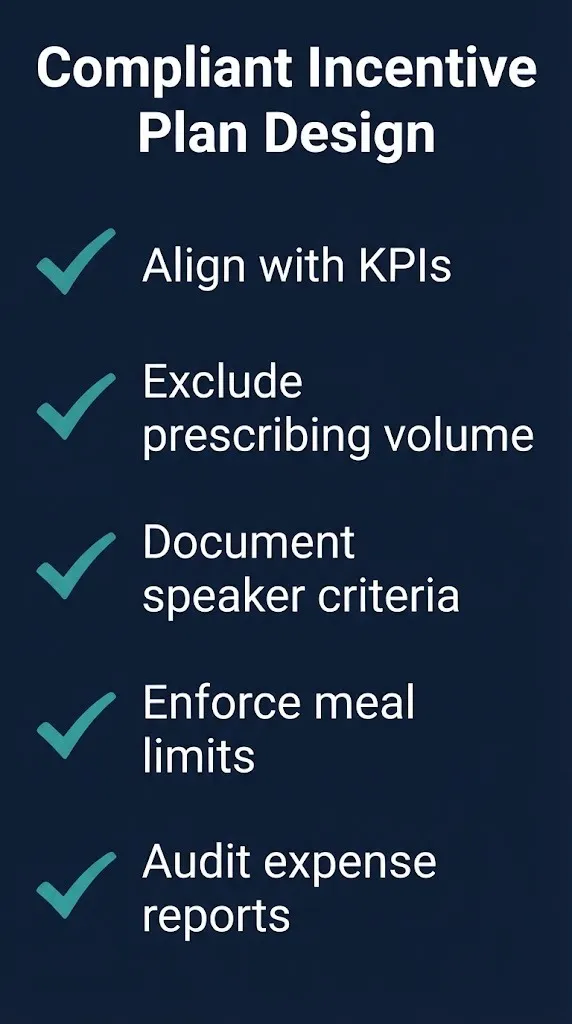
Start with the design. Does any compensation formula include a metric tied to prescribing volume, referral patterns, or sales of specific drugs to federal healthcare beneficiaries? If yes, that is the highest-risk element.
Next, examine execution. Are meal limits enforced? Are speaker selection criteria documented? Do repeat attendees have a legitimate educational justification? The Takeda case involved programs exceeding the company’s own $125 per-person food and beverage limit .
Finally, review documentation. Are expense reports accurate? Do consulting agreements reflect work actually performed? Veloxis paid for consulting work that was never performed and disguised payments as data collection services .
A compliance audit should produce:
- A clear map of every incentive metric and its connection to federal healthcare programs.
- Documentation of speaker selection criteria and how they exclude sales influence.
- Evidence of meal limit enforcement and monitoring.
- Verification that expense reports match actual events and attendees.
- A review of ROI tracking practices for language that could imply kickback intent.
What Happens Next in Pharma Incentive Compensation Enforcement?
Ongoing: DOJ continues to pursue speaker program cases. The five settlements since 2022 exceed $1.17 billion, and the enforcement theory remains consistent .
Expected late 2026: More scrutiny of consulting arrangements and data collection agreements with specialty pharmacies, following the Veloxis model .
Expected 2027: Increased use of the Sunshine Act as an independent enforcement tool, building on the record $1.55 million Veloxis penalty .
Ongoing: Companies that cooperate and remediate receive credit. Veloxis got a deferred prosecution agreement rather than a guilty plea because it disclosed evidence and terminated responsible employees .
Emerging: ROI tracking practices will face more legal scrutiny. The Novartis ruling treated marketing analytics as evidence of scienter .
Frequently Asked Questions
What is incentive compensation design in pharma?
Incentive compensation design in pharma is the structure of variable pay programs for sales teams, executives, and speakers. It determines how companies reward performance without creating illegal kickback exposure.
Why do pharma speaker programs lead to lawsuits?
Speaker programs lead to lawsuits when sales metrics influence who gets paid to speak and how much they receive. DOJ views that link as evidence that payments are kickbacks disguised as education .
How much did Takeda pay in the 2026 settlement?
Takeda agreed to pay $13,670,921 to resolve False Claims Act allegations tied to its Trintellix speaker program .
What was the largest Sunshine Act penalty in history?
The largest Sunshine Act penalty is the $1.55 million civil penalty Veloxis paid in August 2026 for underreporting physician payments .
Can ROI tracking be used as evidence in kickback cases?
Yes. The Novartis ruling allowed ROI tracking to serve as corroborating evidence of scienter in an Anti-Kickback Statute case .
What is the at-least-one-purpose rule?
The at-least-one-purpose rule means the government only needs to allege that inducing prescriptions was one purpose of the remuneration, not its primary motivation .
How should companies design compliant speaker programs?
Companies should base speaker selection on medical and scientific criteria, document the rationale, enforce meal limits, and exclude prescribing volume from any compensation formula .