Executive Compensation Strategy: The 2026 Guide to Pay, Plans, and Packages
Quick Answer
- Executive compensation strategy means the formal system boards use to recruit, retain, and reward top leadership through a mix of fixed and variable pay.
- The four standard components are base salary, annual bonus, long-term equity incentives, and pensions and benefits.
- A growing share of pay is “at-risk,” meaning executives only earn it if specific performance targets are met.
Executive compensation strategy is the system a company’s board of directors builds to answer one question: how do we pay our top leaders to get the results we need? The answer in 2026 almost always includes four pieces: base salary, an annual performance bonus, long-term equity awards, and standard benefits.
That structure is not random. Boards design it so most of an executive’s pay depends on hitting targets. At companies like Kratos, 72.7% of the CEO’s target compensation in 2025 was “at risk,” tied to equity grants that only pay off if the company’s EBITDA grows over five years .
If you are researching this topic, you probably fall into one of a few camps. You might be a shareholder trying to understand what you are voting on. You might work in HR or finance and need to benchmark your own plan. Or you might just be curious how the other half lives.
This article breaks down the standard components, the money involved, and the mechanics boards use to keep executive pay tied to results. One number that stands out: one company disclosed spending over $1 million on personal private aircraft use for a single executive in a single year .
The Facts
| Case | Executive Compensation Strategy (corporate governance concept) |
|---|---|
| Status | Standard corporate governance practice, not a legal case |
| Fund Size | Not applicable |
| Est. Per Person | Varies widely; one disclosed package reached $25 million in 2025 |
| Claim Deadline | Not applicable |
| Administrator | Not applicable |
| Proof Needed | Read the company’s annual proxy statement (DEF 14A filing) |
What Is Executive Compensation Strategy?
Executive compensation strategy is a company’s deliberate plan for how it pays its top officers, built around a mix of fixed pay and variable, performance-based pay. The strategy is set by the board’s compensation committee, usually with help from an outside consultant. It is not just about generosity. It is about incentives.
Boards use compensation to solve a specific problem. Executives make decisions that affect long-term shareholder value, but they only work at the company for a limited time. The pay plan tries to make those time horizons match.
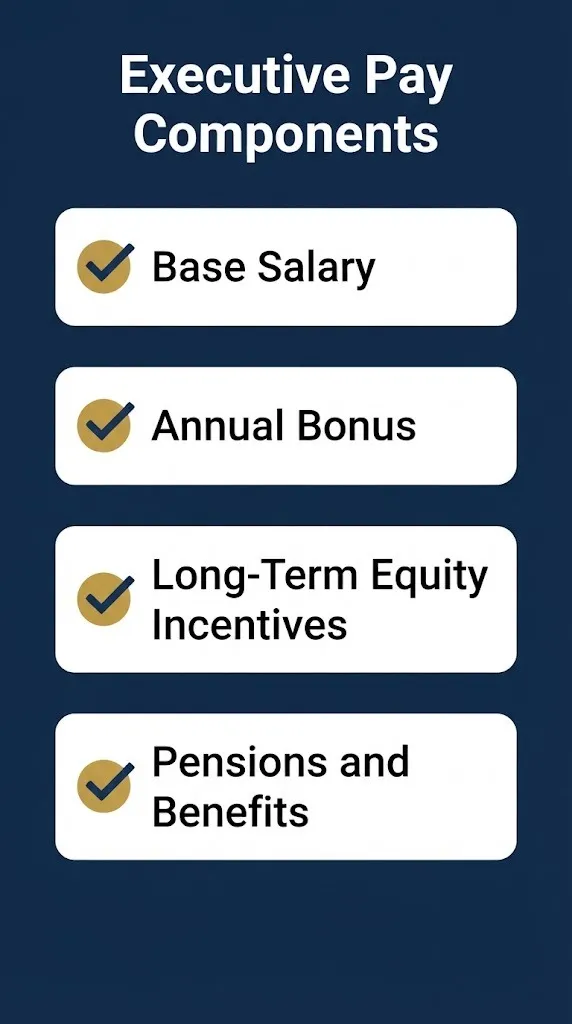
The standard four components are base salary, annual bonus, long-term incentives (usually equity), and pensions and benefits . Base salary and benefits are largely set by market benchmarks. The annual bonus and equity awards are the parts boards tailor to the company’s specific strategy.
For a company in a growth phase, the equity piece might dominate. For a mature utility, the annual bonus tied to earnings per share might carry more weight. The strategy shifts with the business.
Key Takeaway: Executive compensation strategy is a board-designed incentive system, not just a pay package. The goal is to align executive decisions with long-term shareholder value.
How Much Do Executives Actually Get Paid?
Executive pay varies wildly by company size, sector, and individual performance, ranging from under $1 million to well over $25 million in target incentive compensation alone. The specific numbers are public because public companies must disclose them in annual proxy statements filed with the Securities and Exchange Commission.
Take Reddit’s CEO, Steve Huffman. His disclosed executive compensation package was valued at $193 million, including a $550,000 annual salary, with the rest tied up in stock . That is an extreme case, but it shows how equity can dwarf salary.
At Jefferies Financial Group, the company set its CEO’s total incentive compensation at $25 million for fiscal 2025. That was actually a nearly 17% decrease from the prior year .
Here is a snapshot of base salaries from one 2025 proxy filing, showing the range even within a single company:
| Role | 2025 Annual Base Salary |
|---|---|
| Chairman and CEO | $1,500,000 |
| Co-President | $540,000 |
| Chief Operating Officer | $470,000 |
| Chief Financial Officer | $435,000 |
The gap between the top and the rest is typically large. The CEO’s salary was more than three times the CFO’s in that example .
Key Takeaway: Executive pay is public in proxy statements, and equity awards often make up the largest single piece of the package.
What Are the Four Main Components of an Executive Compensation Package?
The four main components of an executive compensation package are base salary, annual bonus, long-term equity incentives, and pensions and benefits . Each piece serves a different purpose, and the mix is what makes the strategy work.
Base salary provides stable income. It is set relative to market data for comparable roles. It does not fluctuate with performance, which is why it is usually the smallest piece for senior executives.
Annual bonus rewards short-term performance. Boards set targets for revenue, earnings, safety metrics, or operational goals. If the executive hits them, they get paid. If not, they do not. At one company, the bonus payout ranged from 101% to 194% of base salary for named executive officers .
Long-term equity incentives are the biggest piece for most senior executives. They come as restricted stock units (RSUs), performance stock units (PSUs), or stock options. These awards vest over three to five years, tying the executive’s payout to the company’s stock price and long-term financial results.
Pensions and benefits include retirement plans, health insurance, life insurance, and perquisites. These are usually the most standard piece, set close to market norms.
How Do Long-Term Equity Incentives Work?
Long-term equity incentives work by granting executives shares or the right to buy shares, with the shares becoming fully theirs only after certain conditions are met. Those conditions are usually time (you have to stay at the company) and performance (the company has to hit financial targets).
The most common forms are RSUs and PSUs. RSUs are time-based: you get the shares if you stay. PSUs are performance-based: you get the shares if the company hits specific goals, like total shareholder return or net income growth.
At Alliant Energy, 75% of the target long-term equity awards for named executive officers were performance-based in 2025. Those awards vest based on relative total shareholder return against a peer group and absolute net income growth. The remaining 25% were service-based RSUs that vest over three years .
At Kratos, the CEO’s performance-based RSUs vest based on Adjusted EBITDA growth over five years. One-third of the award vests for every 10% increase in EBITDA .
The design choice matters. Time-based awards retain talent but do not guarantee performance. Performance-based awards push for results but can create pressure to hit short-term targets.
Key Takeaway: Equity incentives come in time-based and performance-based forms. Performance-based awards tie the biggest payouts to specific financial or stock metrics.
What Is the Role of the Compensation Committee?
The compensation committee of the board of directors is the group that sets executive pay, usually with the help of an outside consultant. The committee is made up of independent directors who do not have a personal financial stake in the decisions .
Their job is to balance competing interests. They want to pay enough to attract and retain top talent. They also want to avoid overpaying for underperformance, which can anger shareholders and trigger “say on pay” votes against the plan.
The committee typically meets quarterly and makes decisions annually for base salary, bonus targets, and equity grants . They rely on peer group data to benchmark their own pay. A peer group is a set of comparable companies selected for size, industry, and growth profile.
At Braze, the compensation committee engaged an outside consultant called Compensia to compile a peer group of 20 companies, including Amplitude, GitLab, and Asana, to use as a reference for pay decisions .
The committee also considers input from the CEO on other executives’ performance, though the CEO does not participate in setting their own pay .
How Do Performance Metrics Shape Executive Payouts?
Performance metrics are the specific financial and operational goals that determine whether executives earn their bonuses and equity awards. The metrics chosen tell you what the board actually wants the company to prioritize.
Financial metrics are the most common. Earnings per share, revenue, Adjusted EBITDA, and net income growth all show up repeatedly in proxy disclosures. At one company, the annual incentive plan used revenue (15% weight), Adjusted EBITDA (30% weight), and operating expense reduction (5% weight) as the corporate performance goals .
Operational metrics matter too. Customer experience, safety, and environmental goals can carry weight. Alliant Energy included customer reliability (measured by outage duration and frequency), renewable generation availability, and lost-time incident reduction in its 2025 incentive plan .
The threshold structure is usually tiered. A minimum performance level must be hit before any payout occurs. Above that, a sliding scale applies. At one company, each goal component had a minimum threshold of 80% achievement, with payouts scaling up to a maximum of 125% for performance at or above 100% .
This structure is the mechanism that makes pay “at risk.” If the company misses, the executive misses.
Key Takeaway: Performance metrics are the engine of variable pay. Boards choose metrics that reflect the company’s strategy, and payouts only happen if thresholds are met.
Reality Check: Executive compensation numbers in proxy statements are accounting values, not cash in hand. The “grant date fair value” of an equity award is what the company reports for accounting purposes. The actual value the executive receives depends on the stock price when the shares vest, which could be higher or lower. Do not read a headline number as money already earned.
How Do Severance and Change in Control Provisions Work?
Severance and change in control provisions are pre-negotiated terms that determine what an executive receives if they are fired or if the company is sold. These terms are set in employment agreements before anything goes wrong. They are part of the compensation strategy because they affect risk and retention.
Severance typically includes salary continuation, a bonus payment, and continued health coverage. The amounts vary by company and executive level. At one company, the CEO’s severance for a termination without cause was 18 months of base salary plus 100% of annual bonus and 50% accelerated vesting of equity awards. If the termination happened in connection with a change in control, the severance increased to 30 months of salary plus 250% of bonus and full equity acceleration .
Change in control provisions are designed to keep executives focused during a merger or acquisition. Without them, an executive might be tempted to fight a deal that is good for shareholders but bad for their own job security. The provisions give them a soft landing if the deal costs them their position.
Some companies include “clawback” provisions that allow the company to recoup bonus or equity pay if the financial results that justified the award are later restated due to misconduct . These provisions have become more common after regulatory pressure.
What Are the Biggest Debates Around Executive Compensation in 2026?
The biggest debates around executive compensation in 2026 center on whether pay is actually tied to performance, whether the gap between executives and average workers is justified, and whether equity incentives create perverse short-term pressures. These debates play out in shareholder votes and proxy advisory firm recommendations every year.
One criticism is that performance metrics can be gamed. If the board sets an Adjusted EBITDA target, management can cut costs temporarily to hit the number, even if that hurts long-term growth. The metric becomes the goal, not the business result.
Another issue is the peer group problem. If every company benchmarks its pay to the 50th percentile of its peer group, and every peer group keeps expanding, pay ratchets upward regardless of actual performance. This is a known structural critique of the benchmarking approach.
Shareholders also push back on perquisites. One company disclosed over $1 million in personal aircraft use for its CEO, plus $109,577 for personal security at his residence, in a single year . Those are real costs that come out of shareholder returns.
The “say on pay” vote gives shareholders a non-binding voice on compensation plans. Proxy advisory firms like ISS and Glass Lewis issue recommendations, and a negative recommendation can lead to a majority vote against the plan.
What Happens Next
Annually: Public companies file proxy statements with the SEC, disclosing executive pay and the reasoning behind it. These are the primary source for verified data.
Spring 2026: Most companies hold annual meetings where shareholders vote on compensation plans and equity incentive proposals.
Ongoing: Compensation committees review peer groups and market data at least annually, adjusting pay targets and equity grants as needed.
Ongoing: Regulatory scrutiny of executive pay disclosure and clawback provisions continues to evolve.
Frequently Asked Questions
What is executive compensation strategy?
Executive compensation strategy is the board-designed system for paying top executives, built on base salary, annual bonuses, long-term equity incentives, and benefits to align their interests with shareholder value.
What are the four components of executive compensation?
Base salary, annual bonus, long-term equity incentives, and pensions and benefits are the standard four components .
How much do executives get paid?
Pay ranges widely. Some executives earn under $1 million in base salary, while others receive total target compensation of $25 million or more, depending on company size and performance.
What is the difference between RSUs and PSUs?
RSUs are restricted stock units that vest based on time, usually over three to five years. PSUs are performance stock units that vest based on hitting specific financial or stock metrics.
What is a change in control provision?
A change in control provision is a pre-negotiated severance term that pays executives if they are terminated in connection with a merger or acquisition.
Who sets executive compensation?
The board of directors’ compensation committee, made up of independent directors, sets executive pay, often with input from an outside compensation consultant.
What is a clawback provision?
A clawback provision allows a company to recover bonus or equity pay from executives if financial results are restated due to misconduct or accounting errors.
How can I find out what a company’s executives are paid?
Public companies file proxy statements (DEF 14A) with the SEC that disclose executive compensation details. These filings are publicly available.