Compensation Management in 2026: Types, Legal Claims, and What Workers Should Verify
Quick Answer
- Compensation management covers wages, bonuses, equity, benefits, and legally required payments.
- Federal law sets minimum wage and overtime rules, but states can go further.
- Misclassification and unpaid overtime are the most common compensation-related legal claims.
If you searched for compensation management, you might be an HR professional, a manager, or a worker trying to understand whether your pay is legal. You may have seen a settlement notice or a news headline about wage claims and wondered if it applies to you.
The verified truth is this: compensation management is not a lawsuit. It is a system of pay practices governed by federal and state law. But those laws generate real lawsuits when employers get them wrong. One surprising detail: unpaid overtime claims outnumber all other workplace compensation lawsuits combined.
The Facts
| Fact | Details |
|---|---|
| Case | No single case, multiple wage and hour laws apply |
| Status | Ongoing regulatory enforcement |
| Fund Size | Varies by employer and violation |
| Est. Per Person | Depends on wages owed |
| Claim Deadline | Two to three years, varies by law |
| Administrator | Department of Labor, state labor agencies |
| Proof Needed | Pay stubs, time records, job description |
What Is Compensation Management?
Compensation management is the process employers use to set wages, salaries, bonuses, and benefits. It includes base pay, variable pay, equity, and legally required payments.
The term matters legally because courts look at total compensation when deciding wage claims. An employer who pays a low base wage but promises a bonus cannot count that bonus as base pay for overtime calculations.
Federal law sets the floor. The Fair Labor Standards Act establishes minimum wage and overtime rules. State laws can go higher. California, New York, and Washington all have stricter rules than the federal baseline.
Key Takeaway: Compensation management is a system, but the law treats each pay type separately.
What Are the Main Types of Compensation?
Compensation types fall into four buckets: base pay, variable pay, benefits, and legally required payments. Each has different legal rules.
| Type | Examples | Legal Rules |
|---|---|---|
| Base pay | Hourly wage, salary | Must meet minimum wage |
| Variable pay | Bonuses, commissions | May count toward overtime if non-discretionary |
| Benefits | Health insurance, retirement | Subject to ERISA and tax rules |
| Required | Overtime, sick leave | Governed by FLSA and state law |
Misclassification happens when employers treat one type as another. The most common error is calling a non-exempt worker “salaried” to avoid paying overtime.
How Does Overtime Work in Compensation Management?
Overtime means time-and-a-half pay for hours over 40 in a workweek for non-exempt workers. The federal rule applies to most employees, but exemptions exist.
To be exempt from overtime, a worker must meet three tests: salary basis, salary level, and job duties. The salary level changes periodically. In 2025, the Department of Labor attempted to raise the threshold, but that rule faced legal challenges.
If you are salaried but earn below the threshold, you may be owed overtime. Many workers do not know this. Employers count on that ignorance.
What Is the Legal Difference Between a Bonus and a Commission?
A bonus is typically discretionary or fixed. A commission is a percentage of sales. The difference matters for overtime calculations.
Non-discretionary bonuses count toward your regular rate for overtime purposes. A non-discretionary bonus is one you expect based on clear criteria. A true discretionary bonus, like a surprise holiday gift, does not count.
If your employer calls everything a bonus to avoid including it in overtime, that may be a wage violation.
Key Takeaway: The label on your pay stub matters less than whether the payment is guaranteed by policy.
What Is Employee Misclassification?
Employee misclassification means treating workers as independent contractors or exempt employees when the law says they are not. It is the most common compensation violation.
Misclassified workers lose overtime pay, benefits, and tax protections. Employers save money. The Department of Labor estimates billions in unpaid wages each year from misclassification.
Here are signs you may be misclassified:
- Your employer controls your schedule and tools.
- You work exclusively for one company.
- Your work is central to the business.
- You cannot negotiate your rate or decline work.
- You are paid a flat daily rate but work more than 40 hours.
Can You Sue for Unpaid Wages?
Yes. Workers can sue for unpaid wages under federal and state law. Most wage claims are filed as individual lawsuits or collective actions, not class actions.
The Fair Labor Standards Act allows workers to recover unpaid wages plus liquidated damages equal to the amount owed. That means double damages in many cases.
You have two years to file, or three years if the violation was willful. State deadlines vary. The clock starts from the last unpaid payday, not from when you discovered the violation.
Reality Check: No legitimate wage claim requires you to pay a filing fee to a third party. You can file a wage complaint free with the Department of Labor or your state labor agency. Lawyers in wage cases typically work on contingency.
What Is the Difference Between a Collective Action and a Class Action for Wages?
A collective action is the federal mechanism for wage claims under the Fair Labor Standards Act. Workers must opt in to join. A class action under state law may be opt-out.
The opt-in rule matters because fewer workers join. That reduces the fund size but increases individual shares. Opt-out class actions under state law, like California’s Private Attorneys General Act, can include thousands automatically.
Many wage lawsuits file both: a federal collective action and a state class action. This maximizes coverage and recovery.
Key Takeaway: Whether you need to opt in or opt out depends on which law the lawsuit uses.
What Are the Most Common Compensation Lawsuits in 2026?
The most common compensation lawsuits in 2026 are unpaid overtime, misclassification, and off-the-clock work claims.
| Lawsuit Type | Typical Claim |
|---|---|
| Unpaid overtime | Employer failed to pay time-and-a-half |
| Misclassification | Worker called contractor or exempt incorrectly |
| Off-the-clock | Work before clock-in or after clock-out unpaid |
| Meal break violations | State-required breaks denied |
| Final paycheck | Wages not paid after termination |
These cases often settle. Payouts depend on the number of affected workers and the violation period.
How Do You Check If Your Compensation Is Legal?
You check your compensation by comparing your pay to the law, not to what your employer tells you. Start with your job duties and salary.
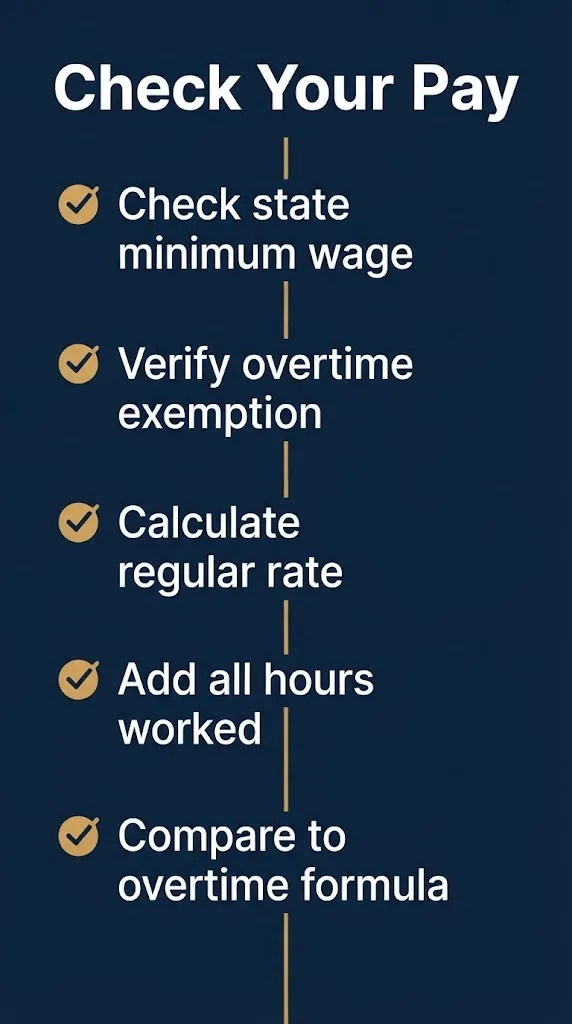
Here is a five-step check:
- Check your state’s minimum wage and compare it to your pay.
- Determine if you are exempt or non-exempt under the duties test.
- Calculate your regular rate, including non-discretionary bonuses.
- Add up your actual hours, including work from home and off-the-clock time.
- Compare your pay to the overtime formula if you worked over 40 hours.
If the numbers do not match, you may have a claim.
What Is the Fair Labor Standards Act?
The Fair Labor Standards Act is the federal law that sets minimum wage, overtime, and recordkeeping rules. It applies to most employers and employees.
The law requires employers to keep accurate time records. If an employer fails to keep records, courts often credit the worker’s reasonable estimate of hours.
The law also protects against retaliation. You cannot be fired for asking about your pay or filing a wage complaint.
Key Takeaway: The Fair Labor Standards Act is the baseline, and state laws build on it.
What Are the Compensation Rules for Remote Workers?
Remote workers are covered by the same wage laws as on-site workers. Hours worked at home count as work time.
The challenge is proving hours. Employers may argue that remote workers were not working, while workers argue they were available and responding.
Evidence matters. Save emails, chat logs, time-tracking screenshots, and any written request to work late. These records support your claim if the employer disputes your hours.
How Does Severance Pay Fit Into Compensation Management?
Severance pay is not required by federal law. It is a negotiated benefit, usually in exchange for a release of claims.
If you receive a severance offer, read the release carefully. Many releases waive your right to sue for wage violations, discrimination, or other claims.
You do not have to sign immediately. Federal law gives workers over 40 at least 21 days to consider a release and seven days to revoke. State rules may add more time.
What Happens Next for Compensation Enforcement in 2026?
Wage enforcement is active. The Department of Labor continues to target misclassification and unpaid overtime. State attorneys general are pursuing their own cases.
- Ongoing: Department of Labor investigations into misclassification.
- Expected 2026 to 2027: New state laws expanding wage transparency and pay disclosure.
- No confirmed date: Any major federal legislative change to overtime rules.
- No confirmed date: Supreme Court review of pending wage cases.
Frequently Asked Questions
What is compensation management in simple terms?
Compensation management is how employers set and administer pay and benefits.
It includes wages, salaries, bonuses, equity, and required payments.
The law treats each type separately for overtime and tax purposes.
What are the four types of compensation?
The four types are base pay, variable pay, benefits, and legally required payments.
Base pay is your wage or salary.
Variable pay includes bonuses and commissions.
Can I sue my employer for unpaid bonuses?
Yes, if the bonus was earned and non-discretionary.
A bonus based on clear criteria is a wage obligation.
A purely discretionary gift is not.
How long do I have to file a wage claim?
You have two years under federal law, or three years for willful violations.
State deadlines may be longer.
The clock starts from the last unpaid payday.
What is the salary threshold for overtime exemption?
The salary threshold for overtime exemption has been subject to legal challenges.
The most recent federal rule changes are being litigated.
Check the Department of Labor website for the current effective threshold.
Do independent contractors get overtime?
No. Independent contractors are not covered by overtime laws.
But misclassification is common, and many workers called contractors are legally employees.
A worker may qualify for overtime if the employer controls the work.
What should I do if my employer did not pay my final check?
File a wage claim with your state labor agency.
Many states require final pay within a set period after termination.
You may also recover waiting time penalties.
Is severance pay required by law?
No federal law requires severance pay.
It is a negotiated benefit.
Some state laws or employment contracts may require it.