How Long Do Class Action Lawsuits Take? 2026 Timeline and Payout Guide
Quick Answer
- Most class action lawsuits take 2 to 5 years from filing to resolution, though simple cases can settle faster and complex ones can take a decade.
- Getting paid takes another 6 to 18 months after settlement approval, and appeals can freeze payments for everyone.
- The AT&T data breach settlement had its final approval hearing in January 2026 with no payment date confirmed as of October 2026.
A class action lawsuit is a legal case filed by one or more plaintiffs on behalf of a larger group of people. The timeline is one of the longest in civil litigation. A 2025 analysis found that class actions typically take 2 to 5 years from filing to resolution . Securities class actions average 2 to 4 years, and complex cases can stretch beyond that .
The payout timeline is separate from the lawsuit timeline. Even after the parties agree to settle, a judge must review the deal, class members file claims, a settlement administrator verifies them, and appeals can pause everything. The AT&T data breach settlement shows how this plays out. The claim deadline passed, a final approval hearing was held on January 15, 2026, four objectors testified, and as of the most recent court update, the judge had still not ruled .
This article breaks down the verified timeline from filing to payout, the factors that speed up or slow down a case, and why your settlement check takes so long to arrive.
The Facts
| Case | Class Action Lawsuit Timeline (general litigation) |
|---|---|
| Status | Active litigation process, timelines vary by case type |
| Fund Size | Not applicable |
| Est. Per Person | Not yet determined |
| Claim Deadline | Case-specific, typically 3 to 6 months after preliminary approval |
| Administrator | Case-specific settlement administrator |
| Proof Needed | Claim form, documentation of class membership |
Is the Class Action Timeline Legit or a Scam?
The class action timeline is legitimate, but it is often misrepresented. Some websites promise “fast settlement payouts” that do not exist. Others claim a settlement is “paying now” when the case is still in appeal.
The scam risk is real. Any site quoting you a specific payment date for a settlement that has not received final approval is making it up. The AT&T settlement had its approval hearing in January 2026. As of October 2026, the court had still not ruled. No one can honestly give a payout date until the judge signs off and all appeals expire .
Legitimate settlements go through a defined process. A judge must grant final approval. An appeal window must close. The settlement administrator must verify claims. Only then can payments go out. Skipping any step is impossible.
Key Takeaway: No one can promise a class action payout date before final approval is granted and appeals expire. Sites that do are guessing or lying.
How Much Can You Get From a Class Action Settlement?
There is no fixed payout for class action settlements. The amount you receive depends on the type of case, the size of the settlement fund, how many valid claims are filed, and whether you qualify for a larger tier of compensation.
In consumer class actions, individual payouts often range from a few dollars to a few hundred dollars. In securities class actions, institutional investors and large shareholders may receive millions, while small investors get proportionally less. In product liability settlements, payouts can reach thousands or more depending on the injury.
Not yet determined: The exact payout in any individual case cannot be predicted. The settlement fund is divided among valid claimants after attorneys’ fees and administrative costs are deducted.
Here is how payout amounts are typically calculated:
| Factor | Effect on Payout |
|---|---|
| Total settlement fund | Sets the ceiling |
| Number of valid claims | More claims mean smaller shares |
| Attorneys’ fees | Typically 25% to 33% of the fund |
| Administrative costs | Deducted before distribution |
| Proof required | Documented claims often receive more |
What Is the Typical Timeline for a Class Action Lawsuit?
The typical timeline for a class action lawsuit runs 2 to 5 years from filing to resolution, with securities cases averaging 2 to 4 years . Complex cases involving multiple defendants, appeals, or scientific evidence can take a decade or longer.
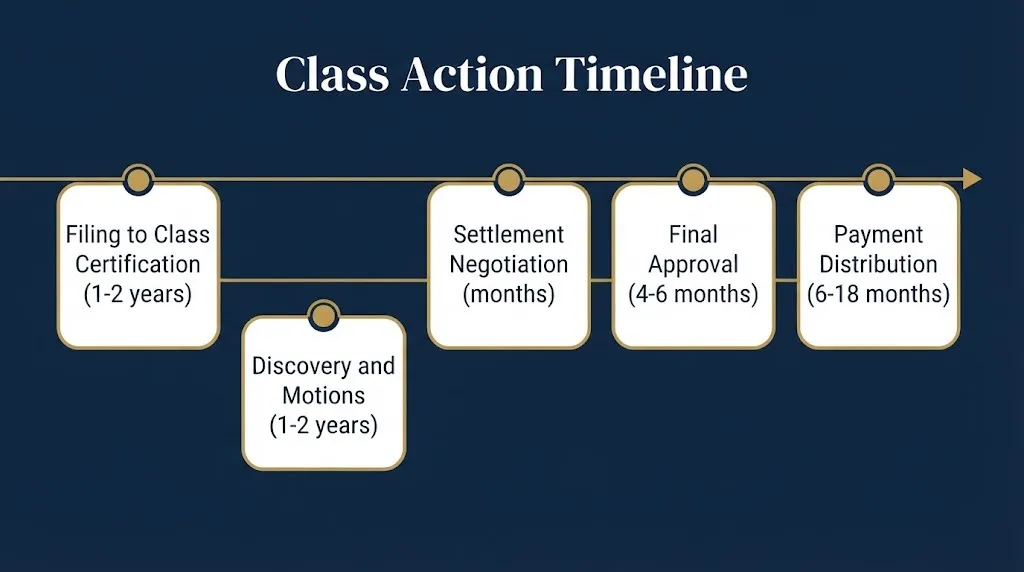
The litigation phase includes several stages. Lead plaintiff appointment takes 1 to 4 months in securities cases. A motion to dismiss typically takes 4 to 18 months. Discovery and class certification can take 18 to 36 months. Expert analysis and pre-trial motions add another 30 to 48 months in complex cases .
Settlement negotiations usually begin after discovery, though some cases settle earlier. If the parties reach agreement, the court must review the deal, hold a fairness hearing, and grant final approval. That approval process alone takes 4 to 6 months after the agreement is reached .
Key Takeaway: The litigation phase alone takes 2 to 5 years. Settlement approval adds another 4 to 6 months. Appeals can add a year or more.
How Long After Settlement Approval Do You Get Paid?
Most class members receive payment 6 to 18 months after final settlement approval, according to a securities litigation timeline . The delay happens because several steps must occur before any money moves.
A settlement administrator must review every claim form. In a case with millions of class members, that review takes months. Duplicates and fraudulent claims must be removed. The administrator calculates each valid claimant’s share only after the total number of valid claims is known.
The final approval order must be issued, and the appeal window must expire. That window is typically 30 to 35 days after approval. If anyone appeals, distribution stops for everyone until the appeal is resolved. That can add a year or more .
Once the settlement reaches its effective date, the administrator issues payments. That process itself takes weeks.
Key Takeaway: Payment typically arrives 6 to 18 months after final approval. Appeals can freeze the entire process indefinitely.
Why Do Class Action Payouts Take So Long?
Class action payouts take so long because the settlement cannot be distributed until four things happen. These are sometimes called the “four gates” of settlement distribution .
Here is what must happen before any money moves:
- The claim deadline passes. The administrator then reviews every claim, removes duplicates, and calculates how many valid claims exist.
- The final approval hearing. A judge decides whether the settlement is fair, reasonable, and adequate. Class members who objected can speak.
- The final approval order. The judge issues the order. Sometimes this happens at the hearing. Sometimes it takes months.
- The effective date. After approval, an appeal window of about 30 to 35 days must expire. If no one appeals, the settlement becomes effective and distribution can begin.
If anyone appeals, everything stops for every class member until the appeal is resolved. That can add a year or more.
Key Takeaway: Four separate gates must open before payment. The claim deadline, final approval, the approval order, and the effective date all must pass.
Reality Check: A settlement announced in the news does not mean payments are coming soon. The AT&T data breach settlement had its final approval hearing in January 2026. As of October 2026, the court had not ruled, and no payment date existed. Any site quoting a specific AT&T payout date is making it up.
What Factors Affect the Class Action Timeline?
Several factors can speed up or slow down a class action lawsuit. The most significant are case complexity, the number of plaintiffs, settlement negotiations, and appeals.
Case complexity is the biggest driver. Consumer cases with clear damages and fewer disputed facts move faster. Securities, environmental, and product liability cases involve extensive discovery, expert testimony, and pre-trial motions that can add years .
The number of plaintiffs matters for administration. Cases involving thousands or millions of claimants require more coordination for notice and claims processing.
Settlement negotiations can happen early or after years of litigation. Some defendants settle quickly to avoid reputational damage. Others fight to the end.
Appeals are the wild card. An appeal by an objector or the defendant can pause the entire settlement for all class members. That adds a year or more to the timeline .
Key Takeaway: Complexity, class size, settlement timing, and appeals are the main factors that determine how long a class action takes.
What Happens Next
After settlement agreement: The court reviews the deal, holds a fairness hearing, and issues a final approval order. This takes 4 to 6 months.
After final approval: The appeal window opens. If no appeal is filed, the settlement becomes effective in about 30 to 35 days.
After effective date: The settlement administrator issues payments. This takes weeks to months depending on class size.
If an appeal is filed: Distribution stops for all class members until the appeal is resolved. This can add a year or more.
Frequently Asked Questions
How long do most class action lawsuits take?
Most class action lawsuits take 2 to 5 years from filing to resolution. Securities class actions average 2 to 4 years. Complex cases can take a decade or longer.
How long after settlement approval do you get paid?
Most class members receive payment 6 to 18 months after final settlement approval. The delay includes claim processing, the appeal window, and payment issuance.
Why is my settlement check taking so long?
Payments cannot be issued until the claim deadline passes, the judge grants final approval, the appeal window expires, and the administrator processes all claims. Appeals can freeze the process.
Can I get paid before final approval?
No. No payments can be distributed before the court grants final approval and the settlement reaches its effective date. Any site promising early payment is misleading you.
What happens if someone appeals a class action settlement?
If anyone appeals, distribution stops for every class member until the appeal is resolved. That can add a year or more to the timeline .
How long do I have to file a claim?
The claim window is typically 3 to 6 months after preliminary approval. The deadline is set by the court and cannot be extended for individual claimants .
Does every class action lawsuit go to trial?
No. The vast majority of class actions settle before trial. Settlement is the most common resolution because both sides usually prefer to avoid the cost and uncertainty of a verdict.
Can I speed up my class action payout?
No. Individual class members cannot speed up the process. The timeline is controlled by the court, the administrator, and any appeals. Patience is the only option.