Startup Compensation 2026: The Complete Guide to Benchmarks, Equity, and What to Expect
Quick Answer
- Startup compensation combines lower base salaries with higher equity stakes compared to corporate jobs.
- Seed-stage founders now earn a median of $85,000 to $130,000, while Series A founders earn $175,000 to $203,000.
- Equity grants have stabilized after shrinking from 2021 peaks, with first hires receiving a median of 1.50% fully diluted equity.
Startup compensation is not just a salary. It is a trade-off. You take less cash now in exchange for ownership in something that might be worth a lot later. That trade-off is the defining feature of startup pay, and it shapes every offer you will evaluate.
The numbers have shifted significantly in 2026. Median startup salaries have risen 6.4% over the past two years, and initial equity grants are up 11%. But the gains are not evenly distributed. AI/ML engineers are seeing equity grants grow 31%, nearly triple the rate of other roles. The market rewards scarce skills.
This guide breaks down the verified benchmarks by stage, the equity ranges for key roles, and what to expect when you negotiate. One detail that surprises most people: your first hire gets nearly 5x the equity of your fifth hire, and that curve drops fast.
The Facts
| Case | Startup Compensation (employment concept) |
|---|---|
| Status | Active market, benchmarks updated through 2026 |
| Fund Size | Not applicable |
| Est. Per Person | Founder salary: $85K-$290K by stage; engineer equity: 0.10%-0.50% at Series A |
| Claim Deadline | Not applicable |
| Administrator | Not applicable |
| Proof Needed | Offer letter, equity grant documents, 409A valuation |
What Is Startup Compensation?
Startup compensation is the total package a startup offers to employees, combining cash salary, equity ownership, and benefits. It differs from corporate compensation because startups typically pay lower base salaries but offer equity stakes that corporate jobs do not. The trade-off is intentional: less certainty now, more upside later.
The Bureau of Labor Statistics tracks benefits costs across industries. In 2026, benefits account for roughly 30% of total employer compensation costs. Startups often cannot match the benefits packages of large corporations, so they use equity to close the gap.
Carta data shows that seed-stage teams are now just four employees on average, down from larger teams in previous years. Smaller teams mean each hire matters more, and each hire commands a bigger share of available capital and equity.
Key Takeaway: Startup compensation is a package, not just a salary. It balances lower cash with higher equity upside compared to corporate roles.
What Are Startup Compensation Benchmarks by Funding Stage?
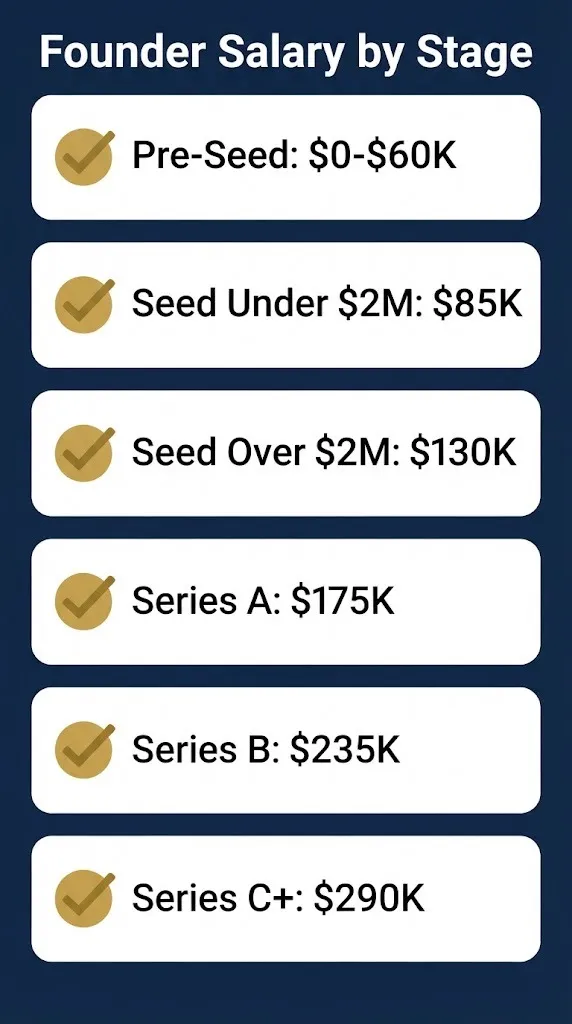
Startup compensation benchmarks rise significantly as funding stages progress. Pre-seed founders often earn token salaries or nothing. By Series C+, founder salaries reach $290,000 median.
Here is the verified founder salary breakdown by stage:
| Funding Stage | Typical Cash Range | Median Founder Salary |
|---|---|---|
| Pre-seed | $0 to $60,000 | $0 to $60,000 |
| Seed (under $2M raised) | $85,000 to $132,000 | $85,000 |
| Seed (over $2M raised) | $130,000 to $149,000 | $130,000 |
| Series A | $175,000 to $203,000 | $175,000 |
| Series B | $214,000 to $235,000 | $235,000 |
| Series C+ | Around $290,000 | $290,000 |
The sharpest jump occurs within the seed stage. Founder CEO pay moves from $85,000 when a seed round is under $2 million raised to $130,000 once that threshold is crossed. The explanation is runway: a round that clears that bar buys enough time for payroll to reflect a planned budget rather than an emergency drawdown.
Kruze Consulting’s data clusters seed-stage founder salaries around $132,000 to $149,000, then moves to $183,000 at Series A and $218,000 at Series B. The exact figures vary by dataset, but the shape is consistent.
Key Takeaway: Founder salaries rise with each funding stage. The biggest jump happens within seed, once a company crosses the $2 million raised threshold.
How Much Equity Do Startup Employees Get?
Startup equity follows a steep curve. Your first hire gets a median of 1.50% fully diluted equity. By your fifth hire, that drops to 0.33%. The decline is 78% in just four hires.
Here is the verified equity curve for the first five hires:
| Hire Number | Median Equity | 25th Percentile | 75th Percentile |
|---|---|---|---|
| Hire #1 | 1.50% | 0.50% | 4.00% |
| Hire #2 | 0.85% | 0.30% | 2.00% |
| Hire #3 | 0.50% | 0.20% | 1.20% |
| Hire #4 | 0.44% | 0.18% | 1.00% |
| Hire #5 | 0.33% | 0.13% | 0.80% |
The range is enormous. At the 75th percentile, the first hire gets 4.00%. At the 25th percentile, they get 0.50%. That is an 8x spread, driven by stage, role, seniority, location, and how desperate the company is to fill the role.
By Series A, equity grants tighten further. Senior engineers at Series A startups typically receive 0.10% to 0.2% equity, with salaries in the high six figures. The trade-off shifts from equity-heavy to cash-heavy as risk decreases.
Key Takeaway: Equity drops fast with each hire. Your first hire gets 5x what your fifth hire gets at median. By Series A, equity grants are much smaller.
What Is the Difference Between Startup and Corporate Compensation?
Startup compensation differs from corporate compensation in three key ways: lower base salaries, higher equity stakes, and broader role scope. Large companies pay higher base salaries with established bands, formalized levels, and the budget to win on cash. Startups pay less base but compensate with equity, broader responsibility, faster growth, and flexibility.
The gap widens with seniority. For a junior role, the difference between startup and corporate pay is often small. For senior and lead roles, the spread can be substantial. Late-stage startups pay 31-34% more for senior talent than early-stage peers, but they still cannot always match Big Tech cash offers.
Here is how the trade-offs compare:
| Factor | Startup | Corporate |
|---|---|---|
| Base Salary | Lower | Higher |
| Equity | Meaningful ownership | Limited or none |
| Role Scope | Broad, multi-functional | Narrow, specialized |
| Growth Speed | Fast, title changes | Structured, slower |
| Job Security | Lower | Higher |
Startups should not try to compete with Big Tech on cash. Instead, they should be generous with equity and clear about the non-cash benefits. As one founder put it, “You should be more generous than what you think you should be” with equity.
Key Takeaway: Startups trade cash for equity and scope. Corporate jobs offer stability and higher base pay. The right choice depends on your risk tolerance and career stage.
What Are Typical Equity Ranges by Role in 2026?
Equity ranges vary significantly by role, stage, and seniority. C-suite and VP roles command the highest equity, while mid-level individual contributors receive much smaller grants.
Here are the verified equity benchmarks by role and stage:
| Role Level | Seed Stage Equity | Series A Equity |
|---|---|---|
| C-Suite / VP | 1.0% to 3.0% | 0.5% to 1.5% |
| Senior Engineer | 0.25% to 1.0% | 0.1% to 0.3% |
| Mid-Level / Ops | 0.05% to 0.25% | 0.01% to 0.1% |
| AI Specialist | 0.5% to 1.5% (est.) | 0.2% to 0.5% (est.) |
AI specialists command a premium. Carta data shows that at startups valued between $1 million and $10 million, the median size of initial equity grants for AI/ML engineers increased by 64% over the past two years. At startups valued between $10 million and $25 million, initial grant size is up 52%.
The AI premium reflects genuine scarcity. But founders should be careful not to create cross-functional resentment by rewarding AI roles far more generously than equally senior roles in other functions.
Key Takeaway: C-suite and VP roles receive the largest equity grants. AI specialists command a significant premium in 2026, reflecting scarce talent.
Reality Check: Equity in a startup is not guaranteed money. Most startups fail. Even successful ones dilute shareholders through multiple funding rounds. Your equity could be worth millions or zero. Do not accept a lower salary than you can afford to live on just for equity. Treat equity as upside, not as a substitute for cash you need to pay rent.
What Is the 20% to 25% Seed Dilution Rule?
The 20% to 25% seed dilution rule is a benchmark for how much equity a startup should expect to give up during a seed round. It helps founders plan their cap table and preserve enough ownership for future rounds.
The math matters because dilution compounds. In companies where the founding CEO remains in place, ownership can be diluted by 28% from the seed round to Series A, and another 11% from Series A to Series B. A founder who owns 40% after seed could be down to 25% by Series B without any additional dilution events.
Employee option pools also dilute founders. After the seed round, the founding team typically owns 56% while the employee pool is at 12%. That pool gets used for hiring, and it must be replenished at later rounds.
Founders who understand the dilution curve make better decisions about how much equity to grant early. Giving away too much in the first 10 hires leaves less for senior leadership later.
Key Takeaway: Seed rounds typically dilute founders by 20% to 25%. Dilution compounds across rounds, so early equity grants have long-term consequences.
How Do You Negotiate Startup Compensation?
Negotiating startup compensation requires understanding the trade-offs and knowing your market value. The base salary is negotiable. The equity grant is negotiable. The vesting schedule, cliff period, and refresh policy are all negotiable. Do not accept the first offer without asking questions.
Here are the steps to negotiate effectively:
- Benchmark your role. Use data from Carta, AngelList, and Pave to find the range for your role, stage, and location.
- Calculate your personal runway. How many months of expenses can you cover with the base salary offered?
- Understand the equity value. Ask for the current 409A valuation and the fully diluted share count.
- Negotiate base first. If the base is too low to live on, negotiate that before optimizing equity.
- Ask about refresh grants. Will you receive additional equity after your initial grant vests?
- Clarify vesting terms. Standard is four years with a one-year cliff. Accelerated vesting on acquisition is negotiable.
- Get it in writing. Verbal promises about equity refreshes or promotions are not enforceable.
Startups should be transparent about their compensation framework. As one expert noted, having standards around compensation helps avoid legal pitfalls and ensures fairness across hires.
What Happens Next
Annually: Review your equity grant and vesting schedule. Ask about refresh grants as you approach your two-year mark.
When considering an offer: Benchmark the base salary against your local market. Remote roles typically pay 12% below San Francisco, and international remote pays 38% below.
When negotiating: Ask for the 409A valuation and fully diluted share count. Calculate what your equity is worth at different exit scenarios.
Ongoing: Understand that equity can be diluted through future funding rounds. Your ownership percentage will decrease even if the company succeeds.
Frequently Asked Questions
What is a typical startup salary?
Startup salaries vary by stage. Seed-stage founders earn a median of $85,000 to $130,000. Series A founders earn $175,000 to $203,000. Senior engineers at Series A earn $190,000 or more.
How much equity should I ask for at a startup?
Equity depends on hire number and role. Your first hire gets a median of 1.50% fully diluted. By the fifth hire, it drops to 0.33%. Senior engineers at Series A typically get 0.10% to 0.2%.
Is startup compensation lower than corporate?
Yes, base salaries are typically lower at startups. But startups offer equity, broader role scope, and faster growth. The trade-off is intentional.
What is the 20% to 25% seed dilution rule?
It is a benchmark for how much equity a startup gives up during a seed round. Dilution compounds across future rounds, so founders plan their cap table around this rule.
How does AI talent affect startup compensation?
AI/ML engineers command higher salaries and equity. At small startups, equity grants for AI engineers increased 64% over two years. The AI premium reflects scarce talent.
What is a typical vesting schedule?
Standard vesting is four years with a one-year cliff. You earn 25% of your grant after one year, then the remainder vests monthly or quarterly.
Should I prioritize salary or equity?
Depends on your financial situation. Ensure your base salary covers at least 12 months of personal runway. Treat equity as upside, not as money you can count on.
How much equity do founders typically keep?
After seed, founding teams own about 56% of the company. After Series A and B, two-founder teams typically each hold 12% to 22% of fully diluted shares.