Compensation Analyst Salary 2026: Real Pay Ranges, Top States, and What Actually Moves the Number
Quick Answer
- Compensation analysts earn an average base salary of $74,000 nationally in 2026, with total pay up to $99,000.
- San Francisco pays the most at $132,334 average, followed by New York at $146,253.
- Information Technology is the top-paying industry with a median total pay of $115,431.
If you’re searching for compensation analyst salary data, you’ve probably noticed the numbers are all over the map. One site says $74,000. Another says $114,000. A third says $146,000. They can’t all be right for the same job in the same place.
Here’s what’s actually happening: “compensation analyst” is a title that covers everything from entry-level HR support to senior total rewards strategy. Location matters enormously. And the source of the data, whether it’s self-reported surveys, job postings, or government databases, swings the number significantly.
This article breaks down the verified 2026 salary data by experience, location, industry, and skills. You’ll see exactly what each source reports, where the gaps come from, and which factors actually move your paycheck.
The Facts
| Case | Compensation Analyst Salary Data 2026 |
| Status | Active data across multiple salary survey platforms |
| National Average | $74,000 base salary, $99,000 total pay (PayScale) |
| High End | $146,253 median in New York, $132,334 in San Francisco |
| Top Industry | Information Technology, median total pay $115,431 |
| Top Skills | Excel, SQL, data analysis, HRIS, salary benchmarking |
| Growth Outlook | +7% to +13% projected growth over next decade |
How much does a compensation analyst make in 2026?
A compensation analyst makes an average base salary of $74,000 per year in the United States in 2026, with total pay (including bonus) reaching approximately $99,000 at the higher end . That’s the median across 742 salary profiles reported to PayScale and updated in June 2026.
The range is wide. At the 10th percentile, base pay sits around $55,000. At the 90th percentile, it reaches $96,000 . Bonuses add another $2,000 to $10,000 on top of base, putting total compensation between roughly $53,000 and $99,000 .
Glassdoor reports a higher national average: $114,834 per year, with a typical pay range of $93,994 to $142,119 . That’s based on 2,119 salaries submitted anonymously as of September 2026.
The gap between PayScale ($74K) and Glassdoor ($114K) isn’t a contradiction. It reflects different data sources. PayScale collects self-reported profiles. Glassdoor pulls from anonymous submissions that skew toward larger employers and tech companies. Both are “real,” but they measure different slices of the market.
| Source | Average Base | Median Total | Range |
|---|---|---|---|
| PayScale | $74,000 | $99,000 | $53,000 to $99,000 |
| Glassdoor | $114,834 | Not stated | $93,994 to $142,119 |
| SalaryExpert | $102,236 | $106,348 | $73,336 to $117,748 |
| SkillShift | $100,000 | Not stated | $62,000 to $142,000 |
Key Takeaway: The national average compensation analyst salary is $74,000 base, but total pay including bonus and the right industry can push past $140,000.
What is the compensation analyst salary by experience level in 2026?
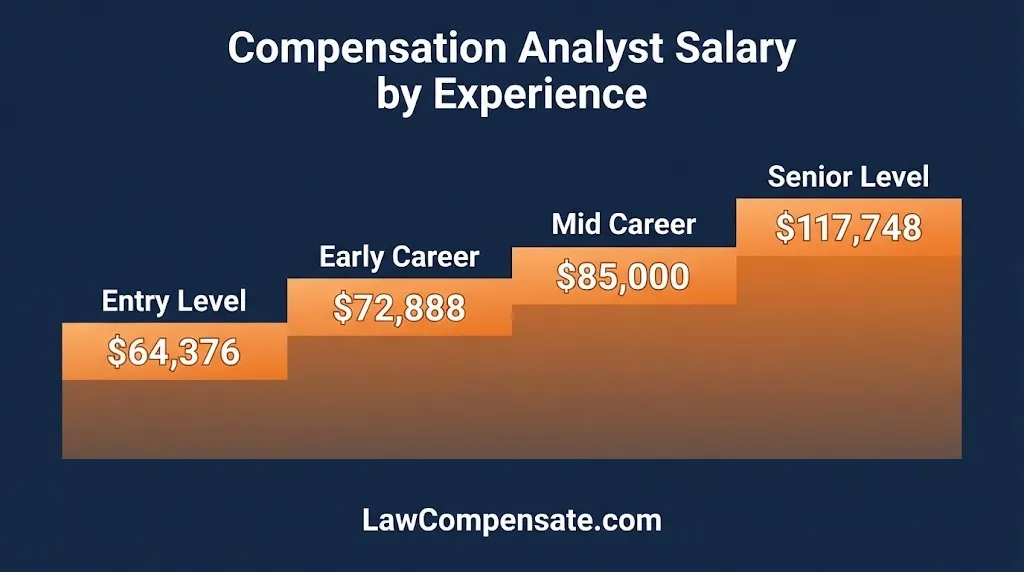
Compensation analyst salary by experience level rises from approximately $64,400 for entry-level analysts to $96,000 or more for experienced professionals, with senior roles reaching $117,000 to $142,000 depending on location and industry.
The progression is steady but not explosive. Here’s what the verified data shows:
| Experience Level | Average Total Pay | Source |
|---|---|---|
| Entry-level (<1 year) | $64,376 | PayScale |
| Early career (1-4 years) | $71,421 to $72,888 | PayScale |
| Mid-career (5-9 years) | $73,807 (Toronto) | PayScale |
| Senior level (8+ years) | $117,748 | SalaryExpert |
SalaryExpert’s data for Landover, Maryland shows entry-level at $73,336, median at $102,236, and senior level at $117,748 . That’s a higher-cost market, so the numbers run above the national median.
Salario reports entry-level starting around $49,000 nationally, with senior professionals reaching $96,000 and top earners hitting $127,000 . That’s a wider spread, reflecting the full range of employers from small businesses to Fortune 500 companies.
SkillShift puts the national median at $100,000, with a range of $62,000 to $142,000 . Their data tracks career intelligence across six skills.
The pattern holds: experience matters, but the jump from mid-career to senior is where the biggest gains happen. An analyst who moves from doing survey submissions to designing total rewards strategy can see their pay increase by 40% or more.
What is the compensation analyst salary by state and city in 2026?
Compensation analyst salary by state and city in 2026 varies dramatically, with San Francisco averaging $132,334 and New York reaching $146,253, while lower-cost markets like Warren, Michigan sit at $80,000.
Location is the single biggest variable after industry. Here’s how the top markets stack up:
| City | Average/Median Salary | Premium vs National |
|---|---|---|
| New York, NY | $146,253 | +98% |
| San Francisco, CA | $132,334 | +15% over national |
| Buffalo, NY | $110,197 | +17% over national |
| Landover, MD | $102,236 | +38% over national |
| Warren, MI | $80,000 | -6% vs national |
San Francisco’s average of $132,334 is based on 44 salaries, with top earners reaching $185,811 at the 90th percentile . The typical range runs from $112,287 to $158,497.
New York’s median of $146,253 reflects a cost-of-living index of 187, nearly double the national average . Entry-level analysts in New York start around $97,000, while top earners reach $251,000. The take-home pay after federal, state, and local taxes is approximately $97,972 annually.
Buffalo, New York shows a surprising $110,197 average, based on just three salaries from job postings, so treat that number with caution . It’s 17% above the national average, which seems high for a lower-cost upstate market.
Warren, Michigan tells a different story. The median there is $80,000, about 6% below the national median . But the cost-of-living index is 85, so that $80,000 buys the equivalent of $94,118 in an average-cost city. Adjusted for living costs, Warren analysts actually come out ahead.
The top-paying states according to Salario are California at $87,000 median, New York at $85,000, and Massachusetts at $83,000 . Texas sits at $73,000, slightly below the national median.
What industries pay compensation analysts the most in 2026?
Information Technology pays compensation analysts the most in 2026, with a median total pay of $115,431, followed by Telecommunications at $102,690 and Energy, Mining & Utilities at $99,885 .
The industry you work in can add $20,000 or more to your compensation compared to the national median. Here’s the verified ranking:
| Industry | Median Total Pay | Premium vs National |
|---|---|---|
| Information Technology | $115,431 | +56% |
| Telecommunications | $102,690 | +39% |
| Energy, Mining & Utilities | $99,885 | +35% |
| Financial Services | $98,912 | +34% |
| Healthcare | $98,129 | +33% |
Top-paying companies in Information Technology include Meta, Microsoft, and Cisco . These are companies with complex equity compensation structures, global operations, and intense competition for talent. Compensation analysts there aren’t just running salary surveys. They’re modeling stock option grants, designing retention packages, and benchmarking against peer tech firms.
Financial Services pays well too, with a median of $98,912. In San Francisco specifically, Financial Services leads with a median of $132,047, slightly ahead of Information Technology at $131,925 .
Healthcare sits at $98,129, which is still well above the national median. Hospitals and health systems have thousands of employees across dozens of job classifications, creating demand for analysts who can manage complex pay structures.
Key Takeaway: Industry choice can add $40,000 or more to a compensation analyst’s total pay, with Information Technology leading at $115,431 median.
What skills increase a compensation analyst salary the most?
Skills that increase a compensation analyst salary the most are data analysis, SQL, HRIS platforms, and advanced Excel (VLOOKUP, INDEX MATCH, pivot tables), with certifications like CCP and GRP adding further premium .
The role has shifted from spreadsheet administration to data science. Employers now expect analysts to query databases directly, build dashboards, and model compensation scenarios without hand-holding.
Here’s what the job postings actually ask for:
- Advanced Excel: VLOOKUP, INDEX MATCH, COUNTIF, AVERAGEIF, pivot tables
- SQL: Querying compensation databases and HRIS systems
- Data analysis tools: Tableau, Power BI, or similar visualization software
- HRIS platforms: Workday, SAP SuccessFactors, Oracle HCM
- Salary survey tools: Mercer, Aon, Radford
- Statistical analysis: Regression modeling, market pricing
The Robert Half job posting for a compensation analyst in Indianapolis lists compensation analysis, salary structures, benchmarking methodologies, and strong analytical skills as core requirements . “Proficiency in working with spreadsheets and compensation data sets” is listed as a technical requirement.
PayScale’s data for compensation analysts with Microsoft Excel skills shows an average salary of $74,236, nearly identical to the overall role average . That suggests Excel is table stakes, not a differentiator. The premium comes from SQL, Python, or specialized HRIS expertise.
Certifications matter too. The Compensation Analyst Credential (CAC) from ERI requires 12 courses and a passing score of 80% on each exam . CCP (Certified Compensation Professional) from WorldatWork and GRP (Global Remuneration Professional) are the other major credentials employers recognize.
How does compensation analyst pay compare to similar HR roles?
Compensation analyst pay runs higher than generalist HR roles but lower than HR management, with analysts earning $74,000 average base compared to HR generalists at $65,000 and HR managers at $95,000.
The comparison matters if you’re deciding whether to specialize. Here’s how the roles stack up:
| Role | Average Base Salary | Source |
|---|---|---|
| Compensation Analyst | $74,000 | PayScale |
| HR Generalist | ~$65,000 | BLS-derived |
| Benefits Analyst | ~$70,000 | BLS-derived |
| HR Manager | ~$95,000 | BLS-derived |
| Compensation Manager | ~$120,000 | Industry data |
Compensation analysts earn more than generalists because the work requires quantitative skills that are harder to find. Benefits analysts are closer in pay, but compensation tends to edge higher because of the direct link to salary budgets and retention.
The career path from analyst to manager is well-defined. Robert Half’s job posting describes the progression: start as an entry-level analyst, move into senior analyst or compensation manager roles, then director of compensation or VP of Total Rewards . Each step up the ladder adds 30% to 50% to total compensation.
What is the job outlook for compensation analysts in 2026?
The job outlook for compensation analysts in 2026 is strong, with projected growth of 7% to 13% over the next decade and approximately 85,000 positions currently in the United States .
SkillShift rates demand as “high” with +12% projected growth . Salario cites +7% growth over 10 years and +13% growth over 5 years . Either way, the field is growing faster than the overall economy.
AI is changing the role but not eliminating it. SkillShift classifies compensation analyst as “ai augmented,” meaning AI will change how the work is done but not replace it . Routine tasks like survey data entry and basic benchmarking can be automated. The human judgment required to interpret ambiguous data, advise leadership, and design equitable pay structures remains essential.
The Bureau of Labor Statistics projects growth for HR specialists broadly, and compensation analysts sit in the higher-skill end of that category. Companies competing for talent need analysts who can make data-driven pay decisions. That need isn’t going away.
Reality Check: No salary survey website can tell you exactly what you’ll earn. The numbers on PayScale, Glassdoor, and SalaryExpert are averages and medians from specific samples. Your actual offer depends on your negotiation, the company’s budget, and the specific scope of the role. Use these numbers as benchmarks, not guarantees.
How can you increase your compensation analyst salary?
You can increase your compensation analyst salary by targeting high-paying industries like tech, moving to a premium market like San Francisco or New York, earning CCP or CAC certification, and building SQL and data visualization skills that separate you from spreadsheet-only analysts.
Here’s a concrete plan in seven steps:
- Get the credentials. CCP from WorldatWork or CAC from ERI signals expertise that generalists lack.
- Learn SQL. Querying databases directly makes you more valuable than analysts who depend on others for data.
- Target tech or finance. These industries pay 30% to 50% above the national median.
- Negotiate the bonus. Bonuses add $2,000 to $10,000 and are often easier to increase than base salary.
- Consider a premium market. San Francisco and New York pay double the national average in some cases.
- Move into management. Compensation manager roles pay $120,000 or more.
- Specialize in equity compensation. Stock options, RSUs, and ESPPs are complex and highly paid specialties.
The fastest path to a higher salary is usually switching industries, not switching companies within the same industry. An analyst moving from healthcare to tech can see a 20% to 30% jump. An analyst moving from a small regional employer to a Fortune 500 company can see similar gains.
What Happens Next
- October 2026: Salary survey data for 2026 continues to update across PayScale, Glassdoor, and SalaryExpert.
- Q1 2027: Annual compensation planning cycles begin, driving demand for analysts who can benchmark and model budgets.
- Expected 2027: WorldatWork and ERI release updated certification requirements and salary survey results.
- Ongoing: Remote work expands the geographic market, allowing analysts in lower-cost cities to earn closer to national averages.
- Expected 2028: BLS releases updated Occupational Employment and Wage Statistics, providing the most authoritative government salary data for this role.
Frequently Asked Questions
How much does a compensation analyst make in 2026?
A compensation analyst makes an average base salary of $74,000 per year in the United States in 2026, with total pay including bonus reaching approximately $99,000. Top earners in premium markets and high-paying industries exceed $140,000.
What is the highest salary for a compensation analyst?
The highest reported salary for a compensation analyst is $185,811 at the 90th percentile in San Francisco, with estimates reaching $322,915 for the highest level of seniority at Glassdoor.
Do compensation analysts make good money?
Yes. Compensation analysts earn above the national median for all occupations and have a clear path to $120,000 or more in management roles. The field rewards quantitative skills and industry specialization.
What education do you need to become a compensation analyst?
Most employers require a bachelor’s degree in human resources, business, finance, or a related field. Certifications like CCP or CAC strengthen your candidacy and can boost salary.
Is compensation analyst a good career in 2026?
Yes. The role has +7% to +13% projected growth, high demand, and salaries well above the national median. AI is changing the work but not replacing the human judgment required.
How much do compensation analysts make in New York?
Compensation analysts in New York City earn a median of $146,253 per year, with entry-level starting around $97,000 and top earners reaching $251,000. The cost of living is nearly double the national average.
What is the difference between a compensation analyst and an HR generalist?
A compensation analyst focuses specifically on pay structures, salary benchmarking, and market data analysis. An HR generalist handles a broader range of duties including recruiting, employee relations, and benefits administration. Analysts typically earn more due to specialized skills.
Can compensation analysts work remotely?
Yes. The role is 55% remote-eligible nationally according to SalaryOptics, which expands the job market for analysts in lower-cost cities . Remote work allows you to earn a national-average salary while living in a lower-cost area.