Workers Compensation Calculator 2026: How to Estimate Your Benefits and Settlement
Quick Answer
- Workers comp calculators estimate benefits based on average weekly wage, state caps, and disability type.
- Most states pay 66 2/3% of your average weekly wage, subject to maximum limits.
- Pennsylvania’s 2026 maximum weekly benefit is $1,394; New Jersey’s is $1,598.66.
If you’ve been hurt at work, the first question is usually: how much will I get? A workers compensation calculator can give you a starting estimate, but it’s only as good as the numbers you put in.
The formula most states use is straightforward. Take your average weekly wage, multiply by a percentage (usually 66 2/3%), and compare that against your state’s maximum and minimum rates. But the details matter enormously, and they change every year.
This article breaks down how workers comp calculators actually work, what numbers you need to gather before using one, and why the online tools can only get you so far. The most surprising verified detail: California’s average settlement runs $67,400, nearly double the national average, largely because of its complex permanent disability rating system.
The Facts
| Case | Workers Compensation Benefit Calculators (2026) |
| Status | Active tools from state agencies and private calculators |
| Fund Size | Not applicable |
| Est. Per Person | Varies by state; PA max $1,394/week, NJ max $1,598.66/week |
| Claim Deadline | State-specific; typically 30 days to 2 years from injury |
| Administrator | State workers compensation boards |
| Proof Needed | Average weekly wage documentation, medical records, injury report |
What is a workers compensation calculator?
A workers compensation calculator is a tool that estimates your weekly benefit rate or potential settlement value based on your pre-injury earnings, the type of disability, and your state’s rules. It’s not a guarantee. It’s a math formula applied to your numbers.

State agencies like New Jersey and Michigan offer official calculators. New Jersey’s OSCAR-Calcs program handles interest calculations, Social Security offsets, commutations, and partial total awards . Michigan’s WCCALC calculates weekly benefit rates for general disability, specific loss, and death claims .
Private calculators, like those from WorkCompCentral and The Hartford, focus on either benefit estimates or premium costs for employers .
The core inputs are almost always the same:
- Your average weekly wage (AWW)
- Your state’s maximum and minimum rates for the injury year
- The type of disability (temporary total, permanent partial, etc.)
- Any Social Security offset that applies
If you don’t have accurate wage records, the calculator output will be wrong. Garbage in, garbage out.
How is the average weekly wage calculated for workers comp?
Your average weekly wage is calculated by totaling your gross earnings for the 52 weeks before your injury and dividing by 52. Overtime, bonuses, tips, and lodging payments typically count.
The Hartford walks through a simple example. An employee made $50,000 over 242 days. Divide $50,000 by 242 to get a daily wage of $206.61. Multiply by 260 (full-time days in a year) to get $53,718.60. Divide by 52 for an average weekly wage of $1,033.05 .
Virginia’s Workers’ Compensation Commission requires the gross earnings for the 52 weeks preceding the date of injury. If the employee worked less than 12 months, you use earnings for the time worked or a similar employee’s earnings .
Some states handle irregular earnings differently. If you work fluctuating hours or seasonal work, the calculation may use average yearly earnings instead of a straight 52-week average.
Key Takeaway: Your average weekly wage is the foundation of every workers comp calculation. If your wage records are wrong or incomplete, your benefit estimate will be wrong too.
What percentage of your wages does workers comp pay?
Most states pay 66 2/3% of your average weekly wage for temporary total disability, but some states pay higher or use net wages instead of gross.
Here’s how several states stack up for 2026:
| State | Benefit Percentage | 2026 Maximum Weekly |
|---|---|---|
| Pennsylvania | 66 2/3% | $1,394.00 |
| New Jersey | 70% | $1,598.66 |
| Connecticut | Varies by filing status | $1,716.00 |
| Virginia | 66 2/3% | $1,290.00 (2022 rate) |
Pennsylvania has a tiered system. If your average weekly wage is $774.43 or less, you get 90% of that amount. If your wage falls between $774.44 and $1,045.50, you get a flat $697.00 per week. Above that, the standard 66 2/3% applies, capped at $1,394.00 .
New Jersey pays 70% of average earnings for wage loss benefits, with a maximum of $1,598.66 and a minimum of $320.00 per week .
Connecticut’s calculation is more complex. It uses your filing status (single, head of household, married filing jointly, married filing separately) and subtracts federal taxes and FICA to determine the benefit rate .
What is the difference between temporary total and permanent partial disability?
Temporary total disability pays while you’re healing and unable to work at all. Permanent partial disability pays after you reach maximum medical improvement but still have lasting impairment.
Temporary total disability (TTD) is the most common benefit. You get weekly payments while you recover. The rate is typically 66 2/3% of your AWW, subject to the state maximum.
Permanent partial disability (PPD) kicks in when you’ve healed as much as you’re going to, but you still have a lasting injury. The payment is based on an impairment rating, often expressed as a percentage of the whole person or a scheduled loss for a specific body part.
In New Jersey, permanency benefits are capped at 70% of the worker’s average earnings or the maximum rate, whichever is less. The rates are set by an annual schedule of disabilities .
The distinction matters because PPD settlements often involve a lump sum, while TTD is paid weekly. A settlement calculator for PPD needs the impairment rating and the number of weeks assigned to that rating.
How do state maximum and minimum rates affect your calculation?
State maximum and minimum rates cap what you can receive, no matter how high or low your average weekly wage is. Every state updates these annually based on its statewide average weekly wage.
Pennsylvania’s maximum for 2026 is $1,394.00 per week. The minimum and various tiers are set by statute .
Maine’s State Average Weekly Wage as of July 1, 2026 is $1,249.12. That number is the basis for calculating maximum benefits and annual adjustments .
Virginia’s rate chart from 2022 shows a maximum of $1,290.00 and a minimum of $322.50 . Rates adjust annually.
If your AWW is high enough that 66 2/3% exceeds the state maximum, you get the maximum. If your AWW is low, the state minimum may apply instead.
How do you calculate a workers comp settlement?
A workers comp settlement calculation multiplies your weekly benefit by the number of weeks assigned to your injury, then adds future medical costs and negotiation adjustments. Surgery cases often settle for 2 to 4 times more than non-surgical cases.
WorkCompCalc’s formula is: Settlement = Weekly Benefit × Disability Weeks × Impairment % + Future Medical + Negotiation Adjustment .
The national average workers comp settlement in 2026 is approximately $29,750, but the range runs from $3,000 for a minor fracture to over $500,000 for catastrophic spinal or brain injuries .
Here’s how body part and severity affect settlement values:
| Body Part | Average Range | With Surgery |
|---|---|---|
| Head/Brain | $100K–$500K+ | $500K–$1M+ |
| Spine/Back | $40K–$150K | $150K–$350K |
| Shoulder | $35K–$75K | $75K–$200K |
| Knee | $25K–$100K | $100K–$200K |
| Wrist/Hand | $15K–$50K | $50K–$100K |
Surgery is a major multiplier. Surgical cases rate 15% to 30% impairment versus 5% to 12% for conservative treatment. Recovery takes 6 to 12 months. And documented future medical needs strengthen your negotiating position .
State matters too. A shoulder fusion in California can exceed $150,000. The same injury in Mississippi might settle for $50,000 .
Reality Check: No online calculator can tell you exactly what your settlement will be. The numbers above are historical averages, not predictions. Your case depends on your medical records, your state’s rules, your attorney’s skill, and the insurance carrier’s willingness to negotiate. Filing a workers comp claim is free. You never need to pay a third party for a “settlement estimate.”
What are the average workers comp settlement amounts by state?
Average workers comp settlement amounts by state range from $35,600 in Minnesota to $67,400 in California, reflecting differences in benefit rates, medical costs, and disability rating systems.
WorkCompCalc ranks the top 15 states by average settlement value :
| Rank | State | Average Settlement |
|---|---|---|
| 1 | California | $67,400 |
| 2 | New York | $58,200 |
| 3 | Illinois | $55,800 |
| 4 | New Jersey | $52,100 |
| 5 | Pennsylvania | $49,600 |
| 6 | Connecticut | $47,350 |
| 7 | Massachusetts | $45,900 |
| 8 | Washington | $44,200 |
| 9 | Ohio | $42,800 |
| 10 | Michigan | $41,500 |
| 11 | Florida | $39,700 |
| 12 | Texas | $38,400 |
| 13 | Oregon | $37,200 |
| 14 | Colorado | $36,800 |
| 15 | Minnesota | $35,600 |
California leads for two reasons: high medical costs and a complex permanent disability rating system that tends to produce higher payouts. New York’s schedule loss of use awards add significant value for extremity injuries. A 50% SLU for a shoulder injury can add over $60,000 to a settlement .
Texas sits at #12 despite being the second-largest state. Its opt-out system and benefit caps keep averages lower .
How do you use a workers compensation calculator step by step?
Using a workers compensation calculator requires gathering your wage records, identifying your state’s current rates, and selecting the right disability type. Here’s the process in seven steps.
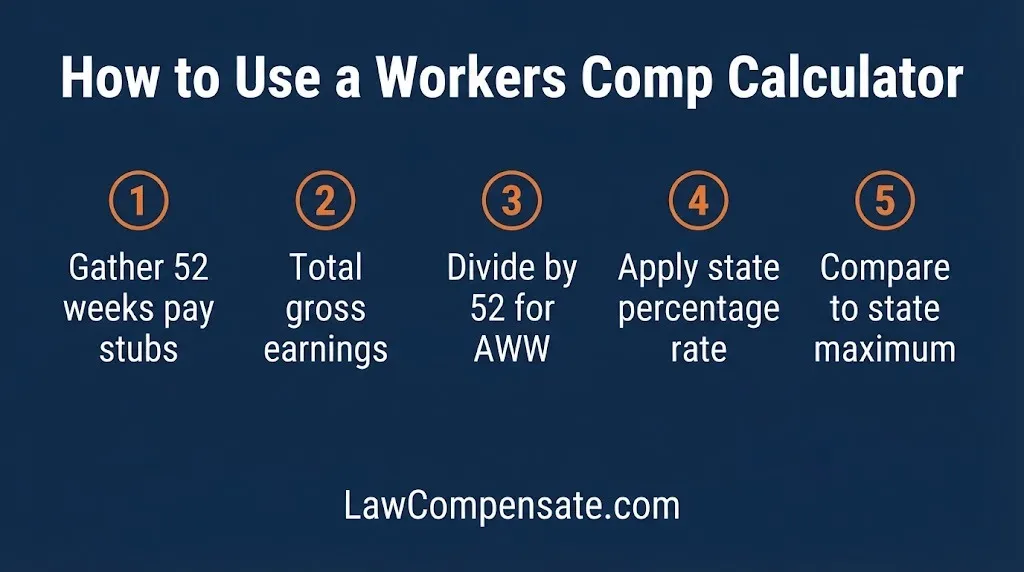
- Gather your pay stubs from the 52 weeks before your injury.
- Total your gross earnings, including overtime and bonuses.
- Divide by 52 to get your average weekly wage.
- Find your state’s maximum rate for the injury year.
- Multiply your AWW by your state’s percentage (usually 66 2/3%).
- Compare against the state maximum and apply the lower number.
- Select your disability type (temporary total, permanent partial, etc.) in the calculator.
New Jersey’s OSCAR-Calcs program handles more complex scenarios: Social Security offsets, commutations, interest on permanency awards, and Section 40 liens . Michigan’s WCCALC adds age reductions and coordination of benefits with pensions or Social Security .
If you’re using a private calculator, check what inputs it requires. Some ask for your class code (a workers comp insurance code based on your job type). Others just need your wage and state.
What Happens Next
- Ongoing 2026: State workers compensation boards update their maximum and minimum rates annually, usually effective July 1 or January 1.
- January 1, 2026: Pennsylvania’s maximum weekly benefit increased to $1,394.00 for injuries on or after that date .
- July 1, 2026: Maine’s State Average Weekly Wage of $1,249.12 took effect, adjusting maximum benefits .
- Expected 2027: New maximum rates will be published by each state’s labor department based on updated wage data.
Frequently Asked Questions
How does a workers comp calculator work?
A workers comp calculator estimates your weekly benefit or settlement by multiplying your average weekly wage by your state’s benefit percentage, then applying the state maximum and minimum rates.
What is the average weekly wage for workers comp?
The average weekly wage is your total gross earnings for the 52 weeks before your injury, divided by 52. It includes overtime, bonuses, and tips.
What percentage of my salary does workers comp pay?
Most states pay 66 2/3% of your average weekly wage for temporary total disability. New Jersey pays 70%. Pennsylvania pays 90% for lower-wage workers.
How much is a workers comp settlement for a back injury?
A back injury settlement ranges from $40,000 to $150,000 without surgery, and $150,000 to $350,000 with surgery, depending on severity and state.
What is the maximum workers comp benefit in Pennsylvania for 2026?
Pennsylvania’s maximum weekly compensation rate for injuries occurring on or after January 1, 2026 is $1,394.00 per week.
Can I calculate my own workers comp settlement?
You can estimate it using a calculator, but you cannot calculate the final number. Settlements depend on medical records, impairment ratings, future medical needs, and negotiation.
Do workers comp calculators include future medical benefits?
Some do. State calculators like Michigan’s WCCALC and New Jersey’s OSCAR-Calcs include options for future medical and accrued benefits. Private calculators may not.
What is the national average workers comp settlement in 2026?
The national average workers comp settlement in 2026 is approximately $29,750, ranging from $3,000 for minor injuries to over $500,000 for catastrophic cases.