Nightingale College Lawsuit 2026: Four Active Cases, No Settlement to Claim
Quick Answer
- Nightingale College filed lawsuits against California, Georgia, and Montana nursing boards in 2026.
- More than 1,300 graduates are blocked from taking the NCLEX-RN exam in California.
- No settlement exists. The college is seeking court orders, not paying out claims.
If you’re searching for a “Nightingale College lawsuit,” you’re likely a student or graduate trying to figure out what’s happening to your licensure. Or you saw a headline and wondered if there’s money to claim.
Here’s the honest answer: Nightingale College is the one suing, not being sued. The college filed four separate lawsuits in 2026 against state nursing boards, arguing those boards are blocking its graduates from getting licensed. There is no settlement fund. No claims administrator. No payout deadline.
This article breaks down each active case, explains which graduates are affected, and shows you exactly where to find updates on your licensure status.
The Facts
| Case | Nightingale College v. California BRN, Nightingale College v. Tanner (Georgia), Nightingale College v. Spangler (Montana), and related actions |
| Status | Active litigation; California preliminary injunction pending, Georgia case stayed pending rulemaking |
| Fund Size | Not applicable; no settlement fund exists |
| Est. Per Person | Not applicable; Nightingale is seeking injunctive relief, not damages |
| Claim Deadline | No consumer claim deadline; licensure applications pending with state boards |
| Administrator | Not applicable; cases are in Sacramento County Superior Court and federal district courts |
| Proof Needed | Not applicable; this is not a claims process |
Is the Nightingale College lawsuit real?
The Nightingale College lawsuit is real, but it’s not what most people assume. Nightingale is the plaintiff in four separate cases filed in 2026. The college is suing state nursing boards, not defending against claims from students.
The cases are:
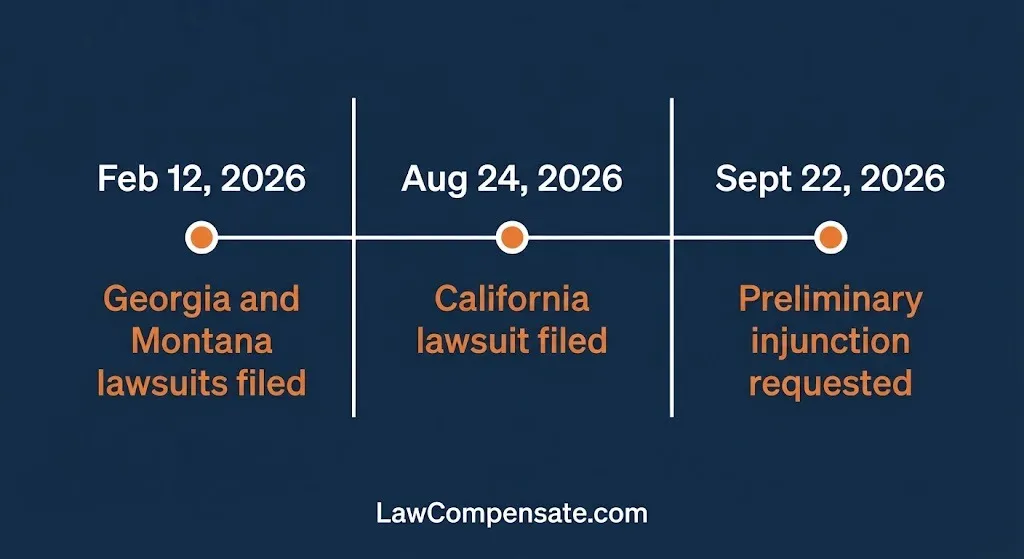
- Nightingale College v. California Board of Registered Nursing, filed August 24, 2026 in Sacramento County Superior Court
- Nightingale College v. Tanner, filed February 12, 2026 in the U.S. District Court for the Northern District of Georgia
- Nightingale College v. Spangler, filed February 12, 2026 in the U.S. District Court for the District of Montana
A separate 2021 case, Nightingale College v. Bailey, involved a former employee who created a website criticizing the college. That case was about defamation and whistleblower claims, not student licensure .
The 2026 lawsuits are about one thing: whether state nursing boards can block Nightingale graduates from taking the NCLEX-RN exam or completing clinical training.
How much is the Nightingale College lawsuit settlement?
There is no Nightingale College lawsuit settlement. Nightingale is not paying money to anyone. The college is asking courts to order state nursing boards to process its graduates’ licensure applications.
The California lawsuit seeks a preliminary injunction that would force the Board of Registered Nursing to process pending applications for more than 1,300 graduates . The Georgia and Montana lawsuits seek to overturn policies that prevent Nightingale students from completing clinical rotations in those states .
If Nightingale wins, the remedy is licensure, not money. If the college loses, graduates face additional coursework or out-of-state testing options.
Reality Check: No one is texting you about a Nightingale settlement. No claims administrator is collecting your information. If you see an ad promising money from a “Nightingale College lawsuit,” it’s a scam. The only thing at stake is your ability to get licensed.
Why did Nightingale College sue California’s nursing board?
Nightingale College sued California’s Board of Registered Nursing because the board stopped processing its graduates’ licensure applications in May 2026 after approving nearly 2,000 of them since 2015. The college argues the board is enforcing two standards that were never lawfully adopted.
The two standards at issue are:
The 500-hour direct patient care threshold. California law requires in-state nursing programs to provide 500 hours of direct patient care. Nightingale argues this standard was never adopted for out-of-state schools and cannot legally apply to its graduates .
The concurrency requirement. Board regulations say theory and clinical practice must be concurrent in five core areas: medical-surgical, pediatrics, obstetrics, psychiatric, and geriatrics. Nightingale says the board never defined what “concurrent” means or how graduates could satisfy it .
Nightingale’s complaint calls both standards “underground regulations,” meaning rules an agency enforces without going through California’s formal rulemaking process .
The college also alleges the board violated California’s Open Meeting Act. According to the complaint, board staff made binding statements about the new standards during public committee meetings on July 29 and August 11, 2026, without placing the topic on the agenda .
Key Takeaway: Nightingale’s California lawsuit is about procedure and fairness, not damages. The college wants the board to follow its own rules or formally adopt new ones.
How many Nightingale graduates are affected by the California lawsuit?
More than 1,300 Nightingale graduates are affected by the California Board of Registered Nursing’s hold on licensure applications, according to the college’s September 2026 court filing . The board itself reported 873 graduates with held applications .
The numbers have grown as more students graduate. Nightingale’s complaint states that approximately 536 of its 561 spring graduates were unable to test as of late August . Another 612 students graduated on August 21, 2026, adding to the backlog .
The human cost is documented in the complaint:
- 70 graduates have already lost job offers
- 86 graduates have been told rescissions are imminent
- 95 graduates hold offers that depend on getting cleared to test
One graduate told a board committee he had an emergency room nursing job set to start August 24 that he couldn’t begin . Another, Sasha Wiltjer, holds an active RN license in Utah and was hired into a San Diego hospital’s September cohort. The hospital deferred her position until March 2027 because California won’t process her application .
What is Nightingale College arguing in Georgia and Montana?
Nightingale College argues in Georgia and Montana that state policies preventing its students from completing clinical training in those states violate the Constitution’s Dormant Commerce Clause and Equal Protection Clause. The college filed both lawsuits on February 12, 2026 .
The Georgia complaint also raises federal antitrust claims, alleging the state’s approach creates an unlawful monopoly for in-state nursing programs .
The core issue is clinical placements. Georgia and Montana have processes to approve out-of-state schools for clinical training, but Nightingale says those states aren’t following their own procedures. As a result, Georgia-based Nightingale students must leave the state for clinical rotations, paying airfare, lodging, and meal expenses that students at in-state programs don’t face .
The Georgia Board of Nursing asked a federal court to stay the litigation in September 2026, arguing that a proposed rule change would likely resolve the dispute . A stay would pause the case while the rulemaking process plays out.
Pacific Legal Foundation, a nonprofit legal organization, represents Nightingale and the student plaintiffs free of charge in both cases .
Is Nightingale College a diploma mill or a legitimate school?
Nightingale College is an accredited institution, not a diploma mill. Its BSN program is accredited by the Commission on Collegiate Nursing Education (CCNE) . The college is headquartered in Salt Lake City, Utah, and operates as a distance-learning program with in-person clinical training arranged locally .
However, the college has faced criticism. A 2021 lawsuit from a former employee alleged “illegal slush funds” and other misconduct, though those claims were made in a removal notice, not proven in court . Student reviews on EDUopinions include complaints from graduates who say they couldn’t get licensed .
The most objective data point is NCLEX pass rates. Utah’s Division of Occupational and Professional Licensing publishes first-time pass rates for Nightingale’s BSN program:
| Year | First-Time Candidates | Pass Rate |
|---|---|---|
| 2021 | 181 | 59.1% |
| 2022 | 333 | 52.0% |
| 2023 | 594 | 68.4% |
| 2024 | 1,009 | 72.0% |
| 2025 | 1,366 | 63.0% |
Source: Utah DOPL data published by Nurse.org
For comparison, all Utah programs averaged 79.2% in 2025, and the national average for U.S.-educated candidates was 86.7% .
Nightingale’s pass rates improved significantly through 2024 before declining in 2025, mirroring a national trend. The program is not a diploma mill, but its outcomes trail state and national averages.
What Happens Next
- October 2026: Nightingale’s motion for preliminary injunction against the California BRN is pending in Sacramento County Superior Court. No hearing date has been confirmed.
- Expected Q4 2026: The Georgia Board of Nursing’s proposed rule may be finalized, potentially resolving the Georgia lawsuit.
- Expected 2027: If California litigation continues, a trial date could be set in Sacramento County Superior Court.
- Ongoing: Nightingale is providing supplemental courses and NCLEX coaching to affected graduates at no cost .
Frequently Asked Questions
Is there a Nightingale College settlement I can claim?
No. Nightingale College is the plaintiff in four lawsuits. There is no settlement fund, no claims administrator, and no money to claim.
How many Nightingale graduates can’t take the NCLEX?
More than 1,300 graduates are affected according to Nightingale’s September 2026 filing. The California BRN reported 873 held applications .
Did Nightingale College lose the California lawsuit?
No final ruling has been issued. The court denied Nightingale’s request for emergency relief on August 28, 2026, but the college can still seek a preliminary injunction through a standard motion .
What is the 500-hour rule in California nursing?
California requires in-state nursing programs to provide 500 hours of direct patient care. Nightingale argues this rule was never adopted for out-of-state schools .
Is Nightingale College accredited?
Yes. Nightingale’s BSN program is accredited by the Commission on Collegiate Nursing Education (CCNE) .
Can Nightingale graduates test in other states?
Yes. Some graduates have obtained licensure in other states, including Utah. However, California is refusing to endorse those out-of-state licenses, according to Nightingale’s CEO .
What should I do if I’m a Nightingale graduate waiting for licensure?
Contact Nightingale’s California Graduate Information Center. The college offers NCLEX coaching and ATT reimbursement for graduates who apply in another state .