Antitrust Litigation 2026: What It Is, How It Works, and Why It Matters for Consumers and Workers
Quick Answer
- What it is: Antitrust litigation challenges monopolies, price-fixing, and mergers that harm competition, brought by the DOJ, FTC, states, or private parties.
- How much: Private plaintiffs can recover treble damages, meaning three times their actual losses, plus attorney fees under the Clayton Act.
- Key date: The first trial in the generic drug price-fixing case is scheduled for February 2027 in Connecticut.
If you are searching for antitrust litigation, you have probably seen headlines about Big Tech monopolies, generic drug price-fixing, or corporate mergers that eliminate competition. The term sounds abstract, but the outcomes affect what you pay at the pharmacy, the grocery store, and even your wages.
Antitrust litigation is the legal process of enforcing laws that keep markets competitive. It targets companies that fix prices, rig bids, allocate markets, or monopolize industries in ways that harm consumers and workers. The government brings criminal and civil cases. Private parties, including consumers and businesses, can sue for damages.
In 2026, federal and state enforcers are active across multiple industries. The FTC and 43 states secured a $400 million settlement with Sandoz over generic drug price manipulation . The FTC settled with Corteva for $35 million to restore pesticide competition . These cases matter because they translate directly into the prices you pay and the choices you have.
This article explains what antitrust litigation is, who enforces the laws, how private lawsuits work, and what remedies are available.
The Facts
| What It Is | Enforcement of laws prohibiting anticompetitive conduct |
|---|---|
| Key Statutes | Sherman Act (1890), Clayton Act (1914), FTC Act (1914) |
| Federal Enforcers | DOJ Antitrust Division, Federal Trade Commission |
| Private Remedies | Treble damages, attorney fees, injunctions |
| Criminal Penalties | Up to $100M corporate fines, 10 years imprisonment for individuals |
| 2026 Sandoz Settlement | $400 million with 43 states and territories |
What Is Antitrust Litigation?
Antitrust litigation is the legal process of enforcing laws that prohibit anticompetitive conduct and protect free competition. It covers monopolization, price-fixing, bid-rigging, market allocation, and mergers that substantially lessen competition.
Congress passed the Sherman Antitrust Act in 1890 as the foundation of federal antitrust law. Section 1 prohibits contracts, combinations, and conspiracies that unreasonably restrain trade. Section 2 prohibits monopolization and attempts to monopolize .
The Clayton Act of 1914 added prohibitions on price discrimination, tying agreements, and mergers that could harm competition. It also provides for private damage remedies, allowing injured parties to sue for three times their losses .
The Federal Trade Commission Act created the FTC and gave it authority to prosecute violations of both the Sherman and Clayton Acts, plus broader unfair competition practices .
Antitrust cases can be criminal or civil. Criminal enforcement targets hardcore violations like price-fixing and bid-rigging. Civil enforcement seeks injunctions, divestitures, and damages.
Who Enforces Antitrust Laws?
Antitrust laws are enforced by the Department of Justice, the Federal Trade Commission, state attorneys general, and private parties. Each plays a different role.
The DOJ Antitrust Division is the primary enforcer of the Sherman Act. It brings criminal and civil actions. Criminal violations are felonies. Corporations face fines up to $100 million, and individuals face up to $1 million in fines and 10 years imprisonment. If the loss or gain exceeds $100 million, the maximum fine can be twice that amount .
The FTC enforces the FTC Act, the Clayton Act, and the Sherman Act through administrative proceedings. It has no criminal jurisdiction. The FTC brings cases before an administrative law judge, with appeals to the full commission and then to federal court .
State attorneys general can bring parens patriae actions on behalf of their residents. In 2026, 43 states and territories joined the Sandoz settlement, showing how state enforcement amplifies federal efforts .
Private parties are the most active enforcers by volume. The Clayton Act allows anyone injured by an antitrust violation to sue for treble damages and attorney fees. This creates incentives for private “attorneys general” to detect and punish violations .
Key Takeaway: Antitrust enforcement is shared among federal agencies, states, and private plaintiffs, with private actions driving the majority of cases.
What Are the Main Types of Antitrust Violations?
The main types of antitrust violations are horizontal restraints, vertical restraints, monopolization, and anticompetitive mergers. Each harms competition in a different way.
Horizontal restraints are agreements between competitors. Price-fixing, bid-rigging, and market allocation are per se illegal, meaning no defense is allowed. A 2026 case filed by X against music publishers alleged collusion through a trade association to monopolize song licensing .
Vertical restraints involve agreements between firms at different levels of the supply chain. Exclusive dealing, tying agreements, and resale price maintenance may be illegal if they harm competition. The Corteva case involved loyalty rebate programs that distributors alleged restricted generic competition .
Monopolization requires possession of monopoly power in a relevant market plus anticompetitive conduct to obtain or maintain it. The DOJ and FTC have brought monopolization cases against major technology platforms.
Mergers can violate Section 7 of the Clayton Act if they may substantially lessen competition. The 2023 Merger Guidelines outline 11 ways mergers can harm competition, including increasing concentration, eliminating head-to-head competition, and entrenching dominant positions .
Reality Check: Antitrust Cases Take Years, Not Months
Reality Check: Antitrust litigation is not a quick process. The DOJ’s case against Microsoft took years. The generic drug price-fixing litigation began in 2016 and the first trial is scheduled for February 2027 . If you are a consumer waiting for damages from an antitrust case, expect to wait. Private class actions often follow government enforcement, adding more time before any payout.
What Remedies Are Available in Antitrust Litigation?
Antitrust litigation offers three main types of remedies: damages, injunctions, and structural relief. The remedy depends on who brings the case and what harm occurred.
Treble damages are the most powerful private remedy. Under Section 4 of the Clayton Act, any person injured in their business or property by an antitrust violation can recover three times their actual damages, plus costs and attorney fees . This triples the financial exposure for violators.
Injunctions stop the anticompetitive conduct. Courts can order a company to cease illegal practices, modify contracts, or take affirmative steps to restore competition. The Corteva settlement requires the company to cap purchase thresholds at 50% for covered active ingredients for 10 years .
Structural remedies break up monopolies or undo mergers. Divestiture requires a company to sell assets or business units. The DOJ sought divestiture in the AT&T case, which led to the breakup of the Bell System.
Criminal penalties apply to hardcore violations. Corporations face fines up to $100 million. Individuals face imprisonment. The DOJ has prosecuted international cartels in auto parts, and more recently has focused on labor market collusion.
How Do Private Antitrust Class Actions Work?
Private antitrust class actions allow groups of injured parties to pool their claims and sue collectively. They are the primary mechanism for consumers and small businesses to recover damages.
Class certification requires plaintiffs to show common questions of law or fact predominate over individual issues. Courts have certified classes in foreign exchange markets and consumer products cases when plaintiffs present common proof of market-wide injury .
The treble damages remedy creates strong incentives for plaintiffs’ lawyers to bring cases on contingency. They recover a percentage of any settlement or judgment.
But class actions face hurdles. Arbitration clauses in consumer contracts can force individual arbitration. The Supreme Court held in American Express v. Italian Colors that class arbitration waivers are enforceable even when the cost of individual arbitration exceeds potential recovery .
The indirect purchaser rule is another obstacle. Under Illinois Brick, only direct purchasers can recover federal damages. Most states have repealed this rule for state law claims, but federal recovery remains limited .
What Are the 2026 Antitrust Settlements to Watch?
Several major antitrust settlements resolved in 2026, with more cases pending. These settlements affect prices in pharmaceuticals, agriculture, and healthcare.
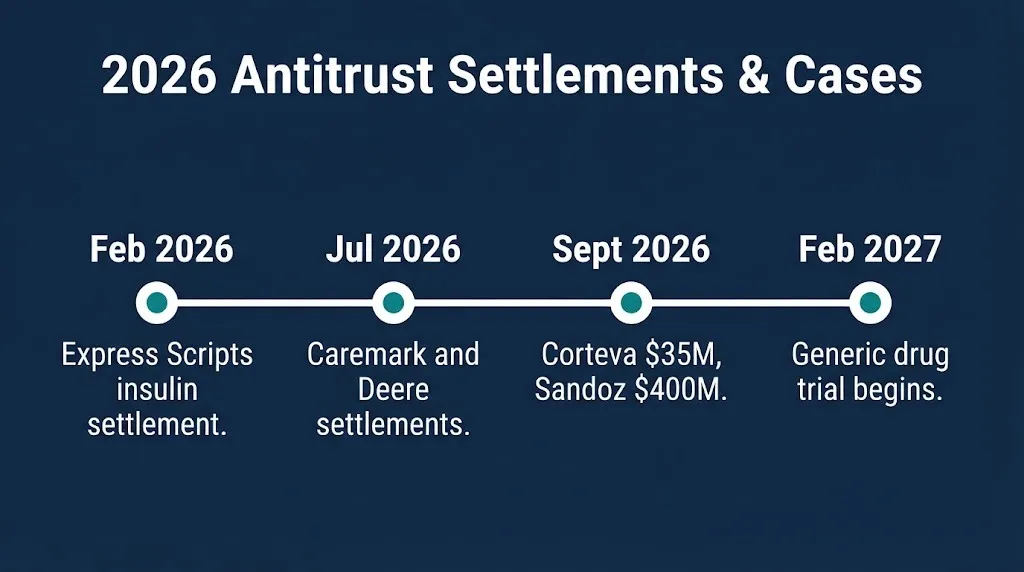
Sandoz Generic Drug Settlement: Sandoz and Fougera agreed to pay approximately $469 million total to resolve allegations of generic drug price-fixing. The $400 million multistate portion involves 43 states and territories. Iowa’s share is $1,380,384.01. The case alleges a long-running conspiracy to inflate prices for numerous generic prescription drugs .
Corteva Pesticide Settlement: The FTC and 12 states secured a settlement requiring Corteva to dismantle loyalty programs that allegedly blocked generic pesticide competition. Corteva will pay $35 million to plaintiff states and cap purchase thresholds at 50% for 10 years .
Caremark Insulin Settlement: The FTC settled with Caremark Rx and Zinc Health Services over rebating practices that inflated insulin prices. The settlement requires changes to drive down out-of-pocket costs and increase transparency .
Deere & Company Settlement: The FTC and five states settled with Deere to ensure farmers can repair their own John Deere tractors and equipment, addressing right-to-repair concerns .
What Happens Next in Antitrust Litigation?
February 2027: First trial in the generic drug price-fixing case in Hartford, Connecticut. This will test the strength of state claims against remaining defendants .
Ongoing: Syngenta remains a defendant in the pesticide case. No trial date has been scheduled .
Ongoing: The UK Competition Appeal Tribunal is considering a £2.8 billion class action against Amazon over Buy Box practices, and a £2 billion claim against Apple from app developers .
Expected 2027: The FTC’s insulin case against remaining pharmacy benefit managers continues, with settlement talks possible.
TBD: Private class actions against Corteva and Syngenta seeking damages for farmers remain pending .
Frequently Asked Questions
What is antitrust litigation?
Antitrust litigation is the enforcement of laws prohibiting monopolies, price-fixing, and other conduct that harms competition.
Who can bring an antitrust lawsuit?
The DOJ, FTC, state attorneys general, and private parties injured by anticompetitive conduct can bring antitrust lawsuits.
What is treble damages in antitrust?
Treble damages allow private plaintiffs to recover three times their actual losses plus attorney fees under the Clayton Act.
What is the difference between the Sherman Act and Clayton Act?
The Sherman Act prohibits restraints of trade and monopolization. The Clayton Act prohibits specific practices like price discrimination and anticompetitive mergers.
How long do antitrust cases take?
Antitrust cases often take three to five years or longer, especially complex class actions or government enforcement actions.
What is the Illinois Brick rule?
The Illinois Brick rule bars indirect purchasers from recovering federal antitrust damages, though many states allow indirect purchaser claims under state law.
Can workers bring antitrust claims?
Yes. The FTC and DOJ issued guidelines in 2025 explaining that wage-fixing and no-poach agreements violate antitrust laws.
What are the 2026 antitrust settlements?
Major settlements include Sandoz ($400M multistate), Corteva ($35M), Caremark (insulin pricing), and Deere (right to repair).
What You Should Do Next
If you believe you have been harmed by anticompetitive conduct, document your losses. Keep receipts, invoices, and records of prices you paid. For consumers, follow class action settlements through official settlement administrators.
The single most important fact: private plaintiffs can recover treble damages under the Clayton Act. If a company’s anticompetitive conduct cost you money, you may have a claim worth three times your loss.