What Is Workers’ Compensation in 2026? Benefits, Payouts, and Deadlines Explained
Quick Answer
- What is it? Workers’ compensation is no-fault insurance that pays your medical bills and part of your lost wages if you’re hurt on the job .
- How much? Most states pay 66.67% of your average weekly wage, but maximums range from $275 to over $2,000 per week depending on your state .
- Deadline? You must report your injury to your employer fast, often within 30 days, or you can lose benefits entirely .
Workers’ compensation is a state-run insurance system that pays for your medical care and replaces part of your paycheck when you get hurt or sick because of your job. It’s a trade-off: you get guaranteed benefits without proving your boss was at fault, and in exchange you give up the right to sue your employer for the injury .
The numbers that matter most are the deadlines. In Florida, you have 30 days to tell your employer about an injury . In Pennsylvania, it’s just 21 days for the initial notice . Miss that window, and you may lose your right to any benefits, no matter how serious the injury.
This guide covers what workers’ comp actually pays in 2026, which injuries count, how to file without getting your claim denied, and the real deadlines you can’t miss. One detail that surprises most people: workers’ comp benefits are tax-free, so a two-thirds wage replacement often puts more money in your pocket than it sounds like .
The Facts
| Item | Detail |
|---|---|
| System | State-mandated no-fault insurance covering work-related injuries and illnesses |
| Status | Active nationwide. Coverage mandatory in every state except Texas (where employers can opt out) |
| Coverage | Medical expenses, lost wages (typically 66.67% of average weekly wage), rehabilitation, death benefits |
| Per Person | Weekly benefits vary by state: Georgia max $275, Iowa max $2,000+, California max $1,680 (2026 figures) |
| Claim Deadline | Report to employer: often 30 days; file formal claim: 1-3 years depending on state |
| Administrator | State workers’ compensation board or commission; some states use third-party administrators like Gallagher Bassett |
| Proof Needed | Medical records linking injury to work, timely employer notification, wage documentation |
Is workers’ compensation real or a scam in 2026?
Workers’ compensation is real and mandatory in nearly every state. It’s not a class action settlement or a government payout program. It’s an insurance system your employer pays into, and it exists to protect both you and your boss .
The “scam” angle comes from a different direction. Some employers misclassify workers as independent contractors to avoid paying premiums. Others discourage injured workers from filing. A 2026 Connecticut state brochure makes the process clear: your employer’s insurance carrier, not your supervisor, decides whether to approve or deny your claim .
If someone texts or emails you offering to “process your workers’ comp claim” for an upfront fee, that’s a red flag. Filing is free. The state board assigns benefits. Attorneys are optional and in most states their fees are capped and deducted from your award, not paid by you upfront .
The system itself is regulated and legitimate. In 2026, the National Association of Insurance Commissioners flagged medical inflation, rising pharmacy costs, and provider shortages as the big issues affecting the system’s performance .
Key Takeaway: Workers’ compensation is a real, mandatory insurance system, not a scam, but watch for employer misclassification and anyone charging upfront fees to “process” a claim.
How much does workers’ compensation pay in 2026?
Most states pay two-thirds (66.67%) of your average weekly wage, up to a state maximum that varies wildly. Iowa tops the charts at over $2,000 per week. Georgia caps at just $275 .
Here’s what that looks like in real scenarios. A warehouse worker in Ohio earning $950 per week gets $633.37 weekly (tax-free) because Ohio’s max is $1,214 . A nurse in California earning $1,600 per week gets $1,066.67 weekly because California’s max is $1,680 . A construction worker in Texas earning $1,200 per week gets $840 weekly because Texas uses a 70% rate instead of 66.67% .
The state-by-state spread is enormous. Here’s a sample of 2026 maximums:
| State | Max Weekly Benefit | Key Detail |
|---|---|---|
| Iowa | $2,000+ | Uses 80% of spendable earnings |
| California | $1,680 | Standard 66.67% rate |
| Ohio | $1,214 | 72% for first 12 weeks, then 66.67% |
| Texas | $1,203 | 70% rate; 75% for low-wage workers |
| New York | $1,318 | Standard 66.67% rate |
| Georgia | $275 | One of the lowest caps in the country |
Your Average Weekly Wage (AWW) is calculated from your gross earnings before taxes, typically over the 13 weeks before your injury. Overtime, bonuses, and shift differentials usually count .
Key Takeaway: Workers’ comp pays roughly two-thirds of your gross wages, but your actual check depends entirely on your state’s maximum, and the spread between Georgia and Iowa is more than $1,700 per week.
What injuries and illnesses does workers’ compensation cover?
Workers’ compensation covers any injury or illness that arises out of and happens during your employment. That includes sudden accidents like falls, machine injuries, and vehicle crashes. It also covers repetitive stress injuries, occupational diseases, and conditions that develop over time .
The key phrase is “arising out of and in the course of employment.” A back injury from lifting boxes at work counts. A car accident while driving to a job site for your employer counts. A slip in the parking lot on your way into work may or may not count, depending on your state’s rules about “premises” injuries.
Occupational diseases have different timing rules. If you develop carpal tunnel from years of assembly work, or lung disease from chemical exposure, the clock typically starts when you knew or should have known the condition was work-related, not from your first day on the job .
Mental health conditions are trickier. Most states require a physical injury as the primary cause before psychological conditions are covered. Some states allow “mental-mental” claims (psychological injury from work stress with no physical component), but the burden of proof is high .
Key Takeaway: Workers’ comp covers both sudden accidents and slow-developing conditions, but occupational diseases use a “knew or should have known” clock, not your hire date.
How do you file a workers’ compensation claim in 2026?
You file by notifying your employer immediately, getting medical care, and submitting the state claim form. The exact steps vary by state, but the sequence is the same everywhere .
Here are the steps that matter:
- Tell your supervisor immediately. Verbal notice may not be enough. Follow up in writing with the date, time, location, and how the injury happened .
- Complete your employer’s incident report. They’re usually required to provide this within one working day .
- Seek medical treatment. If your employer has a designated provider network, use it for initial care unless it’s an emergency .
- File the state claim form. In New York, that’s Form C-3. In California, it’s the DWC-1. Your employer provides the form, but you can also file directly with the state board .
- Keep copies of everything. Medical records, wage statements, correspondence with the insurer. You’ll need them if the claim is disputed .
- Respond to insurer requests promptly. Missed paperwork can delay or derail your claim .
- Watch for denial letters. If denied, you have a limited window to appeal, often 30 to 90 days .
Key Takeaway: Report in writing, use the company doctor if required, and keep your own copies of every document, because the insurer’s file is not your file.
What is the deadline to report a work injury in 2026?
Deadlines vary by state, but the shortest window for notifying your employer is just 3 days in Wyoming. Most states give you 30 days. Pennsylvania gives you 21 days for the initial notice, then 120 days total, but you forfeit benefits for the gap .
Here’s the critical distinction: notice deadlines and filing deadlines are two different things. You tell your employer quickly. You file the formal claim with the state within a longer window, often one to three years .
| State | Notice to Employer | Formal Claim Deadline |
|---|---|---|
| Wyoming | 3 days | Varies |
| Pennsylvania | 21 days (120 days with forfeiture) | 3 years |
| New York | 30 days | 2 years |
| Florida | 30 days | 2 years |
| Texas | 30 days | Varies |
| Illinois | 45 days | 3 years |
| Minnesota | 180 days | 3 years (6 for some conditions) |
| Utah | 180 days | Varies |
Occupational diseases flip the script. The notice clock often starts when you learn the condition is work-related, not when you first had symptoms .
Key Takeaway: Report your injury within days, not weeks. Wyoming’s 3-day window is the shortest in the country, and even 30-day states will deny claims for late notice.
What are the different types of workers’ compensation benefits?
Workers’ comp pays four main types of wage-loss benefits, plus medical coverage. The type you get depends on whether you can work, how much you can work, and whether your injury is permanent .
Temporary Total Disability (TTD) means you can’t work at all while you recover. You get two-thirds of your average weekly wage, up to your state’s maximum .
Temporary Partial Disability (TPD) means you’re back at work but earning less, either fewer hours or a lower-paying role. You get two-thirds of the difference between your old and new wages .
Permanent Partial Disability (PPD) means your injury has stabilized but left you with a lasting impairment. Your doctor assigns an impairment rating, a percentage, which gets multiplied by the number of weeks your state assigns to that body part .
Permanent Total Disability (PTD) means you can never return to gainful employment. In most states, that means lifetime benefits at the TTD rate .
Medical benefits are separate and typically unlimited. The insurer pays for doctor visits, hospital care, prescriptions, physical therapy, and necessary equipment. In New York, you’re not supposed to pay anything out of pocket for approved workers’ comp treatment .
Key Takeaway: TTD pays while you’re fully off work, TPD pays the gap if you return at reduced wages, and PPD pays a lump sum or weekly benefit for permanent impairment.
What should you do if your workers’ compensation claim is denied?
You appeal, and you do it fast. Denial doesn’t mean the end. It means the insurer disputed something: causation, timeliness, or the severity of your injury. You have the right to challenge that decision .
Start by reading the denial letter carefully. It will state the reason. Common reasons include late reporting, a pre-existing condition the insurer claims is the real cause, or a dispute about whether the injury happened at work .
Then gather evidence. Medical records that link your condition to the work incident. Witness statements. Your written notice to the employer. Any communication with the insurer .
File the appeal with your state’s workers’ compensation board. The deadline varies. In Louisiana, for example, you have 15 calendar days to file a disputed claim for medical treatment after a denial . Miss that, and the denial sticks.
Most states allow you to request a hearing before an administrative law judge. You can represent yourself, but having an attorney helps in complex disputes. In New York, attorney fees are set by the board and deducted from your award, not billed to you upfront .
Key Takeaway: Denial is not final. Read the reason, gather evidence, and file your appeal before the state deadline, which can be as short as 15 days.
What does workers’ compensation NOT cover in 2026?
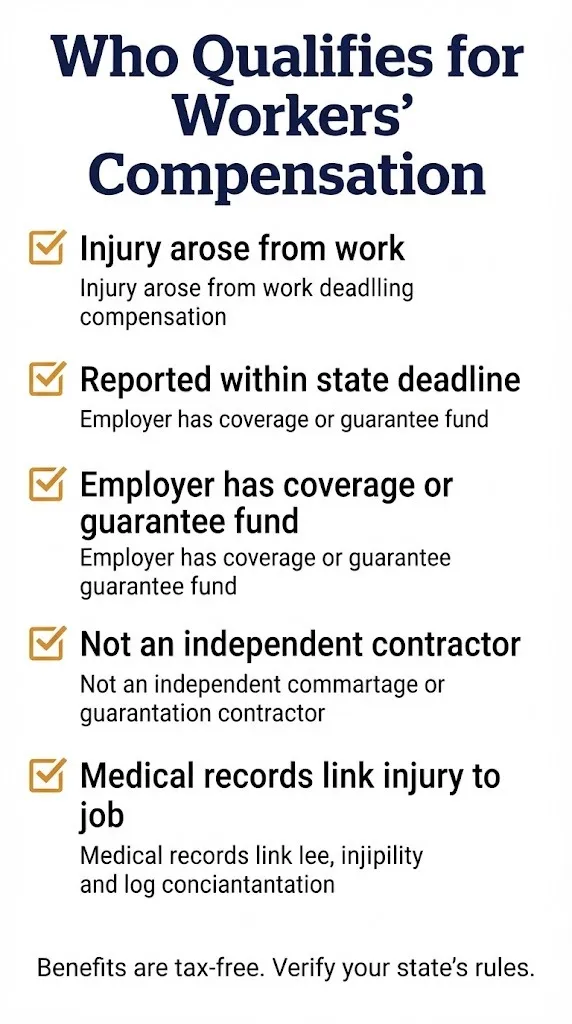
Workers’ comp does not cover injuries that happen outside work, self-inflicted injuries, or injuries from intoxication or drug use. It also doesn’t cover independent contractors in most states, which is a growing problem as gig work expands .
If you were commuting to work in your own car and got in an accident, that’s usually not covered. The “coming and going” rule excludes normal commutes, with exceptions for travel that’s part of the job .
If you tested positive for drugs or alcohol after the injury, the insurer may deny the claim, even if impairment didn’t cause the accident. Many states have rebuttable presumptions against intoxication .
Independent contractors are the biggest coverage gap. If you’re classified as a 1099 worker, you’re generally not eligible for workers’ comp. That’s a problem because some employers misclassify workers to avoid premiums. If you’re told you’re a contractor but your boss controls your schedule, tools, and work methods, you may actually be an employee .
Key Takeaway: Commutes, intoxication, and independent contractor status are the three biggest reasons a claim gets denied, so know where you stand before you file.
Reality Check: No one texts you workers’ comp money. Filing is free. The state board or the insurer’s adjuster processes your claim, not a third-party “helper” charging you a fee. If someone asks for payment upfront to “release” your benefits, it’s a scam. Your employer’s insurance pays. Your state board oversees. That’s it.
What happens next in your workers’ compensation claim?
The timeline from injury to first payment varies by state, but most insurers must respond to a claim within 14 to 30 days. Here’s what to expect after you file .
- Immediately: Report the injury to your employer in writing and seek medical care .
- Within 1 to 7 days: Your employer files the claim with their insurance carrier .
- Within 14 to 30 days: The insurer approves, denies, or requests more information. In Louisiana, the employer has 5 business days to respond to a medical treatment request .
- First payment: If approved, benefits typically begin within 14 to 21 days of the claim being accepted .
- If disputed: A hearing before an administrative law judge is scheduled, often within 30 to 90 days depending on the state’s backlog .
If your injury keeps you off work for more than 7 days, you should start receiving lost wage benefits. If you’re off for more than 14 days, you may be entitled to retroactive pay for the first week .
Key Takeaway: First payment usually arrives within 14 to 21 days of approval, and if you’re off work more than 7 days, you should start getting wage replacement.
Frequently Asked Questions
Is workers’ compensation taxable?
No. Workers’ comp wage replacement benefits are not subject to federal or state income tax .
Can I be fired for filing a workers’ comp claim?
No. Most states prohibit retaliation against employees for filing a claim or reporting a workplace injury .
Do I need a lawyer for a workers’ comp claim?
Not for a simple claim that’s approved. But if your claim is denied, disputed, or involves a permanent disability rating you disagree with, an attorney can help .
What if my employer doesn’t have workers’ comp insurance?
You can still file a claim, often through a state guarantee fund. Your employer may face penalties for non-compliance .
How long can I receive workers’ comp benefits?
It depends on the type. TTD usually lasts until you reach maximum medical improvement or a state-imposed cap (often 104 to 500 weeks). PTD can last for life .
Does workers’ comp cover COVID-19 or other infectious diseases?
It can, if you can prove you caught it at work. Many states passed presumptions for first responders and healthcare workers during the pandemic. For other workers, the burden is on you to show workplace exposure .
What is an Independent Medical Examination (IME)?
An IME is a doctor chosen by the insurer to evaluate your condition when there’s a dispute about your treatment or disability level. You must attend, or you risk losing benefits .
Can I choose my own doctor?
Sometimes. Some states let you pick any authorized provider. Others require you to use the employer’s network for initial treatment. Check your state’s rules before you seek care .
Your next step: If you’ve been hurt on the job, report it in writing to your supervisor today. Then find your state’s workers’ compensation board website and download the claim form. The deadline clock is already running, and in some states, it’s as short as three days.