Average Settlement for Broken Leg with Surgery in 2026: Real Payout Data, Ranges, and What Drives the Number
Quick Answer
- No universal average exists because each broken leg case is unique to your injury, bills, and lost income.
- Surgically repaired leg fractures commonly settle between $90,000 and $375,000; femur cases often reach $200,000 to $500,000.
- Surgery raises settlement value because it proves severity, adds medical costs, and often leaves permanent hardware.
The honest answer to “what’s the average settlement for a broken leg with surgery” is that no single number fits every case. A tibia fracture with a rod is not the same as a femur fracture with a plate and six months of lost work.
What the data does show is a clear pattern. Leg fractures requiring surgery settle for 2.5 to 4 times more than the same fracture treated with a cast alone . That multiplier is not marketing talk. It reflects higher medical bills, undeniable proof of injury, longer recovery, and documented complications.
This article breaks down real 2026 settlement ranges by bone and severity, explains exactly what drives the number up or down, and gives you the documentation checklist that insurance adjusters actually respond to.
The Facts
| Factor | What the Data Shows |
|---|---|
| Typical Range (Surgical Leg Fracture) | $90,000 to $375,000 |
| Femur Fracture with Rods/Screws | $200,000 to $500,000 |
| Surgery Multiplier vs. Cast | 2.5x to 4x higher settlement |
| Medical Bills (Surgery) | $20,000 to $80,000 |
| Recovery Timeline | 3 to 6 months minimum |
| Second Surgery (Hardware Removal) | Adds $25,000 to $75,000 |
| Proof Needed | Operative reports, imaging, wage verification |
How much is a broken leg with surgery worth in 2026?
A broken leg requiring surgery is typically worth $90,000 to $375,000 in a personal injury settlement, according to 2026 settlement data . The exact number depends on which bone broke, how many surgeries you needed, and whether you have permanent limitations.
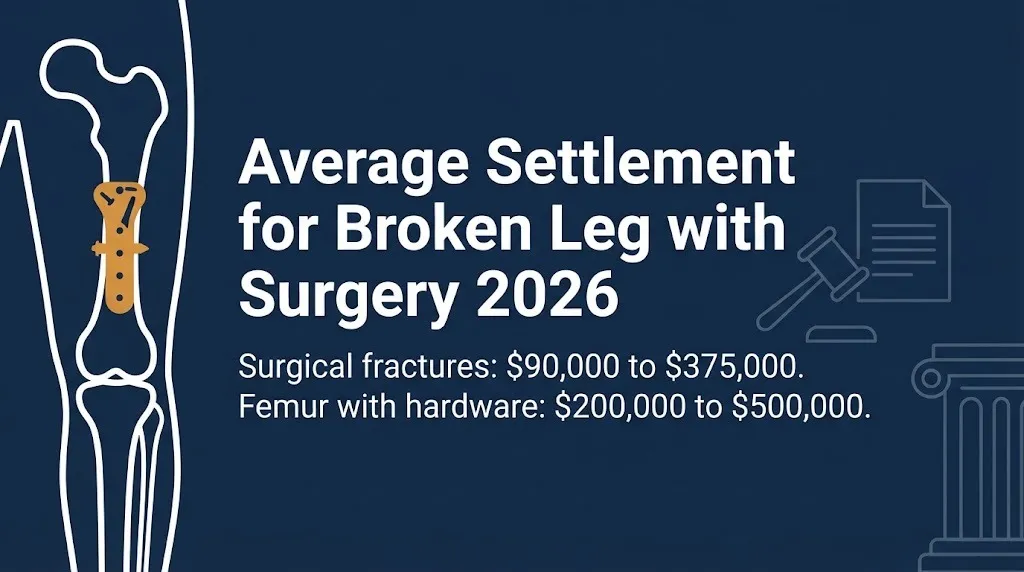
Femur fractures sit at the top of the range. A surgically repaired femur or hip commonly lands between $175,000 and $650,000 . One 2026 source puts femur fractures with rods and screws at $200,000 to $500,000, depending on age, recovery complications, and long-term mobility limits .
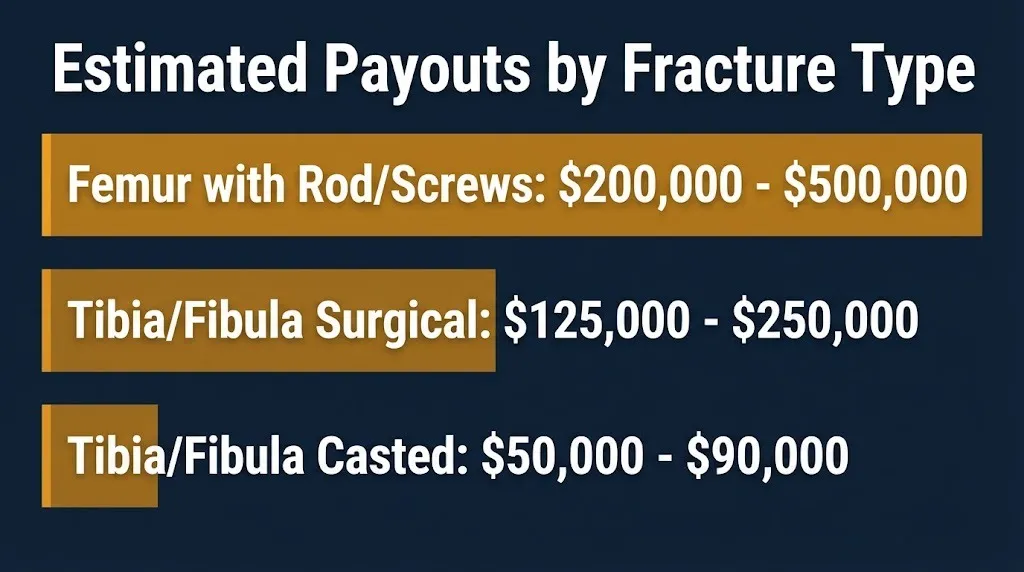
Tibia and fibula fractures fall lower. The average settlement for a tibia or fibula fracture is around $70,000 to $90,000 without surgery . Add surgery, and the number jumps significantly. A casted tibial fracture might settle for $50,000 to $80,000. The same fracture with plate and screw fixation typically settles for $125,000 to $250,000 .
What does the settlement data show for slip and fall broken leg cases?
Slip and fall cases with broken legs settle in a wide range, from about $30,000 to $90,000 for average cases up to $270,000 or more for severe fractures with surgery. The location, liability evidence, and your documentation drive the final number.
One verified 2025 case from Virginia shows the upper end of this range. A 70-year-old woman slipped on a spill at a country club and fractured her left tibia and fibula. She had $85,808.86 in special damages. The case settled for $270,000 after extended negotiations .
Another case shows what happens with catastrophic injuries. A woman who broke her left leg on an icy sidewalk, requiring six surgeries, settled for $800,000 .
Most slip and fall leg fracture cases do not reach those numbers. The average range for broken arm or leg in a slip and fall is $30,000 to $90,000 . Surgery and permanent hardware push cases toward the top of that range or above it.
Key Takeaway: Surgical leg fractures settle for 2.5 to 4 times more than casted fractures because surgery proves severity, adds medical costs, and often leaves permanent hardware that insurance companies cannot dismiss.
What drives the settlement value up for a broken leg with surgery?
Five factors consistently increase settlement value in surgical leg fracture cases. The more of these apply to your situation, the higher the likely range.
Permanent hardware in your body. Metal plates, screws, or rods left in your leg are powerful evidence. They show the injury was severe enough to require internal fixation. They can cause ongoing sensitivity, limit range of motion, and sometimes require a second surgery for removal .
Longer recovery and more lost wages. Surgical fracture recovery takes 3 to 6 months minimum, compared to 6 to 12 weeks for a cast . More time off work means higher lost income damages.
Documented complications. Post-traumatic arthritis develops in 30% to 70% of fractures involving joint surfaces, even with perfect surgical repair . Chronic pain syndrome adds $25,000 to $100,000 or more. Leg length discrepancy from femur or tibia fractures causes gait problems and secondary injuries.
Visible scarring. Surgical incisions leave scars. Visible scarring on exposed areas adds a disfigurement component. Keloid or hypertrophic scarring can add $10,000 to $75,000 in additional damages .
Younger age. Younger victims often receive higher settlements because they face a lifetime of potential pain and limitations from the same injury that an older person might not live long enough to experience fully .
What are the average settlement amounts by broken leg type in 2026?
Different leg bones produce different settlement ranges. Here is the verified 2026 breakdown:
| Fracture Type | Settlement Range | Key Factors |
|---|---|---|
| Tibia/Fibula (Casted) | $50,000 to $90,000 | No surgery, shorter recovery |
| Tibia/Fibula (Surgical) | $125,000 to $250,000 | Plates, screws, longer recovery |
| Femur (Surgical) | $175,000 to $650,000 | Major surgery, longer disability |
| Femur with Rod/Screws | $200,000 to $500,000 | Permanent hardware, mobility limits |
| Multiple Fractures | $500,000+ | Combined severity, longer recovery |
The same fracture treated differently produces dramatically different values. A tibial fracture treated with a cast may settle for $50,000 to $80,000. With plate and screw fixation, the same fracture typically settles for $125,000 to $250,000 .
Femur fractures are the most valuable leg injury short of amputation. The femur is the largest bone in your body. Breaking it requires massive force. Recovery is brutal. A 22-year-old Reddit user with a bilateral femur fracture and a broken arm was told the national average for a bilateral femur fracture alone is $175,000 .
How does the multiplier method calculate a broken leg settlement?
The multiplier method estimates settlement value by adding your economic damages, then multiplying by a number between 1.5x and 5x based on injury severity. The multiplier represents pain and suffering.
Here is how it works in practice:
- Add your economic damages. Medical bills, lost wages, future medical costs, out-of-pocket expenses.
- Pick a multiplier. Minor injuries get 1.5x to 2x. Surgeries and permanent damage get 3x to 5x.
- Multiply. The result is your estimated settlement range.
A $10,000 medical bill with a broken ankle treated by cast might get a 3x multiplier for a $30,000 estimate . A surgical leg fracture with $50,000 in medical bills and 3 months of lost wages at $4,000 per month ($12,000) totals $62,000 in economic damages. A 4x multiplier for major surgery and permanent hardware produces a $248,000 estimate.
The multiplier method is a negotiating tool, not a guarantee. Insurance companies have their own formulas. But it gives you a starting point for understanding what your case might be worth.
Key Takeaway: The multiplier method adds your medical bills and lost wages, then multiplies by 1.5x to 5x based on severity. Surgical leg fractures with permanent hardware typically justify 3x to 5x multipliers.
Reality Check
No one texts you settlement money first. If you get a message saying you have unclaimed funds from a broken leg settlement, it is a scam. You do not have a settlement until you or your attorney have negotiated one with the at-fault party’s insurance company. Filing a claim is free. Any “claim helper” charging upfront fees is unnecessary. Personal injury attorneys work on contingency, meaning they get paid only if you win.
How do I prove my broken leg claim and maximize the settlement?
You prove a broken leg claim with medical records, operative reports, wage documentation, and evidence of how the injury changed your daily life. Insurance adjusters respond to documentation, not sympathy.
Use this numbered checklist:
- Get the operative report. This document describes the surgery, the hardware placed, and the damage found. It is the single most important medical record in a surgical fracture case.
- Keep all imaging. X-rays, CT scans, and MRIs show the fracture and the hardware. They are objective proof of severity.
- Document lost wages. Pay stubs, employer letters, and tax returns establish your income and time missed.
- Save every receipt. Prescriptions, crutches, wheelchair rentals, rides to appointments, home modifications.
- Take photos. Photograph your scars, your mobility aids, and anything that shows how the injury limits you.
- Keep a pain journal. Note good days and bad days. This supports pain and suffering claims.
- Do not settle before Maximum Medical Improvement. Wait until your doctor says you have healed as much as you will. Settling early cuts off future damages.
What happens next in a broken leg settlement case?
A broken leg with surgery typically moves through these stages:
Immediately after the accident: Seek medical treatment. Document everything.
Weeks 1 to 4: Contact a personal injury attorney if liability is disputed or injuries are severe.
Months 2 to 6: Treatment and recovery. Do not discuss the case with insurance adjusters without legal guidance.
Month 6 to 12: Reach Maximum Medical Improvement. Your doctor provides a final prognosis.
After MMI: Demand package sent to insurance. Negotiations begin.
Settlement or trial: Most cases settle. Complex cases may go to trial.
Payment: After settlement, payment typically arrives within 30 to 60 days.
Frequently Asked Questions
What is the average settlement for a broken leg with surgery?
There is no single average. Surgically repaired leg fractures typically settle between $90,000 and $375,000. Femur fractures with rods or screws often reach $200,000 to $500,000.
How much can I get for a broken femur with rods and screws?
A broken femur with rods and screws typically settles for $200,000 to $500,000. The exact amount depends on your age, recovery complications, and long-term mobility limitations .
Is a broken leg worth more if I had surgery?
Yes. Fractures requiring surgery settle for 2.5 to 4 times more than the same fracture treated with a cast. Surgery proves severity, increases medical bills, and often leaves permanent hardware.
How long does a broken leg lawsuit take to settle?
Most broken leg lawsuits settle within 12 to 24 months. Complex cases with disputed liability or multiple surgeries can take longer.
What if I need a second surgery to remove hardware?
A second surgery to remove plates, screws, or rods adds $25,000 to $75,000 in additional claim value. It adds both medical costs and pain and suffering damages .
Can I sue if I broke my leg in a slip and fall?
You can file a lawsuit if the property owner was negligent. You must prove they knew or should have known about the hazard and failed to fix it or warn you.
How much is a broken leg claim worth if I was partially at fault?
If you were partially at fault, your settlement is reduced by your percentage of blame. In a $100,000 settlement with 20% fault, you receive $80,000. Some states bar recovery entirely if you are 51% or more at fault .
Should I settle my broken leg claim before I am fully healed?
No. Do not settle before reaching Maximum Medical Improvement. If you settle early and later develop arthritis or chronic pain, you cannot reopen the case for those damages .
Your Next Step
If you are dealing with a broken leg from an accident, the most important action is to document everything starting now. Get your operative report, save every receipt, and track your lost wages. Do not accept a quick settlement offer before you know your full prognosis.
The single most important fact to remember: your settlement value depends on proving severity. Surgery, permanent hardware, and documented complications are what move the number from $50,000 to $250,000 or more.