Total Loss Settlement 2026: Why the First Offer Is Never Final, How Insurers Undervalue Your Car, and the Exact Steps to Get More
Quick Answer
- A total loss settlement is the actual cash value (ACV) of your car before the accident, minus your deductible .
- The insurer’s first offer is a starting point, not a final number, and you can negotiate it with comparable sales data .
- You must document your car’s condition, mileage, and features before accepting anything; missing details cost hundreds or thousands .
If your car was just declared a total loss, you are probably staring at a settlement offer that feels too low to replace what you lost. Here is the verified truth: the first offer is built on an algorithm, and that algorithm has a track record of undervaluing vehicles.
State Farm agreed to pay $15.6 million in 2026 to settle claims that its Audatex valuation system applied improper “negotiation adjustments” that reduced payouts for Arkansas policyholders . The company denied wrongdoing, but the settlement exists because thousands of people believed their cars were worth more than the algorithm said.
This article covers how total loss settlements actually work in 2026, why your car’s ACV is often lower than its fair market value, the exact evidence that moves an offer upward, what happens if you still owe money on the car, and the mistakes that cost people thousands.
The Facts
| What it is | Insurance payout when repair costs exceed a set percentage of your car’s value, typically 70% to 80% |
| Payout basis | Actual Cash Value (ACV) of your vehicle immediately before the accident, minus deductible |
| Est. Per Person | Varies widely; State Farm settlement averaged $489 per claimant |
| Claim Deadline | No universal deadline; your policy and state law set timelines |
| Administrator | Your insurance company’s claims department |
| Proof Needed | Valuation report review, comparable vehicle listings, maintenance records, pre-accident photos |
How Is a Total Loss Settlement Calculated?
A total loss settlement is calculated by determining your vehicle’s Actual Cash Value (ACV) immediately before the accident, then subtracting your deductible . ACV is not the replacement cost, not what you paid, and not what you still owe. It is what a willing buyer would have paid for your specific car, with its specific mileage and condition, the moment before the crash .
Insurers determine ACV using third-party valuation tools like CCC One, Mitchell, or Audatex . These systems pull data from recent sales and listings in your geographic area, then apply adjustments for mileage, condition, and options .
The problem is that these systems are not always accurate. They may pull comparable vehicles from hundreds of miles away, apply condition adjustments that do not reflect your car’s actual maintenance history, or miss features that add value . In the State Farm case, the system applied a uniform “negotiation adjustment” of roughly 9% to every comparable vehicle, effectively reducing the payout by assuming every buyer would haggle the price down .
A total loss is declared when repair costs exceed a percentage of your car’s value. Most states and insurers use a threshold between 70% and 80% .
Why Is the First Total Loss Offer Usually Low?
The first total loss offer is usually low because insurance companies are businesses that aim to resolve claims quickly and inexpensively . That does not mean the offer is final. It means it is the opening number.
Adjusters use valuation software that generates a number, and that number is often below what your car would actually sell for on a dealer lot. The software might list your car as “average” condition when you kept it in excellent shape. It might use comparables with higher mileage or fewer options. It might ignore the new tires you bought three months ago.
State Farm’s settlement illustrates the pattern. Lead plaintiff Rose Chadwick’s vehicle was valued at $4,121, and she received $1,383 after deductions . The valuation report used four comparable vehicles and applied the negotiation adjustment to each one. Chadwick argued that used vehicle listings reflect intense competition, not room for negotiation .
You do not have to accept the first number. You have the right to question the valuation, request the report, and present evidence .
Key Takeaway: The first total loss offer is an algorithm-generated starting point, not a final judgment, and insurers have paid millions in settlements for using methods that systematically undervalued cars.
How Do You Negotiate a Higher Total Loss Settlement?
You negotiate a higher total loss settlement by auditing the insurer’s valuation report, gathering your own comparable vehicle listings, and presenting documented evidence of your car’s actual condition and features . The process is evidence-based, not emotional.
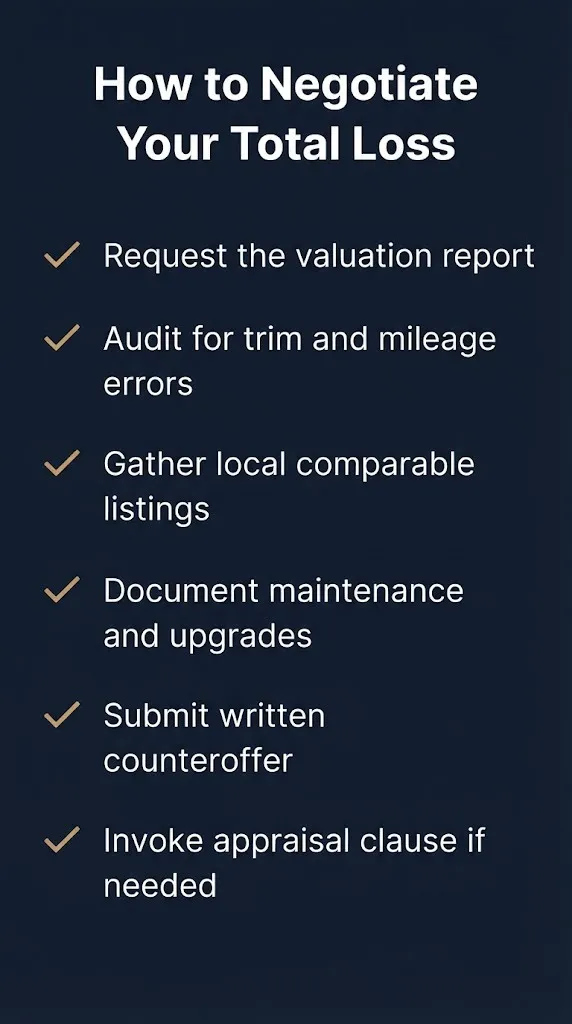
Start by requesting the full valuation report in writing. Identify which comparable vehicles the insurer used, their mileage, condition ratings, and geographic location. Look for errors: wrong trim level, missing packages, incorrect mileage, or unfair condition ratings .
Then build your own comparable set. Search Autotrader, Cars.com, and local dealer websites for vehicles matching your make, model, year, trim, and mileage within 50 to 100 miles of your location . Save screenshots showing asking prices. Focus on retail listings, not trade-in values.
Gather your documentation: maintenance records, receipts for recent repairs or upgrades, pre-accident photos showing the car’s condition. Submit everything to the adjuster in writing with a clear counteroffer .
If the gap remains large, request a re-inspection or invoke your policy’s appraisal clause. Most policies include a provision allowing each side to hire an independent appraiser, with a neutral umpire resolving disagreements .
Reality Check: The insurer’s valuation is not a government determination or a final ruling. It is one company’s estimate. You can challenge it with evidence, and many people successfully raise their payouts by doing exactly that .
What Evidence Actually Increases Your Total Loss Payout?
Documented evidence increases your total loss payout, not complaints or threats . Insurers respond to facts they can verify. The strongest evidence includes local comparable listings, proof of recent maintenance, and documentation of value-adding features.
Here is what moves the number:
- Local comparable vehicle listings: 3 to 5 vehicles matching your make, model, year, and trim within 50 to 100 miles, showing asking prices
- Maintenance records: Receipts for recent major services like new tires, brakes, timing belt, or transmission work
- Aftermarket upgrades: Receipts and installation dates for stereos, remote starters, tow packages, or other additions
- Pre-accident photos: Images showing the interior, exterior, and condition before the crash
- Independent appraisal: A professional valuation report from a certified appraiser
If your car had low mileage for its age, that is a value-adding factor the valuation may have underweighted. If you kept detailed service records, that supports a higher condition rating. If you installed new tires six months before the accident, that is money you spent that should be reflected.
Do not rely on your feelings about the car’s worth. “I love this car” does not move an adjuster. “Here are three local listings for the same trim with higher mileage at $18,500, and here is my receipt for new tires installed in March” does .
What Happens If You Still Owe Money on the Car?
If you still owe money on a totaled car, the settlement goes to your lienholder first, up to the loan balance . If the ACV is greater than what you owe, the lender releases the title and any surplus goes to you. If the ACV is less than what you owe, you are responsible for the difference unless you have GAP insurance .
This is where many people get caught off guard. They owe $18,000 on a car the insurer values at $15,000. The lender gets the full $15,000, and the borrower still owes $3,000 on a car they no longer have .
GAP insurance, or Guaranteed Asset Protection, covers that shortfall. If you have it, the policy pays the difference between the settlement and the loan balance . If you do not, you owe the remaining balance out of pocket.
Before your claim closes, request your exact loan payoff amount from your lender, not just the current statement balance. Payoff amounts include accrued interest and may be higher than what you see online .
If you have a lease, confirm what charges the leasing company will apply beyond the settlement. Excess mileage fees and wear-and-tear charges are typically not covered by GAP .
Can You Keep Your Car After a Total Loss?
You can keep your car after a total loss in most states if you are willing to accept a salvage title and the insurer deducts the salvage value from your settlement . This is called owner retention or buyback.
The math works like this: if your settlement is $12,000 and the salvage value is $3,000, the insurer pays you $9,000 and you keep the car. You are then responsible for repairing it to your state’s rebuilt title requirements.
A rebuilt title carries significant consequences. Resale value drops by 20% to 40% compared to a clean-title vehicle . Many traditional lenders will not finance a rebuilt-title car. Some insurance carriers limit coverage to liability only .
Keeping a totaled car makes sense if the vehicle is paid off, the damage is mostly cosmetic, you plan to drive it long-term, and you can secure adequate insurance . It usually does not make sense if you still owe money, the structural damage is significant, or you plan to sell within a few years.
What Is Diminished Value and Does It Apply to Total Loss?
Diminished value does not apply to total loss claims. If your car is declared a total loss, you pursue a total loss settlement instead . Diminished value is a separate claim for vehicles that were repaired, not totaled.
Diminished value measures the reduction in a car’s resale worth because of its accident history, even after repairs are complete . A buyer will pay less for a car with a reported accident, even if the repair work was flawless.
You can typically file a diminished value claim only against the at-fault driver’s insurer, not your own, in most states . Some states restrict or prohibit these claims entirely.
If your car was repaired rather than totaled, and the other driver was at fault, diminished value may be worth pursuing. For newer or high-value vehicles, the loss can be thousands of dollars. But if the car is totaled, diminished value is not the right claim .
What Happens Next in a Total Loss Claim?
The timeline for a total loss claim depends on your insurer, the complexity of the valuation dispute, and whether you have a lienholder. Here are the typical stages:
Immediately: Report the accident and file the claim. The insurer inspects the vehicle and determines whether it is a total loss .
Within days to weeks: The insurer presents a settlement offer based on ACV. This is the number you can negotiate .
If you dispute: Request the valuation report, gather your evidence, and submit a counteroffer. This can add days to weeks depending on how quickly the insurer responds .
If you invoke appraisal: The process adds time while both sides hire appraisers and potentially an umpire .
After agreement: The insurer issues payment. If there is a lienholder, the check goes to the lender first. You transfer the title and the insurer takes the vehicle or you retain it with a salvage deduction .
Frequently Asked Questions
How much should I expect from a total loss settlement?
You should expect the actual cash value of your vehicle immediately before the accident, minus your deductible. ACV varies widely based on make, model, age, mileage, condition, and local market.
Can I negotiate a total loss settlement?
Yes, you can negotiate a total loss settlement. The first offer is a starting point, and you can present comparable sales data and documentation to support a higher value .
What if the insurance company’s offer is too low?
If the offer is too low, request the valuation report, identify errors or missing features, gather your own comparable listings, and submit a written counteroffer with evidence .
Do I have to accept the first total loss offer?
No, you do not have to accept the first offer. You can question it, negotiate, request a re-inspection, or invoke your policy’s appraisal clause if you and the insurer cannot agree .
What is the appraisal clause in my insurance policy?
The appraisal clause is a provision that allows you and the insurer to each hire an independent appraiser when you disagree on value. If the appraisers cannot agree, a neutral umpire makes a binding decision .
What happens if I owe more than the car is worth?
If you owe more than the car is worth, you are responsible for the difference unless you have GAP insurance. The settlement goes to your lender first, and any remaining balance is your obligation .
Can I keep my totaled car?
Yes, you can keep your totaled car in most states by accepting a salvage title and having the salvage value deducted from your settlement. This reduces resale value and may limit financing and insurance options .
How long does a total loss settlement take?
A total loss settlement can take days to weeks, depending on whether you dispute the valuation, whether there is a lienholder, and how quickly the insurer processes paperwork. Delays often stem from missing title documents or valuation disputes .