Roanoke Settlement 2026: Lost Colony Mystery, Domtar River Deal, and Opioid Funds Explained
Quick Answer
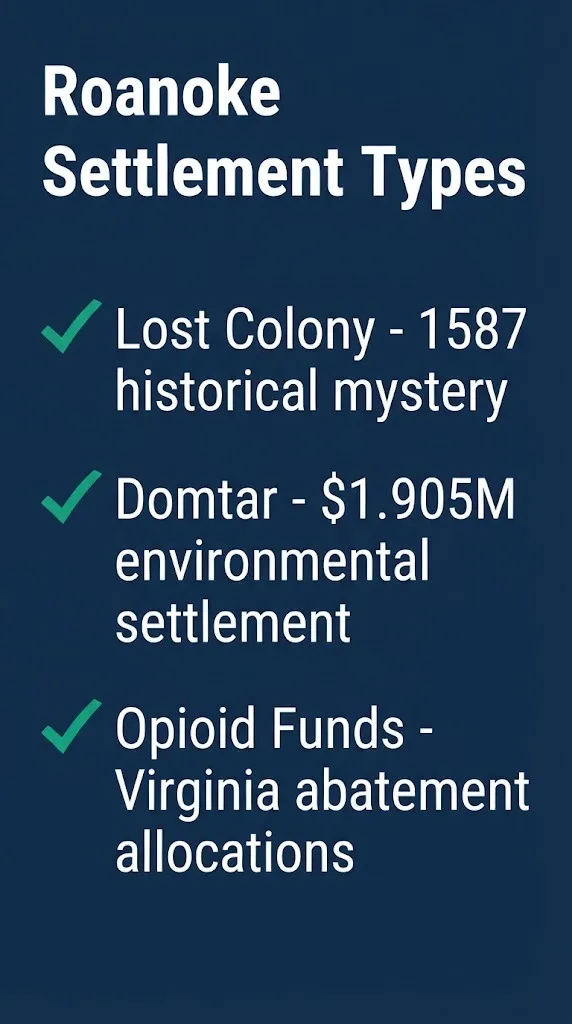
- What it is: “Roanoke settlement” has three meanings: the famous 1587 Lost Colony, a 2026 Domtar river pollution settlement, and Virginia opioid fund allocations.
- How much is the Domtar settlement? $1.905 million proposed, with $1.75 million for restoration and $155,000 for trustee oversight.
- Key deadline: The Domtar consent decree is subject to public comment and court approval. The opioid fund allocations are already in progress through FY 2030.
What Is the Roanoke Settlement?
The “Roanoke settlement” in 2026 is not one single case. The phrase pulls up three unrelated matters, and knowing which one you’re looking for changes everything about what you need to know.
The oldest and most famous is the Lost Colony of Roanoke, the 1587 English settlement on Roanoke Island that vanished without a trace, leaving only the word “CROATOAN” carved into a tree . That mystery remains unsolved, though recent archaeological work suggests the settlers may have integrated with the Croatoan people on Hatteras Island .
The newest is a proposed federal environmental settlement with Domtar Paper Company over decades of contamination at the Plymouth mill site along North Carolina’s lower Roanoke River. The consent decree was lodged September 16, 2026, and requires public comment and court approval .
The third involves Roanoke County, Virginia, and its allocation of funds from Virginia’s opioid abatement settlements. These funds are already flowing through the county budget for projects through FY 2030 .
This article covers all three, with verified facts and no guesses.
The Facts
| Detail | Lost Colony | Domtar Settlement | Opioid Funds |
|---|---|---|---|
| What It Is | 1587 English colony that vanished | CERCLA natural resource damage settlement | Virginia abatement fund allocations |
| Location | Roanoke Island, NC | Lower Roanoke River, NC | Roanoke County, VA |
| Status | Historical mystery, unsolved | Proposed consent decree, pending approval | Funds allocated and in use |
| Amount | N/A | $1.905 million | Varies by project and year |
| Key Date | 1587-1590 | Lodged September 16, 2026 | FY 2026 through FY 2030 |
| Administrator | N/A | U.S. DOJ and NOAA | Virginia Opioid Abatement Authority |
What Is the Domtar Roanoke River Settlement?
The Domtar Roanoke River settlement is a proposed $1.905 million consent decree resolving natural resource damage claims tied to industrial contamination at the Plymouth mill site. The U.S. Department of Justice lodged the decree on September 16, 2026, in the U.S. District Court for the Eastern District of North Carolina .
The case was brought under the Comprehensive Environmental Response, Compensation, and Liability Act (CERCLA) by federal and state natural resource trustees . The settlement addresses alleged injuries to fish, aquatic habitat, and recreational fishing caused by hazardous substance releases from the site.
Here’s how the money breaks down:
| Allocation | Amount | Purpose |
|---|---|---|
| NOAA Restoration Fund | $1.75 million | Future floodplain, wetland, and fish-passage projects |
| DOI Trustee Fund | $155,000 | Trustee planning, oversight, and monitoring |
The settlement is more than cash. Domtar would also permanently protect approximately 760 acres of Warren Neck forested wetlands through a conservation agreement . A separate project would reconnect about three miles of historic stream channels and improve more than 600 acres of floodplain habitat.
The mill site has operated since 1937. Weyerhaeuser ran it from 1957 to 2007, when Domtar acquired the operation and assumed environmental cleanup obligations .
The settlement remains proposed and subject to public review and court approval.
What Is the Roanoke Island Lost Colony Settlement?
The Roanoke Island Lost Colony is not a legal settlement in the modern sense. It was England’s first attempt at a permanent settlement in North America, and it disappeared sometime between 1587 and 1590 .
Sir Walter Raleigh funded the expedition and received a charter from Queen Elizabeth I. The colony of about 117 men, women, and children landed on Roanoke Island in 1587. John White served as governor. His granddaughter, Virginia Dare, was the first English child born in the New World .
White returned to England for supplies but was delayed by the Anglo-Spanish War. When he finally returned in August 1590, on Virginia Dare’s third birthday, he found the settlement deserted. The houses had been dismantled, not destroyed. There were no signs of battle or panic .
The only clue was the word “CROATOAN” carved into a wooden post, and “CRO” on a nearby tree . Before leaving, White had instructed the settlers to carve a cross if they were forced to leave. No cross was found, suggesting the departure was voluntary.
The leading theory is that the colonists integrated with the Croatoan people on what is now Hatteras Island. Archaeological excavations have found English artifacts, including hammer scales from iron forging, in Native American village sites dating to the late 16th century .
Key Takeaway: The Roanoke Lost Colony is a historical mystery, not a legal claim. No one can file a claim or receive compensation for the 1587 settlement. The Domtar environmental settlement is the active legal matter in 2026.
How Much Is the Domtar Roanoke River Settlement Worth?
The Domtar settlement is worth $1.905 million in cash payments, plus significant non-cash restoration commitments. The cash portion is divided between federal restoration funds and trustee oversight costs .
The non-cash components have substantial value:
- 760 acres of forested wetlands permanently protected through conservation agreement.
- Three miles of historic stream channels reconnected.
- 600+ acres of floodplain habitat improved through culvert replacement.
- Credit for cooling-water improvements already completed by Domtar.
The U.S. Department of Justice lodged the proposed consent decree on September 16, 2026. The public comment period is part of the review process before final court approval .
The settlement is not yet final. Anyone can submit comments on the proposed decree through the Department of Justice Environment and Natural Resources Division.
How Do Virginia Opioid Settlement Funds Work in Roanoke?
Virginia’s opioid settlement funds are distributed to cities and counties through the Virginia Opioid Abatement Authority. Roanoke County has authorized and approved the Virginia Abatement Fund Settlement Allocation Memorandum of Understanding .
The funds are allocated through a structured process. Roanoke County’s FY 2026 budget shows an Individual Distribution (IDIC) of $40,000, with the Gold Standard Distribution at $0 for the year .
The county uses these funds for specific projects. One example is a sewer extension project in an area lacking public water and sewer infrastructure. The project description states that “Monsanto Settlement is being utilized for funding of this project,” with shared funding between Roanoke County, Roanoke City, and the City of Salem planned for FY 2027 through FY 2029 .
The funding continues through multiple fiscal years. Roanoke County’s revenue projections show Settlement Funds of approximately $1.55 million in FY 2026, declining to about $811,000 by FY 2030 .
Reality Check: Opioid settlement funds are not paid to individuals. They go to state and local governments for abatement programs. No one can file a claim to receive a direct payment from the Virginia Opioid Abatement Fund. If someone contacts you promising opioid settlement money, it is a scam.
What Happens Next With the Domtar Settlement?
The Domtar consent decree is in the public comment phase. After the comment period closes, the court will review the settlement and decide whether to approve it.
September 16, 2026: Consent decree lodged in U.S. District Court for the Eastern District of North Carolina .
Ongoing: Public comment period on the proposed settlement.
Expected late 2026: Court review and potential final approval.
After approval: Domtar pays the $1.905 million. Restoration projects begin.
Ongoing: 760-acre wetland conservation agreement recorded. Floodplain restoration projects implemented.
The settlement is not final until the court approves it.
Frequently Asked Questions
What is the Roanoke settlement in 2026?
It refers to three things: the 1587 Lost Colony, a $1.905 million Domtar environmental settlement for the Roanoke River, and Virginia opioid abatement fund allocations in Roanoke County.
How much is the Domtar Roanoke River settlement?
The proposed settlement is $1.905 million, with $1.75 million for restoration and $155,000 for trustee oversight. It also includes 760 acres of wetland protection.
Can I get money from the Roanoke settlement?
No. The Domtar settlement goes to federal and state restoration funds. The opioid funds go to local government programs. No direct payments to individuals.
Is the Roanoke Lost Colony a legal settlement?
No. It was a historical English settlement that disappeared. There is no legal claim or compensation tied to the Lost Colony.
What happened to the Roanoke Lost Colony?
The settlers disappeared between 1587 and 1590. The word “CROATOAN” was the only clue. Recent research suggests they may have integrated with the Croatoan people.
Is the Domtar settlement final?
No. It was lodged on September 16, 2026, and is subject to public comment and court approval. It is not final yet.
How do I comment on the Domtar settlement?
Public comments can be submitted through the U.S. Department of Justice Environment and Natural Resources Division during the public comment period.
What are Roanoke County opioid funds used for?
They fund abatement programs, including sewer infrastructure projects. The funds are distributed through the Virginia Opioid Abatement Authority.