Lawsuit in Spanish (2026): What “Demanda” Means and How to Read a Spanish Claim Notice
Quick Answer
- Lawsuit in Spanish is most often “demanda,” the formal legal claim filed with a court.
- Payout: not applicable to the word itself. Amounts depend on each settlement’s own terms.
- Deadline: use the date printed on your own notice. Every case sets its own.
Lawsuit in Spanish is “demanda,” and that’s the word to learn first. It names the court filing itself, not the whole fight.
This matters most if a Spanish notice just landed in your mailbox or inbox. Every class action notice carries its own deadlines, and the date printed on yours is the only one that counts.
Below, you’ll get the core vocabulary, a step-by-step way to read a Spanish claim notice, and your interpreter rights. One detail surprises people: one Spanish notice we reviewed said a valid, on-time claim form was the only route to payment.
The Facts
| Case | Not a single case. Reference guide covering Spanish legal terms and notices |
| Status | Not applicable. Check the status of your own case |
| Fund Size | Not applicable to this guide |
| Est. Per Person | Not yet determined. Depends on each settlement |
| Claim Deadline | Printed on your notice. Watch the official settlement website |
| Administrator | Named in each notice. Not yet appointed for any case here |
| Proof Needed | Check the claim form for your case |
What is lawsuit in Spanish?
Lawsuit in Spanish is most commonly “demanda,” the formal claim a person submits to a court. It works in civil contexts across Spanish-speaking countries. If you want one word that travels, use it.
Dictionaries list other options. Collins gives “pleito” and “juicio” as its main entries. Bab.la adds “litigio,” “causa,” “querella,” and “acción judicial.”
Each word leans a different direction:
- Demanda: the filing or claim itself
- Pleito: the overall dispute, a bit more conversational
- Juicio: usually the trial, though people stretch it to mean the whole case
- Litigio: a dispute being fought in court
- Causa: the legal matter as a whole
Pick “demanda” when you mean the paper someone files. Pick “juicio” when you mean the courtroom stage.
Is a Spanish settlement notice legitimate or a scam?
A Spanish settlement notice is legitimate when it names a real court, a real case, and an official settlement website you can verify. It’s called an “aviso,” and it summarizes a proposed settlement in plain language. A real one explains what rights class members have and helps them choose what to do.
Real notices also name an administrator with a mailing address and toll-free number. One Spanish notice we reviewed, for an ATM fee case, lists both. It also tells readers not to phone the court or the clerk’s office.
Run this quick check before you click anything:
- Does the notice name a court and a case?
- Does it list a settlement website you can find on your own?
- Does it give an administrator’s phone number and mailing address?
- Does it avoid asking for a fee, a card number, or a Social Security number up front?
If two of those answers are no, stop. Search the case name yourself, then contact the administrator directly.
How much money can a Spanish settlement notice offer?
How much you could get is not yet determined by anything in the word “demanda” or the language of the notice. The settlement agreement sets the amount, and the notice only summarizes it. One Spanish notice says the complete terms live in the settlement agreement on the case website.
Amounts depend on several moving parts. Reported fund totals can mislead you, so read them carefully. The ATM fee notice mentions that earlier settlements in that case added up to $67 million. That’s a total for the class, not a check for you.
| Factor | How it can change your payout |
|---|---|
| Fund size | A bigger fund can mean bigger shares |
| Valid claims filed | More claimants can shrink each share |
| Class definition | Only people who fit it may qualify |
| Proof required | Missing proof can block a claim |
| Court-approved fees | These come out before shares are set |
Think of it like splitting a restaurant bill you didn’t order from. The total is printed, but your share depends on who else is at the table.
Do you have to pay to file a claim from a Spanish notice?
Filing a class action claim normally costs you nothing. The ATM fee notice says class members won’t be charged for the lead class counsel’s services. That’s a strong sign of how a real notice reads.
Paying an outsider to “help” you file is optional, and the free form on the official website is usually enough. The administrator’s toll-free line can answer basic form questions at no charge.
Watch for two pressure tactics: a demand for money before you can claim, and a claim that you’ll lose your payment unless you act in hours. Real deadlines are printed as dates, not countdown timers.
Key Takeaway: “Demanda” is the word, the settlement agreement sets the money, and a real notice never charges you to file.
Reality Check: Nobody legitimate texts you settlement money first. Filing a claim is free, and third-party “claim helpers” who charge a fee aren’t required. Always find the official settlement website yourself instead of using a link in a message.
How do you file a claim from a Spanish notice?
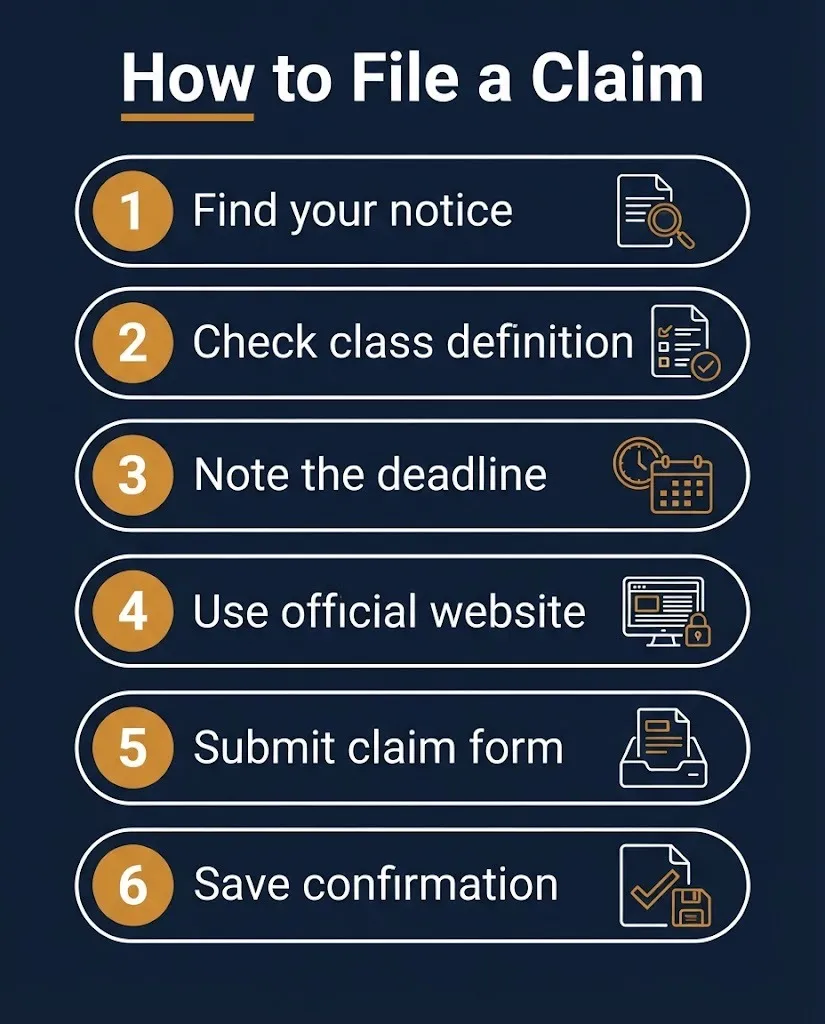
You file by reading the class definition, finding your deadline, and submitting the “formulario de reclamo” on the official settlement website. Here’s the order that keeps you out of trouble:
- Read the section asking who is included in the class.
- Check the class period dates against your own history.
- Find the claim deadline printed in the notice.
- Open the settlement website named in the notice.
- Complete the claim form in Spanish or English.
- Attach proof if the form asks for it.
- Submit before the deadline and save the confirmation.
Here’s a real-world example of how specific these definitions get. A Spanish notice for a streaming privacy case defined its class as people who used the service between June 23, 2021 and August 26, 2024. That case is past-dated, so don’t rely on it for your own filing.
The same notice says a valid, timely claim form is the only way to get a payment. Doing nothing doesn’t collect money.
How do you ask for a court interpreter?
You ask the court clerk as early as possible and name the language and hearing date. Iowa Legal Aid tells people to request an interpreter from the court or agency as soon as possible. Waiting until the hearing day is the most common mistake.
Use this checklist:
- Tell the clerk you need Spanish interpretation.
- Give your case number and hearing date.
- Ask whether the court wants a written request.
- Ask whether a certified interpreter will be assigned.
- Confirm the interpreter will be present for the whole hearing.
- Ask who pays, and get the answer in writing.
- Skip bringing a relative to interpret.
That last point has a real problem behind it. Some people who need interpreters are told to bring a friend or family member, whose skills are unknown and whose interests may differ.
Requesting an interpreter is like booking a table for a large group. Call early, not at the door.
What Spanish legal terms should you know on a claim form?
The most useful Spanish claim-form terms are “aviso,” “conciliación,” “formulario de reclamo,” “excluirse,” “objetar,” and “renuncia.” Learn these six and most notices become readable.
| Spanish term | English meaning | What it means for you |
|---|---|---|
| Aviso | Notice | A summary of your rights |
| Acuerdo de conciliación | Settlement agreement | The full legal terms |
| Grupo or clase | Class | The group covered by the case |
| Formulario de reclamo | Claim form | How you ask for payment |
| Excluirse | Opt out | You keep your right to sue |
| Objetar | Object | You tell the court why you disagree |
| Renuncia | Release | You give up certain legal claims |
| Audiencia de imparcialidad | Fairness hearing | The court reviews the deal |
| Administrador de la Conciliación | Settlement administrator | The company running claims |
One notice explains that opting out means no payment, but you aren’t bound by what happens in the case. Another explains that staying in means giving up your right to sue the defendant over the covered claims.
How do you say “file a lawsuit” in Spanish?
To file a lawsuit in Spanish, say “presentar una demanda” or “entablar una demanda.” “Entablar una demanda” is the phrase closest to the English “to file a lawsuit.”
Here are the verbs you’ll hear most:
- Presentar una demanda: to file a lawsuit
- Entablar una demanda: to bring or start a lawsuit
- Demandar a alguien: to sue someone
- Ganar la demanda: to win the lawsuit
- Perder el juicio: to lose the trial
Cambridge shows the pattern with a sentence about a company filing suit against a rival. The structure is simple: subject, verb, “una demanda,” then “contra” plus the defendant.
My own example: “Ella presentó una demanda contra el arrendador.” She filed a lawsuit against the landlord. Swap the nouns and the sentence still works.
How do you say “class action lawsuit” in Spanish?
Class action lawsuit in Spanish is “demanda colectiva.” Some legal texts use “acción de clase,” a direct copy of the English, but “demanda colectiva” is widely understood across Latin America and Spain.
You’ll see both “grupo” and “clase” for the class itself. The Tubi notice, for example, uses “Grupo de la Conciliación” for the settlement class, while another notice says “la clase.”
Settlement vocabulary varies too. Some notices say “conciliación,” others say “acuerdo,” and one uses “arreglo.” All three point to the same idea: a negotiated deal that ends the case if the judge approves it.
The takeaway for you: match your notice’s own words. If it says “conciliación,” search that word plus the case name.
Key Takeaway: Learn “presentar una demanda” for filing and “demanda colectiva” for class actions, and you can read most Spanish legal notices.
What deadlines apply, and how do you read them in a Spanish notice?
The only deadline that counts is the one printed on your notice. Different actions have different dates, and missing one can cost you your payment or your right to object.
| Action | Common Spanish wording | What the date controls |
|---|---|---|
| File a claim | Presentar un reclamo | Whether you’re paid |
| Opt out | Excluirse | Whether you keep your right to sue |
| Object | Objetar | Whether the judge hears your concern |
| Attend the hearing | Audiencia | When the judge reviews the deal |
One New Mexico Spanish notice shows how tightly they can sit. It gave January 6, 2025 as an objection deadline and set a hearing for January 9, 2025 at 3:15 pm. That case is past, so treat it only as a pattern.
Don’t assume the claim date and the opt-out date match. They often don’t. Write each date on a calendar the day you get the notice.
Where do you check settlement status in Spanish?
Check the official settlement website named in your notice, or call the toll-free number printed there. Many administrators post the Spanish notice and the settlement agreement on a “court documents” tab.
The ATM fee notice gives a good model. It lists a website, a toll-free phone number, an email address, and a mailing address for the administrator. It also says to skip calling the court. Follow that instruction where a notice includes it.
Payment timing is not yet confirmed for any case in this guide, because none is one case. For your own case, payment usually follows final approval, and timing varies.
It’s like waiting for a delayed tax refund. The status page tells you where the file sits, and calling the wrong office only slows you down.
What’s the difference between demanda, pleito, juicio, litigio, and causa?
“Demanda” is the filing, “juicio” is usually the trial, “pleito” is the dispute, “litigio” is the fight in court, and “causa” is the whole legal matter. They overlap in speech, so context decides.
| Term | Best use | Example |
|---|---|---|
| Demanda | The formal claim | Presentaron la demanda en marzo. |
| Juicio | The trial or hearing stage | “El juicio comenzará el próximo lunes.” |
| Pleito | The dispute, casual tone | Tienen un pleito con el vecino. |
| Litigio | An ongoing legal dispute | “El litigio en curso podría resultar en más pérdidas para la empresa.” |
| Causa | The legal matter overall | La causa sigue abierta. |
One guide says “pleito” feels broader and more colloquial than “demanda,” which is more formal and points at the document. The same guide says “juicio” strictly means trial, though people use it for the case in everyday speech.
If you’re filling out a form, use “demanda.” If you’re chatting, “pleito” sounds natural.
Are lawsuits in Latin America the same as in the United States?
No. A lawsuit’s Spanish name travels across borders, but the procedure doesn’t. One 2026 guide describes the U.S. system as adversarial, where each side presents its case and a judge or jury decides.
The same guide says many Latin American countries use an inquisitorial system, where the judge investigates the facts directly. That’s a general description, and each country has its own rules.
Here’s why it matters for you. A Spanish word like “demanda” in a U.S. notice means a U.S. lawsuit. Class actions, opt-outs, and fairness hearings follow U.S. court rules, not your home country’s process.
If a relative abroad tells you how it works “back home,” treat that as background only. For your notice, follow the notice. If you need legal advice about your rights, contact a licensed attorney.
Who pays for a Spanish court interpreter?
It depends on the state and the type of case, so ask the court early and get the answer in writing. Rules vary a lot, and Title VI of the Civil Rights Act pushes federally funded courts to give people with limited English meaningful access.
| Place | What we verified |
|---|---|
| California | Interpreters in civil and family cases at no cost to a party, if the court is able, in priority order |
| North Carolina | Interpreter at state expense in civil and criminal proceedings |
| West Virginia | Interpreters at no cost, regardless of ability to pay |
| Iowa | Court pays if you can’t afford one, but may later assign the cost to a party |
| Indiana | Court doesn’t provide interpreters for one party’s own deposition |
| Federal courts | Court Interpreters Act (1978) covers criminal cases and civil cases brought by the U.S. |
Iowa Legal Aid says that if a court orders you to pay, a lawyer can check whether Title VI made it free. Don’t accept a fee bill without asking that question.
Texas offers a remote service too. Its Office of Court Administration provides Spanish, French, Portuguese, and German interpreters to courts at no cost by phone and video. That’s a courts-side resource, so ask your clerk how it applies to you.
Key Takeaway: Interpreter rules and costs depend on your state and case type, so ask the clerk early and ask who pays.
What Happens Next
Your next steps depend on your own notice. Here’s the general order, with dates left as “expected” where they aren’t verified:
Now: Find your notice and confirm the official settlement website yourself.
Before your claim deadline (date printed on your notice): Submit the claim form and save your confirmation.
Before your opt-out or objection deadline (date printed on your notice): Decide whether to stay in, opt out, or object.
Expected, date set by the court: The judge holds a fairness hearing and decides on final approval.
Expected after final approval, not yet confirmed: The administrator sends payments to valid claimants.
Frequently Asked Questions
How do you say lawsuit in Spanish?
The most common word is “demanda.”
It names the formal claim filed in court.
Other words include “pleito,” “juicio,” “litigio,” and “causa.”
What’s the difference between demanda and juicio?
“Demanda” is the filing, and “juicio” is usually the trial.
People also use “juicio” loosely for the whole case.
Use “demanda” on forms.
How do you say class action lawsuit in Spanish?
It’s “demanda colectiva.”
“Acción de clase” also appears in some legal texts.
Both are understood, but “demanda colectiva” is more common.
Can I file a settlement claim from a Spanish notice?
Yes, if you may qualify under the class definition.
Use the claim form and website named in your notice.
Amounts depend on the settlement and are not guaranteed.
Do I have to pay to file a claim?
Filing a class action claim normally costs nothing.
One Spanish notice says class counsel doesn’t charge class members.
Be wary of anyone asking for upfront fees.
Can the court give me a Spanish interpreter?
Often, yes, but rules vary by state and case type.
Ask the clerk as early as possible.
Ask who pays before your hearing.
Is a Spanish settlement notice a scam?
Not if it names a real court, case, and official settlement website.
Find the site yourself instead of clicking a message link.
Avoid any notice asking for payment to file.
What does “excluirse” mean on a notice?
It means to opt out of the settlement.
You receive no payment, but you keep your right to sue.
Check the deadline printed on your notice.
Closing
Find your notice, then find the official settlement website on your own. Write down the claim, opt-out, and objection dates the same day, because each one does something different.
If you need a Spanish interpreter, ask the clerk now. The date printed on your notice is the one that decides everything.