EarnIn Lawsuit 2026: Colorado Suit and Settlement Status
Quick Answer
- What it is: Colorado’s attorney general sued EarnIn on August 27, 2026, alleging its Cash Out advances are illegal payday loans.
- Money: not yet determined. No settlement exists, though Colorado seeks restitution for affected consumers.
- Deadline: none. No claim form, opt-out date, or final approval hearing exists for any 2026 EarnIn settlement.
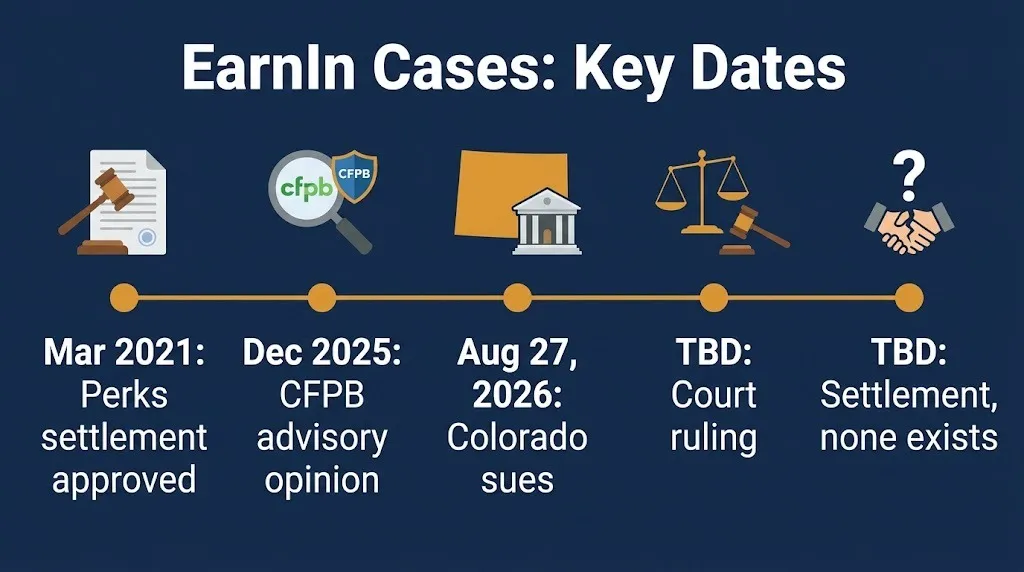
The EarnIn lawsuit most people mean is Colorado’s. On August 27, 2026, the state attorney general sued EarnIn, alleging its Cash Out advances are illegal high-cost payday loans. EarnIn disputes that.
The suit touches EarnIn app users, especially in Colorado. No settlement, claim form, or deadline exists, though private class actions are pending in other courts.
This guide covers the allegations, the money, the other cases, and scam risks. One surprising detail: Colorado says EarnIn charged a tip or an expedite fee on more than 92 percent of its transactions.
| The Facts | |
|---|---|
| Case | State of Colorado v. Activehours, Inc. d/b/a EarnIn, No. 2026CV033099 (Denver District Court) |
| Status | Filed Aug. 27, 2026; no ruling confirmed; EarnIn disputes the allegations |
| Fund Size | None. No settlement exists |
| Est. Per Person | Not yet determined |
| Claim Deadline | None. No claim process exists |
| Administrator | Not yet appointed |
| Proof Needed | Not applicable now; keep your EarnIn records |
Is there an EarnIn lawsuit?
Yes, there are several, and the newest is Colorado’s attorney general suit filed August 27, 2026.
Colorado sued in the Denver District Court, and the case number is 2026CV033099. The District of Columbia attorney general sued EarnIn earlier, and that case is in discovery. Private putative class actions are pending in Maryland, Pennsylvania, California, North Carolina, and D.C.
A tracker from the Center for Responsible Lending, dated September 29, 2026, lists them. That group is an advocacy organization, so check the dockets. Activehours, Inc. is EarnIn’s legal name.
Here’s what’s confirmed:
- Colorado’s complaint was filed August 27, 2026.
- EarnIn has publicly disagreed with Colorado’s claims.
- No court has awarded consumers money in a 2026 EarnIn case.
Is the EarnIn settlement real or already closed?
The only EarnIn consumer class settlement I could verify is closed. Perks v. Activehours received final approval on March 25, 2021.
That case (No. 5:19-cv-05543, N.D. Cal.) covered people charged overdraft or insufficient-funds fees that a bank tied to an EarnIn withdrawal. The class period ran from September 3, 2015, to May 28, 2020. About 273,071 users were in the settlement class.
EarnIn agreed to $3 million in cash relief and to forgive $9.5 million in balances, reported as a $12.5 million deal. No claim form was needed. The administrator says the settlement is fully administered and can’t advise on old claims.
Is there an EarnIn class action payout in 2026?
No. As of October 11, 2026, I found no EarnIn settlement, payout, or claim form.
Colorado seeks restitution, but no court has ordered it. The private cases are putative class actions, and I found no certified class or approved settlement. Payout: not yet determined.
Here’s what doesn’t exist:
- A settlement fund
- A claims administrator
- A claim deadline or opt-out deadline
- A final approval hearing
Key Takeaway: The only closed EarnIn consumer settlement dates to 2021, and no 2026 EarnIn payout, claim form, or deadline exists.
How much money could you get from the EarnIn lawsuits?
Not yet determined. No settlement exists, and no court has ordered restitution in the Colorado case.
Colorado seeks restitution, civil penalties, disgorgement, and an injunction. Here’s what the record shows:
| Item | Figure |
|---|---|
| EarnIn advances to Colorado consumers, Jan. 2023 to July 2025 | About $300 million |
| Loans and borrowers (per Colorado) | More than 3.1 million loans to 56,778 consumers |
| Tips and Lightning Speed fees collected in Colorado | More than $16 million |
| Average APR Colorado alleges | Nearly 388% |
| Earlier Perks settlement | $3 million cash plus $9.5 million forgiven |
Simple arithmetic: $16 million across 56,778 consumers is about $280 each in fees collected. That’s what was collected, not what anyone will recover.
Reality Check: Nobody texts you EarnIn settlement money first. A real settlement is free to claim and comes with a court-approved notice naming the case and administrator. Sites advertising an EarnIn payout today are guessing, because none exists.
Can you join an EarnIn lawsuit or file a claim?
No claim can be filed now, because no EarnIn settlement or claim period exists.
You can still prepare in case that changes. Here are the steps:
- Save your EarnIn history: advance amounts, dates, tips, and Lightning Speed fees.
- Export app activity and bank statements that show EarnIn debits.
- Note your state, since each case follows its own state’s laws.
- If you’re in Colorado, you can file a complaint with the attorney general’s office.
- Watch Colorado case 2026CV033099 and D.C. case 2024-CAB-007303 for updates.
- Ignore any “EarnIn claim” link that asks for a fee or login.
- If a notice arrives, verify the case name and administrator first.
Your terms of service can matter. In one North Carolina case, a court sent EarnIn users to arbitration and stayed the case.
Why did Colorado sue EarnIn?
Colorado alleges EarnIn’s Cash Out advances are high-cost loans disguised as access to pay.
The state says EarnIn required repayment authorization from bank accounts and repeatedly debited them until repaid. It alleges tips and Lightning Speed fees were finance charges producing an average APR of nearly 388 percent, with some loans above 1,000 percent. Colorado says EarnIn lacked a supervised lender license and required loan disclosures.
The complaint also targets app design. It alleges that declining a tip took numerous taps and that messages like “pay it forward” steered users, though tips went to EarnIn. It says Colorado consumers repaid on 99.18 percent of transactions.
Two examples from the state:
- One consumer took 1,151 loans and paid $4,038.50 in Lightning Speed fees.
- Another took 1,033 loans and paid $8,561.22 in tips and fees.
The suit challenges EarnIn’s direct-to-consumer product, not employer-integrated products. These are allegations a court hasn’t decided.
Key Takeaway: Colorado alleges EarnIn’s tips and fees are interest, but a court hasn’t decided that.
What has EarnIn said about the Colorado suit?
EarnIn says it firmly disagrees with the attorney general’s characterization of Cash Out.
The company said it was disappointed that, after more than a year of engagement, the attorney general’s office had favored a legislative solution and then sued. Trade reports note EarnIn took part in efforts to create a separate Colorado framework for wage-advance services.
EarnIn markets the product as access to earnings with no interest and no hidden fees. Colorado says its data shows otherwise. Weigh the “optional tip” label against the state’s claim that a tip or fee hit over 92 percent of transactions, but remember that’s an allegation.
What other EarnIn class actions are pending in 2026?
At least seven private cases against EarnIn were pending as of the September 29, 2026, tracker. None had a confirmed settlement or certified class.
| Case | Court | Status per tracker |
|---|---|---|
| Thomas and Johnson v. Activehours (1:24-cv-02283) | D. Md. | Motions to dismiss partly denied; discovery |
| Golubiewski v. Activehours (3:22-cv-02078) | M.D. Pa. | Motion to dismiss denied; discovery |
| Orubo v. Activehours (5:24-cv-04702) | N.D. Cal. | Motion to dismiss denied; judgment-on-pleadings motion pending |
| Ramirez v. ActiveHours (5:25-cv-03625) | N.D. Cal. | Motion to dismiss denied; arbitration also referenced |
| Stow v. Activehours (1:25-cv-00391) | M.D.N.C. | Arbitration compelled; stayed |
| Handy-Gerena v. Activehours (2025-CAB-002545) | D.C. Superior | Dismissed on primary jurisdiction |
Plaintiffs allege tips and Lightning Speed fees work as interest. Courts have mostly let some claims proceed, though outcomes vary by state.
Did the CFPB’s 2025 opinion change the EarnIn cases?
It helps providers on one federal question, but it doesn’t decide Colorado’s state-law claims.
The CFPB issued an advisory opinion on December 23, 2025. It said “Covered EWA” isn’t credit under Regulation Z and that its fees and tips aren’t finance charges. Covered EWA is narrow: wages already earned, repayment through employer payroll, no recourse, and no credit assessment.
The opinion doesn’t address direct-to-consumer products. Colorado alleges EarnIn takes repayment from bank accounts, which falls outside those criteria. A legal analysis also noted the opinion doesn’t decide whether a product is a loan under state law.
Key Takeaway: The CFPB’s 2025 opinion covers a narrow, employer-payroll form of earned wage access and doesn’t address direct-to-consumer apps.
How do EarnIn tips and Lightning Speed fees work?
EarnIn’s Cash Out advances can carry an optional tip and a Lightning Speed fee for faster delivery.
Those two charges are the center of every case. Plaintiffs and regulators call them interest. EarnIn calls tips voluntary.
| Charge | The framing | The allegation |
|---|---|---|
| Tip | Optional, from the user | Colorado says it was hard to decline and went to EarnIn |
| Lightning Speed fee | Pay for faster delivery | Plaintiffs say it works as interest |
Colorado says a tip or expedite fee was charged on more than 92 percent of transactions. Plaintiffs elsewhere claim effective APRs from 130 percent to over 1,700 percent. These are allegations, and no court has accepted those rates.
Is earned wage access a loan or a paycheck advance?
Earned wage access is a service that lets workers draw earned pay before payday, and whether it’s a loan is the legal fight.
Employer-integrated services typically repay through payroll deduction. Direct-to-consumer apps like EarnIn’s Cash Out repay through bank debits, according to Colorado. That difference drives the arguments.
Think of getting your tax refund early. If the money is truly yours, it’s one thing. If you must repay it, it looks like a loan.
| Employer-integrated EWA | Direct-to-consumer advance | |
|---|---|---|
| Repayment | Payroll deduction | Bank debit, per Colorado |
| CFPB 2025 opinion | Addresses “Covered EWA” | Doesn’t address it |
| Legal fight | Narrower | Whether fees and tips are interest |
What happened in the D.C. attorney general’s EarnIn case?
The D.C. attorney general’s case is in discovery after a split ruling on whether Cash Out is a loan.
D.C. sued in 2024 (No. 2024-CAB-007303), alleging Cash Out was marketed as fee-free while Lightning Speed fees produced APRs over 300 percent. The District caps interest at 24 percent. D.C. also alleges EarnIn lacked a lending license.
The court dismissed the claims on whether Cash Out is a loan, deferring to the D.C. banking regulator under the primary jurisdiction doctrine. Deception claims moved forward. The attorney general’s reconsideration motion was denied and an interlocutory appeal was granted.
Key Takeaway: Courts have split EarnIn cases between letting claims proceed and deferring the loan question to regulators or arbitrators.
Have courts ruled that cash advance apps are loans?
Several courts have treated similar apps as credit, but EarnIn’s own cases have mixed results.
The Center for Responsible Lending says every court analyzing payday loan app products has found them to be credit. That’s an advocacy group’s summary, and most rulings involve other companies and the Military Lending Act. For EarnIn, a Maryland court found it plausible the advances are loans, while D.C. courts deferred to regulators.
The Maryland court also noted that repayment preauthorization and a buried disclaimer supported an inference of a practical duty to repay. That’s a motion-to-dismiss finding, not a final ruling.
Are other cash advance apps being sued too?
Yes, several other apps face similar claims, and one has a pending class settlement.
| Company | Matter | Status per tracker |
|---|---|---|
| Dave | FTC v. Dave (2:24-cv-09566, C.D. Cal.) | Motion to dismiss denied; discovery |
| MoneyLion | New York AG suit; class actions | Motion to dismiss pending; appeals before the Second Circuit |
| Brigit | Minnesota attorney general suit | Filed |
| DailyPay | New York AG suit | Motion to dismiss filed Jan. 23, 2026 |
| Albert | Servicemember class action | Settlement pending final approval |
Albert’s proposed fund is $5.2 million, estimated at about $30 per eligible transaction. That’s a different company and a different law. It isn’t a forecast for EarnIn.
What happens next in the EarnIn lawsuits?
No stage is guaranteed, and EarnIn’s response in Colorado comes first.
Expected, near term: EarnIn answers or moves to dismiss in Denver District Court. Not yet confirmed.
Expected, ongoing: The D.C. interlocutory appeal and discovery continue.
Expected, not yet confirmed: Courts rule on pending motions, including Orubo’s judgment-on-the-pleadings motion in California.
Expected, 2026 and beyond: Appeals in other app cases may shape how courts view EarnIn’s arguments.
Only if a settlement is reached: The court would order notice, set a claim deadline, and hold a final approval hearing. None exists now.
Frequently Asked Questions
Is there an EarnIn class action settlement I can claim?
No, I found no open EarnIn settlement in 2026.
The only verified one, Perks v. Activehours, was approved March 25, 2021, and is closed.
Why did Colorado sue EarnIn?
Colorado alleges Cash Out advances are illegal payday loans with APRs averaging nearly 388 percent.
It also alleges deceptive app design pushed users to tip.
EarnIn disputes the claims.
How much money could I get from the EarnIn lawsuit?
Not yet determined, because no settlement or restitution order exists.
Colorado seeks restitution, civil penalties, and an injunction.
Is EarnIn a payday loan?
That’s contested and undecided.
Colorado says yes, and EarnIn disagrees.
The CFPB’s 2025 opinion doesn’t address direct-to-consumer apps.
Did EarnIn settle a class action before?
Yes, in the Perks case, approved March 25, 2021.
It involved $3 million in cash relief and $9.5 million in forgiven balances.
It’s fully administered.
Does the Colorado suit affect people outside Colorado?
Colorado’s case is about Colorado consumers and Colorado law.
Other states and D.C. have separate matters.
Check your state’s docket or attorney general.
How can I check the status of the EarnIn lawsuit?
Look up Colorado case 2026CV033099 in Denver District Court.
For D.C., use case 2024-CAB-007303.
Trade outlets and the attorney general’s press office report major rulings.
Save your EarnIn history now: dates, advances, tips, and Lightning Speed fees. If you’re in Colorado, you can file a complaint with the attorney general’s office.
No EarnIn settlement, claim form, or deadline exists today. Colorado’s case was filed August 27, 2026.