Average Workers Comp Settlement in Pennsylvania 2026: Real Numbers, Rate Caps, and What Actually Drives Payouts
Quick Answer
- There is no official average settlement amount in Pennsylvania. Payouts range from a few thousand dollars for minor injuries to six figures for permanent disabilities.
- The 2026 maximum weekly compensation rate is $1,394.00, up 3.5% from 2025’s $1,347.00.
- Your settlement value depends on your average weekly wage, injury severity, and whether you negotiate a lump sum or keep benefits open.
Pennsylvania doesn’t publish an average workers’ comp settlement amount. That’s not an oversight. It’s because every case depends on variables that don’t compress into a single number.
The state does set one hard figure: the maximum weekly compensation rate. For injuries on or after January 1, 2026, that cap is $1,394.00 per week . That’s the statewide average weekly wage, and it rises each year with the economy.
What you actually receive depends on what you earned, what happened to you, and how well you document it. This guide breaks down the rate schedules, the factors that move settlement values, and the realistic ranges for common Pennsylvania injuries.
The Facts
| Item | Detail |
|---|---|
| Governing law | Pennsylvania Workers’ Compensation Act |
| 2026 Maximum Weekly Rate | $1,394.00 per week |
| 2025 Maximum Weekly Rate | $1,347.00 per week |
| 2026 SAWW Increase | 3.5% |
| Benefit formula | 66 2/3% of average weekly wage |
| Partial disability cap | 500 weeks |
| Published “average” range | $20,000 to $50,000 for most claims |
| Administrator | Pennsylvania Bureau of Workers’ Compensation |
Is There an Average Workers Comp Settlement in Pennsylvania?
No. Pennsylvania does not publish or recognize an average workers’ comp settlement amount. The Bureau of Workers’ Compensation sets rate caps, not payout averages.

Attorneys who practice in this state say the same thing. “There is no ‘average amount’ of Workers Comp payment/settlement,” one Virginia practitioner explains, and the logic holds across state lines . Every case turns on its own facts.
You may see national figures floating around. One source puts the national average lump sum settlement at approximately $29,750 in 2026 . Another cites a median of $21,800, with roughly 55% of injured workers receiving between $2,000 and $20,000 .
Those numbers include every state, every injury type, and every wage level. They don’t tell you what a Pennsylvania back injury or hand amputation is worth.
The honest answer is that your settlement depends on your specific average weekly wage, your medical records, your impairment rating, and whether the insurance carrier believes your case is strong or weak.
Key Takeaway: Pennsylvania has no average settlement figure because every case depends on wage history, injury severity, and negotiation leverage. The only hard numbers are the statutory rate caps.
What Is the Maximum Workers Comp Rate in Pennsylvania for 2026?
The maximum weekly workers’ compensation rate in Pennsylvania for 2026 injuries is $1,394.00 per week. This reflects a 3.5% increase from the 2025 cap of $1,347.00 .
That maximum applies to your weekly wage-loss benefit, not to lump sum settlements. If your average weekly wage exceeds roughly $2,091.00, your benefit gets capped at $1,394.00 per week .
The rate schedule works in tiers. Here’s how it breaks down for 2026 injuries:
| Average Weekly Wage Range | Weekly Benefit Rate |
|---|---|
| $2,091.00 and above | $1,394.00 (maximum) |
| $1,045.51 to $2,091.00 | 66 2/3% of your AWW |
| $774.44 to $1,045.50 | $697.00 (flat rate) |
| $774.43 or less | 90% of your AWW |
Your average weekly wage includes overtime, bonuses, tips reported to the IRS, vacation pay, and even lodging payments . If you work multiple jobs, all gross wages from every employer at the time of injury count toward the calculation.
The year of your injury controls which rate schedule applies. A 2024 injury uses the 2024 maximum of $1,325.00. A 2025 injury uses $1,347.00. Only injuries occurring on or after January 1, 2026 get the $1,394.00 cap .
What Factors Determine Your Pennsylvania Workers Comp Settlement Amount?
Your settlement amount depends on seven primary factors: your average weekly wage, the body part injured, whether you had surgery, your permanent impairment rating, your age, whether you have an attorney, and the insurance carrier’s assessment of your case.
The first three drive most of the variation . A high earner with a back injury requiring surgery will always settle for more than a low earner with a strain that resolves in six weeks.
Here’s what moves the number:
- Your pre-injury wage: Higher wages mean higher weekly benefits, which means a higher settlement baseline.
- Injury severity: Fractures, herniated discs, and amputations settle for far more than strains and sprains.
- Surgery: Any surgical intervention increases case value significantly.
- Permanent impairment rating: A higher rating translates to more weeks of benefits and greater settlement leverage.
- Your age: Younger workers may receive higher total compensation because they have more working years ahead.
- Attorney representation: Studies consistently show represented workers receive higher settlements, even after attorney fees.
- Medical documentation: Consistent treatment without gaps is critical. Carriers scrutinize gaps and use them to argue your injury isn’t serious.
One Pennsylvania attorney notes that workers who fail to document their wages completely may receive lower weekly benefits than they deserve . Your average weekly wage is calculated from your earnings in the year before your injury. Missing overtime or bonus records can cost you thousands over the life of a claim.
How Are Pennsylvania Workers Comp Benefits Calculated?
Pennsylvania workers’ comp benefits are calculated as two-thirds (66 2/3%) of your average weekly wage, subject to the annual maximum and minimum adjustments set by the Department of Labor and Industry .
If you earn $900 per week, your benefit rate is $600 per week. If you earn $1,500 per week, your benefit is $1,000 per week. If you earn $2,500 per week, your benefit is capped at $1,394.00 for 2026 injuries .
The calculation sounds simple. The execution isn’t.
Your average weekly wage isn’t just your base pay. It includes overtime, bonuses, tips you reported to the IRS, vacation pay, and even lodging payments . If you receive the same amount each week, your AWW is your gross weekly paycheck.
For hourly workers, the calculation depends on how long you worked for the employer where you were injured. A worker with two years on the job has a different calculation than someone with six months.
The benefit rate is set using the annual maximum in place at the time of injury. If you were hurt in 2025, your cap is $1,347.00. If you were hurt in January 2026, your cap is $1,394.00 .
Key Takeaway: Your weekly benefit is two-thirds of your average weekly wage, capped at $1,394.00 for 2026 injuries. Documentation of overtime, bonuses, and secondary jobs directly increases your benefit rate.
What Are Realistic Settlement Ranges for Common Pennsylvania Injuries?
Realistic settlement ranges for Pennsylvania workers’ comp cases run from a few thousand dollars for minor injuries to six figures for permanent disabilities. The range depends entirely on severity and wage loss.
Here are common injury categories and typical settlement ranges based on published attorney data and national averages:
| Injury Type | Typical Settlement Range |
|---|---|
| Minor strain or sprain, no surgery | $2,000 to $15,000 |
| Back injury, conservative treatment | $15,000 to $50,000 |
| Back injury requiring surgery | $50,000 to $150,000+ |
| Hand or finger amputation | $100,000 to $250,000 |
| Knee injury requiring surgery | $45,000 to $125,000 |
| Neck injury with permanent restrictions | $56,000+ |
| Permanent total disability | $500,000 to $1,000,000+ |
One Pennsylvania law firm cites an average workers’ comp settlement value of $42,008, but immediately notes this figure is unreliable because settlements range from $2,000 to millions . Another source puts the national median at $21,800 .
For context on specific Pennsylvania examples: a hospital worker with a back injury requiring surgery and six months off work might receive approximately $125,000. A factory worker with crushing hand injuries requiring multiple surgeries and permanent restrictions might receive $275,000 .
Those are illustrative examples, not guarantees. Your case value depends on your medical records, your wage history, and how aggressively your attorney negotiates.
What Is a Compromise and Release Settlement in Pennsylvania?
A Compromise and Release settlement is a lump sum payment that closes your workers’ comp case permanently. You give up future wage-loss benefits and future medical coverage in exchange for a one-time payment.
Pennsylvania calls this a “C&R” or a full and final settlement. The trade-off is straightforward: immediate cash now versus ongoing benefits later.
The formula carriers use to evaluate a C&R looks something like this:
(Remaining Weekly Benefit × Disability Weeks) + Future Medical Cost + Permanent Impairment Value
One source breaks down the calculation: if you receive $600 per week, have 52 weeks of expected disability, and have a permanent impairment value based on 400 weeks at $900 average weekly wage, your pre-negotiation value might be around $125,000. A negotiated settlement might land between 70% and 90% of that figure .
The decision to settle isn’t purely financial. If your condition might worsen and require future surgery, keeping medical benefits open may be worth more than a lump sum. If you’re nearing retirement age and want to close the case, a C&R can make sense.
Pennsylvania requires that third-party settlements be coordinated with workers’ comp benefits to avoid double recovery . If you have a personal injury claim against a non-employer, your attorney needs to structure both recoveries carefully.
Reality Check: No one calls you offering settlement money out of the blue. If someone contacts you claiming you’re owed a workers’ comp settlement and asks for payment or personal information upfront, that’s a scam. Pennsylvania workers’ comp filings are free, and legitimate settlement offers come through your attorney or the insurance carrier, never through unsolicited texts or calls.
How Do You File a Pennsylvania Workers Comp Claim?
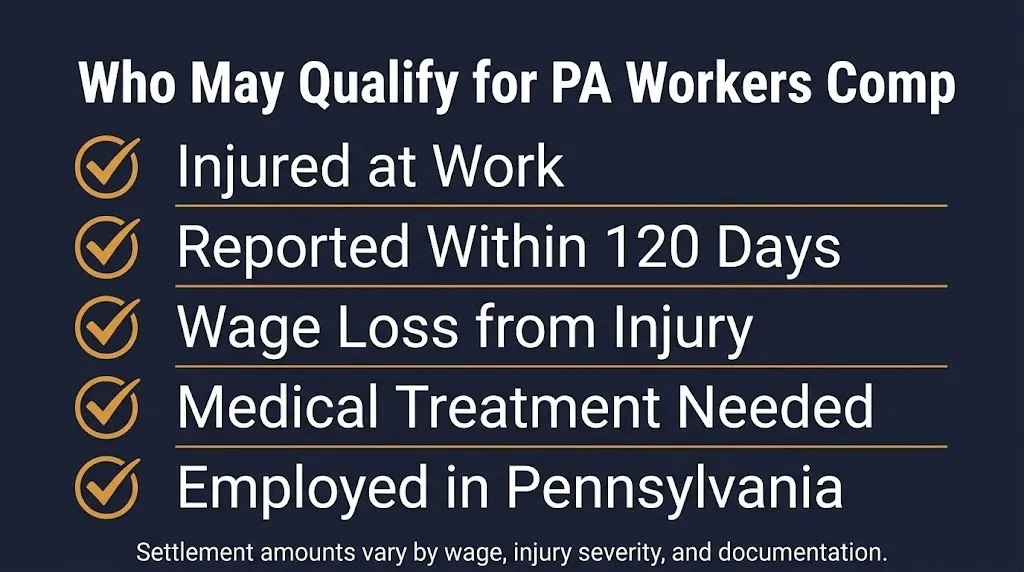
Filing a Pennsylvania workers’ comp claim starts with reporting your injury to your employer within 120 days. Miss that deadline and you may lose your right to benefits.
Here are the steps:
- Report the injury to your employer immediately. Tell your supervisor and put it in writing.
- Seek medical treatment. You can see a company doctor initially, but you have the right to switch to your own doctor after 90 days.
- File a Claim Petition if benefits are denied. The Bureau of Workers’ Compensation provides the forms.
- Document everything. Keep records of medical visits, wage stubs, and correspondence.
- Attend all medical appointments. Gaps in treatment give carriers ammunition to reduce your settlement.
- Consider hiring an attorney. Represented workers consistently receive higher settlements.
- Negotiate or litigate. Most cases settle. Some go to a workers’ comp judge.
The Bureau of Workers’ Compensation oversees the system. If your employer denies your claim, you can file a petition and request a hearing before a workers’ compensation judge.
When Will You Receive Your Pennsylvania Workers Comp Settlement?
There is no set timeline for receiving a Pennsylvania workers’ comp settlement. Some cases resolve in months. Others take years.
The timeline depends on how quickly you reach maximum medical improvement, whether the insurance carrier disputes your disability rating, whether negotiations stall, and whether a hearing becomes necessary .
Once you sign a Compromise and Release agreement, the carrier typically issues payment within 30 days. If the agreement requires judge approval, add time for the hearing and approval process.
For ongoing benefits, payments should arrive weekly. If they stop without explanation, contact the Bureau of Workers’ Compensation or your attorney immediately.
What Happens Next: Pennsylvania Workers Comp Timeline
Immediately after injury: Report to your employer and seek medical treatment.
Within 120 days: File your claim. Missing this deadline can bar your benefits.
Ongoing: Attend medical appointments and document your wage history.
When you reach maximum medical improvement: Your doctor assigns an impairment rating. This drives settlement value.
Negotiation phase: Your attorney and the carrier exchange demands and offers. Most cases settle here.
If no settlement: A workers’ compensation judge hears the case and issues a decision.
After settlement: If you signed a C&R, payment typically arrives within 30 days.
Frequently Asked Questions
What is the average workers comp settlement in Pennsylvania?
There is no official average. Settlements range from a few thousand dollars for minor injuries to six figures for permanent disabilities, depending on your wage, injury severity, and negotiation.
What is the maximum workers comp rate in Pennsylvania for 2026?
The maximum weekly compensation rate for 2026 injuries is $1,394.00 per week. This is a 3.5% increase from the 2025 cap of $1,347.00 .
How is workers comp calculated in Pennsylvania?
Your weekly benefit is two-thirds of your average weekly wage, capped at $1,394.00 for 2026 injuries. Your AWW includes overtime, bonuses, and tips reported to the IRS .
Can I get a lump sum settlement in Pennsylvania?
Yes. A Compromise and Release settlement closes your case permanently in exchange for a one-time payment. You give up future wage-loss and medical benefits.
How long do I have to report a work injury in Pennsylvania?
You must report your injury to your employer within 120 days. Failing to do so may bar your claim for benefits.
How long can I receive partial disability in Pennsylvania?
Partial disability benefits are capped at 500 weeks (approximately 9.6 years), though those weeks need not be consecutive .
What happens if I can’t return to work after my injury?
You may qualify for permanent total disability benefits. Eligibility depends on your impairment rating and whether you can perform any work.
Do I need an attorney for a Pennsylvania workers comp claim?
You’re not required to hire one, but represented workers typically receive higher settlements. Attorney fees in workers’ comp are usually capped at 20% of the recovery.
The Bottom Line
There is no average workers comp settlement in Pennsylvania. The state sets a maximum weekly benefit rate of $1,394.00 for 2026 injuries, but what you actually receive depends on your wage history, injury severity, and how well you document your case .
If you’ve been hurt at work, report it immediately. The 120-day deadline is real. Gather your wage records, including overtime and bonuses. Consistent medical treatment matters more than you might think.
Your settlement isn’t a lottery ticket. It’s compensation for a specific injury, calculated from specific numbers. The better your documentation, the stronger your position.