McDonald’s Coffee Lawsuit 2026: Settlement Updates and Claim Facts
Quick Answer
- Is it real? Yes, several active personal injury lawsuits allege McDonald’s serves coffee at temperatures causing second and third-degree burns.
- How much? Payouts are not yet determined for pending cases, though historical settlements reached mid-six figures after trial reductions.
- Deadline: Claim deadlines vary by state statutes of limitations, typically two to four years from the date of the injury.
The McDonald’s coffee lawsuit remains one of the most misunderstood legal topics in the United States. While many remember the 1994 Liebeck case, new filings in 2024 and 2025 have brought these safety concerns back into 2026 court dockets. These modern cases allege that the fast-food giant still struggles with lid security and liquid temperatures.
You may qualify for a legal claim if you suffered severe burns from McDonald’s coffee recently. Courts are currently looking at specific evidence regarding lid application and beverage temperature at the time of sale. This article breaks down the latest filings, the evidence you need, and how these individual cases differ from a class action.
We analyze the court records from the San Francisco Superior Court and other jurisdictions to see what is actually happening. You will find verified details on the Mable Childress case and other 2026 legal movements. This is the most current report on how to handle a burn claim this year.
The Facts
| Feature | Details |
|---|---|
| Case | Multiple individual filings (e.g., Childress v. McDonald’s) |
| Status | Active litigation in multiple state courts |
| Fund Size | Not yet confirmed (Individual settlements vary) |
| Est. Per Person | Not yet determined (Based on injury severity) |
| Claim Deadline | TBD (Depends on state statute of limitations) |
| Administrator | Not yet appointed (Handled by private counsel) |
| Proof Needed | Medical records, receipt, photos of burns/lid |
Is the McDonald’s coffee lawsuit real in 2026?
The short answer is yes, but it is not a single nationwide class action settlement. Many people expect a giant fund where they can simply fill out a form online. That is not how these cases work in 2026. Instead, individual plaintiffs are filing personal injury lawsuits against specific franchises and the corporation.
The most prominent active case involves Mable Childress, who filed suit after a 2023 incident. Her legal team alleges that a lid was not properly secured at a San Francisco drive-thru. This resulted in severe burns that required medical intervention. Other similar cases have appeared in New Jersey and Texas over the last 24 months.
You should know that these are “negligence” cases. A lawyer must prove that the restaurant failed to provide a safe product. They also look at whether the coffee was hotter than industry standards. If you see an ad claiming there is a “generic” settlement for everyone, be careful. You must usually prove a specific injury to participate.
How much is the McDonald’s coffee lawsuit payout?
The payout for a coffee burn lawsuit is not a fixed number for everyone. Every case depends on the “damages” the person suffered. Damages include medical bills, lost wages, and pain and suffering. In the famous 1994 case, the jury awarded $2.86 million, but the judge lowered it to $640,000.
Modern settlements are often kept confidential. Most legal experts suggest that a successful claim for a severe burn may range from $50,000 to over $500,000. These figures are not guaranteed. If the burn was minor and healed quickly, the payout might only cover medical costs.
Insurance companies for franchises often try to settle quickly for small amounts. You should wait until your medical treatment is finished before accepting any money. This ensures you know the total cost of your care. Taking a check too early could mean you lose the right to more money later.
Who qualifies for a McDonald’s hot coffee burn claim?
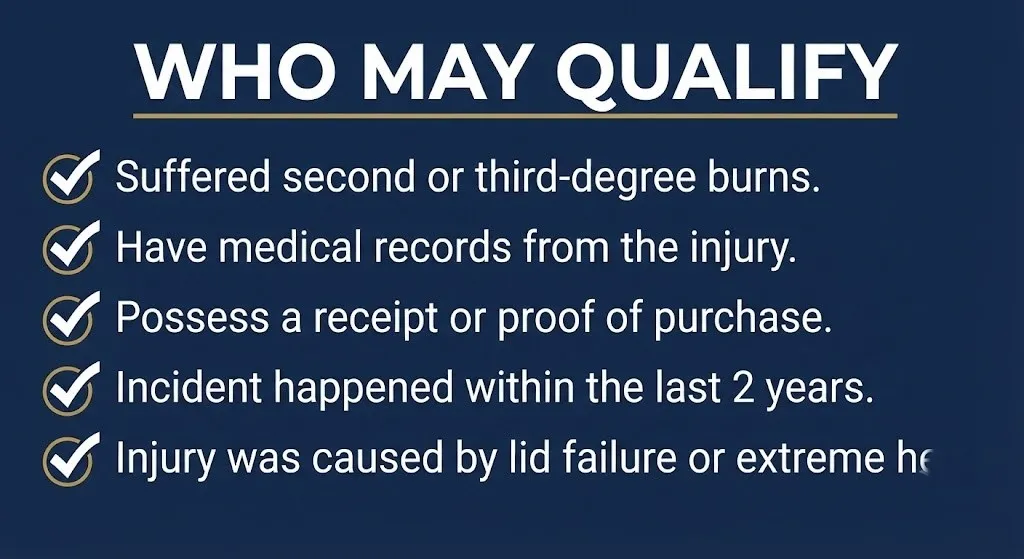
Qualification starts with the severity of the injury. Courts rarely entertain lawsuits for first-degree burns, which are like mild sunburns. To have a strong case in 2026, you generally need medical records showing second-degree or third-degree burns. These injuries often involve blistering or permanent scarring.
You must also prove the incident happened at a McDonald’s location. A receipt is the best way to do this, but bank statements or store video can also work. The timing of the incident is another factor. Most states require you to file within two years of the burn.
- Injury Severity: Second or third-degree burns confirmed by a doctor.
- Location: Incident occurred at a corporate or franchised McDonald’s.
- Evidence: Proof of purchase and photos of the faulty lid or cup.
- Timeframe: Within the state’s statute of limitations for personal injury.
- Medical Care: Immediate treatment at an urgent care or hospital.
Key Takeaway: Current 2026 claims against McDonald’s are individual personal injury lawsuits, not a single class action fund, and require proof of severe medical injury.
How to file a lawsuit against McDonald’s for coffee burns
Filing a lawsuit is a formal process that requires specific legal steps. It is not as simple as sending an email to the corporate headquarters. You generally need to hire a personal injury lawyer who works on a “contingency fee” basis. This means they only get paid if you win the case.
- Seek medical attention immediately to document the burn.
- Save the cup, lid, and your receipt from the transaction.
- Take clear photos of the injury and the location where it happened.
- Write down the time, date, and names of any employees you spoke with.
- Consult with a licensed personal injury attorney in your state.
- Your lawyer will file a “complaint” in the local civil court.
- The court will serve the restaurant with the lawsuit papers.
- Both sides will enter a “discovery” phase to exchange evidence.
Comparing a lawsuit to a store return is helpful. If you return a shirt, you just need a receipt. If you sue for a burn, the “receipt” is your medical file. The court needs to see exactly what went wrong and how much it cost you to fix it.
Latest updates on the Mable Childress McDonald’s case
The Mable Childress case is one of the most watched litigations in 2026. The lawsuit claims she suffered “scarring and emotional distress” after her coffee spilled in her lap. The central argument is that the employee did not secure the lid correctly. This is a common theme in modern coffee lawsuits.
In 2025, the case moved into the discovery phase. This is where lawyers look at store training manuals. They want to know if employees are taught how to check lids. McDonald’s has defended its safety record, stating that millions of cups are served safely every day.
We expect a trial date or a settlement announcement later this year. This case is important because it sets a precedent for other 2026 filings. If Childress wins a large award, more people may come forward with similar claims. If she loses, it might discourage future lawsuits over lid safety.
Why is McDonald’s being sued for hot coffee again?
Many people ask why this is still a problem 30 years after the first big case. The issue is the balance between flavor and safety. Coffee experts say the best flavor is extracted at high temperatures. McDonald’s often serves coffee between 180 and 190 degrees Fahrenheit.
At 190 degrees, liquid can cause a third-degree burn in less than three seconds. This leaves very little room for error if a spill occurs. Plaintiffs in 2026 argue that this temperature is “unreasonably dangerous” for a drive-thru environment. They claim the company prioritizes “holding time” over customer safety.
A second issue is the cup design. Some lawsuits allege that the cups become soft when the coffee is too hot. This can lead to the cup collapsing or the lid popping off when a customer squeezes it. These technical failures are the core of many current 2026 legal arguments.
Key Takeaway: Modern litigation focuses on the extreme temperature of the liquid and the mechanical failure of the lids or cups during drive-thru handoffs.
What are the current McDonald’s coffee temperature standards?
McDonald’s internal manuals typically require coffee to be brewed at very high temperatures. The company has historically maintained that customers want their coffee hot when they reach their destination. In 2026, most locations still serve coffee significantly hotter than home-brewed versions.
Industry standards for “hot” beverages usually sit around 160 to 175 degrees. McDonald’s often exceeds this. Their argument is that the temperature drops quickly once the customer adds cream or sugar. They also believe the high heat keeps the coffee fresh for longer periods.
Lawyers for burn victims argue that 180 degrees is the “danger zone.” They point out that water boils at 212 degrees. Serving a drink just 30 degrees below boiling is a risk many consumers do not realize they are taking. This temperature difference is the main evidence in most 2026 court filings.
Difference between a class action and individual personal injury
It is important to understand that there is no “class action” for McDonald’s coffee burns right now. A class action is for when thousands of people suffer the exact same small loss. For example, if a store overcharged everyone by five cents, that would be a class action.
A coffee burn is a personal injury case because every burn is different. One person might have a small scar while another needs a skin graft. One person might miss a week of work while another is retired. Because the “damages” are unique to you, you must usually sue on your own.
Think of it like a car accident. You would not join a “class action” for every person hit by a certain brand of car. You would file your own claim for your specific car and your specific injuries. This is why you need your own lawyer for a 2026 coffee claim.
How long does a McDonald’s settlement take to pay out?
A settlement with a major corporation rarely happens overnight. It is more like waiting for a complex insurance claim to process. From the time you file the lawsuit, it can take 12 to 24 months to reach a resolution. Some cases go even longer if they go all the way to a jury trial.
If both sides agree to a settlement, the payout usually arrives in 30 to 60 days. The money goes to your lawyer first. They take their fee and pay off any medical liens. Then, they send you a check for the remaining balance.
In 2026, many courts are still backlogged. This means getting a trial date can take a long time. Many plaintiffs choose to settle out of court to avoid the long wait. A settlement gives you guaranteed money now instead of a “maybe” in two years.
Key Takeaway: Expect a timeline of one to two years for a resolved claim, as individual personal injury cases require extensive discovery and medical verification.
What evidence is needed for a hot coffee burn claim?
Evidence is the most important part of your 2026 claim. Without it, the court will likely dismiss your case. You need to prove three things: the coffee was from McDonald’s, it was too hot or the lid failed, and you were hurt.
Photos are the strongest evidence you can provide. You should take pictures of the cup, the lid, and the area where the spill happened. Most importantly, take photos of the burn every day as it heals. This shows the court the progression of the injury and the pain you endured.
- Original Packaging: Keep the cup and lid in a plastic bag if possible.
- Medical Records: Hospital intake forms specifically mentioning “scald” or “burn.”
- Witness Information: Names of passengers or people who saw the spill.
- Expert Testimony: A doctor’s report explaining the permanence of the scar.
- Store Footage: Your lawyer can request the drive-thru camera video.
Settlement amounts in historical McDonald’s coffee cases
Looking at the past helps us understand the future of 2026 claims. The Stella Liebeck case is the benchmark. Even though her award was reduced, it changed how companies look at temperature. Since then, many smaller settlements have happened behind closed doors.
In 2002, a woman in California received an undisclosed settlement after a similar lid failure. In 2017, a jury in Florida awarded a woman $100,000 for a burn from a different fast-food chain. These cases show that courts are still willing to hold companies accountable.
The amounts vary wildly based on the state. Some states have “caps” on how much you can get for pain and suffering. Other states allow juries to award “punitive damages” to punish the company. Your lawyer will look at these historical trends to estimate your specific claim value.
Common defenses McDonald’s uses in burn lawsuits
McDonald’s does not simply hand over money when someone gets burned. They have a team of lawyers who use several common defenses. The most frequent defense is “comparative negligence.” This means they argue the spill was actually your fault.
They might say you were driving too fast or that you held the cup too tightly. They also argue that the “open and obvious” danger of hot coffee is something everyone should know. In their view, if you order hot coffee, you should expect it to be hot enough to burn you.
Another defense involves the “warning” on the cup. Every McDonald’s cup has a warning printed on it. They argue that this warning fulfills their legal duty to protect you. A 2026 jury will have to decide if a tiny warning is enough to justify serving near-boiling liquid.
Key Takeaway: McDonald’s often fights these cases by claiming the customer was responsible for the spill or that the warning labels were sufficient.
Reality Check
Reality Check: You should never pay an upfront fee to join a “settlement” or file a claim. Legitimate personal injury lawyers work on contingency, meaning they take a percentage of the final payout. If someone texts you asking for a “processing fee” to get your McDonald’s money, it is likely a scam.
Will there be a 2026 nationwide McDonald’s settlement?
It is very unlikely that we will see a single nationwide settlement in 2026. Because every franchise is often owned by a different person or group, a global settlement is difficult. Each store has its own insurance policy and its own set of facts.
A nationwide settlement usually only happens if there is a massive product recall. Since coffee is a prepared food item, not a manufactured widget, the legal path stays individual. You should focus on your specific incident rather than waiting for a “big group” settlement.
Keep an eye on the news for any “Multi-District Litigation” (MDL) filings. An MDL is a way to group many similar cases together to speed them up. While one does not exist for coffee burns right now, a sudden surge in cases could change that later in 2026.
State laws and statutes of limitations for burn claims
The rules for suing McDonald’s change the moment you cross a state line. For example, in California, you generally have two years to file a lawsuit. In Tennessee, you might only have one year. If you miss this deadline, you lose your right to sue forever.
Some states follow “contributory negligence” rules. In these states, if you are even 1% at fault for the spill, you get nothing. Most states use “comparative negligence,” where your payout is reduced by your percentage of fault. If the jury says you were 20% responsible, you only get 80% of the money.
- California: 2-year limit, comparative negligence.
- Texas: 2-year limit, modified comparative negligence (51% rule).
- Florida: 2-year limit (recently changed), comparative negligence.
- New York: 3-year limit, pure comparative negligence.
- Virginia: 2-year limit, strict contributory negligence.
Risks of using third party claim helpers for lawsuits
In 2026, the internet is full of “claim aggregator” websites. These sites look like official government agencies but are actually lead-generation tools. They take your information and sell it to various law firms. Sometimes, they use misleading language to make you think you are already part of a settlement.
The risk is that your private medical data could be shared with dozens of companies. You are much safer finding a reputable, local personal injury attorney. You can check their reviews and see their actual office location. This ensures you are getting real legal help, not just being sold as a “lead.”
Always verify that the person you are talking to is a licensed attorney. You can do this by searching the “State Bar” website in your state. If a company cannot provide a bar license number, you should stop talking to them immediately.
Key Takeaway: Protect your privacy by dealing directly with licensed attorneys rather than third-party websites that sell your personal injury data.
What Happens Next
The legal landscape for coffee burns is moving toward several key dates in the coming months.
- Expected Q4 2026: Final rulings on pre-trial motions for the Mable Childress case in San Francisco.
- Expected early 2027: Trial dates for several 2025 filings in New Jersey and Texas.
- Ongoing 2026: Discovery phases for new claims filed in the first half of this year.
Frequently Asked Questions
Is the McDonald’s coffee settlement a scam?
No, the lawsuits are real legal actions filed in civil courts.
However, some websites claiming you can “instantly” get money without an attorney are misleading.
Always verify the case through official court records or a licensed lawyer.
How do I join the 2026 McDonald’s coffee lawsuit?
You do not “join” a class action; you file an individual personal injury claim.
Contact a personal injury lawyer to start a lawsuit based on your specific burns.
You will need to provide medical records and proof of purchase.
Can I still sue for a burn that happened years ago?
It depends on your state’s statute of limitations, which is usually two to three years.
If the injury happened more than four years ago, it is likely too late to file.
Check with a local attorney to see if any “tolling” rules apply to your case.
What is the average settlement for a coffee burn?
There is no “average” because settlements are based on individual medical costs.
Cases with permanent scarring or surgery often settle for much higher amounts.
Minor burns that heal without scarring may only result in a few thousand dollars.
Does McDonald’s pay for medical bills after a spill?
They do not automatically pay bills unless you win a lawsuit or reach a settlement.
You must usually pay your own bills or use your health insurance first.
The settlement later reimburses you for these out-of-pocket costs.
What if I didn’t keep the cup or receipt?
You can still file a claim, but it is much harder to prove your case.
Bank statements showing the purchase or store surveillance video can serve as evidence.
Your lawyer will need to work harder to verify the location and time.
Do I have to go to court for a coffee lawsuit?
Most cases settle before they ever reach a courtroom.
You may have to give a “deposition,” which is an interview under oath.
If the company refuses to settle, a trial may be necessary to get compensation.
Is the coffee still served at 190 degrees?
Many locations still brew and serve coffee at temperatures between 175 and 190 degrees.
McDonald’s maintains this is the industry standard for hot coffee.
Plaintiffs continue to argue this temperature is too high for safe handling.
To protect your rights in 2026, you should act quickly. Gather every piece of evidence you have, including your medical records and any photos of the injury. Consult with a legal professional to see which state laws apply to your situation. The most important step is ensuring you do not miss the filing deadline in your specific state.