Compensation Grade Meaning 2026: How Pay Grades Work in Government and Private Jobs
Quick Answer
- A compensation grade is a pay level that groups similar jobs into a defined salary range.
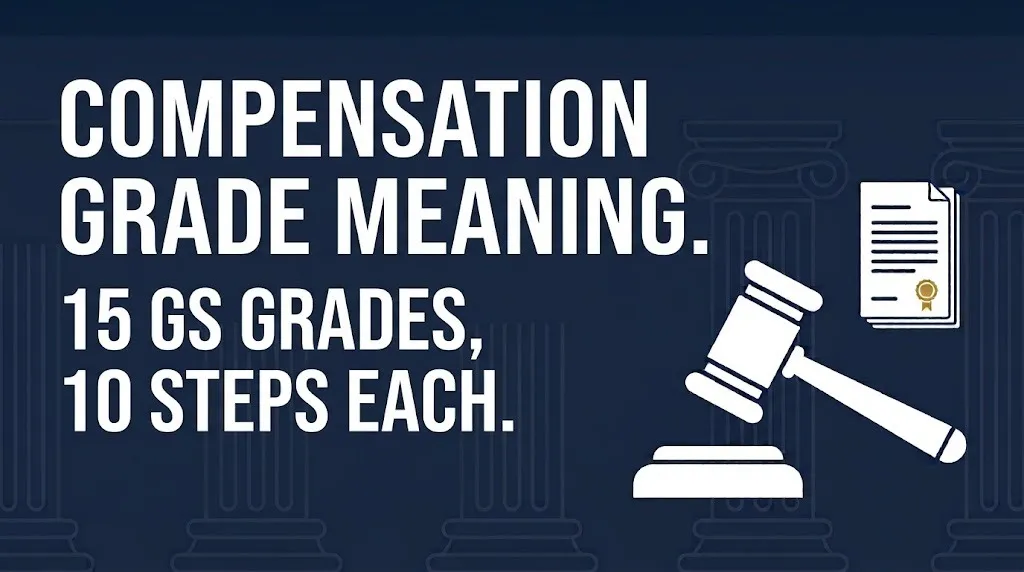
- The federal General Schedule (GS) uses 15 grades, from GS-1 (lowest) to GS-15 (highest).
- Each grade has 10 steps, with increases worth roughly 3% per step.
The term “compensation grade” shows up in job postings, federal hiring announcements, and HR policy documents. It’s one of those phrases that feels official but often goes unexplained.
A compensation grade is a pay classification that groups jobs requiring similar levels of difficulty, responsibility, and qualifications into a defined salary range. The federal government’s General Schedule is the most structured example, but private employers, state agencies, and international organizations all use some version of pay grading.
This article breaks down exactly what compensation grades mean, how the federal GS system works, how steps and promotions function, and what to look for when you see a grade listed in a job announcement.
The Facts
| Detail | Status |
|---|---|
| Federal pay system | General Schedule (GS) |
| Number of GS grades | 15 (GS-1 lowest, GS-15 highest) |
| Steps within each grade | 10 (step 1 lowest, step 10 highest) |
| Step increase value | Approximately 3% of salary |
| Waiting periods for steps | 1 year (steps 1-3), 2 years (steps 4-6), 3 years (steps 7-9) |
| Time to advance step 1 to 10 | Normally 18 years |
| Locality pay areas | 47 (lower 48, DC, Alaska, Hawaii, territories) |
| Education benchmarks | Bachelor’s degree typically GS-5, Master’s typically GS-9 |
What is a compensation grade?
A compensation grade is a defined pay level that groups jobs with similar difficulty, responsibility, and qualification requirements into a single salary structure. The U.S. Office of Personnel Management explains that agencies “establish (classify) the grade of each job based on the level of difficulty, responsibility, and qualifications required” .
In plain terms, it’s a way to categorize jobs so that people doing similarly complex work get paid within the same range. A file clerk and a senior policy analyst aren’t paid the same because their jobs require different skills and carry different responsibility levels.
The federal General Schedule covers about 1.5 million civilian white-collar employees worldwide in professional, technical, administrative, and clerical positions . Each grade represents a specific level of work complexity and required expertise.
Private companies often use their own pay grades, sometimes labeled with letters or numbers instead of GS designations. The underlying principle stays the same: jobs with similar value to the organization fall into the same compensation band.
Key Takeaway: A compensation grade is a pay classification that groups jobs by difficulty, responsibility, and qualifications into a defined salary range. The federal GS system has 15 grades.
How does the federal General Schedule compensation grade system work?
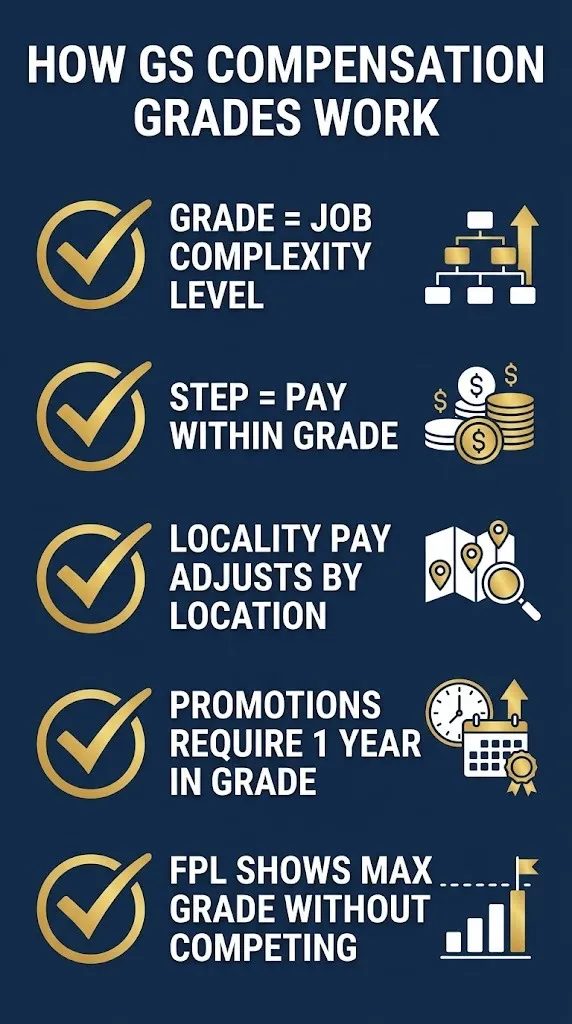
The federal General Schedule uses 15 grades and 10 steps within each grade to create a structured pay system . Your grade determines your base salary range, and your step determines where you fall within that range.
Grades reflect the complexity and responsibility of the work. GS-1 covers the simplest entry-level positions. GS-15 covers the highest-level professional and administrative roles below the Senior Executive Service.
Steps reward longevity and performance within a grade. A new GS employee usually starts at step 1 of their grade . Each step increase adds roughly 3% to your salary.
| Grade | Typical Education/Experience | Work Complexity |
|---|---|---|
| GS-1 to GS-4 | High school diploma or less | Routine, structured tasks |
| GS-5 to GS-8 | Bachelor’s degree (GS-5) | Standard professional work |
| GS-9 to GS-12 | Master’s degree (GS-9) | Specialized, independent work |
| GS-13 to GS-15 | Advanced experience | Expert-level, leadership, program direction |
The federal law that governs GS classification, 5 USC 5104, spells out detailed criteria for each grade. GS-13 positions, for example, require “work of unusual difficulty and responsibility” with “wide latitude for the exercise of independent judgment” .
Key Takeaway: The GS system uses 15 grades and 10 steps. Your grade reflects job complexity, and your step reflects time and performance within that grade.
What do the steps within a compensation grade mean?
Steps are salary increments within a grade that increase pay by roughly 3% each. There are 10 steps per grade, and you advance based on waiting periods and acceptable performance .
The waiting periods are structured to reward longevity:
- Steps 1 to 3: One year between increases
- Steps 4 to 6: Two years between increases
- Steps 7 to 9: Three years between increases
Moving from step 1 to step 10 within a single grade normally takes 18 years if you stay in that grade . That’s the structured progression the system is designed to produce.
Employees with outstanding performance ratings may qualify for quality step increases faster than the standard waiting periods, with a maximum of one per year .
A new federal employee is usually hired at step 1 of their grade. In special circumstances, agencies can authorize a higher starting step based on “special need of the agency or superior qualifications of the prospective employee” .
Key Takeaway: Steps are 3% pay increases within your grade. Standard progression takes 18 years from step 1 to step 10, but quality step increases can accelerate that.
How do locality pay areas affect compensation grades?
Locality pay adds a geographic percentage adjustment on top of the base GS pay scale. There are currently 47 locality pay areas covering the lower 48 states, Washington DC, Alaska, Hawaii, and U.S. territories .
The General Schedule base pay is set nationally. But federal workers in expensive metropolitan areas receive locality adjustments to reflect local labor market conditions. These adjustments are determined by surveys conducted by the U.S. Bureau of Labor Statistics .
The 44 large metropolitan areas include places like Los Angeles, New York, and Washington DC. Alaska and Hawaii each have their own statewide locality areas. The rest of the country falls into the “Rest of U.S.” catch-all area .
Locality pay is separate from your grade and step. It’s a percentage added on top of the base salary for your grade and step. Two employees at GS-12 step 5 can earn different amounts if they work in different localities.
GS employees in foreign areas are not eligible for locality pay .
Key Takeaway: Locality pay adjusts your base grade-and-step salary based on where you work. There are 47 locality pay areas, and foreign postings don’t qualify.
How do promotions work between compensation grades?
Promotions between grades generally require at least one year at the lower grade and a competitive process. After you reach the full promotion potential of your position, further advancement requires competing for a new job .
The “career ladder” concept is central to how federal promotions work. A job announcement might list a promotion potential of GS-13, meaning you can advance up to that grade without competing for a new position, subject to time-in-grade requirements and performance .
Generally, a GS promotion increase is equal to at least two steps at the GS grade immediately before promotion to the higher grade . So moving from GS-11 to GS-12 doesn’t just add one step’s worth of pay, it adds at least two.
After you reach the full promotion potential advertised in your job announcement, “competition under merit system principles is necessary to advance to a higher GS grade” .
The full performance level (FPL) is the highest grade you can reach in a position without competing. You’ll see this in job announcements as “FPL-13” or similar notation.
Key Takeaway: Promotions to higher grades require at least one year in grade and competitive selection. The promotion increase is at least two steps at your current grade level.
What does a compensation grade look like in a job announcement?
In a federal job announcement, you’ll see the compensation grade written as a code: “GS-0201-13” or “GS-11/12” . The GS stands for General Schedule. The four-digit number is the occupational series. The final number is the grade level.
The occupational series groups similar types of work. All secretary positions are in the 0318 series, all chemist positions are in the 1320 series, and so on . This helps you find other jobs in the same field.
When you see “GS-11/12” it means the agency may hire you at either grade level depending on your qualifications. The salary range shown in the announcement will reflect both grades .
The “FPL” notation means “Full Performance Level.” A job advertised as “GS-09, FPL-13” means you can be promoted up to GS-13 without competing for a new position, subject to time and performance requirements .
You’ll also see “promotion potential” listed separately. This tells you the highest grade you can reach in the position you’re applying for .
Key Takeaway: Job announcements show grade as a code like GS-0201-13. The FPL tells you how high you can advance without competing for a new job.
How does compensation grading work in the private sector?
Private sector compensation grades are less standardized than the federal GS system but follow similar principles. Companies design pay grades based on job factors like education needed, tasks involved, skills used, and abilities required.
A pay structure is “a collection of pay grades, levels or bands, linking related jobs within a hierarchy or series, that provides a framework for the implementation of reward strategies and policies” . Private employers often use letter-based grades (A, B, C) or number-based bands (Level 1, Level 2).
The military uses a multi-axial approach where pay depends on rank and time in service at that rank . This transparent model lets service members know exactly what their base income is and where it will be years from now.
Some international systems use special pay scales for defense and research organizations. Pakistan’s SPS system, for example, runs from SPS-1 to SPS-14 with different basic pay amounts and annual increments .
Key Takeaway: Private sector grades follow similar logic to federal grades but aren’t standardized across employers. Military systems often use rank and time-in-service instead of GS-style grades.
Reality Check
A compensation grade isn’t a guarantee of a specific salary. It’s a range. Your actual pay depends on your step, locality, and any special rates that apply. Two people at the same grade can earn different amounts. Also, a high grade doesn’t automatically mean a high salary if you’re at step 1 in a low-cost locality. Check the full salary range for your specific grade, step, and duty location before making career decisions.
What is the difference between a grade and a step?
A grade determines the salary range based on job complexity. A step determines where you fall within that range based on time and performance. Grades reflect the job. Steps reflect the person filling it .
You can’t negotiate your way to a higher grade in the federal system without changing jobs. Your grade is tied to the position’s classification. But your step can be negotiated at hire, and it increases automatically over time.
A GS-12 position will always be classified as GS-12 regardless of who fills it. But the person filling it can be at step 1 earning the minimum, or step 10 earning roughly 30% more, depending on how long they’ve been in that grade.
This is different from private sector jobs where salary is often fully negotiable. In the federal GS system, grade and step create a structured, predictable pay trajectory.
What happens next
January 2026: Annual GS pay adjustment took effect based on nationwide wage changes.
Ongoing: Agencies classify positions and set grades based on OPM standards.
Ongoing: Within-grade step increases process on standard waiting periods.
TBD: Future pay adjustments depend on Presidential and Congressional action.
Ongoing: Locality pay rates updated annually based on Bureau of Labor Statistics surveys.
Frequently Asked Questions
What does compensation grade mean?
A compensation grade is a pay level that groups jobs of similar difficulty, responsibility, and qualifications into a defined salary range.
How many grades are in the federal General Schedule?
The GS system has 15 grades, from GS-1 (lowest) to GS-15 (highest) .
How many steps are in each GS grade?
Each GS grade has 10 steps, with increases worth approximately 3% each .
How long does it take to go from step 1 to step 10?
Normally 18 years if you stay in the same grade, based on standard waiting periods .
What does GS-11/12 mean in a job announcement?
It means the agency may hire you at either GS-11 or GS-12 depending on your qualifications .
What is the Full Performance Level (FPL)?
The FPL is the highest grade you can reach without competing for a new position. It’s usually listed in job announcements .
Do private companies use compensation grades?
Yes. Many private employers use pay grades or bands, though they’re not standardized across companies like the federal GS system .
What is locality pay?
A geographic adjustment added to base GS pay based on where you work. There are 47 locality pay areas .
Closing
A compensation grade is your job’s pay classification, and your step is where you sit within it. The federal GS system uses 15 grades and 10 steps, with locality pay adding geographic adjustments. Check the full salary range for your specific grade, step, and duty location before accepting any offer.