Annuity Settlement Options 2026: The Complete Guide to Structured Payouts
Quick Answer
- Annuity settlement options are payout structures that convert a lump sum into periodic tax-free payments for injury settlements .
- The most common options are life annuities, period-certain annuities, and life with period certain .
- Structured settlements under IRC 104(a)(2) produce tax-free payments for physical injury claims .
When you settle a personal injury or workers compensation claim, you face a choice: take a lump sum or structure the payout over time. The annuity settlement options available to you determine how that money flows and for how long.
Most people don’t realize the range of options. They think “settlement” means a single check. But structured settlements, funded by annuities issued by life insurance companies, offer dozens of payout configurations tailored to your needs .
This article breaks down every major annuity settlement option, how each one works, the tax rules that make structured settlements valuable, and how to evaluate which option fits your situation.
The Facts
| Detail | Status |
|---|---|
| Funding mechanism | Single-premium annuity from a life insurance company |
| Tax treatment (physical injury) | Payments fully tax-free under IRC 104(a)(2) |
| Tax treatment (non-qualified) | Portion of each payment taxable as earnings |
| Common payment intervals | Monthly, quarterly, semi-annual, or annual |
| Minimum payment threshold | Typically $50 per payment |
| Regulatory framework | State Structured Settlement Protection Acts |
| Factoring companies | J.G. Wentworth, Peachtree Settlement Funding, Stone Street Capital |
What is an annuity settlement option?
An annuity settlement option is a payout structure that converts a lump-sum settlement into a stream of periodic payments. The defendant or their insurer purchases a single-premium annuity from a life insurance company, and that annuity funds the payments you receive .

The structure works like this: you settle your claim for an agreed amount. Rather than taking a check, you elect a payout option. The defendant assigns its payment obligation to an assignment company, which buys an annuity matching your chosen payment schedule .
The insurance company becomes the obligor. You receive payments directly from them, backed by their financial strength rather than the defendant’s credit .
For a $500,000 settlement, you might elect $3,000 per month for life, or $10,000 per month for five years, or $150,000 lump sums every five years. The options are nearly limitless because the annuity can be customized.
Key Takeaway: An annuity settlement option is a customized payout schedule funded by an insurance company annuity. You choose the timing and duration of payments.
What are the different types of annuity settlement options?
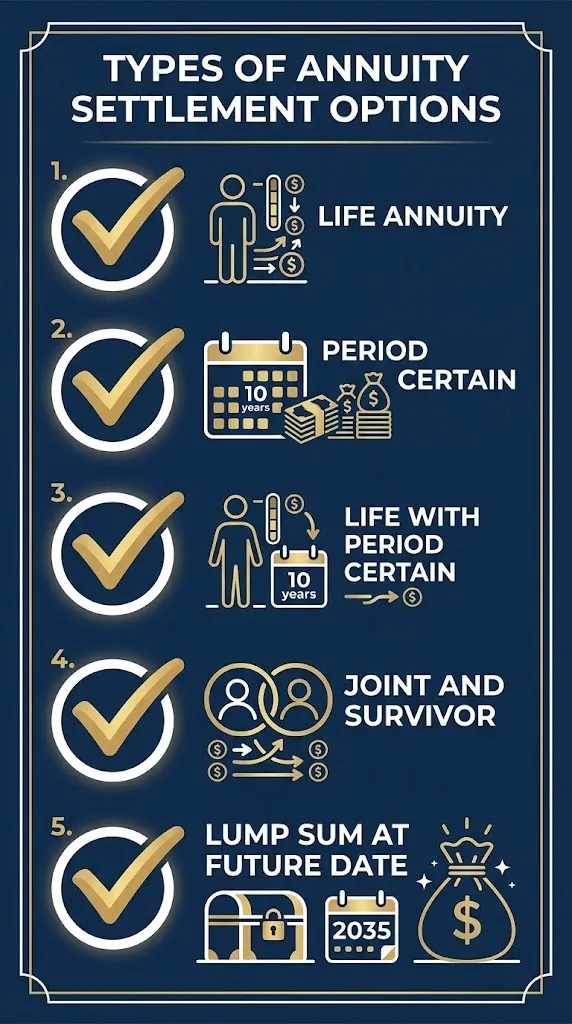
There are four primary categories of annuity settlement options: life annuities, period-certain annuities, life annuities with a guaranteed period, and lump-sum payments at future dates .
The Society of Actuaries identifies these standard forms:
| Option Type | How It Works | Key Feature |
|---|---|---|
| Annuity Certain | Fixed payments for a set number of years | Payments go to estate if you die |
| Single Life Annuity | Payments for your lifetime | Stops at death, no survivor benefit |
| Temporary Life Annuity | Payments for life but with an end date | Stops at death or end date, whichever first |
| Life with Period Certain | Life payments with guaranteed minimum | Estate gets remaining certain payments |
Most structured settlements combine elements. A single life annuity with a 20-year certain period guarantees payments for at least 20 years, then continues for life if you live longer .
Key Takeaway: The four core option types are annuity certain, single life, temporary life, and life with period certain. Most settlements mix these to match specific needs.
How does a life annuity settlement option work?
A life annuity pays you a guaranteed income stream for as long as you live. The payment amount is calculated based on your age, sex, and the amount funding the annuity .
The trade-off is straightforward. Lifetime payments mean smaller monthly amounts than a period-certain option of the same duration. But you can’t outlive the income .
Life annuities transfer longevity risk to the insurance company. If you live to 100, they keep paying. If you die at 60, payments stop and any remaining value stays with the insurer .
Most structured settlements don’t use pure life annuities because plaintiffs want guarantees. Instead, they use life with period certain. A life annuity with a 10-year certain period guarantees at least 120 monthly payments. If you die in year three, your beneficiary receives the remaining seven years of payments .
Key Takeaway: A life annuity guarantees income for life but stops at death. Life with period certain guarantees a minimum number of payments even if you die early.
What is a period-certain annuity settlement option?
A period-certain annuity pays fixed payments for a set number of years regardless of whether you live or die. The payments go to your estate or designated beneficiary if you die during the term .
This option is simpler than a life annuity. You know exactly how many payments you’ll receive and the total amount. A 20-year certain annuity at $2,500 per month delivers $600,000 total .
The downside is that if you outlive the certain period, payments stop. A 20-year certain option that starts at age 40 ends at age 60, leaving you without settlement income for the rest of your life .
Period-certain options work well for settlements meant to cover a specific future need, like education expenses or a defined period of lost earning capacity. They’re less suited for lifetime income replacement .
Key Takeaway: Period-certain annuities pay for a fixed term and go to your estate if you die. They don’t protect against outliving the payments.
How are structured settlement annuity payments taxed?
Structured settlement payments from physical injury or workers compensation claims are tax-free under Internal Revenue Code Section 104(a)(2) . This includes the investment earnings inside the annuity.
The tax benefit is significant. If you invest a $500,000 lump sum yourself, every dollar of growth is taxable. Inside a structured settlement, the annuity’s investment return comes to you tax-free .
For non-qualified settlements (claims not involving physical injury), the tax treatment differs. Each payment has two parts: a return of principal (not taxed) and earnings (taxed as ordinary income) .
| Settlement Type | Tax Treatment | Source |
|---|---|---|
| Physical injury/workers comp | Fully tax-free | |
| Non-qualified (e.g., employment) | Principal tax-free, earnings taxable | |
| Attorney fees (structured) | Tax-deferred, taxed when received |
The tax-free treatment only applies if the structure is incorporated into the settlement agreement before it becomes binding. You can’t settle, take the money, then decide to structure it .
Key Takeaway: Physical injury structured settlements are fully tax-free. Non-qualified settlements tax the earnings portion of each payment.
What documents must be in place for a structured settlement?
A structured settlement requires specific documentation before the settlement becomes legally binding. Timing matters because constructive receipt rules can destroy the tax benefits .
The required documents include:
- Settlement agreement provisions: The agreement must state that the plaintiff has no right to accelerate or defer payments.
- Attorney fee agreement: If the attorney is structuring fees, the fee agreement must permit periodic payments .
- Qualified assignment: The defendant assigns its obligation to a assignment company, typically a subsidiary of the annuity provider .
- Annuity application: The assignment company purchases the single-premium annuity.
- Court order (if minor): Settlements involving minors require court approval of the structure.
The documentation must be in place before the release is signed. Once the plaintiff has constructive receipt of the funds, structuring becomes ineffective for tax purposes .
Key Takeaway: Structured settlements require documentation completed before the settlement is binding. Timing is critical for preserving tax benefits.
Reality Check
A structured settlement isn’t right for everyone. If you need flexibility to invest, start a business, or handle unexpected expenses, a lump sum may serve you better. Structured settlements lock you into a payment schedule that’s difficult and expensive to change. Factoring companies will buy your future payments, but at a significant discount and with court approval required in most states . Don’t let anyone pressure you into structuring without understanding the trade-offs.
What is a joint and survivor annuity settlement option?
A joint and survivor annuity pays benefits until the death of two people, usually a married couple. When the first person dies, payments continue to the survivor, often at a reduced rate .
The standard form is a joint and one-half survivor annuity. Payments continue at 100% while both are alive. After the first death, the survivor receives 50% of the original payment until their death .
This option protects a surviving spouse who depends on the settlement income. A single life annuity stops at the injured person’s death, potentially leaving a spouse without income .
The trade-off is lower initial payments. Because the annuity is expected to pay for two lifetimes rather than one, the monthly amount is smaller than a single life option .
Some contracts also offer joint and two-thirds or joint and full survivor options, though these are less common in structured settlements .
Key Takeaway: Joint and survivor annuities protect a spouse by continuing payments after the first death. The cost is lower monthly payments while both are alive.
How do variable annuity settlement options work?
Variable annuity settlement options tie payment amounts to investment performance rather than fixing them at a set dollar amount. Payments fluctuate based on the subaccounts you select .
The mechanics work through “annuity units.” Your initial payment is converted into a number of units based on the unit value at the start date. Each subsequent payment equals the number of units multiplied by the current unit value .
If investments perform well, unit values rise and payments increase. If they perform poorly, payments decrease .
The assumed interest rate determines the baseline. If actual returns equal the assumed rate (often 4% or 5%), payments stay level. Returns above that rate increase payments. Returns below it decrease them .
Variable options are rare in personal injury structured settlements because plaintiffs want predictability. They’re more common in retirement annuities where inflation protection matters.
Key Takeaway: Variable annuity settlement options fluctuate with investment performance. They’re uncommon in structured settlements because predictability matters more than growth potential.
What happens if you need to sell your structured settlement payments?
If you need a lump sum later, you can sell some or all of your future structured settlement payments to a factoring company . The process requires court approval in most states.
The major factoring companies include J.G. Wentworth, Peachtree Settlement Funding, and Stone Street Capital . They purchase payment streams at a discount, often significantly less than the total value of the payments sold.
State Structured Settlement Protection Acts govern these transfers. Most require:
- A written disclosure statement given to you in advance
- Certification that you’ve been advised to seek independent professional advice
- Notice to affected parties
- An itemized calculation of the present value and fees
- Court approval finding the transfer is in your best interest
Forty-six states have enacted transfer laws based on the Model State Structured Settlement Protection Act . The court acts as a check against predatory factoring deals.
Key Takeaway: You can sell structured settlement payments, but court approval is required in most states. Factoring companies buy at a discount, often significantly reducing total value.
What happens next
Ongoing: Structured settlements continue as a preferred method for resolving large personal injury and workers compensation claims .
Ongoing: Factoring transactions require court approval under state Structured Settlement Protection Acts .
TBD: Federal tax treatment of structured settlements remains stable under IRC 104(a)(2) unless Congress acts .
Ongoing: Insurance companies continue offering customized annuity structures to match plaintiff needs .
Frequently Asked Questions
What is an annuity settlement option?
An annuity settlement option is a payout structure that converts a lump-sum settlement into periodic payments funded by an insurance company annuity .
What are the main types of annuity settlement options?
The main types are life annuities, period-certain annuities, life with period certain, and lump-sum payments at future dates .
Are structured settlement annuity payments tax-free?
Yes, for physical injury and workers compensation settlements. Payments are tax-free under IRC 104(a)(2) .
What is a life annuity with period certain?
It guarantees payments for a minimum period (like 10 or 20 years), then continues for life if you survive that period .
Can I sell my structured settlement payments?
Yes, but most states require court approval. Factoring companies buy payments at a discount .
What is a joint and survivor annuity?
An annuity that pays until the death of two people, usually spouses. The survivor receives reduced payments after the first death .
How is a structured settlement funded?
The defendant or insurer purchases a single-premium annuity from a life insurance company, which becomes obligated to make the payments .
What documents are needed for a structured settlement?
Settlement agreement with non-acceleration provisions, attorney fee agreement (if structuring fees), qualified assignment, and annuity application .
Closing
Annuity settlement options give you control over how settlement money reaches you. Life annuities protect against outliving your money. Period-certain options guarantee a fixed number of payments. Joint and survivor options protect spouses.
The most important step: understand the trade-offs before you sign anything. Once the settlement is binding, changing your structure is difficult and expensive.