Litigation Paralegal Jobs 2026: Salary Data, Remote Openings, and What Employers Actually Require
Quick Answer
- Litigation paralegal jobs are real, active hiring demand exists in 2026, with firms rebalancing work toward experienced paralegals as associate leverage shrinks.
- Pay ranges from roughly $50,000 for early-career roles to $110,000 or more for senior trial-focused positions, depending on market and specialty.
- The single most important thing to watch: application deadlines on specific postings, which move fast in litigation-heavy markets.
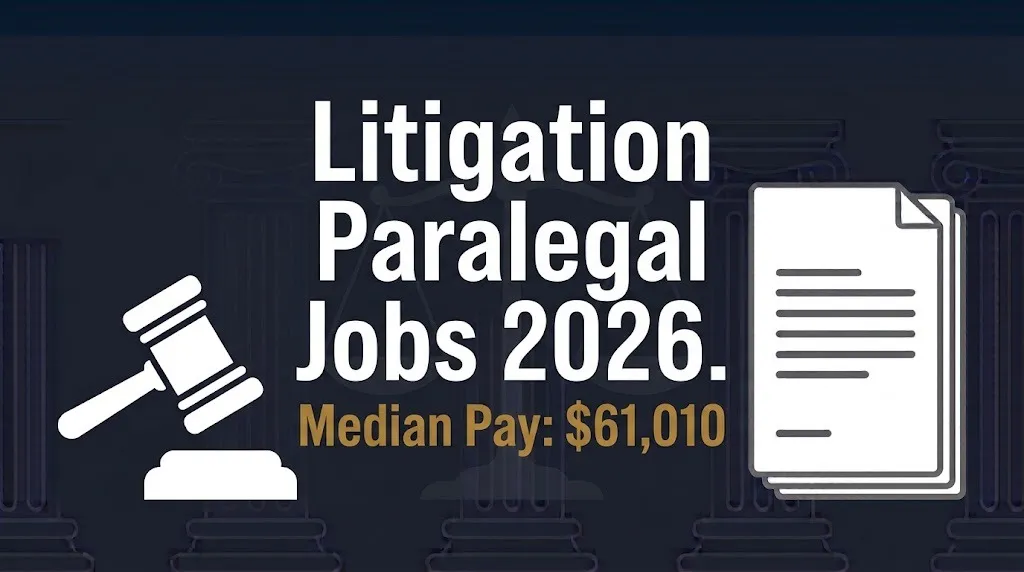
If you are searching for litigation paralegal jobs in 2026, the data tells a clear story: this is not a role growing because the legal profession is expanding. It is growing because litigation teams cannot function without it. The U.S. Bureau of Labor Statistics reports a median annual wage of $61,010 for paralegals and legal assistants, but experienced litigation specialists routinely earn well above that figure .
Civil caseloads remain elevated in several federal districts, particularly in employment, tort, and contract litigation. That matters because those cases are discovery-heavy and procedurally complex. Firms are pushing more operational responsibility onto paralegals as junior associate leverage tightens and clients refuse to pay associate rates for document review and scheduling .
This article covers what litigation paralegal jobs pay in 2026, which practice areas are hiring hardest, what remote openings actually require, and the specific skills that separate a $55,000 offer from a $110,000 one. The surprising detail: the highest-paying litigation paralegal roles in 2026 are not always at the biggest firms. Corporate legal departments and tech companies are bidding up compensation for paralegals who can manage e-discovery and regulatory response without hand-holding.
The Facts
Case: Litigation paralegal employment market, 2026
Status: Active hiring across multiple sectors
Fund Size: Not applicable (employment market, not settlement)
Est. Per Person: Median annual wage $61,010, BLS May 2024 data; experienced specialists $85,000 to $110,000+
Claim Deadline: Application deadlines vary by posting, typically 7 to 30 days after listing
Administrator: Not applicable
Proof Needed: Paralegal certificate, degree, or equivalent experience, depending on employer
How Do You Know If a Litigation Paralegal Job Is Legitimate in 2026?
A legitimate litigation paralegal job means a real employer with a verifiable business presence, a specific pay range or salary, and a posted application deadline. If a listing asks you to pay for training or equipment upfront, it is not a legitimate job.
The legal staffing market has always attracted bad actors. In 2026, the scam patterns are predictable: vague “remote paralegal” listings with no firm name, requests for your Social Security number before an interview, or “certification” programs that charge $500 for a credential no employer recognizes .
Here is what a real posting looks like. Jacoby & Meyers, a firm with a recognizable consumer law practice, posted a fully remote litigation paralegal role at $30 to $38 per hour with specific requirements: 1 to 3 years civil litigation experience, a paralegal certificate, and the ability to handle high-volume caseloads . Haleon, a consumer health company, listed a hybrid litigation paralegal role in Warren, New Jersey at $40.43 to $55.60 per hour plus an 8% bonus target, with a posting end date of April 1, 2026 .
Those are the markers: named employer, specific pay, clear location or remote designation, and a deadline.
If a listing is missing all of those, treat it as unverified. Check the firm’s website directly. Call the main office number. Do not send documents until you have confirmed the employer exists.
How Much Do Litigation Paralegal Jobs Pay in 2026?
Litigation paralegal pay in 2026 ranges from roughly $50,000 for early-career roles to $110,000 or more for senior trial-focused positions, with significant variation by market, practice area, and employer type.
The Bureau of Labor Statistics reports a median annual wage of $61,010 for paralegals and legal assistants as of May 2024 . That is the floor-level national number, and it understates what experienced litigation paralegals actually earn.
Glassdoor data from 2026 shows an average total pay of $75,462 for litigation paralegals, with a 25th percentile of $62,059 and a 75th percentile of $92,463 . Top earners in that dataset reach $110,676.
ZipRecruiter reports a median of $72,200 for litigation paralegals in New York, with most workers earning between $61,800 and $85,300 . Adzuna lists an average salary of $79,920 for litigation paralegal jobs in Texas .
Litigation Paralegal Pay by Experience Level (2026)
| Experience Level | Typical Annual Range | What Drives the Number |
|---|---|---|
| Early career (0 to 3 years) | $50,000 to $65,000 | Certificate or degree, basic filing and discovery support |
| Mid-level (3 to 7 years) | $65,000 to $85,000 | Case ownership, e-discovery proficiency, deposition prep |
| Senior or trial-focused | $85,000 to $110,000+ | Trial support, mass tort experience, minimal supervision |
| Corporate or tech in-house | $90,000 to $130,000+ | E-discovery management, regulatory response, AI tool proficiency |
Salary variation is less about cost of living and more about exposure to risk and volume. Paralegals who support trial teams, manage large discovery sets, or operate within compressed court schedules command higher compensation because mistakes carry financial consequences .
Key Takeaway: The spread between a $55,000 litigation paralegal and a $110,000 one is rarely about years of experience alone. It is about whether you can own a discovery workflow without supervision and whether you have been in a courtroom during trial.
What Practice Areas Are Hiring Litigation Paralegals the Most in 2026?
The practice areas hiring the most litigation paralegals in 2026 are commercial litigation, employment and labor disputes, product liability and mass tort, insurance defense, and regulatory or white-collar matters.
Those areas generate sustained work rather than episodic spikes. That matters for job security. A paralegal hired into a single-plaintiff personal injury practice might see workload drop between cases. A paralegal in mass tort or employment class action support has a steadier pipeline .
Haleon’s litigation paralegal posting specifically names class actions, employment litigation, product liability, consumer fraud, and contract disputes as the matters the role supports . That is a corporate in-house role, and it tells you what companies are staffing for: high-volume, multi-jurisdictional disputes.
On the firm side, Shine Lawyers in Australia posted a Law Clerk role specifically for Class Actions Investigations, noting a “structured career pathway” from that role toward solicitor . While that is an Australian posting, the pattern translates: class action and mass tort support is where firms are investing in paralegal talent.
Practice Areas With the Strongest Hiring Demand in 2026
- Commercial litigation with accelerated discovery schedules and multi-party disputes
- Employment and labor involving multi-plaintiff claims, FEHA and Title VII matters
- Product liability and mass tort where discovery volume is measured in terabytes
- Insurance defense with heavy document flow and medical record review
- Regulatory and white-collar requiring procedural precision and government agency communication
If you are choosing a specialty, pick one where the work is volume-driven and procedurally complex. That is where employers are willing to pay a premium for reliability.
What Does a Remote Litigation Paralegal Job Actually Require in 2026?
A remote litigation paralegal job in 2026 requires the same core skills as an in-office role, plus proven ability to manage deadlines and communicate in writing without constant supervision. Remote is not a lower bar. It is a higher one.
Jacoby & Meyers posted a fully remote litigation paralegal role that includes tracking statutes of limitations, communicating with government agencies, drafting summons and complaints, and maintaining case management software . The pay is $30 to $38 per hour. The requirements include 1 to 3 years of civil litigation experience and a paralegal certificate.
The remote roles that pay above $80,000 tend to be with corporate legal departments or tech companies. Amazon posted a Litigation Paralegal role in Seattle with a base salary range of $82,700 to $121,300, plus sign-on payments and restricted stock units . The responsibilities include managing litigation and regulatory matters from intake through resolution.
Remote Litigation Paralegal Roles: What Employers List
- Jacoby & Meyers (fully remote): $30 to $38 per hour, 1 to 3 years civil litigation, certificate required
- TikTok (onsite, five days per week in Los Angeles): $39.46 to $62.12 per hour, 5+ years litigation experience, patent docket oversight
- BD&J (remote): $30 to $45 per hour, personal injury litigation support
- Prime Legal Staffing analysis: remote roles emphasize discovery workflow management and court filing proficiency
Remote employers screen for written communication first. If your application email has typos or vague answers, you will not advance. The second screen is self-management: can you track a deadline calendar and flag problems before they become missed filings?
Reality Check: No legitimate litigation paralegal job asks you to pay for training, software, or “certification” before you start. If a remote listing requires an upfront fee for equipment or onboarding, it is a scam. Real employers pay for your tools and your time.
How Do You Get a Litigation Paralegal Job With No Experience in 2026?
You can get a litigation paralegal job with no experience if you have a paralegal certificate from an ABA-approved program and can demonstrate attention to detail through your application materials. Some employers will train on the job for entry-level support roles.
The Jacoby & Meyers posting asks for 1 to 3 years of experience, not 5. That is an entry point. The role includes drafting pleadings, communicating with agencies, and maintaining case records. If you have a certificate and can show you understand civil litigation procedure, you have a shot .
But “no experience” does not mean “no preparation.” The candidates who get hired without a litigation background usually have one of these:
- A paralegal certificate from an ABA-approved program
- A demonstrated research skill, such as cite-checking or PACER searches
- Administrative experience in a law firm, even if not litigation-specific
- Bilingual capability, which several postings list as a plus
What does not work: applying to senior roles with no relevant experience and hoping the cover letter carries you. The firms posting these roles are explicit about experience thresholds. Read the posting and apply only where you meet the minimum.
Key Takeaway: Entry into litigation paralegal work in 2026 runs through the certificate plus a willingness to start in a support role. The 1-to-3-year roles exist. The 5-to-7-year roles do not hire from zero.
What Skills Separate a $60,000 Litigation Paralegal From a $110,000 One?
The skills that separate a $60,000 litigation paralegal from a $110,000 one are trial support experience, e-discovery platform proficiency, and the ability to manage discovery workflows with minimal supervision.
Look at what the high-paying postings ask for. Akerman’s litigation paralegal role in New York pays $90,000 to $120,000 and requires five years of litigation experience, proficiency with Relativity, and comfort learning “evolving legal technology and AI tools” . Eastridge Workforce Solutions lists a Los Angeles litigation paralegal role at $90,000 to $120,000 requiring five years at an AmLaw 100 firm and experience with eDiscovery databases including Relativity and Opus 2 .
Lower-paying roles focus on filing, calendar management, and document organization. Higher-paying roles focus on case ownership.
Skills That Move You Up the Pay Scale in 2026
- Relativity and e-discovery platforms: The most frequently named technical requirement in high-paying postings
- Trial support: Exhibit lists, witness coordination, deposition designations, in-courtroom assistance
- PACER and CM/ECF proficiency: Federal court filing is a baseline expectation, not a bonus
- AI tool familiarity: Employers are explicitly asking for comfort with legal AI tools
- Mass tort or class action exposure: High-volume, multi-plaintiff experience commands a premium
The pattern is clear. If you can only file documents and manage calendars, you are competing for $55,000 roles. If you can run a discovery production and prepare trial exhibits, you are in a different market.
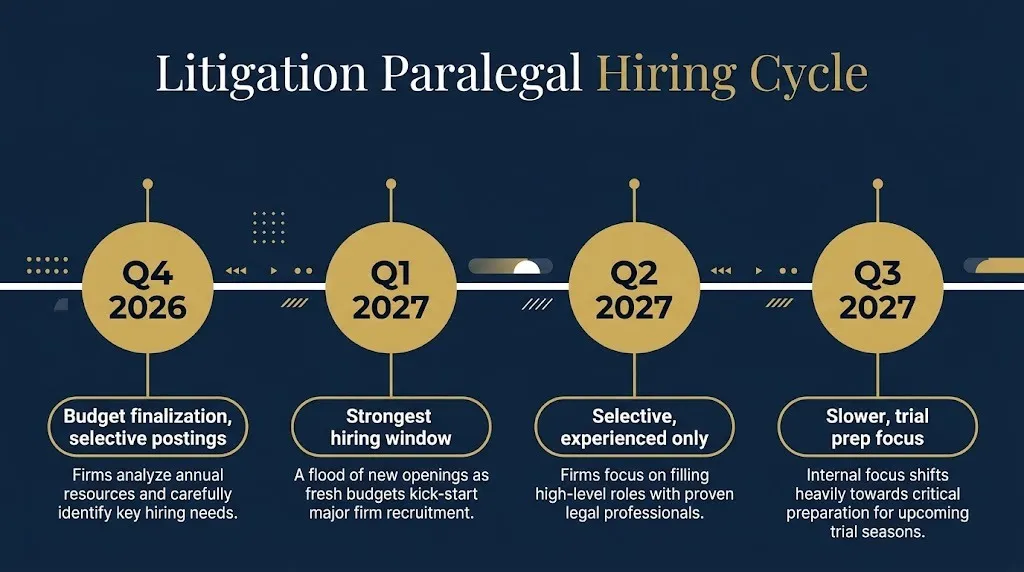
What Happens Next: Litigation Paralegal Hiring Timeline for Late 2026
The hiring cycle for litigation paralegal jobs follows a predictable rhythm, with year-end budget decisions and first-quarter staffing pushes driving most activity.
Expected Q4 2026: Firms finalize budgets and post roles that must be filled before year-end billing closes. Corporate legal departments may slow hiring until new budgets are approved in January.
Expected Q1 2027: The strongest hiring window of the year. Law firms staff up for trial calendars and new matter intake. This is when the most positions open and when competition is highest.
Expected Q2 2027: Hiring continues but becomes more selective. Firms fill remaining gaps with experienced candidates rather than training entry-level hires.
Expected Q3 2027: Summer associate programs conclude, and firms convert some law clerks to permanent roles. Paralegal hiring may slow as attention shifts to fall trial schedules.
Ongoing: Remote and hybrid roles remain available but face more competition. Corporate in-house roles with e-discovery focus continue to pay premiums.
Frequently Asked Questions
Is litigation paralegal a good career in 2026?
Yes, litigation paralegal work is a stable career in 2026 with consistent demand across firm sizes and rising compensation for specialized experience.
The role is growing because litigation teams cannot function without paralegal support, not because the profession is expanding overall.
How much do litigation paralegals make in 2026?
Litigation paralegals make a median of $61,010 per year according to BLS data, with experienced specialists earning $85,000 to $110,000 or more.
Glassdoor reports an average total pay of $75,462, with top earners reaching $110,676.
Do you need a paralegal certificate for litigation paralegal jobs?
Most litigation paralegal postings prefer or require a paralegal certificate from an ABA-approved program, though some accept equivalent experience.
Jacoby & Meyers requires a certificate for its remote role, while other employers list it as preferred rather than mandatory .
Can you work remotely as a litigation paralegal?
Yes, remote litigation paralegal jobs exist in 2026, but they are competitive and typically require proven experience with deadline management and court filing systems.
Remote roles at firms pay $30 to $45 per hour, while remote corporate roles can pay $80,000 or more annually.
What do litigation paralegals actually do all day?
Litigation paralegals manage case files, coordinate discovery, draft pleadings and discovery responses, track deadlines, prepare deposition and trial materials, and communicate with clients, courts, and vendors.
The specific mix depends on the practice area and whether the role is firm-side or in-house.
Is it hard to get a litigation paralegal job with no experience?
It is difficult but not impossible. Entry-level litigation paralegal roles exist for candidates with a certificate and demonstrated attention to detail.
The most common entry path is through a legal assistant or support role that transitions into paralegal responsibilities.
What is the difference between a litigation paralegal and a legal assistant?
A litigation paralegal performs substantive legal work under attorney supervision, including drafting documents and managing discovery, while a legal assistant handles more administrative tasks like scheduling and filing.
Some employers use the titles interchangeably, but pay and responsibility typically differ.
Where are the most litigation paralegal jobs in 2026?
The most litigation paralegal jobs are in major legal markets: New York, Los Angeles, Dallas, Houston, Chicago, and Washington, D.C.
Remote roles have expanded the geographic reach, but the highest-paying positions still cluster in major metropolitan areas.
Your Next Step
Check the specific job postings that match your experience level and apply before the deadline. The roles are real, the pay data is public, and the demand is steady.
If you are early in your career, focus on the $50,000 to $65,000 range and build e-discovery skills. If you have five years and trial experience, target the $90,000-plus roles and name Relativity in your application. The single most important fact: litigation paralegal hiring in 2026 rewards specialization, not general legal support experience.