What Is a Defamation Lawsuit? 2026 Guide to Claims, Damages and Deadlines
Quick Answer
- A defamation lawsuit is a civil claim that a false statement of fact harmed your reputation.
- No fixed payout exists. Damages depend on proof of harm, the statement, and state law.
- Deadlines run one to three years by state, and one year in California, New York, and Texas.
A defamation lawsuit is a civil case where you claim someone published a false statement of fact that harmed your reputation. Written statements are libel, and spoken ones are slander.
It can reach anyone, from a business owner facing a false review to a public figure. The date that matters most is your state’s filing deadline, which is one year in California, New York, and Texas.
This guide covers the elements, damages, deadlines, and 2026 case developments. One surprise: in many states, an early anti-SLAPP motion can make a losing plaintiff pay the defendant’s legal fees.
The Facts
| Case | Not a single case. A civil claim over false statements that harm reputation |
| Status | Available in every state. Rules and deadlines vary by state |
| Fund Size | Not applicable. No settlement fund exists |
| Est. Per Person | Not yet determined. Amounts depend on proof of harm and state law |
| Claim Deadline | Commonly one to three years. One year in California, New York, and Texas |
| Administrator | None. A state or federal court decides the case |
| Proof Needed | A false statement of fact, publication, fault, and harm |
What is a defamation lawsuit?
A defamation lawsuit is a civil claim that someone made a false statement of fact about you and caused you harm. You file it in court, and a judge or jury decides whether the claim holds up.
It isn’t a criminal case. No one goes to jail because of it. The usual outcome sought is money, and sometimes a court order to remove the statement.
Courts care about facts, not feelings. A rude opinion usually doesn’t qualify. A false claim that you committed fraud, stole, or broke a rule at work can.
The target can be a person, a company, or a publisher. The statement can be a post, a review, an article, a video, or something said out loud.
What is the difference between libel and slander?
Libel is written or recorded defamation, and slander is spoken defamation. Both are forms of the same claim.
The medium is the main difference. A news article, social media post, or online review is usually libel. A false statement made in a meeting or on a phone call is usually slander.
| Form | Medium | Example |
|---|---|---|
| Libel | Written or recorded | A blog post, review, or article |
| Slander | Spoken | A false claim said aloud to others |
The two share core elements. They can differ in how damages are presumed under most state laws.
Some states treat time limits differently by form. Arkansas allows three years for libel and one year for slander in one chart. Tennessee, per another state chart, gives six months for slander and one year for libel.
Check your own state before you assume the clock.
What must you prove in a defamation lawsuit?
You must prove a false statement of fact about you, that it was published to others, that the speaker was at fault, and that it caused harm. Fault is the element people miss.
Here’s the standard checklist:
- A false statement of fact about a person or company.
- Publication, meaning someone other than you saw or heard it.
- Fault, which is higher for public figures or matters of public concern.
- Harm, such as damaged reputation, lost income, or emotional distress.
Internet defamation counts. A blog post, comment, review, or video can all be “published.”
California lists five elements instead of four in its own breakdown. States slice the test differently, so your state’s wording matters.
The pleading itself needs precision. A best practice is to quote the exact words of the statement in the complaint.
Key Takeaway: A defamation lawsuit requires a false statement of fact, publication, fault, and harm, and you must prove each one.
How much money can you get from a defamation lawsuit?
The amount you can get is not yet determined for any one claim, because awards swing from small settlements to billion-dollar verdicts. Damages depend on proof of harm, the fault standard, and state law.
No verified national average exists. Public numbers come from famous cases, and those aren’t typical.
| Case | Outcome | Takeaway |
|---|---|---|
| Alex Jones, Sandy Hook | $1.4 billion verdict. The Supreme Court declined to hear his appeal | Intentional falsehoods can bring huge awards |
| Depp v. Heard | Settled in December 2022 for $1 million after the jury verdict | Final amounts can differ from headlines |
| Melania Trump v. Daily Mail | $2.9 million settlement plus a retraction and apology | Settlements can include corrections |
| Trump Media v. Washington Post | $3.8 billion claim dismissed July 7, 2026 | A big demand can end at zero |
Courts also trim awards. Judges can reduce verdicts they see as excessive, and appeals add another layer of risk.
Plaintiffs usually seek two kinds of money: compensatory damages for real harm, and punitive damages meant to punish. A law firm reported one federal jury awarding $10 million in combined compensatory and punitive damages against a social media personality.
Can you sue for defamation without proving financial losses?
In some states, yes. Certain states allow defamation per se, which lets you plead a case without proving specific money damages.
That doctrine covers statements considered so harmful that damage is presumed. The exact categories vary by state, so check yours.
The other path is defamation per quod. Those claims need outside evidence or explanation to show why the statement is defamatory.
| Type | What you must show |
|---|---|
| Per se | The statement fits a protected category, and damage is presumed in some states |
| Per quod | Extra facts that explain the harm |
Think of it like a warranty claim. Some defects are obvious and covered automatically. Others need an inspection report to prove.
Even without money losses, you still must prove the statement was false and published. Presumed damages don’t erase that burden.
Reality Check: No lawyer or “reputation service” can guarantee a defamation payout. Be wary of anyone who texts or emails you first promising a settlement, or charges a fee to “file your claim” in a case you never joined.
Who pays legal fees if a defamation lawsuit fails?
In states with anti-SLAPP laws, a losing plaintiff can be ordered to pay the defendant’s legal fees. That risk is the biggest money trap in defamation cases.
Anti-SLAPP laws let a defendant file an early motion to dismiss. The goal is to stop suits meant to chill protected speech.
Under these laws, the plaintiff must show a probability of success at the start. If they can’t, the court can award fees to the defendant.
About 33 states have anti-SLAPP statutes, per legal commentary. Strength varies widely by state.
The practical lesson is simple. Before you file, ask what happens if you lose. A weak case against a speaker on a public issue can cost you more than it wins.
Many plaintiffs also pay their own lawyer. Fee terms vary, so get them in writing.
Key Takeaway: Damages range from small settlements to billion-dollar verdicts, and in anti-SLAPP states a losing plaintiff can owe the other side’s fees.
How long do you have to file a defamation lawsuit?
You generally have one to three years to file a defamation lawsuit, and one year in California, New York, and Texas. A survey dated April 30, 2026 found 28 of 51 jurisdictions allow only one year.
Missing the deadline usually ends your claim. It’s like an expired coupon: the product is still there, but the offer is gone.
| Deadline | States (examples) |
|---|---|
| 1 year | California, New York, Texas, Illinois, New Jersey, Arizona, Colorado, Georgia |
| 2 years | Florida, Alabama, Washington, Nevada, Connecticut |
| 3 years | Massachusetts, New Hampshire, Vermont, Wisconsin |
The clock usually starts when the statement is first published. In California, republishing the same statement, such as a retweet, doesn’t restart it.
Some states use a discovery rule that starts the clock when you learn of the statement. Don’t count on it, especially for public online posts.
Check your state’s code or a licensed attorney today. Waiting a few months can forfeit the claim in a one-year state.
How do you file a defamation lawsuit?
You file a defamation lawsuit by preparing evidence, checking your deadline, and filing a complaint in the right court. Most people consult an attorney before filing.
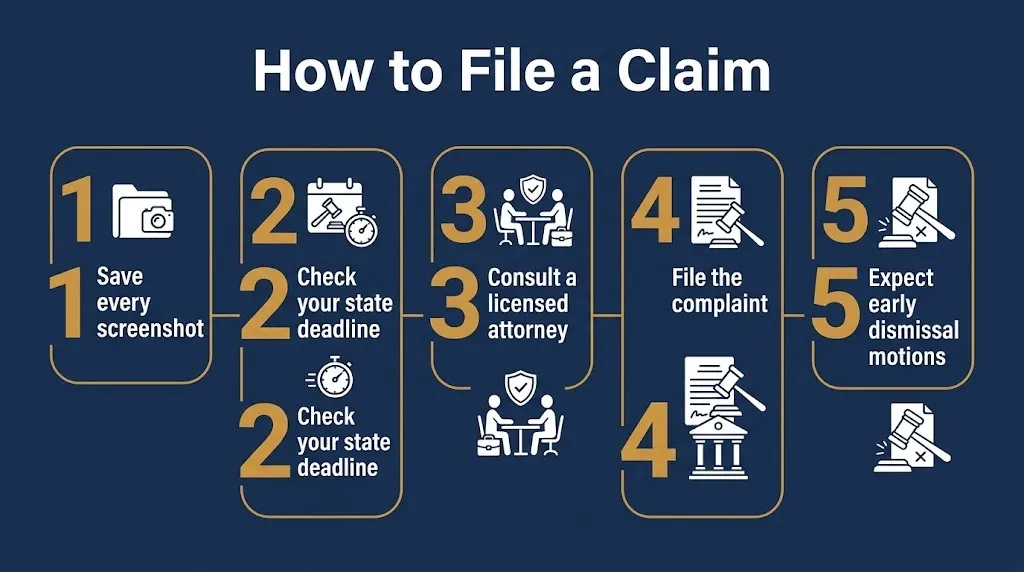
- Save screenshots, links, dates, and copies of the statement.
- Write down the exact words and who saw them.
- Confirm your state’s filing deadline.
- Consider a demand letter or other pre-suit step with an attorney.
- Consult a licensed attorney about whether the claim is strong.
- File the complaint in a court with proper venue and jurisdiction.
- Serve the defendant under your court’s rules.
- Prepare for an early motion to dismiss, including anti-SLAPP motions.
Cases move through pleading, any anti-SLAPP motion, discovery, summary judgment, and trial. Many end before trial.
Jurisdiction can be a hurdle, especially when the speaker lives in another state. Federal and state courts apply different procedural rules.
Filing fees and costs vary by court. Ask about them at the start.
What evidence do you need to prove defamation?
You need the exact statement, proof it’s false, proof others saw it, and proof of harm. A strong file ties each fact to a document.
It works like a store return with a receipt. Without proof of purchase, the clerk relies on memory. Documents carry the weight.
Build your file with this checklist:
- A saved copy of the statement, with the date and web address.
- Evidence that the statement is false, such as records or records requests.
- Proof of publication, like view counts, shares, or witness names.
- Proof of harm, such as lost clients, canceled contracts, or income loss.
- Evidence about the speaker’s fault, like earlier warnings or notice of the error.
- A timeline that shows when you learned of the statement.
Preserve everything quickly. Posts can be deleted, and links can break.
Don’t edit or crop screenshots. Keep originals, plus a clean copy.
Key Takeaway: Your deadline is usually one to three years, and a dated, preserved copy of the statement is the first piece of evidence you need.
What’s happening in defamation lawsuits in 2026?
The biggest 2026 stories show how hard defamation cases are to win and how large verdicts can get. Courts have both upheld big awards and dismissed big claims.
| Date | Development |
|---|---|
| March 2026 | Judge Nina Wang rejected Mike Lindell’s post-trial challenge to a defamation verdict. She also denied the plaintiff’s bid to raise damages |
| 2026 | The U.S. Supreme Court declined to hear Alex Jones’s appeal of the $1.4 billion verdict |
| July 7, 2026 | A federal judge dismissed Trump Media’s $3.8 billion suit over a 2023 Washington Post article |
| September 2025 | Trump’s $15 billion suit against The New York Times was dismissed, with permission to refile an amended complaint |
Courts show deference to juries on facts. They also hold public figures to a high bar.
One legal-news review notes that judges are more willing to trim punitive awards. That pushes some parties toward settlement.
None of these cases creates a fund readers can join. They’re useful as benchmarks, not claim opportunities.
Which states have anti-SLAPP laws in 2026?
About 33 states have anti-SLAPP laws, and a growing group has adopted a model law called the Uniform Public Expression Protection Act. Strength and rules still vary state by state.
States listed as adopting that model law include Delaware, Hawaii, Idaho, Iowa, Kentucky, Maine, Michigan, Minnesota, Montana, New Jersey, Ohio, Pennsylvania, Utah, and Washington. South Dakota’s version took effect July 1, 2026.
Why does that matter to you? Anti-SLAPP rules decide how early a case can be thrown out and who pays fees.
Some plaintiffs pick a forum with weaker protection. Defendants may respond by moving to federal court or contesting jurisdiction.
If you’re sued for defamation, act fast. Anti-SLAPP motions often have tight timing rules.
If you’re the plaintiff, ask your attorney how your state’s law treats fees. Make that part of your decision.
What is actual malice, and who has to prove it?
Actual malice means the speaker knew a statement was false or acted with reckless disregard for the truth. Public figures, and cases about matters of public concern, must prove it.
The rule traces to the Supreme Court’s decision in New York Times v. Sullivan. It protects journalists from honest mistakes.
Actual malice isn’t spite. It’s about what the speaker knew about falsity when publishing.
| Plaintiff | Fault standard |
|---|---|
| Public figure | Actual malice, proven by the plaintiff |
| Matter of public concern | Plaintiff must prove falsity and actual malice |
| Private person, private matter | Lower fault standard, set by state law |
Public figures come in two kinds. All-purpose public figures are widely known, and limited-purpose public figures are known on one issue.
For ordinary people, this rule can feel unfair. It exists to protect public debate, and it makes many celebrity and politician cases very hard to win.
What are common defenses to a defamation lawsuit?
Common defenses include privilege, lack of actual malice, anti-SLAPP protection, and the statute of limitations. A defendant can also argue the statement was true.
Truth matters because falsity is a core element. If the statement is accurate, there’s no claim.
A privileged statement is one the speaker had the right to make. Privilege is a defense, and it covers some statements in court filings and official proceedings.
Honest mistakes get protection in some cases. If a speaker got the facts wrong without actual malice, they generally aren’t liable in public-figure cases.
| Defense | What it argues |
|---|---|
| Truth | The statement is accurate |
| Privilege | The speaker had a right to say it |
| No actual malice | The speaker didn’t know it was false |
| Anti-SLAPP | The suit targets protected speech |
| Time bar | You filed too late |
Defenses often decide cases early. Many suits end at the first motion.
Can you sue over a social media post or online review?
Yes, you can sue over a social media post or online review if it contains a false statement of fact that harmed you. Online posts are usually treated as libel.
Internet defamation commonly involves blog posts, comments, reviews, and videos. The same elements apply.
Deadlines can start fast online. The clock generally runs from first publication, and in California a retweet doesn’t restart it.
Platforms are a different matter. A federal law known as Section 230 generally shields websites from liability for user posts, so claims usually target the person who wrote the content.
Opinion is not the same as fact. “This restaurant is terrible” is opinion. “This restaurant poisoned me” is a factual claim that can be tested.
Before suing, save the post and check the time limit. Don’t confront the poster in ways that could prompt deletion.
What Happens Next
Now: Save the statement, dates, and links, and note your state’s deadline.
Within weeks, expected: Consult an attorney and decide whether to send a demand letter.
Before your state deadline: File the complaint in the proper court.
After filing, expected: The defendant may file a motion to dismiss, including an anti-SLAPP motion.
Later, expected: Discovery, summary judgment, and settlement talks, with trial only if needed.
Frequently Asked Questions
What is a defamation lawsuit in simple terms?
It’s a civil claim that someone published a false statement of fact that harmed your reputation.
Libel is written, and slander is spoken.
You must prove falsity, publication, fault, and harm.
What are the elements of defamation?
The core elements are a false statement of fact, publication, fault, and harm.
Public figures must also prove actual malice.
Your state’s wording may differ.
How long do you have to file a defamation lawsuit?
Most states allow one to three years.
California, New York, and Texas allow one year.
Check your state before you wait.
How much can you win in a defamation lawsuit?
There’s no fixed amount, and awards range from small settlements to billion-dollar verdicts.
Damages depend on proof of harm and state law.
Courts can reduce large awards.
Is a negative review defamation?
Only if it contains a false statement of fact that harmed you.
Opinions generally don’t qualify.
Keep a copy and note the date.
What is an anti-SLAPP motion?
It’s an early motion to dismiss a suit aimed at chilling protected speech.
About 33 states have such laws.
A losing plaintiff can owe the defendant’s fees.
Do you need a lawyer to file a defamation lawsuit?
You can file without one, but these cases are technical.
Deadlines, jurisdiction, and anti-SLAPP motions add risk.
A licensed attorney can review your claim.
Closing
Save the statement today. Capture the exact words, the date, and the web address before it changes or disappears.
Then check your state’s deadline. In California, New York, and Texas, you have one year from first publication.