Can I Get Disability After a Workers’ Comp Settlement? The 2026 Offset Rules, Explained
Quick Answer
- Yes, you can apply. A workers’ comp settlement does not automatically disqualify you from Social Security disability benefits.
- Your SSDI check may be reduced. SSA offsets SSDI when combined benefits exceed 80% of your pre-disability average earnings.
- The offset ends at full retirement age. At that point, SSDI converts to retirement benefits and the workers’ comp reduction stops.
You can get disability after a workers’ comp settlement. The two programs are separate, and receiving a settlement does not bar you from filing for Social Security Disability Insurance.
The catch is money, not eligibility. The Social Security Administration applies a workers’ compensation offset when your combined benefits exceed a federal cap.
That cap is 80% of your average current earnings before you became disabled. If your settlement pushes you over that line, your SSDI payment shrinks until the math works.
This guide covers the 2026 offset math, how lump sums are prorated, the settlement language that actually protects your benefits, and the mistakes that cost injured workers thousands. The rules are real and published. The confusion comes from how they are applied.
The Facts
| Item | Verified Detail |
|---|---|
| Programs involved | SSDI (federal), workers’ compensation (state) |
| Offset cap | 80% of average current earnings before disability |
| Governing statute | 42 U.S.C. § 424a |
| Offset applies to | SSDI only, not Social Security retirement |
| Offset ends | At full retirement age, when SSDI converts to retirement |
| Lump sum treatment | Prorated as if paid weekly, then counted toward the cap |
| Key document | Settlement agreement language and SSA-required reporting forms |
| Administrator | Social Security Administration (not a settlement administrator) |
Is it true you can get disability after a workers’ comp settlement?
Yes. Receiving a workers’ comp settlement does not make you ineligible for Social Security disability. The programs serve different purposes and have different eligibility rules.
Workers’ comp is a state system. It pays for medical care and lost wages from a work-related injury. SSDI is a federal program. It pays monthly benefits to people who cannot work because of a disability expected to last at least a year or result in death .
The Social Security Administration does not treat a workers’ comp settlement as a disqualifier. It treats it as income that may reduce your monthly SSDI check under the offset formula .
That distinction matters. You are not choosing one program over the other. You are coordinating two payments so the combined total does not exceed a federal ceiling.
How much does a workers’ comp settlement reduce SSDI?
The reduction is capped by a formula, not a flat percentage. SSA adds your workers’ comp benefit and your SSDI benefit together. If the total exceeds 80% of your average current earnings, SSA reduces your SSDI payment to bring the combined amount back to that 80% line .
Here is the math in plain terms:
- Suppose your average current earnings before disability were $5,000 per month.
- Eighty percent of that is $4,000.
- If your workers’ comp payment plus your SSDI payment totals more than $4,000, SSA cuts your SSDI check.
- The reduction continues until the combined total equals $4,000, or until the offset ends.
The 80% cap is a federal rule under 42 U.S.C. § 424a. It applies whether your workers’ comp comes as weekly checks or a lump sum .
Key Takeaway: A workers’ comp settlement does not block SSDI eligibility, but it can shrink your monthly SSDI check under a strict 80% combined-benefit cap.
What counts as average current earnings for the 80% offset?
Average current earnings, or ACE, is not your last paycheck. SSA calculates it using your highest-earning years during a specific lookback period.
The agency typically looks at your highest year of earnings within the five years before your disability began. It may also compare other high-earning periods. The highest figure among those calculations becomes your ACE .
This matters because a high ACE gives you more room before the offset kicks in. A low ACE means the 80% ceiling is lower, and a modest workers’ comp settlement can trigger a reduction faster.
Errors in your earnings record are common. If SSA has wrong wage data, your ACE is wrong, and your offset is wrong. Checking your earnings history before you settle is not optional. It is the difference between a correct offset and an overpayment you have to repay later.
Does a lump sum settlement trigger the SSDI offset differently than weekly checks?
Yes. A lump sum is not ignored. SSA prorates it over time as if you were receiving weekly workers’ comp payments, then applies that prorated amount to the 80% calculation .
The proration method depends on the settlement terms. If the agreement states a weekly rate, SSA uses that. If it does not, SSA may use the weekly rate you were receiving before the lump sum. In some cases, SSA has prorated a lump sum at the prior weekly benefit rate rather than over life expectancy .
The practical result: a large lump sum can reduce or eliminate your SSDI payment for months or years, even though you received the money in one check.
This is where settlement drafting becomes a financial decision, not just a legal formality. The way the agreement describes the payments, and what they are meant to cover, affects how SSA counts them.
How can settlement language protect your SSDI benefits?
The language in your workers’ comp settlement agreement can limit how much SSA counts against your SSDI. It is not a loophole. It is a documented allocation of what the money is actually for.
Three categories can reduce the offset when properly documented:
- Medical expenses. Money allocated to past or future medical care related to the injury is not counted the same way as wage-loss compensation .
- Legal fees. Attorney fees paid from the settlement can be excluded when the agreement specifies the amount and purpose .
- Specific weekly rate. If the settlement states a clear weekly rate rather than a vague lump sum, SSA has a defined figure to prorate, which can produce a smaller offset than an arbitrary calculation .
A poorly worded settlement that says only “lump sum for all claims” gives SSA maximum discretion. A well-drafted one itemizes what the money replaces and what it reimburses.
This is not a do-it-yourself drafting task. The difference between a protected settlement and an exposed one is often a paragraph.
What is the Reality Check on workers’ comp and disability claims?
Reality Check: No one texts you settlement money first. Filing for SSDI is free. Third-party “claim helpers” who charge a percentage of your benefits are unnecessary. The Social Security Administration does not charge an application fee, and you can file directly online, by phone, or at a local office. If someone contacts you claiming they can unlock a workers’ comp settlement or disability payment for an upfront fee, that is not how either system works.
Do you have to report a workers’ comp settlement to Social Security?
Yes. You must report workers’ comp payments and settlements to SSA. The agency needs the information to calculate the offset correctly and to stop the reduction when it should end.
SSA provides forms for reporting workers’ compensation. The agency may also request the settlement agreement or documentation from the state workers’ comp agency .
Failing to report a settlement does not make the offset disappear. It creates an overpayment. SSA will eventually find the workers’ comp payment through state records or data matching, and you will owe money back, sometimes with penalties.
Report the settlement when it happens. Report when payments change. Report when the workers’ comp benefits end. The offset is adjustable, but only if SSA has accurate information.
How does the SSDI offset end?
The offset ends when you reach full retirement age. At that point, SSDI automatically converts to Social Security retirement benefits, and the workers’ comp reduction no longer applies .
Full retirement age depends on your birth year. For most workers reaching retirement now, it is 67. For earlier birth years, it may be 66 or a few months between.
Until that date, the offset continues as long as the workers’ comp payment is counted. If the workers’ comp settlement runs out before you reach full retirement age, the offset ends earlier and your SSDI payment returns to its full rate.
SSA sends notices when the offset starts, changes, or ends. If you receive a notice that does not match your records, contact SSA. The agency has a process for correcting offset errors.
What are the steps to apply for SSDI after a workers’ comp settlement?
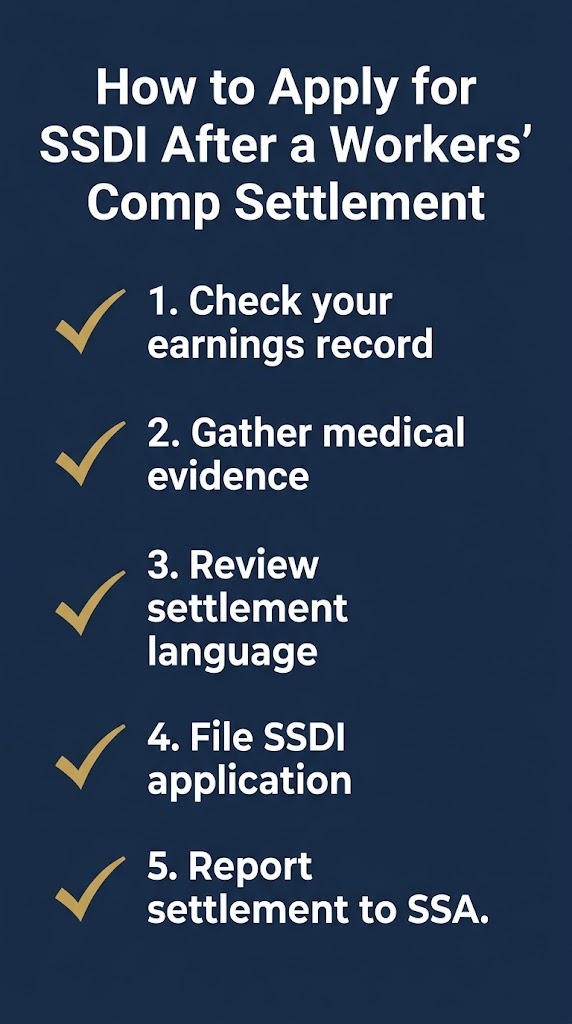
- Check your earnings record. Request your Social Security statement and verify your average current earnings. Errors here affect the offset.
- Gather medical evidence. SSDI requires proof that your condition prevents substantial work for at least 12 months. Workers’ comp medical records may not be enough; you may need updated evaluations .
- Review your settlement agreement. Identify what the money is allocated to cover. Medical and legal reimbursements should be documented separately.
- File the SSDI application. Apply online, by phone, or at a local SSA office. There is no fee.
- Report the workers’ comp settlement. Provide SSA with the settlement amount, structure, and any weekly rate stated in the agreement.
- Respond to SSA requests. The agency may ask for the settlement agreement, state workers’ comp records, or medical documentation.
- Watch for the offset notice. Once approved, SSA will calculate the reduction and send a notice explaining the math.
- Report changes. If the workers’ comp payment stops or changes, tell SSA immediately to adjust or end the offset.
What happens next in the offset process?
Expected timing depends on your case status:
- If you have not filed SSDI: The application and initial decision typically take months, and appeals can take longer. Filing early starts the clock.
- If you are already receiving SSDI: Reporting a new workers’ comp settlement should trigger an offset calculation. Watch for a notice with the new benefit amount.
- If the offset is already active: The reduction continues until the workers’ comp payment ends or you reach full retirement age.
- At full retirement age: SSDI converts to retirement benefits, and the workers’ comp offset stops. No new application is required for the conversion.
Frequently Asked Questions
Can I collect both workers’ comp and SSDI at the same time?
Yes, but the combined total is capped at 80% of your average current earnings before disability. SSA reduces your SSDI if the total exceeds that cap.
Does a lump sum workers’ comp settlement affect SSDI?
Yes. SSA prorates the lump sum as if it were paid weekly, then counts that prorated amount toward the 80% cap. A large lump sum can reduce your SSDI for an extended period.
Will my SSDI go up after my workers’ comp ends?
Yes. When the workers’ comp payment ends or the prorated settlement period expires, the offset stops and your SSDI returns to its full rate, assuming you still meet the disability criteria.
Does workers’ comp affect Social Security retirement?
No. The offset applies to SSDI, not retirement benefits. Once you reach full retirement age and SSDI converts to retirement, workers’ comp no longer reduces your benefit.
What if my settlement says “no liability” but pays me money?
SSA can still count the payment. The agency looks at what the money is for, not just whether the employer admitted fault. A settlement that compensates you for lost wages or disability is generally subject to the offset rules.
Can I apply for SSDI before I settle my workers’ comp case?
Yes. You can file for SSDI at any time. If you are approved before the settlement, report the settlement when it happens so SSA can adjust the offset.
Do I need a lawyer for the SSDI part?
Not required, but the offset math and settlement language are technical. A workers’ comp attorney who understands SSDI coordination, or a disability attorney, can review the agreement before you sign.
What if SSA reduces my SSDI and I think the math is wrong?
You can request a review. SSA has appeal and correction processes for offset calculations. Gather your earnings records, the settlement agreement, and any SSA notices, and contact the agency.
Closing
The 80% cap is the number that controls this decision. Check your average current earnings before you sign any settlement, and make sure the agreement itemizes what the money covers.
If you are already receiving SSDI and a settlement is pending, report it to SSA as soon as it is finalized. The offset is adjustable, but only with accurate information.