PA Workers Compensation Insurance Rates 2026: The 1.22% Cut and What You Actually Pay
Quick Answer
- Is it legit? Yes. The Pennsylvania Insurance Department approved the 1.22% loss cost cut on April 1, 2026 .
- How much? Average rates run near $0.94 per $100 of payroll, but industry ranges swing from $0.08 to $36.20 .
- Key deadline? April 1, 2026 was the effective date for new and renewed policies reflecting the cut .
Pennsylvania workers’ compensation insurance rates are not a lawsuit or a settlement fund. They are the premiums employers pay to cover workplace injuries. If you searched this term expecting claim money, you are in the wrong place.
What you will find here is the verified 2026 rate picture. The headline number is a 1.22% decrease in loss costs, approved by state regulators and effective April 1 . That sounds like good news for employers. And it is, on paper.
But the cut is smaller than last year’s 8.67% reduction . It also does not mean every business pays less. Your actual premium depends on your industry class code, your claims history, and the carrier you choose. A roofing contractor and a clerical office pay wildly different rates for the same payroll.
This article breaks down what the 2026 rate cut means, how Pennsylvania sets rates, and the industry-by-industry numbers that actually matter.
The Facts
| Item | Detail |
|---|---|
| Rate Change | 1.22% decrease in loss costs, effective April 1, 2026 |
| Regulator | Pennsylvania Insurance Department (PID) |
| Rating Bureau | Pennsylvania Compensation Rating Bureau (PCRB) |
| Average Rate | $0.94 per $100 payroll (state average estimate) |
| Carriers | About 375 insurers offer coverage in PA |
| Claim Deadline | Not applicable (insurance premium, not a claim) |
Is the PA workers compensation rate cut real or just marketing?
The PA workers compensation rate cut is real and government-approved. The Pennsylvania Insurance Department approved the 1.22% decrease in loss costs on April 10, 2026, with an effective date of April 1 .
Loss costs are the foundation of your premium. They represent the estimated future cost of claims for each job classification. Insurance carriers take the approved loss costs and add their own expenses and profit margin. That is why your final rate is higher than the loss cost number.
The cut applies to new or renewed policies issued on or after April 1, 2026. If your policy renews in July, you see the new rate then. If it renewed in March, you wait until next year. The timing is mechanical, like a tax refund that arrives on a schedule you do not control.
How much do PA workers compensation insurance rates cost in 2026?
PA workers compensation insurance rates average around $0.94 per $100 of payroll, according to 2026 state-by-state estimates . That average hides enormous variation. The rate you pay depends almost entirely on what your employees do.
Here is the verified range by industry from 2026 Pennsylvania rate data:
| Industry | Rate Range per $100 Payroll |
|---|---|
| Clerical/office | $0.08 to $0.25 |
| Restaurant | $0.96 to $3.06 |
| Retail store | $1.33 to $4.24 |
| Landscaping | $3.48 to $11.09 |
| Asphalt/paving | $4.66 to $14.85 |
| Tree trimming | $8.02 to $25.26 |
| Roofing | $11.36 to $36.20 |
The pattern is obvious. Desk work is cheap to insure. Roofing is expensive because falls are catastrophic and frequent. A roofing company with $1 million in payroll could pay $113,600 to $362,000 in premiums. An office with the same payroll pays $800 to $2,500.
Key Takeaway: Your class code drives your rate more than the state average ever will; a 1.22% cut means little if your base rate is already $36 per $100.
Who may qualify for lower PA workers comp rates?
You may qualify for lower PA workers comp rates if you meet specific safety and experience criteria. The state average is a starting point, not a ceiling. Several programs and factors can push your premium below the base rate.
- You have a clean claims history. A low experience modification rate (EMR) reduces your premium directly. The EMR is the single biggest lever you control .
- You run a certified workplace safety committee. Thousands of Pennsylvania employers have saved on premiums through this state program .
- Your class code is low-risk. Clerical, professional, and retail operations pay far less than construction or agriculture .
- You shop carriers. About 375 insurers write workers’ comp in Pennsylvania, and their multipliers on top of loss costs differ .
- You use a PEO for pooled buying power. Professional employer organizations can negotiate lower rates for small employers, especially in high-risk trades .
Reality Check: No one texts you workers’ comp premium savings. The rate cut is automatic for eligible policies. Anyone charging a fee to “unlock” a lower rate or “apply” the state reduction is not legitimate. Your carrier applies the approved loss costs.
How do you lower your PA workers compensation premium?
You lower your PA workers compensation premium by controlling claims, improving your EMR, and shopping carriers annually. The state rate cut is helpful, but it is a small slice of the pie.
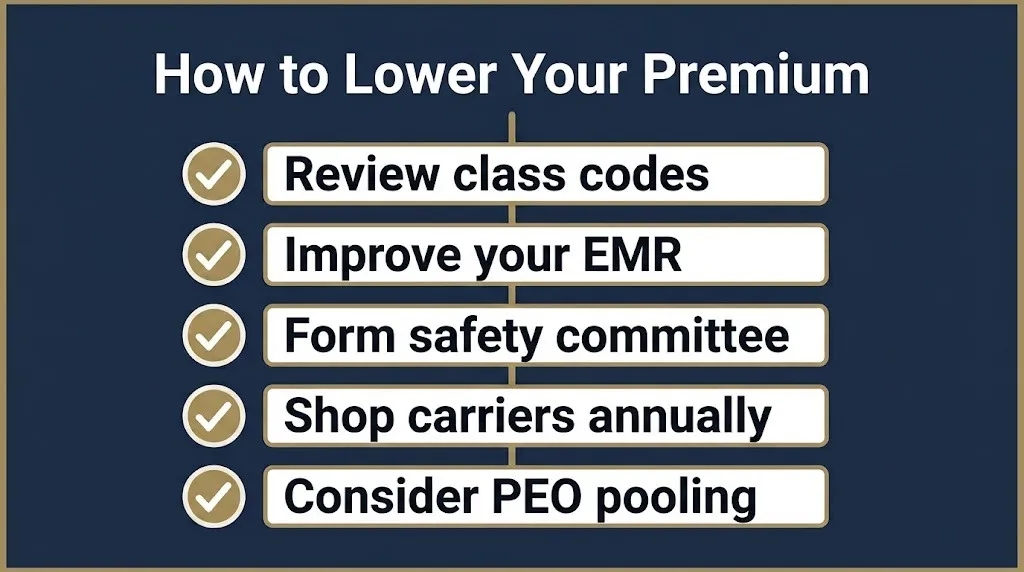
- Review your class codes. Misclassification inflates premiums. A clerical worker coded as a field laborer costs you money.
- Focus on your EMR. Every claim affects it for three years. Safety programs and return-to-work policies lower it.
- Form a certified safety committee. This state program offers premium savings for qualifying employers .
- Shop carriers at renewal. With roughly 375 insurers in the market, competition exists .
- Consider a PEO if you are small. Pooled rates can beat direct market rates for high-risk trades .
- Verify the loss cost application. Confirm your carrier applied the April 1, 2026 rates on your renewal.
Why are PA workers comp costs still high despite the rate cut?
PA workers comp costs are still high because Pennsylvania ranks high among study states for total costs per claim, and the 1.22% cut does little to change that. The Workers Compensation Research Institute reported in June 2026 that Pennsylvania’s costs per claim are high relative to other states in its study .
The WCRI identified higher indemnity benefits per claim as a key factor. Medical payments and benefit delivery expenses also contributed to cost growth. Costs resumed growth after 2021 and increased faster than in most study states .
The rate cut helps at the margins. But Pennsylvania’s underlying claims costs remain elevated compared to peer states. A small loss cost reduction does not reverse that structural picture.
What is the difference between loss costs and manual rates?
Loss costs are the estimated claim costs for a job classification. Manual rates are loss costs plus the carrier’s expenses and profit. You pay the manual rate, not the loss cost.
The PCRB files loss costs with the state. Carriers take those numbers and apply their own loss cost multiplier. A carrier with higher expenses or a conservative profit target charges a higher multiplier. A lean, competitive carrier charges less.
This is why two roofing companies with identical payroll and identical claims history can pay different premiums. They chose different carriers. The loss cost is the same. The multiplier is not.
Key Takeaway: The state cut loss costs by 1.22%, but your carrier’s multiplier determines what you actually pay.
What happened to the April 2026 rate filing?
The April 2026 rate filing resulted in a 1.22% decrease in loss costs, approved by the Pennsylvania Insurance Department. The PCRB submitted the filing, designated Proposal C-387, in November 2025 .
The cut took effect April 1, 2026. New and renewed policies issued on or after that date reflect the updated loss costs . The filing applies to state act coverages. A separate filing covered federal USL&HW classifications .
Last year’s cut was much larger. The 2025 filing reduced loss costs by 8.67% . The 2026 cut is smaller because the easy savings have already been captured.
What happens next for PA workers comp rates?
The next rate change comes with the April 1, 2027 filing cycle. The PCRB typically submits its proposal in late 2026, and the Pennsylvania Insurance Department reviews and approves or modifies it before the effective date.
Expected late 2026: PCRB files its proposal for the April 1, 2027 loss costs.
Expected early 2027: Pennsylvania Insurance Department reviews the filing and issues a decision.
April 1, 2027: New loss costs take effect for new and renewed policies.
TBD: Any further rate decrease or increase. The 2026 cut was modest, and underlying claims costs remain high.
Frequently Asked Questions
What is the average workers comp rate in PA?
The estimated state average is about $0.94 per $100 of payroll, but actual rates range from $0.08 for clerical work to $36.20 for roofing .
Did PA workers comp rates go down in 2026?
Yes. The Pennsylvania Insurance Department approved a 1.22% decrease in loss costs effective April 1, 2026 .
Who sets workers comp rates in Pennsylvania?
The Pennsylvania Compensation Rating Bureau files loss costs, and the Pennsylvania Insurance Department approves them. Carriers then apply their own multipliers .
Is workers comp required in Pennsylvania?
Most Pennsylvania employers are required to carry workers’ comp, though thresholds vary. Confirm your specific obligation with the PCRB or a licensed agent .
Why is my workers comp premium higher than the state average?
Your premium depends on your class code, claims history, and carrier. High-risk trades like roofing pay far more than the state average .
What is an EMR and how does it affect my rate?
EMR stands for experience modification rate. It adjusts your premium up or down based on your claims history compared to your industry. A lower EMR means a lower premium .
Can I get a discount for having a safety program?
Yes. Pennsylvania offers premium savings for employers with certified workplace safety committees .