Construction Litigation Attorney Near Me: What to Know Before You Hire in 2026
Quick Answer
- This is not a lawsuit or settlement; it is a search for a lawyer who handles construction defects, liens, and contract disputes.
- Costs are not fixed by any court; typical hourly rates run $250 to $700, and retainers start around $2,000.
- The most important deadline is your state’s statute of repose, which can cut off your claim even if you just discovered the defect.
You are searching for a construction litigation attorney because something went wrong on a build, a renovation, or a payment, and you need someone who knows both the law and the job site. The first thing to understand is that this is a service search, not a settlement search. No court has approved a fund, no administrator is mailing checks, and no claim form will get you paid. What you need is a lawyer licensed in your state who concentrates on construction disputes, and the numbers that matter are the fee structure and the filing deadline .
This article covers what these lawyers actually cost, how to separate a real construction specialist from a general practitioner with a website, the state deadlines that can kill a valid claim, and the warning signs that you are about to overpay for representation. One detail worth knowing up front: construction litigation is classified as complex litigation because the legal and factual issues are technically dense, and a lawyer who does not know the trade will burn your money learning it .
The Facts
| Item | What to Know |
|---|---|
| Service Type | Legal representation for construction disputes, defects, liens, and contract claims |
| Typical Hourly Rate | $250 to $700 per hour nationally |
| Typical Retainer | $2,000 to $15,000 depending on case complexity |
| Filing Deadline | Varies by state; statutes of repose typically run 6 to 15 years from substantial completion |
| Administrator | Not applicable; this is not a settlement |
| Proof Needed | Contracts, payment records, inspection reports, and expert evaluations |
Is Hiring a Construction Litigation Attorney Legit or a Scam Risk?
Hiring a construction litigation attorney is legitimate, but the search term itself carries a scam risk because “near me” results are crowded with lead-generation sites that sell your information. A real construction lawyer will tell you their bar license number, their state, and their actual experience with construction cases. A lead broker will ask for your phone number and route you to whoever pays for the lead. The difference matters because construction cases are expensive and technical; the wrong lawyer can cost you the case and the fees .
The clearest signal that you are dealing with a real specialist is whether they can discuss the technical side of your dispute without prompting. A seasoned construction lawyer understands the difference between a design defect and a workmanship defect, knows what a mechanics lien is, and can explain how the statute of repose applies in your state . If the person on the other end of the phone cannot do that, you are talking to a marketer, not an attorney.
Key Takeaway: A real construction lawyer can explain your state’s filing deadline and the technical nature of your defect in the first conversation.
How Much Does a Construction Litigation Attorney Cost in 2026?
Construction litigation attorneys charge $250 to $700 per hour in 2026, and retainers commonly start between $2,000 and $15,000, according to current legal marketplace data . The wide range reflects case complexity, geography, and whether the lawyer is a solo practitioner or part of a firm with a construction practice group. A simple lien foreclosure might come in at the low end. A multiparty defect case with expert witnesses and depositions will sit at the top and climb.
The retainer is not the total cost. It is the upfront deposit that the lawyer bills against. When it runs out, you get another invoice. Construction cases often require expert witnesses, such as engineers or quantity surveyors, and those fees are separate from attorney time. A realistic budget includes the hourly rate, the retainer, expert costs, filing fees, and potentially mediation or arbitration fees if your contract requires them.
Not yet determined for your specific case until a lawyer reviews your documents. Anyone who quotes you a flat total before seeing your contract is guessing.
| Cost Component | Typical Range (National) | Notes |
|---|---|---|
| Hourly rate | $250 to $700 per hour | Varies by market and experience |
| Upfront retainer | $2,000 to $15,000 | Billed against, not a flat fee |
| Expert fees | Case-dependent | Engineers, inspectors, quantity surveyors |
| Filing and court fees | State-dependent | Check your county court |
How Do You Find a Real Construction Litigation Attorney Near You?
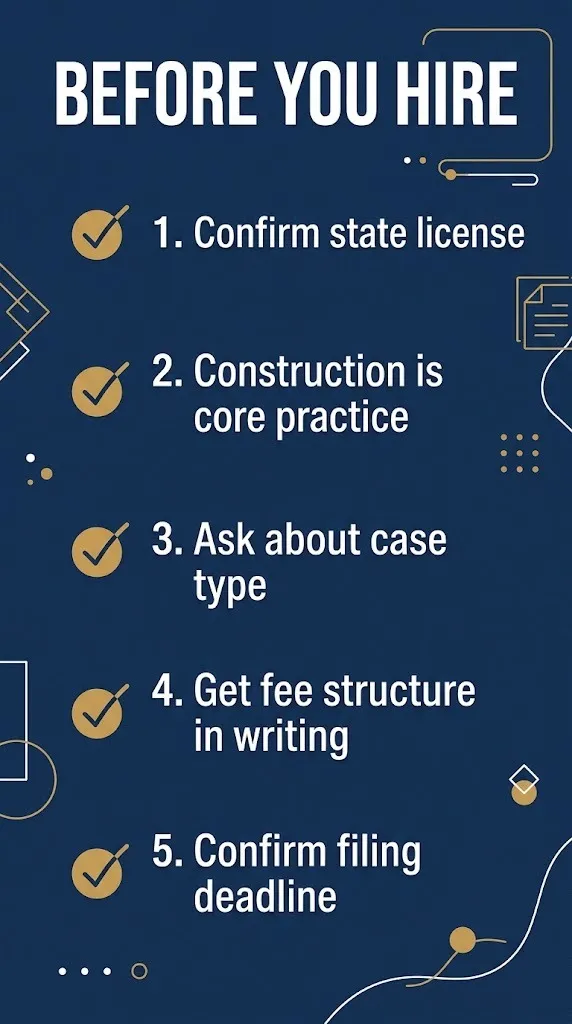
You find a real construction litigation attorney by checking three things: bar licensure in your state, a practice concentrated on construction, and a track record you can verify. Start with your state bar association’s lawyer referral service, which confirms licensure and discipline history. Then look for firm profiles that list construction litigation as a primary practice area, not a secondary line item among twenty others .
Peer recognition directories can help filter, but they are not proof of skill. A Rising Stars selection in 2026, for example, signals peer nomination but does not tell you whether the attorney has tried a construction defect case . What matters more is whether the lawyer can describe specific construction matters they have handled and whether their firm has depth beyond one person .
Here is a practical filter:
- Confirm the attorney is licensed in your state.
- Check that construction litigation is a core practice area, not an add-on.
- Ask what percentage of their caseload is construction work.
- Ask whether they have handled your specific issue type (defect, lien, delay, payment).
- Ask whether their firm has access to experts in engineering or cost estimation.
- Read their bar discipline record before you sign anything.
What Questions Should You Ask Before You Hire?
You should ask a construction litigation attorney five direct questions before paying a retainer, and the answers will tell you whether to walk away. The first is whether they have handled a case like yours, not just construction law generally. The second is what their fee structure is and what happens when the retainer runs out. The third is what experts they expect to retain and roughly what those experts cost. The fourth is what deadline applies to your claim. The fifth is what outcome they think is realistic, not what outcome you want to hear .
A good lawyer will answer these without flinching. A bad one will promise a win, dodge the fee question, or claim they can handle anything . The Federal Trade Commission has warned about legal services scams that demand upfront fees for guaranteed outcomes, and the same caution applies here. No attorney can guarantee a construction case outcome, because the facts, the contract, and the judge or arbitrator all matter.
What Is the Deadline to File a Construction Defect Claim?
The deadline to file a construction defect claim is set by your state’s statute of limitations and statute of repose, and those two clocks work differently. The statute of limitations typically runs 2 to 6 years from when you discovered or should have discovered the defect. The statute of repose is an absolute outer wall, typically 6 to 15 years from substantial completion, and it can bar your claim even if the limitations period has not expired .
This is the single most important number in your case. California, for example, sets a 10-year statute of repose for latent defects measured from substantial completion . Texas sets a 10-year repose period against architects, engineers, and contractors . New York is one of the few states without a specific statute of repose for buildings, which changes the calculus entirely . If you are within one year of a repose deadline, you need a lawyer now, not after you gather more paperwork.
Key Takeaway: The statute of repose can kill a valid construction claim even if you just discovered the problem, so confirm your state’s outer deadline first.
What Does a Construction Litigation Attorney Actually Do?
A construction litigation attorney handles disputes over how a building was designed, built, or paid for, and the work splits into three broad categories. The first is defect claims: foundations that settle unevenly, roofs that leak, building envelopes that trap moisture, and structural failures that show up years after completion . The second is payment and lien disputes: contractors who were not paid, owners facing mechanics liens, and bond claims on public projects . The third is contract and delay disputes: change order fights, schedule delays, and liquidated damages .
The work itself is document-heavy and expert-dependent. Your attorney will review contracts, change orders, payment applications, inspection reports, and correspondence. They will likely retain an engineer or a cost estimator to establish what went wrong and what it costs to fix. They may file a lawsuit, defend one, negotiate a settlement, or take the case to mediation or arbitration if your contract requires it . Construction litigation is classified as complex litigation for a reason: the legal and technical threads are tightly woven, and pulling one affects the others .
Should You Choose Litigation or Arbitration for a Construction Dispute?
You should follow your contract’s dispute clause first, because many construction contracts require arbitration or mediation before litigation. If the contract is silent, the choice between courtroom litigation and alternative dispute resolution comes down to speed, cost, publicity, and appeal rights. Litigation typically takes 12 to 36 months or more through formal trial, and the public record is open. Arbitration or mediation can resolve in 3 to 12 months, but proceedings are confidential and appeal rights are extremely limited .
| Feature | Courtroom Litigation | Arbitration or Mediation |
|---|---|---|
| Decision-maker | Judge or jury | Neutral arbitrator or mediator |
| Public record | Yes | No, confidential |
| Typical timeline | 12 to 36+ months | 3 to 12 months |
| Appeals | Full appellate review | Extremely limited |
| Discovery | Exhaustive | Streamlined |
The practical difference is like the difference between a public court trial and a private settlement meeting. One is on the record and slow. The other is faster and private, but you give up most of your ability to appeal a bad outcome . Ask your attorney which forum your contract requires before you assume you are going to court.
What Happens Next
Immediate: Gather your contract, change orders, payment records, photos, and any inspection reports before your first attorney consultation.
Within days: Confirm your state’s statute of limitations and statute of repose deadlines; ask the attorney to state them in writing.
Within weeks: Decide whether to pursue negotiation, mediation, arbitration, or litigation based on the contract’s dispute clause.
Ongoing: Expect expert retention and document review; construction cases are document-intensive and the opposing side will have its own experts.
No fixed date: Resolution timing depends on forum; litigation can run past 2026, while arbitration may conclude within months.
Frequently Asked Questions
How much does a construction litigation attorney cost near me?
Construction litigation attorneys charge roughly $250 to $700 per hour in 2026, with retainers commonly starting at $2,000 to $15,000. The total depends on your case complexity and whether experts are needed .
How do I find a construction litigation attorney near me?
Start with your state bar’s lawyer referral service to confirm licensure, then look for attorneys who list construction litigation as a primary practice area. Ask about their specific experience with your type of dispute .
What is the deadline to sue for construction defects in my state?
The statute of limitations is typically 2 to 6 years from discovery, and the statute of repose is typically 6 to 15 years from substantial completion. California and Texas both use a 10-year repose period for many defects .
Do I need a lawyer who specializes in construction law, or can a general attorney help?
You need a construction specialist. Construction litigation is classified as complex litigation because it requires knowledge of engineering, architecture, and project management alongside the law. A general practitioner will learn on your dime .
Can I sue for construction defects if I already moved in?
Yes, if you are within your state’s deadlines. Defects often stay hidden for years, and the discovery rule can start the clock when you found the problem. But the statute of repose can still cut off the claim .
What is a mechanics lien and does my attorney handle it?
A mechanics lien is a statutory security interest against property for unpaid construction work. The deadlines are rigid, and missing one by even a day can extinguish your rights. Many construction litigators handle lien filings and foreclosures .
How long does a construction lawsuit take?
Courtroom litigation typically runs 12 to 36 months or more. Arbitration or mediation can resolve in 3 to 12 months, but appeal rights are limited. Your contract may dictate which forum applies .