Fiserv Lawsuit 2026: Status, Payout and What Happens Next
Quick Answer
- The Fiserv lawsuit is a real investor class action in New York federal court, not a customer refund case.
- Payout: not yet determined. No settlement fund exists, so nobody can claim money today.
- Key date: Fiserv’s motion to dismiss was filed August 11, 2026. A ruling date is not confirmed.
The Fiserv lawsuit is a securities class action brought by shareholders, not by customers or merchants. The amended complaint says company statements about Clover growth and Argentina were misleading. Fiserv disputes that.
It affects people who bought Fiserv securities during the alleged class period. The amended complaint lists that period as February 6, 2024 to October 28, 2025. The date that matters most right now is August 11, 2026.
This article covers status, money, eligibility, and next steps. One detail stands out: Fiserv reported an accrual of just $18 million for all its legal proceedings combined at June 30, 2026.
The Facts
| Item | Detail |
|---|---|
| Case | In re Fiserv, Inc. Securities Litigation, No. 1:25-cv-06094 |
| Court | U.S. District Court, Southern District of New York |
| Status | Motion to dismiss filed August 11, 2026; ruling pending |
| Fund Size | Not yet confirmed (no settlement exists) |
| Est. Per Person | Not yet determined |
| Claim Deadline | None. No claim process is open |
| Administrator | Not yet appointed |
| Proof Needed | Not applicable yet. Keep your trade records |
Is the Fiserv lawsuit real?
Yes, the Fiserv lawsuit is real. It sits in the Southern District of New York under Case No. 1:25-cv-06094. Fiserv itself lists the case in its quarterly report for the period ended June 30, 2026.
The case carries the caption In re Fiserv, Inc. Securities Litigation. A Kessler Topaz case page names Judge Jennifer H. Rearden as the assigned judge.
The first complaint was filed in July 2025. Later suits filed in Wisconsin were folded in. An order entered April 28, 2026 transferred the consolidated action to New York.
Here is what that means in plain terms:
- The court case exists and is active.
- The claims are allegations, not findings.
- No court has ruled that Fiserv did anything wrong.
Real does not mean winning. Plaintiffs have made accusations. Fiserv has pushed back hard.
Is there a Fiserv settlement you can claim?
No. As of October 21, 2026, no Fiserv settlement has been announced. No settlement fund, administrator, or claim form appeared in any court filing, SEC report, or news source I checked.
That makes any site asking you for a Fiserv claim form suspect. Real class settlements come with a court-approved notice and an official website. None exists here.
Watch for one common mix-up. Fidelity Investments, a separate company, settled a 2024 data breach case for $2.5 million. That settlement had a July 27, 2026 claim deadline, and it has nothing to do with Fiserv.
If you saw a text or email about a Fiserv payout, treat it as unverified. Don’t click, don’t pay, and don’t share account details.
Does the Fiserv lawsuit involve auto loans or car buyers?
No connection to auto loans, dealerships, or car buyers appears in the sources I reviewed. The case concerns what Fiserv told investors about its business, mainly its Clover payments platform.
If you landed here from a car-related search, the court filings don’t describe a vehicle claim. They describe stock purchases and company statements about growth.
Fiserv is a payments company. It processes card transactions and runs banking technology. A merchant or a bank customer isn’t automatically part of this class.
Your status depends on one thing: did you buy Fiserv stock or other securities during the class period? If not, this case doesn’t cover you.
Key Takeaway: The Fiserv lawsuit is a real investor case with no settlement, no claim form, and no connection to auto claims found.
Is the Fiserv class action legit, or just a lawyer advertisement?
The case is legit, but much of what you’ll see online is law firm marketing. Dozens of press releases from plaintiff firms use urgent headlines and “deadline” language.
Those deadlines were for one narrow task. They covered asking the court to be named lead plaintiff. The New York deadline was September 22, 2025, and the Wisconsin deadline was January 5, 2026. Both have passed.
Think of those notices like a contractor’s flyer after a storm. The storm is real. The flyer is still a sales pitch.
A Shareholders Foundation release dated August 13, 2026 invited investors to make contact. That’s outreach, not a court notice. The court appointed lead plaintiffs on November 17, 2025. You don’t need to hire anyone to stay in the class.
How much money could Fiserv investors get?
Not yet determined. No settlement or judgment exists, and the case is still at the motion to dismiss stage. Any number you see online today is a guess.
| Question | Verified answer |
|---|---|
| Is there a settlement fund? | Not yet confirmed |
| Is there a per-person amount? | Not yet determined |
| Has a payout plan been approved? | No |
| Has Fiserv been found liable? | No |
Don’t read the $18 million accrual as a settlement estimate. That figure covers various legal proceedings, not this case alone.
In securities class actions generally, payouts depend on how many shares you bought, when you bought them, and when you sold. Claims are usually split pro rata from a fund, after legal fees. None of that applies yet.
Who may qualify for a Fiserv payout if one happens?
Only investors who bought or acquired Fiserv securities during the final class period may qualify. That period isn’t locked in yet. Different complaints used different windows.
| Complaint | Class period |
|---|---|
| First New York complaint | July 24, 2024 to July 22, 2025 |
| Wisconsin complaint | July 23, 2025 to October 29, 2025 |
| Amended complaint (June 12, 2026) | February 6, 2024 to October 28, 2025 |
The amended complaint is the live one. Class certification isn’t confirmed in the sources I checked.
You may qualify if:
- You bought Fiserv common stock inside the window.
- You can document the purchase with a statement or trade confirmation.
- You aren’t a defendant or an affiliate of one.
Merchants and bank customers don’t qualify on that basis alone.
Reality Check: No one will text you first with Fiserv settlement money. Filing a real claim is free, and no “claim helper” needs your Social Security number or a fee. If a site demands payment to release funds, close it.
Key Takeaway: Any Fiserv payout depends on a settlement or win that doesn’t exist yet, and only stock buyers in the class window may qualify.
How do you join the Fiserv class action?
You generally don’t have to join. In a securities class action, investors who fit the class definition are usually treated as absent class members. Lead plaintiff windows have closed.
Here is what you can do now:
- Pull your brokerage statements for 2024 and 2025.
- Confirm whether you held Fiserv shares inside the class window.
- Save trade confirmations showing dates, prices, and share counts.
- Ignore any request to pay a fee to “register.”
- Watch your mail and email for an official court notice.
- If a settlement appears, file only on the official settlement website.
- Calendar the claim deadline the day you learn it.
An absent class member who does nothing keeps their place. A settlement later will explain the claim steps. Until then, records are your only job.
Do you need a lawyer to be part of the Fiserv class?
No. You don’t need a lawyer to remain an absent class member. Plaintiff firm notices say a class member may choose to do nothing and stay inactive.
Hiring a lawyer is a personal choice. Some investors with large losses talk to securities attorneys. Many firms take cases on contingency, meaning fees come from any recovery.
LawCompensate is a news publisher, not a law firm. We don’t recommend any attorney, and nothing here is legal advice.
If you do contact a firm, ask three questions:
- Who actually litigates the case?
- How are fees calculated?
- What happens if there’s no recovery?
Compare that with doing nothing. If a settlement comes, you could file a claim yourself.
How can you check the Fiserv case status yourself?
You can verify the case without relying on any firm’s press release. Three public sources do the job.
| Source | What it shows |
|---|---|
| Federal court docket (PACER), Case No. 1:25-cv-06094 | Every filing and order, by date |
| Fiserv’s SEC reports (10-K and 10-Q) | The company’s own legal proceedings summary |
| Payments trade news | Plain-language coverage of rulings and filings |
Search the docket by case number. Look for entries labeled motion to dismiss, opposition, reply, and opinion and order.
Fiserv’s 10-Q is useful because the company must describe material litigation honestly. A company can spin a press release. A securities filing carries legal risk.
Check at least monthly. When a ruling or settlement filing appears, the docket shows it first.
Key Takeaway: You don’t need to join anything, and the court docket and SEC filings are free ways to verify every claim you read.
What is the latest news in the Fiserv lawsuit?
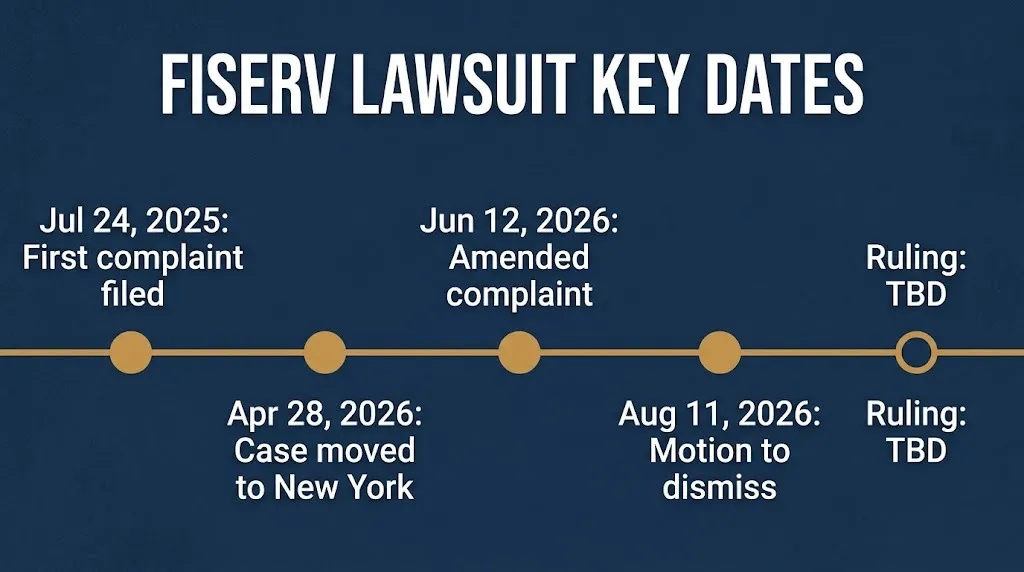
The latest verified development is the motion to dismiss, filed August 11, 2026. A Shareholders Foundation release says the amended complaint came on June 12, 2026, followed by that motion.
Recent milestones:
- April 28, 2026: Wisconsin actions transferred to New York.
- June 12, 2026: Amended securities complaint filed.
- June 2026: Michael Lyons resigned to lead Truist Financial, per Payments Dive.
- August 11, 2026: Motion to dismiss filed.
Fiserv’s former CEO Frank Bisignano left earlier after Senate confirmation to lead the Social Security Administration, per the same outlet.
I found no ruling and no scheduled hearing in the sources checked. If you see a post claiming a decision, verify it on the docket first.
What did Fiserv ask the court to do?
Fiserv asked the court to dismiss the case. The company argued plaintiffs identified no securities fraud and that this suit is the kind the 1995 reform law targets.
The defense also offers a different reading of events. It says the October 2025 reset reflected a new CEO making a business decision, not fraud.
A motion to dismiss is routine in securities cases. It isn’t a verdict. Think of it like a store denying a return before anyone checks the receipt. The question is whether the claim is even strong enough to proceed.
The judge must decide whether the complaint states facts that, if true, could add up to a securities violation. At this stage, the court doesn’t weigh who is right.
When will the judge rule on the Fiserv motion?
No ruling date is confirmed. The court hasn’t published a decision schedule in the sources I reviewed. Rulings on motions like this often take months, so don’t expect one overnight.
The process usually runs in order. Plaintiffs file an opposition. Fiserv files a reply. The judge then decides, sometimes after oral argument.
Possible outcomes:
| Outcome | What it means for you |
|---|---|
| Dismissed fully | Case ends unless plaintiffs appeal or refile |
| Dismissed in part | Narrower case continues |
| Motion denied | Case moves toward discovery |
Even if the case survives, settlement isn’t automatic. Many securities cases take years. Any deal would need court approval after notice to the class.
Key Takeaway: Fiserv’s August 11, 2026 motion to dismiss is the live event, and the ruling date is not confirmed.
Are there other Fiserv lawsuits or investigations?
Yes, there are related shareholder and government matters. They don’t create consumer payouts, but they shape risk.
Derivative suits were filed by shareholders in federal court in Wisconsin and in Milwaukee County state court. Those cases accuse insiders of breaching duties. Any recovery in derivative suits typically goes to the company, not to individual investors.
The derivative actions are stayed pending a ruling on the forthcoming motion to dismiss. So the New York ruling affects them directly.
Fiserv’s annual report also discloses SEC and U.S. Attorney’s Office inquiries tied to its 2025 earnings guidance. Investigations are not charges. I found no enforcement action in the sources checked.
Together, these matters explain why the New York ruling carries weight beyond one docket.
What are investors accusing Fiserv of?
Investors accuse Fiserv of misleading the market about its growth. The amended complaint targets statements on Clover’s growth and Argentina’s effect on organic growth.
Earlier complaints told a more detailed story. They alleged Fiserv pushed merchants from its older Payeezy platform onto Clover. They claimed those conversions inflated Clover’s gross payment volume and hid slowing new business.
They further alleged that many converted merchants then left because of pricing, downtime, and compatibility problems. Those are plaintiffs’ claims, not proven facts.
Fiserv has said it disagrees and will defend itself. That’s the honest picture: serious allegations, a firm denial, and no ruling on who is right.
Who is named in the Fiserv lawsuit?
Fiserv is the main defendant. The amended complaint also names four former senior executives, including Frank J. Bisignano and Michael P. Lyons.
People and firms you’ll see in coverage:
- Judge: Jennifer H. Rearden, per Kessler Topaz.
- Lead plaintiffs: Appointed November 17, 2025. Their names are not confirmed in my sources.
- Pension fund bid: A Hollywood, Florida police pension fund, represented by Labaton Keller Sucharow, competed for the lead role, per Payments Dive.
- Plaintiff firms: Berger Montague, Robbins Geller, Levi & Korsinsky, and others issued notices.
Being named in a complaint isn’t a finding of fault. Both former executives have since moved to other roles, according to Payments Dive.
Why did Fiserv stock fall in October 2025?
Plaintiff firms say Fiserv’s shares fell 44% in one day. They report a drop from $126.17 on October 28, 2025 to $70.60 on October 29.
The trigger was a company admission. Fiserv said its July 2025 guidance rested on assumptions that would have been objectively difficult to meet. Plaintiffs say that proves the earlier outlook misled investors.
The drop works out to $55.57 a share. That’s the number driving the damages theory in the Wisconsin complaint.
A big drop doesn’t prove fraud. Defendants argue a new management team simply reset expectations. The judge, not a press release, will decide which story the law supports.
Key Takeaway: The core dispute is whether Fiserv misled investors or simply reset expectations after a leadership change.
What happens next in the Fiserv lawsuit?
Here is the expected sequence. Only the August 11, 2026 filing is verified.
- August 11, 2026: Fiserv filed its motion to dismiss.
- Expected, date not confirmed: Plaintiffs oppose the motion; Fiserv replies.
- Expected, date not confirmed: The judge rules on dismissal, in full, in part, or not at all.
- If the case survives: Discovery and a possible class certification fight follow.
- Only after that: A settlement, if any, would need court approval and public notice.
Money, if it ever comes, sits at the end of that list. Patience beats panic here.
Frequently Asked Questions
Is there a Fiserv settlement I can claim?
No settlement has been announced as of October 21, 2026.
No claim form or administrator exists yet.
Who can join the Fiserv class action?
Investors who bought Fiserv securities during the class period may be covered.
The amended complaint lists February 6, 2024 to October 28, 2025.
How much will I get from the Fiserv lawsuit?
That’s not yet determined, because no fund exists.
Any future payout would depend on your share purchases and total claims.
Is the Fiserv class action a scam?
No, it’s a real federal case in New York, Case No. 1:25-cv-06094.
Be wary of anyone asking for fees or account details.
Did Fiserv ask to dismiss the lawsuit?
Yes, the company filed a motion to dismiss on August 11, 2026.
A ruling date has not been confirmed.
Do Fiserv customers or merchants qualify?
Not on that basis alone, since this is a shareholder case.
Your claim depends on owning Fiserv securities in the class window.
What should I do right now?
Gather brokerage statements showing any Fiserv purchases in 2024 and 2025.
Then check the court docket monthly for updates.
Check your brokerage records for Fiserv purchases between February 2024 and October 2025. Save every confirmation. Ignore anyone asking for money to “unlock” a payout.
The date to remember is August 11, 2026, when Fiserv asked the court to end the case.