Texas Crime Victims Compensation in 2026: The $50,000 Cap, the Three-Year Deadline, and What the State Won’t Pay
Quick Answer
- Is it legit? Yes. It’s a state program run by the Texas Attorney General, funded by court fees and offender payments.
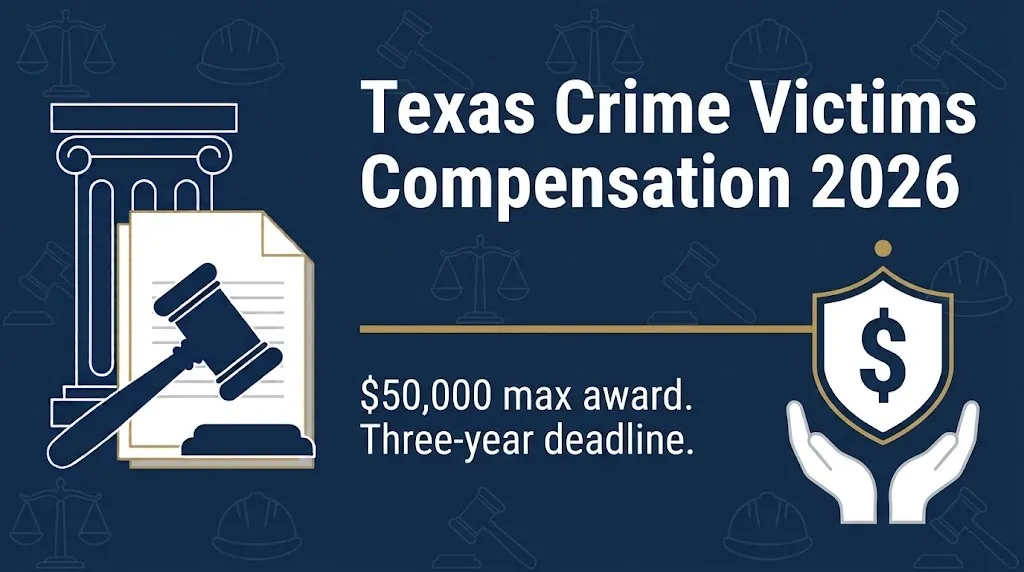
- How much? Most victims can receive up to $50,000 for medical bills, counseling, lost wages, and funeral costs .
- Most important deadline? You must apply within three years of the crime, though extensions are possible for good cause .
If you were the victim of a violent crime in Texas, you’re probably dealing with a lot more than paperwork. Medical bills. Missed work. Maybe a funeral to plan. The last thing you want is a government program with strict rules.
Here’s the direct answer. Texas does have a fund for crime victims. It’s real. It pays for specific expenses. But it is not a settlement, it is not automatic, and it does not cover everything.
This article explains who qualifies, what the state actually pays for, the hard limits on awards, and the one mistake that gets applications denied faster than anything else.
The Facts
| The Facts | |
|---|---|
| Program | Texas Crime Victims’ Compensation (CVC), Office of the Attorney General |
| Maximum Award | $50,000 per victim for most expenses |
| Catastrophic Injury Add-On | Up to $75,000 extra for total permanent disability |
| Application Deadline | Three years from the crime date |
| Payer of Last Resort | All other insurance and sources must pay first |
| What’s Not Covered | Lost or stolen property, car repairs, pain and suffering |
| Sexual Assault Exam Cap | $25,000 for emergency medical care |
Is Texas Crime Victims Compensation Legit or a Scam?
It’s a legitimate state program, not a scam. The Texas Attorney General’s Office administers the Crime Victims’ Compensation program under the Texas Code of Criminal Procedure .
The fund is financed primarily by court costs collected from people convicted of felonies and misdemeanors. In fiscal year 2025, court fees made up more than 62 percent of state revenue into the fund .
The program was created in 1979 with a simple premise: people who commit crimes help pay for the harm they cause. It is not a lawsuit against anyone. It is not a settlement. It is a reimbursement program with strict rules.
The scam risk is not the program itself. It’s third parties charging fees to “help” you apply. You can apply directly through the Attorney General’s online portal for free .
How Much Can You Get From Texas Crime Victims Compensation?
The maximum award is $50,000 per victim for most covered expenses . That cap is an aggregate, meaning it covers all expenses combined, not per category.
For catastrophic injuries that result in total and permanent disability, the Attorney General can award an additional $75,000 for specific costs like home accessibility modifications, job training, and long-term medical care .
Relocation expenses for victims of family violence, stalking, trafficking, or certain sexual assaults are capped at $5,000 in aggregate .
Here is the breakdown:
| Expense Type | Limit |
|---|---|
| Aggregate award (most victims) | $50,000 |
| Catastrophic injury add-on | Up to $75,000 extra |
| Relocation and housing (qualifying crimes) | $5,000 aggregate |
| Bereavement leave for family members | $3,333 |
| Sexual assault emergency medical care | $25,000 |
The program is a payer of last resort. That means every other source must pay first: private health insurance, Medicaid, Medicare, workers’ comp, auto insurance, and any settlements . The CVC fund fills the gap.
Reality Check: No one calls you from the Attorney General’s office asking for a processing fee. The CVC application is free. Victim advocates at local centers help people apply at no cost. If a “claims service” wants payment to unlock your compensation, walk away.
What Does Texas Crime Victims Compensation Cover?
The program reimburses specific out-of-pocket expenses caused by the crime, not general damages. Covered costs include medical care, mental health counseling, lost earnings, funeral expenses, and crime scene cleanup .
Lost support is covered for dependents of a deceased victim. Child care and dependent care may be reimbursed if the crime caused the need. Replacement of seized property is covered in limited circumstances .
What is not covered is just as important. The program does not pay for lost or stolen property. It does not pay for car repairs. It does not pay for pain and suffering .
New legislation effective September 1, 2025 expanded some coverage. Tattoo removal for trafficking victims is now covered when the tattoo was forced as part of the crime. Continuing follow-up care after a sexual assault forensic exam is covered for 30 days after the exam .
Who Qualifies for Texas Crime Victims Compensation?
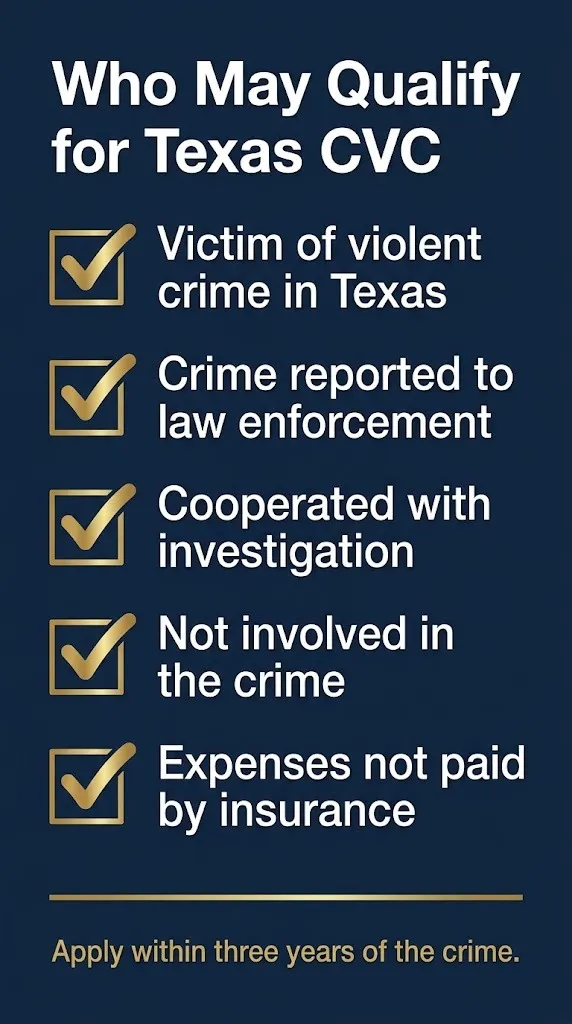
You may qualify if you are a Texas or U.S. resident who was the victim of a violent crime in Texas, and the crime was reported to law enforcement. The program covers victims of assault, sexual assault, family violence, homicide, kidnapping, and other crimes that pose a substantial threat of personal injury .
A Texas resident victimized in a country without a compensation program may also qualify. So may a Texas resident who is the victim of terrorism outside the United States .
You do not need a Social Security number to apply or be found eligible. But you do need a tax ID or Social Security number to receive a payment .
Here is a checklist of the core eligibility rules:
- The crime was reported to law enforcement in a reasonable time and not so late that it hampered the investigation
- You cooperated with the investigation and prosecution
- You were not involved in the crime and did not provoke it
- You have no other source that has paid or will pay the expense
How Do You Apply for Texas Crime Victims Compensation?
You apply by submitting a CVC application through the Attorney General’s online portal, by mail, or by phone request. The fastest method is the online portal, which lets you upload documents and check status .
Here are the steps:
- Gather what you have. You do not need every document to start.
- Create a CVC Portal account or download the paper application .
- Provide the law enforcement agency name and offense report number. Write the full agency name, not an abbreviation .
- Describe the costs you need help with as specifically as you can.
- Submit the application. You can add documents later.
- Work with a victim advocate if you can. Advocates can submit through Presumptive Eligibility for faster review .
- Request Priority Processing if you have an urgent financial need.
One common mistake: assuming the police report will reach the Attorney General automatically. It won’t. The CVC program requests the report using the information you provide. If you give the wrong agency name or no report number, your application sits in limbo.
How Long Does a Texas Crime Victims Compensation Application Take?
There is no published average processing time, and the Attorney General does not guarantee a timeline. Applications move faster when they are complete and the police report is easy to locate.
Presumptive Eligibility submissions through trained advocates may be reviewed faster. Priority Processing is available if you can document an urgent financial need, but it is not automatic .
The most common delay is a missing police report. If the agency name is wrong or the report number is missing, the program has to track it down. That adds weeks.
The three-year deadline from the crime date gives you room, but waiting does not help. Bills accumulate. Evidence gets harder to find. Apply as soon as you have the law enforcement information.
What Happens Next
Ongoing: The three-year application window runs from the crime date. Calendar it immediately .
September 1, 2025 (already effective): Expanded coverage for trafficking tattoo removal and post-sexual assault follow-up care applies to crimes after this date .
Ongoing: Apply through the CVC Portal for the fastest review. Paper applications are still accepted .
If denied: You can request a review or appeal. The denial notice should explain your options.
Frequently Asked Questions
How much does Texas crime victims compensation pay?
The maximum is $50,000 per victim for most expenses.
Catastrophic injuries resulting in total permanent disability can qualify for an additional $75,000.
How long do I have to apply for Texas crime victims compensation?
Three years from the date of the crime.
The Attorney General may extend the deadline for good cause, including the victim’s age or incapacity.
What expenses does Texas crime victims compensation cover?
Medical bills, counseling, lost wages, funeral costs, and crime scene cleanup.
It does not cover lost property, car repairs, or pain and suffering.
Does Texas crime victims compensation pay for pain and suffering?
No.
The program reimburses out-of-pocket expenses only, not general damages.
Can I get compensation if I was partially at fault?
Possibly, but eligibility depends on whether you were involved in the crime or provoked it.
The program requires that you were an innocent victim.
Do I need a lawyer to apply for Texas crime victims compensation?
No.
You can apply for free through the Attorney General’s portal, and victim advocates can help at no cost.
What if the crime was not reported to police?
The program requires that the crime be reported to law enforcement.
Exceptions exist for children and extraordinary circumstances, but reporting is generally required.
Can I get compensation for relocation after domestic violence in Texas?
Yes, if you qualify.
Relocation and housing expenses are capped at $5,000 in aggregate for qualifying victims.
The One Thing to Do Now
Write down the date of the crime and add three years. Put that date somewhere you will see it.
If you have not reported the crime to law enforcement, that is the first call. Without a police report, the CVC application cannot move. The three-year window is generous, but the police report is the gate.