Lawsuit Firm in 2026: How to Vet a Lawyer, What Fees Really Look Like, and Where the Scams Hide
Quick Answer
- What is a lawsuit firm? A private law practice that represents plaintiffs or defendants in civil litigation, usually for a contingency fee or hourly rate.
- How much do they cost? Personal injury firms typically charge 33% to 40% of any recovery. You pay nothing upfront.
- What should you check? State bar licensing, disciplinary history, and whether the firm is a real practice or a lead-generation call center.
A lawsuit firm is a private law practice that takes on civil cases, from personal injury to patent disputes. But the term covers everything from a two-attorney shop to a global giant, and the difference matters when your money and your case are on the line.
If you’re searching for a lawsuit firm right now, you’ve probably been injured, received a notice, or seen an ad promising a payout. The pressure is real, and the market knows it. Some firms are legitimate advocates. Others are lead generators that sell your information to the highest bidder.
This article breaks down how lawsuit firms actually work, what the fee structures look like in 2026, how to vet a firm before you sign anything, and where the red flags cluster. One detail most people miss: New York changed its attorney advertising rules in June 2026, and the old warning labels and “Attorney Advertising” disclaimers are gone.
The Facts
| Entity Type | Private law practice (plaintiff or defense) |
| Typical Fee Structure | Contingency (33% to 40%) or hourly |
| Regulator | State bar associations and supreme courts |
| Key 2026 Change | NY attorney advertising rules amended June 1, 2026 |
| Common Scam | Lead generators posing as law firms |
| Verification Tool | State bar online license lookup |
What Is a Lawsuit Firm and How Does It Differ from a Lead Generator?
A lawsuit firm is a licensed legal practice that employs attorneys who can represent you in court. A lead generator is a marketing operation that collects your information and sells it to firms. The two look similar online, and that confusion is the problem.
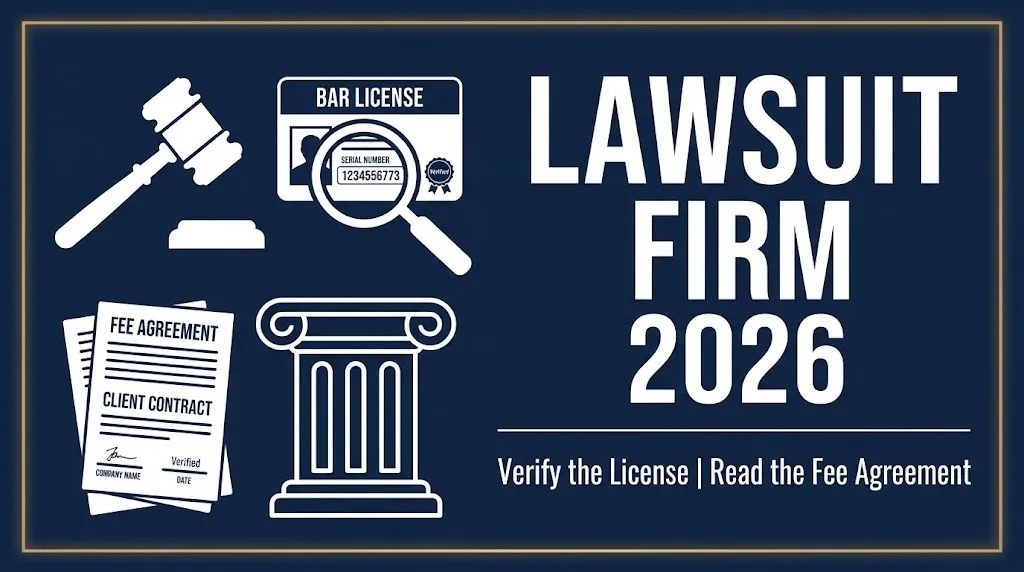
Real firms have attorneys licensed in your state. They can file pleadings, negotiate settlements, and appear before a judge. Lead generators cannot do any of that. They run ads, capture your contact details, and route your claim to a firm that pays for it.
The Uber passenger sexual assault litigation exposed how deeply lead generators penetrate mass torts. Court filings from September 2026 describe “Blue Sky Legal” advertising itself to plaintiffs’ firms as a “turn-key client acquisition” service designed to help firms “scale effectively” . That’s a marketing vendor, not a law practice.
Here’s the plain comparison. Hiring a real firm is like going to a dentist with a license on the wall. Working with a lead generator is like calling a number on a billboard and hoping the person who answers is a dentist.
How Much Does a Lawsuit Firm Cost in 2026?
Most lawsuit firms handling injury or consumer claims charge a contingency fee of 33% to 40% of any recovery. You pay nothing upfront, and the firm gets paid only if you win.
Hourly rates apply to other types of cases. Corporate litigation, contract disputes, and defense work typically run $300 to $800 per hour depending on the market and the attorney’s experience.
Contingency pricing is standard for personal injury. Lerner & Rowe, a Phoenix firm, advertises a range of 33⅓% to 40% with “no fee unless you win” . That’s typical. What varies is whether the percentage slides based on when the case settles.
Read the fine print on costs. The contingency percentage covers the attorney’s fee, but case expenses (filing fees, expert witnesses, depositions) may come out of your share separately. Ask whether expenses are deducted before or after the fee is calculated. That difference can be thousands of dollars.
What Is the Difference Between a Plaintiff Firm and a Defense Firm?
A plaintiff firm represents the person bringing the lawsuit. A defense firm represents the company or individual being sued. The career paths, pay structures, and daily work look nothing alike.
Plaintiff firms usually work on contingency. They take on risk, front costs, and get paid a percentage of the recovery. Defense firms usually bill hourly, often to insurers or corporate clients.
The Kirkland & Ellis Chambers Global 2026 rankings illustrate the defense side’s scale: 86 practice areas ranked, 142 attorneys listed, Band 1 in 30 categories . That’s a corporate defense powerhouse. It doesn’t take slip-and-fall cases.
For you, the distinction matters when you’re evaluating a firm. A firm that primarily defends insurance companies may not have the plaintiff-side trial experience you need. Check the firm’s actual case history, not just its marketing copy.
How Do You Check If a Lawsuit Firm Is Legitimate?
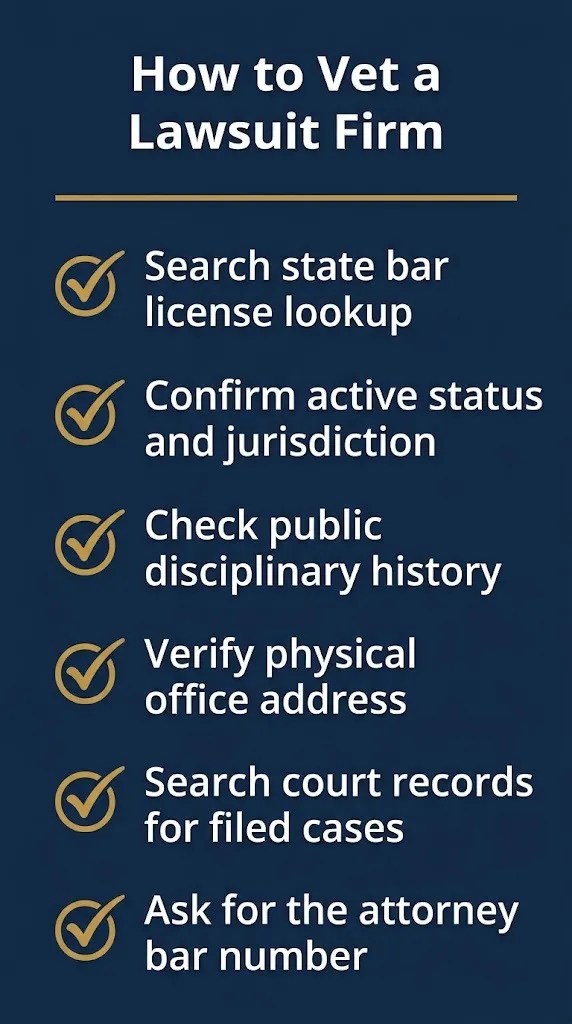
You check a lawsuit firm’s legitimacy through your state bar association’s online license lookup, which shows active status, disciplinary history, and contact information. Every licensed attorney in the U.S. is listed.
Here are the steps:
- Search the attorney’s name on your state bar’s website.
- Confirm active license status and jurisdiction.
- Check for public discipline (suspensions, reprimands, disbarment).
- Verify the firm’s physical address exists and matches bar records.
- Search court records for the firm’s actual filed cases.
- Ask for the attorney’s bar number and confirm it.
A firm that can’t or won’t give you a bar number is a red flag. So is a “firm” whose address is a UPS Store or a virtual office with no attorneys listed.
The New York rules change in June 2026 removed the requirement that ads be labeled “Attorney Advertising” and eliminated the mandatory “prior results do not guarantee a similar outcome” warning . That makes independent verification more important, not less. The labels are gone, but the bar lookup still works.
What Are the Red Flags of a Predatory Lawsuit Firm?
The biggest red flag is a firm that contacts you first with a promise of guaranteed money. Ethical firms don’t cold-call injury victims with guaranteed outcomes.
Other warning signs:
- No bar number available or refusal to provide it.
- Pressure to sign immediately without reading the contract.
- Open-ended fee language like “reasonable fees” instead of a fixed percentage.
- Requests for payment upfront on a contingency case.
- No physical office or a virtual address only.
- Reviews describing payment delays or unreturned calls after settlement.
One review of a Chicago firm described a contract with open-ended “reasonable fees” that could exceed the state’s standard 33% cap . Another reviewer said the firm “dodged” them after settlement funds arrived. Those are patterns, not isolated complaints.
Reality Check: No legitimate lawsuit firm will ask you to pay a fee to “unlock” a settlement or claim. Contingency means you pay nothing until money arrives. Any request for upfront payment on an injury case is a scam signal.
How Do Contingency Fees Work in a Lawsuit Firm?
A contingency fee means the firm gets paid a percentage of your recovery, and nothing if you lose. The percentage is agreed in writing before you hire the firm.
The typical structure: 33⅓% if the case settles before a lawsuit is filed, 40% if it goes to trial. Some firms use a flat 33% throughout. Others slide upward as the case progresses.
Here’s what the contract should specify:
| Term | What to Check |
| Fee Percentage | Fixed number, not “reasonable fees” |
| When It Increases | Settlement vs. filing vs. trial |
| Case Expenses | Deducted before or after the fee? |
| Lien Resolution | Who handles medical liens? |
| Withdrawal Terms | What happens if you fire the firm? |
Ask explicitly: “If I fire you, what do I owe?” Some contracts include a “quantum meruit” clause that lets the firm bill for hours worked even if you terminate. That’s legal in many states, but you should know it exists before signing.
What Happens If You Can’t Afford a Lawsuit Firm?
You can still hire a lawsuit firm if you can’t afford one, because contingency firms front the costs and take payment only from the recovery. That’s the entire point of the contingency model.
But not every case qualifies for contingency. Firms screen for liability and damages before taking a case. If your case is weak or the potential recovery is small, a firm may decline.
Options if you can’t find a contingency firm:
- Legal aid for low-income clients in civil matters.
- Law school clinics that handle cases under supervision.
- Pro bono programs through local bar associations.
- Limited-scope representation where you hire a lawyer for one task only.
The American Bar Association’s 2026 mental health study found that 47.4% of lawyers screen positive for high burnout and 41.8% screen positive for risky drinking . That doesn’t mean your lawyer will be impaired. It means the profession is under strain, and you should pay attention to whether your firm returns calls and meets deadlines.
How Has Attorney Advertising Changed in 2026?
New York amended its attorney advertising rules effective June 1, 2026, eliminating several disclosure requirements that had been standard for years. The old rules required ads to be labeled “Attorney Advertising” and to include the warning “Prior results do not guarantee a similar outcome.”
Those requirements are gone. The new Rule 7.1 prohibits false or misleading communications, but it defines misleading as a material misrepresentation or omission . The word “material” matters. It means a small inaccuracy might not trigger discipline.
The practical effect for you: ads are less cluttered, but the built-in warnings that used to remind you that results vary are no longer mandatory. You have to supply that skepticism yourself. Prior results still don’t guarantee a similar outcome, whether the ad says so or not.
What Happens Next When You Hire a Lawsuit Firm?
The timeline after hiring a lawsuit firm moves through intake, investigation, demand, negotiation, and either settlement or trial. Most cases settle before trial, but the path takes months.
Day 1: Sign the contingency agreement and provide documents.
Weeks 1 to 4: Firm investigates liability, gathers records, and notifies insurers.
Months 1 to 6: Treatment, documentation, and demand preparation.
Months 6 to 12: Negotiation or filing of a lawsuit.
Year 1 to 3: Discovery, mediation, trial if needed.
Ask the firm for a realistic timeline at the intake meeting. A firm that promises a fast, guaranteed settlement before reviewing your records is telling you what you want to hear, not what the case supports.
Frequently Asked Questions
How do I find a legitimate lawsuit firm near me?
Start with your state bar association’s lawyer referral service and verify the firm’s license on the bar website. Check disciplinary history and court records before signing.
Do lawsuit firms charge upfront fees?
Contingency firms do not charge upfront fees on injury cases. They take a percentage of the recovery. Hourly firms bill from the start, so confirm the fee structure in writing.
What percentage do lawsuit firms take from a settlement?
Most personal injury firms charge 33% to 40% of the recovery. The exact percentage and when it increases should be stated in the signed agreement.
Can I fire my lawsuit firm?
Yes, you can generally fire your attorney, but the contract may require you to pay for work already done. Read the withdrawal clause before signing.
How long does a lawsuit take with a firm?
Most cases settle in six months to two years. Complex litigation can take longer. No firm can guarantee a timeline before reviewing the facts.
Are lawsuit firm reviews trustworthy?
Reviews can be gamed. Use them as one signal alongside bar records, court filings, and direct questions about the attorney’s experience.
What is a mass tort lawsuit firm?
A firm that handles claims grouped into multidistrict litigation, often involving drugs, devices, or products. These firms may use lead generators to find clients, so verify the actual attorneys.
What You Should Do Before Signing with a Lawsuit Firm
Verify the license first. Go to your state bar’s website and search the attorney’s name. Confirm active status, check for discipline, and write down the bar number.
Then read the fee agreement line by line. Find the percentage, the expense clause, and the withdrawal terms. If anything is blank or says “reasonable fees” without a number, ask for it in writing or walk away.
The date that matters most is not a deadline in a case. It’s the date you sign. Once you sign a contingency agreement, you’re bound by its terms. Check the bar record, read the contract, and ask the question every ethical firm expects: “What happens if you lose?” The answer should be that you owe nothing.