How Long Does a Lawsuit Take for a Car Accident? 2026 Timeline Guide
Quick Answer
- A car accident lawsuit typically takes nearly two years from filing to verdict, based on 2005 state court data.
- Most claims never reach a lawsuit. Surveyed successful claims paid in an average of 10.7 months.
- Most states allow two or three years to sue, but ranges run from one to six.
A car accident lawsuit usually takes close to two years from filing to verdict, but most claims never get that far. Surveyed successful claims paid out in an average of 10.7 months.
This matters to anyone hurt in a crash whose insurer hasn’t made a fair offer. The date that counts most is your state’s filing deadline, usually two or three years after the crash.
Below, you’ll find stage-by-stage timelines, a state deadline table, and federal court wait times. One surprising detail: the last Bureau of Justice Statistics survey of state civil trials covers 2005.
| The Facts | |
|---|---|
| Case | General guide. No single case applies |
| Status | Not applicable |
| Fund Size | Not applicable |
| Est. Per Person | Not applicable. Amounts depend on injuries, fault, and policy limits |
| Claim Deadline | Statute of limitations: usually 2 to 3 years, range 1 to 6 years. Verify your state |
| Administrator | Not applicable. Your insurer and the court handle the claim |
| Proof Needed | Typically medical records, crash report, bills. Check your insurer’s requirements |
How long does a lawsuit take for a car accident?
A car accident lawsuit typically takes about two years from filing to verdict. The last Bureau of Justice Statistics survey of state civil trials put the median for tort trials at 21.8 months. Jury trials took about 23 months, and bench trials about 18.
Most claims never get that far. Nolo reports that most car accident cases settle before anyone files a lawsuit. Those claims resolve much faster.
| Path | Typical time |
|---|---|
| Claim settles without a lawsuit | 10.7 months on average; 39% paid within 3 months |
| Lawsuit filed, settles before trial | Roughly 12 to 18 months (one Missouri firm’s estimate) |
| Lawsuit tried to verdict | Nearly two years (2005 median: 21.8 months), longer in busy courts |
Treat these as ranges, not promises. Your timeline depends on your injuries, who disputes fault, and how crowded your local court is.
Is there an official average time for a car accident lawsuit?
No current official national average exists for car accident lawsuits. The Bureau of Justice Statistics no longer collects this data. Its last survey of state civil trials covers 2005, when motor vehicle cases made up over a third of trials.
That gap explains why law-firm estimates vary so much. Each firm measures something different.
| Source | Estimate |
|---|---|
| BJS, 2005 | Tort trials: median 21.8 months from filing to verdict |
| BJS, 1992 | All tort cases: median 13.7 months, mean 19.3 months |
| Martindale-Nolo survey, 2015 to 2020 | Successful claims: 10.7 months on average |
| Missouri law firm | Most cases: 6 to 18 months |
| FindLaw | Tort trials: average of two years, filing to disposition |
The 1992 data showed auto tort cases resolving faster than other tort types. Be careful with old numbers. Courts have changed since then.
Does filing a lawsuit mean your car accident case will take years?
No. Filing a lawsuit starts a process, but most filed cases settle before a verdict. It’s like joining a waitlist, not booking the final appointment.
Only 2% of successful claims in the Martindale-Nolo survey were resolved at trial. Those cases took two to three years or more. One firm says more than 90% of personal injury cases settle before trial.
After filing, the defendant is typically given 20 to 30 days to respond. Serving the paperwork can take a day or stretch past a month. Discovery then runs for months, and most settlements land during or right after it.
Key Takeaway: Filing a lawsuit starts a long process, but most filed cases still settle before anyone reaches a verdict.
How long does a car accident settlement take if you never sue?
A car accident settlement without a lawsuit averaged 10.7 months in the Martindale-Nolo survey of claims from 2015 to 2020. The pace varied widely. Some claims paid fast, and some dragged on.
| Time to payout | Share of successful claims |
|---|---|
| Within 3 months | 39% |
| More than 2 years | 13% |
| Resolved at trial | 2% |
Medical treatment usually sets the pace. That phase takes one to six months for minor injuries and a year or more for serious ones. Cases that settle before a lawsuit often wrap up three to six months after you reach maximum medical improvement.
Insurers typically reply to a demand letter within 30 to 45 days. Getting a reply doesn’t mean the case settles that fast.
How long after a settlement is agreed do you get paid?
The wait after a deal is agreed is not yet determined at the national level. It depends on your state, your insurer, and the paperwork. One firm says formalizing a settlement takes several days to a few weeks.
Things that can add time:
- Signing and returning a release.
- Resolving medical bills or liens tied to your treatment.
- Insurer processing and attorney trust account steps.
Some states set deadlines for insurers to pay after an agreement. Check your state’s insurance department for the rule that applies to you. Don’t rely on a blog’s number for your state.
If you’re waiting past a month with no explanation, ask your adjuster in writing what’s pending. Keep the reply.
Why do some car accident cases take so long?
Cases take longer when injuries are severe, fault is disputed, or many parties are involved. One firm’s estimates put minor injury cases at 6 to 12 months, moderate cases at 1 to 2 years, and severe or contested cases at 2 to 3 years or more.
Common delay factors:
- Ongoing treatment: Claims often wait until you’ve reached maximum medical improvement.
- Disputed fault: Reconstruction, witnesses, and motions add months.
- Multiple parties: Insurers can take 60 to 90 days to evaluate multi-party claims.
- Insurer tactics: Slow replies and low first offers stretch talks.
- Court backlog: Some courts take years to reach trial.
You can’t control all of these. You can control how fast your records get organized.
Reality Check: No lawyer, insurer, or website can guarantee a timeline. Negotiating doesn’t stop your filing deadline, so the clock keeps running while the insurer stalls. Treat any “paid in days” promise as unverified.
Key Takeaway: Injuries, disputed fault, and court backlogs drive how long your case takes, and no one can promise a date.
How long do you have to file a car accident lawsuit?
You usually have two or three years from the crash to file, but state deadlines range from one to six years. Twenty-five states use two years. Missing your deadline almost always ends the case.
| State | Deadline | Note |
|---|---|---|
| California | 2 years | |
| Texas | 2 years | |
| Florida | 2 years | Accidents on or after March 24, 2023 |
| Georgia | 2 years | Injury; 4 years for property damage |
| Louisiana | 2 years | Injuries on or after July 1, 2024 |
| Colorado | 3 years | Car accident claims |
| Nebraska | 4 years | |
| Missouri | 5 years | |
| Maine | 6 years | |
| Tennessee | 1 year | |
| Kentucky | Not yet confirmed | Sources disagree: 1 year or 2 years for motor vehicle claims |
Think of it like a tax filing deadline. Waiting on a refund doesn’t extend it. Verify your state’s statute or ask a licensed attorney.
Did Florida and Louisiana change their car accident deadlines?
Yes. Florida cut its deadline from four years to two, and Louisiana extended its from one year to two. Both changes affect newer accidents only.
| State | Old rule | New rule | Applies to |
|---|---|---|---|
| Florida | 4 years | 2 years | Accidents on or after March 24, 2023 |
| Louisiana | 1 year | 2 years | Injuries on or after July 1, 2024 |
Florida’s change came from HB 837, a 2023 tort reform law. Older Florida accidents may still fall under the four-year rule. Louisiana’s older injuries may still fall under the one-year rule.
Be careful with stale guides. Several 2026 articles still list Louisiana at one year. The accident date decides which deadline applies to you.
What should you do to keep your car accident claim moving?
Keep your records organized, track your deadline, and follow up in writing. This isn’t legal advice. Here’s a practical checklist.
- Get medical care and follow your treatment plan.
- Save the crash report, photos, bills, and repair estimates.
- Calendar your state’s filing deadline from the crash date.
- Send your demand once treatment is stable.
- Follow up with the insurer if 30 to 45 days pass without a reply.
- If talks stall, ask a licensed attorney about filing before the deadline.
- Respond quickly to discovery and mediation requests.
Delays on your side cost the same time as delays on theirs. A complete demand package, with medical records and the crash report, tends to move faster.
Key Takeaway: Your filing deadline runs on its own clock, so calendar it from the crash date and don’t wait on the insurer.
What are the stages of a car accident lawsuit and how long does each take?
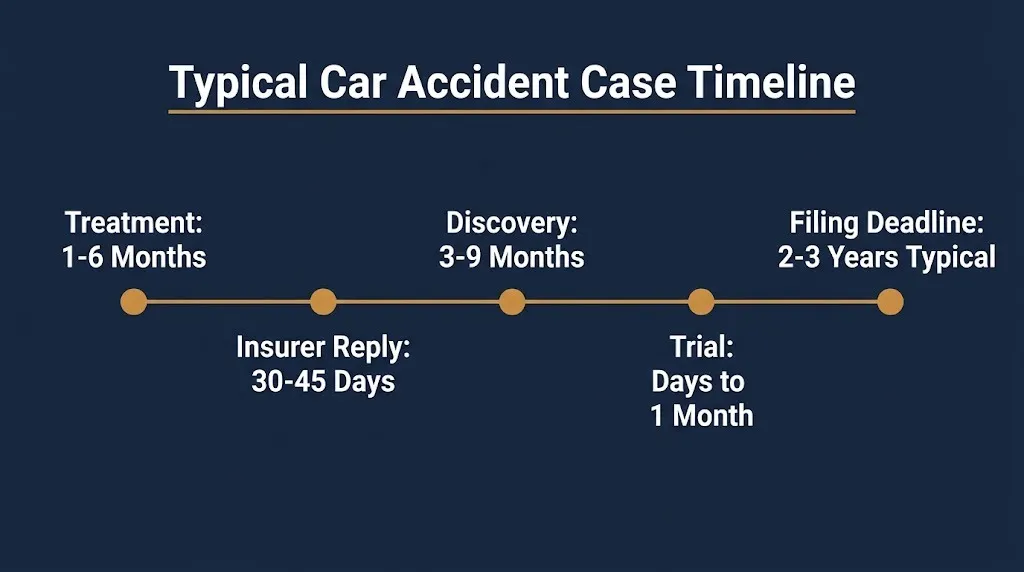
A car accident lawsuit has six main stages, and discovery usually takes the longest. These ranges come from law-firm guides, not court data.
| Stage | Typical time |
|---|---|
| Medical treatment and investigation | 1 to 6 months; a year or more for serious injuries |
| Demand and insurer response | 30 to 45 days for a first reply |
| Complaint filed and served | Service in a day to over a month; response in 20 to 30 days |
| Discovery | 3 to 9 months; longer in complex cases |
| Mediation | A few hours to a full day |
| Trial | Often 3 to 7 days; Nolo says one day to a month |
An appeal adds more time. That stage isn’t quantified here. Many courts also require mediation before trial.
How long does a federal car accident lawsuit take?
Federal court is slower in many districts, but most car accident suits are filed in state court. The Congressional Budget Office estimates about 95% of tort lawsuits are filed in state courts. A federal case usually involves special circumstances, such as parties from different states.
| Court | Median filing to civil trial |
|---|---|
| S.D. Florida (2025) | 16.4 months |
| E.D. Virginia (2025) | 17.9 months |
| N.D. Texas (2025) | 18.8 months |
| N.D. New York (2025) | 57.3 months |
| D. Nevada (2025) | 59.7 months |
| D. Utah (2025) | 67.7 months |
Colorado’s federal trial court averaged 39 months from filing to trial in 2024. The range shows why location matters. The same case can move in a year and a half in one court and in five years in another.
How often do car accident cases go to trial?
Only a small share of car accident cases go to trial. Government and survey data point to a range of about 2% to 3%.
| Source | Finding |
|---|---|
| BJS, 1992 | 3% of tort cases went to trial; three of four settled out of court |
| Martindale-Nolo survey | 2% of successful claims resolved at trial |
| CBO | 97% of federal tort cases in fiscal 2000 ended before a verdict |
| One law firm | More than 90% of personal injury cases settle before trial |
Trial is rare, but its timeline shapes negotiations. Insurers know a trial can take years. That pressure pushes both sides toward a deal.
Key Takeaway: Only a small share of car accident cases reach trial, but the threat of a long trial shapes most settlements.
Does the filing deadline pause for minors or government claims?
Sometimes. In most states, the clock doesn’t start for a minor until age 18. Other exceptions can also pause it, but each state differs.
- Minors: The deadline is generally tolled until the child turns 18.
- Legal incompetence: The clock can pause until the condition ends.
- Active military duty: The clock can pause until the person returns.
- Government vehicles: Some states allow as little as six months and require pre-filing notice.
Florida law also recognizes a small number of exceptions that may pause the clock. Don’t assume one applies to you. Ask a licensed attorney early, especially if a government entity was involved.
What happens next in a car accident case?
Here’s the typical sequence, with dates tied to your own crash and filings.
- 30 to 45 days after your demand (expected): The insurer replies with an acceptance, rejection, or counteroffer.
- 20 to 30 days after service (expected): The defendant responds if you file a lawsuit.
- 3 to 9 months (expected): Discovery runs, often with mediation near the end.
- Trial or settlement (expected): A trial typically lasts days, though settlement can come at any point.
- Two to three years from the crash (most states): Your filing deadline passes. Verify yours.
Frequently Asked Questions
How long does a lawsuit take for a car accident?
Nearly two years from filing to verdict, based on the last BJS state trial survey.
Most cases settle sooner, and many never go to court.
How long does a car accident settlement take?
Surveyed successful claims averaged 10.7 months.
39% paid within three months, and 13% took over two years.
How long do I have to sue after a car accident?
Most states allow two or three years from the crash.
Ranges run from one year to six years, so check your state.
Why is my car accident case taking so long?
Ongoing treatment, disputed fault, multiple parties, and slow insurers all add time.
Court backlogs can add months or years.
Do most car accident cases go to trial?
No. Only about 2% to 3% reach trial in the data reviewed.
Most settle before a verdict.
How long does a car accident trial last?
Often three to seven days.
Nolo says trials run from one day to a month.
Can I settle a car accident claim without filing a lawsuit?
Yes. Most car accident cases settle before a lawsuit is filed.
Your deadline to sue still runs while you negotiate.
Look up your state’s filing deadline today and calendar it. Keep your crash report, medical bills, and insurer letters in one folder.
Most claims settle in under a year. Your deadline to sue still runs from the crash date, usually two or three years.