Pre Settlement Loans Over $5,000 in 2026: Real Rates, Real Costs, and When the Money Actually Arrives
Quick Answer
- Pre-settlement loans over $5,000 are non-recourse cash advances repaid only if your lawsuit wins or settles.
- Rates run about 2.95% to 5% per month, and many funders cap advances near 10% of your case’s estimated value.
- The money typically arrives 24 to 48 hours after your attorney provides the case documents.
If you are searching for pre settlement loans over $5,000, you are likely waiting on a personal injury case and running out of ways to cover rent, medical bills, or everyday expenses. The product exists, and it is widely available in 2026. Baker Street Funding advertises approval amounts from $1,500 to $2,500,000, customized up to roughly 10% of your estimated settlement value . Nova Legal Funding quotes an average rate of 4% per month on its advances .
The number that matters most is not the advance. It is the total repayment, which depends on your monthly rate, whether that rate compounds, and how long your case drags on. A $5,000 advance at 4% simple interest costs $5,900 if your case settles in six months. The same $5,000 at 4% compounding over 24 months costs far more, and that gap is where borrowers get hurt.
This article covers what $5,000-plus funding actually costs in 2026, who qualifies, how fast the cash moves, and the fee traps that separate a fair deal from an expensive one.
The Facts
| Item | Detail |
|---|---|
| Product | Non-recourse pre-settlement cash advance |
| Typical Approval Range | $1,500 to $2,500,000, often capped near 10% of estimated case value |
| Monthly Rate Range | Roughly 2.95% to 5% |
| Repayment Trigger | Only if the case settles or wins |
| Credit Check | None |
| Income Verification | None |
| Funding Speed | 24 to 48 hours after attorney sends case file |
| Collateral | None; the settlement proceeds are the only source of repayment |
| Upfront Fees | $0 from reputable funders |
Are Pre Settlement Loans Over $5,000 Legit or a Scam?
Pre-settlement loans over $5,000 are legitimate financial products offered by regulated and unregulated funders across the United States. They are not scams in themselves, but the industry has bad actors, and the difference between a fair contract and a predatory one is often buried in the fine print.
The core product is a non-recourse advance. The funder evaluates your case, advances cash, and gets repaid from the settlement only if you win. If you lose, you owe nothing . That structure is real, and it is why borrowers with no income and bad credit can still qualify.
The scam risk sits in how some companies present the cost. A funder that advertises a low monthly rate but compounds interest, adds processing fees, and refuses to cap total repayment can turn a $5,000 advance into a five-figure debt. Legitimate funders put the full fee schedule in writing before you sign, require your attorney’s acknowledgment, and do not charge application fees .
How Much Do Pre Settlement Loans Over $5,000 Actually Cost?
Pre settlement loans over $5,000 cost between roughly 2.95% and 5% per month in 2026, and the total you repay depends on whether that rate is simple or compounding and how long your case takes.
Here is what a $5,000 advance looks like under different terms:
| Rate Structure | 6 Months | 12 Months | 24 Months |
|---|---|---|---|
| 3% simple | $5,900 | $6,800 | $8,600 |
| 4% simple | $6,200 | $7,400 | $9,800 |
| 4% compounding | $6,346 | $8,005 | $12,816 |
| 5% compounding | $6,700 | $8,958 | $16,050 |
The compounding column is the one to watch. Nova Legal Funding’s own example shows that a 4% rate compounded over 24 months turns a $10,000 advance into $25,633, while simple interest at the same rate over the same period produces a much smaller balance . The advertised rate is only half the story. The other half is whether the interest grows on the original amount or on the balance including accrued interest.
Most reputable funders now disclose whether their rate is simple or compounding. Baker Street Funding advertises a 2.95% to 3.4% simple monthly rate with a two- or three-year cap on accrued fees . Nova Legal Funding states plainly that it uses simple interest . If a funder will not answer the simple-versus-compound question in writing, that is your answer.
Key Takeaway: A $5,000 advance at 4% simple interest costs $7,400 over a year. At 4% compounding, the same advance costs more, and over two years the difference can exceed the original principal.
Reality Check: No One Sends You Settlement Money First
Reality Check: No legitimate pre-settlement funder texts you out of nowhere offering cash, and no one can guarantee approval before reviewing your case file. If a company promises a specific dollar amount before your attorney sends documents, it is not underwriting, it is marketing. The money only moves after your lawyer provides the complaint, medical records, and insurance information, and after you sign a written agreement your attorney has reviewed. Upfront fees are a red flag, and any funder that asks you to pay before receiving funds is not operating a non-recourse advance.
Who Qualifies for a Pre Settlement Loan Over $5,000?
You may qualify for a pre-settlement loan over $5,000 if you have an active personal injury lawsuit, you are represented by an attorney on contingency, and your case has enough estimated value to support the advance. The funder’s decision rests on the case, not on your credit score or income.
Baker Street Funding states that it does not factor in credit score or financial status when assessing an application . Nova Legal Funding notes that it cannot quote a rate until it speaks with your attorney about the case . The underwriting focuses on liability, damages, insurance coverage, and venue.
The practical threshold for a $5,000-plus advance is a case that a funder believes will settle or win for enough money to cover the advance, the accrued fees, your attorney’s contingency fee, and any medical liens. A small soft-tissue auto case with minimal treatment may not support $5,000. A case with clear liability, documented injuries, and adequate insurance coverage is more likely to clear that bar.
Most funders also require that your attorney cooperate with the process. The attorney acknowledges the funding agreement and agrees to repay the advance from the settlement proceeds. If your lawyer refuses to participate, most funders will not proceed .
How Fast Can You Get a Pre Settlement Loan Over $5,000?
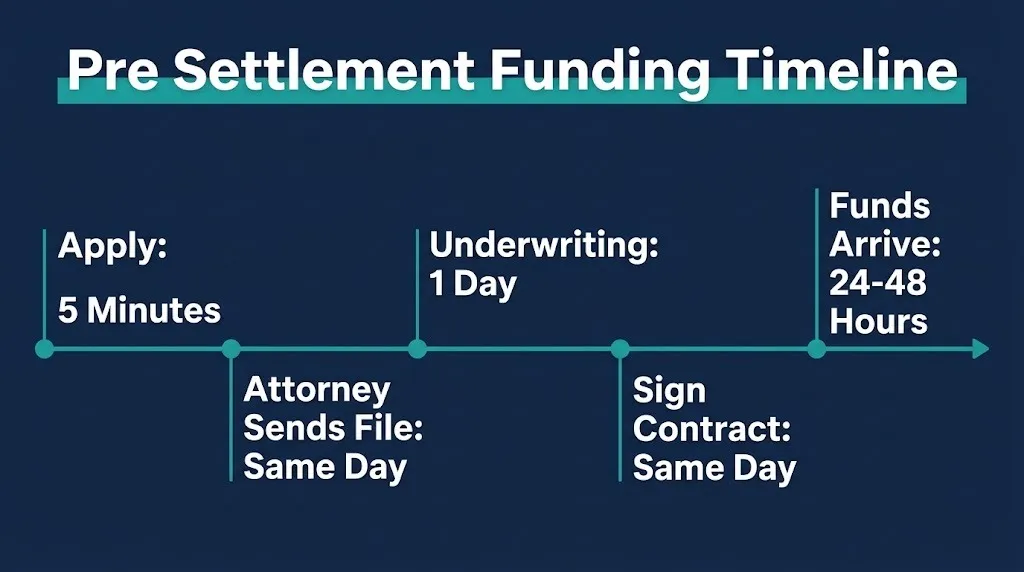
You can get a pre-settlement loan over $5,000 in 24 to 48 hours after your attorney sends the case file to the funder, and sometimes the same day. The application itself takes minutes.
The timeline breaks down like this:
- Apply online or by phone. Basic details: your contact information, your attorney’s name and number, the case type, and the injury date.
- The funder contacts your attorney. This is the single biggest variable. If your lawyer responds quickly, the process moves. If your lawyer is slow or skeptical of funding, the process stalls .
- Underwriting. The funder reviews the complaint, medical records, police report, insurance information, and any settlement correspondence. Because there is no credit check, this stage is faster than a traditional loan.
- Contract issued. The written agreement shows the advance amount, the monthly rate, whether it is simple or compounding, any cap on total fees, and the repayment terms.
- You and your attorney sign. Funds are disbursed by wire or check, typically posting the same or next business day .
Baker Street Funding states that the full sequence from application to deposit usually completes in 24 to 48 hours from the moment the attorney provides the case file . That is faster than most personal loans and far faster than waiting for the lawsuit itself.
What Fees Should You Watch for on a $5,000 Advance?
The fees to watch on a $5,000 pre-settlement advance are processing fees, origination fees, wire fees, monthly maintenance fees, and attorney communication fees. Reputable funders charge none of these upfront, but some contracts bury them in the balance.
A fee schedule circulating in consumer reporting shows what the bad version looks like: a 7.5% origination fee deducted from the advance, a $350 processing fee, $35 per month in maintenance, and a $30 wire fee. On a $10,000 advance, the borrower receives $9,250 and owes $11,760 before a single dollar of interest accrues .
For a $5,000 advance, the same fee structure would look like this:
| Fee | Amount | Effect on $5,000 Advance |
|---|---|---|
| Origination (7.5%) | $375 | You receive $4,625 |
| Processing | $350 | Added to balance |
| Monthly maintenance | $35 x 18 months = $630 | Added to balance |
| Wire fee | $30 | Added to balance |
| Total fees before interest | $1,385 | You owe $6,385 before interest |
That is the trap. The advertised rate looks manageable, but the fees inflate the principal before interest even starts.
The questions to ask before signing are simple: Is there a cap on total repayment? Is the rate simple or compounding? Are there any application, processing, origination, or wire fees? What would I owe at 6, 12, and 24 months? A funder that answers these in writing is one you can work with. Mustang Litigation Funding, a funder, tells borrowers to ask exactly these questions .
What Happens Next for Pre Settlement Funding in 2026 and 2027?
The 2026 funding market is operating under the same state-by-state patchwork that has governed it for years. Some states have dedicated statutes with registration, disclosure, and rate caps. Others have no specific regulation at all.
October 2026: Pre-settlement funding is legal in most states, with regulated frameworks in states including Maine, Nebraska, Nevada, New York, Ohio, Oregon, Tennessee, Utah, Vermont, Virginia, and West Virginia .
Expected late 2026: Federal disclosure legislation, including the Litigation Funding Transparency Act of 2026 introduced in February, remains pending and is not yet law . Its impact on consumer funding is not yet confirmed.
January 2027: State legislative sessions begin, and additional states may introduce or amend pre-settlement funding statutes. Specific bills are not yet confirmed.
Ongoing: Funders continue to advertise simple-interest products with caps, and the competitive pressure is pushing some rates down. The advertised range of 2.95% to 5% per month is likely to hold or narrow slightly in 2027, though no verified forecast exists.
Frequently Asked Questions
Can I get a pre settlement loan over $5,000?
Yes, if your case supports it. Many funders approve advances above $5,000, often capped near 10% of the case’s estimated settlement value .
How much does a $5,000 pre settlement loan cost?
At 4% simple interest, you would repay about $5,900 if the case settles in six months. Compounding interest or added fees can push the total much higher .
Do I need good credit to get pre settlement funding?
No. Funders evaluate the lawsuit, not your credit score. Baker Street Funding states that it does not factor in credit score or financial status .
How fast can I get the money?
Typically 24 to 48 hours after your attorney sends the case file to the funder. The biggest delay is usually your attorney’s response time .
Do I have to pay the loan back if I lose my case?
No. Pre-settlement funding is non-recourse, meaning you owe nothing if your case does not settle or win .
What is the difference between simple and compound interest on a lawsuit loan?
Simple interest is charged only on the original advance. Compound interest is charged on the balance including accrued interest, which grows much faster over a long case .
Are there upfront fees for pre settlement funding?
Reputable funders charge no application or processing fees. Some contracts include origination, wire, or maintenance fees that are added to the balance, so ask for a full fee schedule in writing .
Is pre settlement funding legal in my state?
It is legal in most states, but the rules vary. Some states have registration and disclosure requirements; others have no specific statute. Check your state’s framework before signing .
What You Should Do Before You Sign
Ask for the full fee schedule in writing, and ask specifically whether the rate is simple or compounding and whether there is a cap on total repayment. Then calculate what you would owe at six, twelve, and twenty-four months. If the numbers at twelve months already exceed what you are comfortable losing from your settlement, borrow less or wait.
Compare at least two written offers. Rates and terms vary widely, and the difference between a 2.95% simple rate and a 5% compounding rate over a two-year case is thousands of dollars on a $5,000 advance. Your attorney can review the agreement before you sign, and a funder that resists that review is telling you something.