Erb’s Palsy Settlement 2026: Real Payout Ranges, Deadlines, and What No One Tells You
Quick Answer
- Is it legit? Yes. Erb’s palsy claims are standard birth injury malpractice cases, not a settlement fund.
- How much? Recent permanent-injury cases settled between $1 million and $3.5 million, depending on severity.
- Key deadline: Most states give parents 2 to 3 years, but minor tolling rules can extend or shorten that window.
If you’re searching for an Erb’s palsy settlement, you’re likely a parent who just heard a diagnosis and wants to know what it means financially. There’s no single national settlement to claim. Each case is a separate malpractice claim filed against the hospital, doctor, or delivery team, and the payout depends on your child’s specific injury.
The numbers you see online are all over the place because they mix verdicts with settlements, and brain injury cases with arm injury cases. This article sorts out what’s verified, what’s realistic, and what deadlines actually apply to your family.
The Facts
| Item | Verified Detail |
|---|---|
| Case Type | Individual medical malpractice claim, not a class action |
| Status | No central settlement fund exists; cases filed and resolved individually |
| Recent Settlement Range | $1 million to $3.5 million for permanent injuries (2026 case reports) |
| Mild/Recovered Cases | $50,000 to $250,000 range reported |
| Claim Deadline | Varies by state, typically 2 to 3 years with minor tolling exceptions |
| Administrator | Not applicable; no claims administrator exists |
| Proof Needed | Medical records showing negligence and injury causation |
Is the Erb’s palsy settlement real or a scam?
The Erb’s palsy settlement is real in the sense that families do receive compensation through malpractice claims. But it is not a settlement fund you can sign up for. There is no administrator, no claim form, and no deadline you can miss out on by not filing a form.

What exists is a legal process. You hire a lawyer, they investigate the delivery records, expert reviews determine whether negligence occurred, and a case is filed against the responsible hospital or physician. Most cases settle before trial. Some go to verdict. Each one is separate.
Scam risk exists around this topic because desperate parents are easy targets. Anyone promising a guaranteed payout or asking for an upfront fee to “process” an Erb’s palsy claim is not describing how this works.
How much is an Erb’s palsy settlement?
Erb’s palsy settlement amounts vary widely based on injury severity, but recent verified cases cluster in distinct ranges. A permanent, severe injury with ongoing functional limitations typically settles for $1 million or more. A mild case that resolves within the first year may settle for far less, or may not support a claim at all.
The most important variable is permanency. If your child recovers full arm function, the damages are limited. If the impairment is permanent and affects daily life, the numbers climb.
Here’s what verified 2026 case reports show:
| Case Detail | Settlement Amount | Source Year |
|---|---|---|
| Permanent right arm impairment, Cook County, Illinois | $3.5 million | 2026 |
| Permanent arm impairment, New York (settled at mediation) | $1 million | 2026 |
| Severe Erb’s palsy, UK case (converted approximation) | ~$1.3 million | 2026 |
| Long-running claim, permanent Group II Erb’s palsy | ~$1.1 million | 2026 |
Not yet determined is the honest answer for any individual case before medical records are reviewed. No lawyer can tell you what your case is worth on the first phone call. Anyone who does is guessing.
What does Erb’s palsy compensation cover?
Erb’s palsy compensation covers the economic and non-economic losses caused by the birth injury. Economic damages include medical bills, future surgeries, therapy costs, and lost earning capacity. Non-economic damages include pain and suffering and loss of enjoyment of life.
For a child, the calculation is complicated because the injury happened at birth. Future medical needs stretch over decades. Therapies, possible nerve graft surgeries, occupational therapy, and adaptive equipment all factor in.
Loss of earning capacity matters too, even for an infant. A permanent dominant-arm impairment can limit certain careers. Experts project what the child’s earnings would have been without the injury and what they’ll likely be with it.
Key Takeaway: Erb’s palsy compensation is built from documented lifetime costs and limitations, not a fixed schedule, which is why two children with the same diagnosis can receive very different amounts.
Who may qualify to file an Erb’s palsy claim?
You may qualify to file an Erb’s palsy claim if your child’s brachial plexus injury was caused by medical negligence during delivery, not by unavoidable complications. The key distinction is how the delivery team handled the shoulder dystocia emergency.
Shoulder dystocia happens when the baby’s shoulder gets stuck behind the mother’s pelvic bone. It’s an obstetric emergency. The standard of care requires specific maneuvers like the McRoberts maneuver and suprapubic pressure to free the shoulder. Applying excessive lateral traction to the baby’s head is not a recognized maneuver and can stretch or tear the brachial plexus nerves.
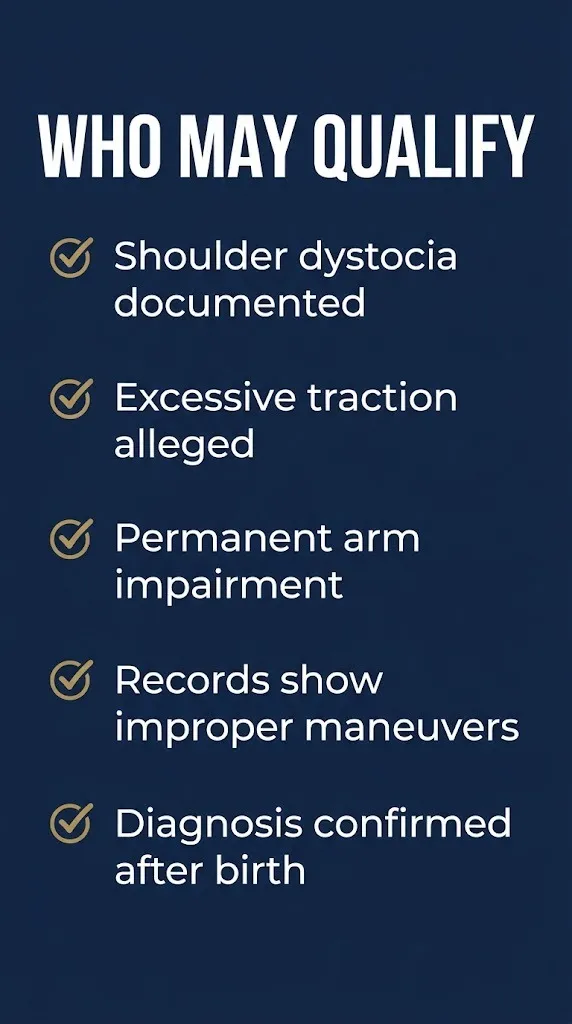
You may have a claim if records show:
- Shoulder dystocia was documented but managed with excessive force or traction
- The delivery team failed to anticipate a large baby or other risk factors
- Recognized maneuvers were not performed or were performed incorrectly
- Your child has lasting impairment beyond the newborn period
Not every Erb’s palsy case is malpractice. Some injuries occur despite proper care. A lawyer and medical expert need to review the records before anyone can say whether negligence occurred.
What is the deadline to file an Erb’s palsy lawsuit?
The deadline to file an Erb’s palsy lawsuit depends on your state and your child’s age. Most states set a 2 to 3 year statute of limitations for medical malpractice, but minor tolling rules often extend the deadline significantly for birth injuries.
Tolling means the clock doesn’t start running until the child reaches a certain age, usually 18 or 21. Some states allow the claim to be filed years after birth. Others have shorter windows or caps.
Here are examples from verified state rules:
| State | Standard Malpractice Deadline | Minor Tolling Note |
|---|---|---|
| New York | 2.5 years | Child can file until age 10 for private defendants |
| California | Varies | Minor rule extends to 8th birthday under CCP 340.5 |
| Texas | 2 years | Limited exceptions |
| Pennsylvania | 2 years | Varies by case type |
New York has a special trap. If the delivery happened at a NYC Health + Hospitals facility, you must file a Notice of Claim within 90 days. That’s a completely different deadline, and missing it can end the case before it starts .
The practical takeaway: don’t assume you have years. Call a lawyer and get the deadline confirmed for your specific state and hospital.
Key Takeaway: Minor tolling rules vary dramatically by state, and a single fact like whether the hospital is public or private can change your deadline from years to 90 days.
Reality Check: No one texts you Erb’s palsy settlement money first. Birth injury claims are filed by lawyers after medical record review, not by claims processors offering quick payouts. If someone contacts you promising money for your child’s diagnosis, it is not how this process works.
How do you file an Erb’s palsy claim?
Filing an Erb’s palsy claim starts with a free consultation and a medical record review, not a form. The process moves through investigation, expert review, filing, and negotiation.
Here are the steps families typically go through:
- Consult a birth injury lawyer. Most offer free case reviews with no upfront cost.
- Gather delivery and medical records. The lawyer requests these from the hospital.
- Expert review. A medical expert determines whether negligence caused the injury.
- File the claim or lawsuit. This must happen before the statute of limitations expires.
- Negotiation or trial. Most cases settle; some go to verdict.
- Court approval for minors. Any settlement for a child requires a judge’s approval.
No step requires you to pay a fee upfront. Birth injury lawyers typically work on contingency, taking a percentage of the final recovery.
What happens next in an Erb’s palsy case?
Most Erb’s palsy cases follow a predictable timeline from investigation to resolution, though every case moves at its own pace. The process can take one to three years or longer if the case goes to trial.
Here’s the expected path:
- Immediately: Consult a lawyer and preserve records before memories fade or records are lost.
- Months 1 to 6: Medical record collection and expert review.
- Months 6 to 12: Filing of the claim or lawsuit.
- Year 1 to 2: Discovery, depositions, and settlement negotiations.
- Year 2 to 3: Mediation, trial date, or settlement.
- After settlement: Court approval for the minor’s compromise and establishment of a trust or structured payout.
The most important early action is securing the records. Hospitals retain them for varying periods, and waiting makes the case harder to prove.
Frequently Asked Questions
How much is the average Erb’s palsy settlement?
There is no single average. Recent permanent-injury cases settled between $1 million and $3.5 million, while mild cases that resolve may settle for $50,000 to $250,000.
Can I sue for Erb’s palsy years after birth?
It depends on your state. Many states toll the deadline for minors, allowing claims until the child turns 18 or 21, but some have caps or shorter windows.
Do I need a lawyer to get Erb’s palsy compensation?
Yes, in practical terms. These cases require medical record review, expert testimony, and court filings. No claims administrator or settlement fund exists for individuals to access without representation.
What causes Erb’s palsy during birth?
Erb’s palsy is caused by damage to the brachial plexus nerves, usually when excessive lateral traction is applied to the baby’s head during a shoulder dystocia delivery.
Is Erb’s palsy always malpractice?
No. Some cases occur despite proper care. A claim requires evidence that the delivery team deviated from the standard of care.
How long does an Erb’s palsy lawsuit take?
Most cases resolve in one to three years. Cases that go to trial can take longer.
What if my child recovered full arm function?
A full recovery significantly reduces the value of a claim. You may still consult a lawyer to review the records, but the damages would be limited.
Can I file a claim if the hospital denies negligence?
Yes. Hospitals routinely deny liability initially. Most Erb’s palsy cases that settle involve an initial denial followed by negotiation after evidence is presented.
What You Should Do Now
If your child has an Erb’s palsy diagnosis, the clock is already running, even if the deadline feels far away. Record retention, witness memory, and expert availability all get harder with time.
Call a birth injury lawyer for a free review and confirm your state’s deadline. That single call is the difference between knowing your options and losing them.