Rural Settlement Patterns in 2026: What the Geography Actually Shows (And Why It’s Not a Lawsuit)
Quick Answer
- Is this a lawsuit? No. “Rural settlement patterns” describes how homes and farms are arranged across the landscape.
- What’s the real research? Recent studies show clustered vs. dispersed patterns tied to terrain, water access, and policy.
- Why does it matter? If you searched this expecting a payout, you were misled by the category label.
You landed here because the category said “Other Lawsuits,” and the keyword sounded like something you could claim. It isn’t. Rural settlement patterns is a term geographers, planners, and archaeologists use to describe how people distribute their homes across rural land.
The most rigorous recent research comes from China, where a 2025 study in Humanities and Social Sciences Communications analyzed settlement evolution across 2000 to 2020 . It found that natural factors shape where villages go, but their relative weight changes by region.
This article explains what rural settlement patterns actually are, what the verified research shows, and why any site that promised you money for this term was wasting your time.
The Facts
| Item | Verified Detail |
|---|---|
| What It Is | The spatial distribution of homes and farms in rural areas |
| Academic Discipline | Human geography, rural planning, archaeology |
| Core Classification | Clustered vs. dispersed settlement |
| Recent Major Study | China settlement evolution, 2000 to 2020 (published 2025) |
| Key Finding | Natural factors matter, but regional context changes their weight |
| Lawsuit or Fund | None. This is not a legal matter. |
| Administrator | Not applicable |
| Claim Deadline | Not applicable |
Is rural settlement patterns a lawsuit or a real legal claim?
No. Rural settlement patterns is an academic and planning term, not a legal cause of action. No court case, settlement fund, or claims administrator exists under this name.
The confusion is understandable if you arrived through a mislabeled category. “Settlement” in this context refers to where people settle on the land, not a legal settlement.
Geographers define a settlement pattern as the physical distribution of a population across space and time . It reflects ecological constraints, social organization, and cultural choices. Nothing about that definition involves a defendant, a plaintiff, or a payout.
What are rural settlement patterns in geography?
Rural settlement patterns describe how homes, farm buildings, and community structures are arranged across a rural landscape. The two broad categories are clustered and dispersed.
Clustered settlements group families close together, with fields surrounding the collection of houses. The layout varies: compact villages with a central core, linear villages along a road or river, or circular villages built around a central open space .
Dispersed settlements scatter farmsteads across the land. Farmers live on individual properties isolated from neighbors rather than in a shared village center. This pattern dominates rural areas of the United States and parts of Europe .
A 2025 multi-scale analysis of China found that expansion patterns differ sharply by region. Southern China tends toward edge expansion, where villages grow outward from existing boundaries. Northern China leans toward outlying expansion, where new development appears farther from the original settlement core .
Why do rural settlement patterns differ from place to place?
They differ because terrain, water access, agricultural systems, and government policy all pull settlement in different directions. A 2025 study confirmed that natural factors significantly influence distribution, but their relative importance shifts by region and expansion type .
In plain areas with reliable water, settlements cluster densely. In mountainous or arid zones, they scatter. The China research found that cold alpine areas and desert fringes had low settlement density and clustered patterns. Plains areas showed denser settlement with random or dispersed distribution .
Government policy adds another layer. Rwanda’s imidugudu program resettled rural populations into planned villages to improve service delivery and land use . Canada’s survey systems shaped farm size and spacing: the long lot system in southern Quebec kept farms close together, while the section system in the prairie provinces spread farms far apart .
What does recent research say about rural settlement evolution?
The most detailed recent work comes from China, where researchers tracked settlement changes across two decades using multi-scale analysis. The key finding: local studies don’t generalize to national patterns.
A study focused on Tongzhou District found edge expansion dominant. The national analysis showed that pattern is more characteristic of southern China, while northern regions tend toward outlying expansion . The lesson is that a finding in one district tells you little about the country as a whole.
Another 2025 study of alpine valleys proposed a hybrid layout called “extensive dispersion with localized concentrations.” The idea is to keep settlements dispersed in disaster-prone areas to reduce risk, while concentrating development in safer zones to share infrastructure .
The research also flagged a gap: policy texts weren’t fully analyzed. Future work needs to examine how land-use regulations and subsidy programs actually shape where people build .
Key Takeaway: Rural settlement patterns are shaped by terrain, water, and policy, but the mix varies so much by region that no single model explains everything.
How do clustered and dispersed settlements affect people who live there?
The pattern you live in shapes your access to services, your daily travel, and your economic options. Clustered settlements make it cheaper to deliver water, power, schools, and clinics because providers serve more people in one place.
Dispersed settlements spread those costs. A study of rural sprawl in Colorado found that low-density residential development does not pay for itself. For each $1.00 of tax revenue from dispersed homes, appropriate services cost $1.30 to $1.60 .
That gap gets covered by public funds or by residents themselves. The same Colorado research noted that a four-acre farm generates about $125 in property tax, while a four-acre rural residential lot with a $350,000 home produces over $3,000. The revenue is higher, but the service demands are higher too .
If you live in a dispersed pattern, you already know the tradeoff: more space, more privacy, more driving, and often fewer nearby services.
What is the difference between nucleated and dispersed settlement?
Nucleated settlements group buildings around a central core. Dispersed settlements scatter them across the landscape with no obvious center.
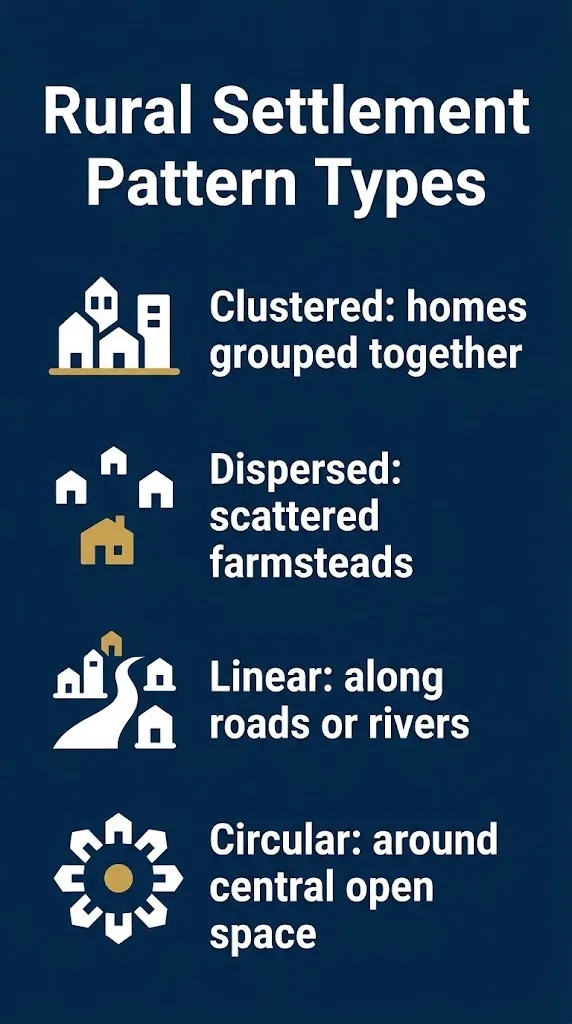
The terms overlap with clustered and scattered. A nucleated village might grow around a church, a crossroads, or a village green. A dispersed pattern might be isolated farmsteads spread across farmland, each self-contained .
Neither is better or worse in the abstract. The pattern reflects what the land allows and what the economy demands. Pastoral economies in rugged terrain tend toward dispersion. Intensive agriculture in fertile plains tends toward nucleation.
What happens next if you thought this was a settlement claim?
Nothing, because there is no claim. But if you arrived here looking for money, you should know why this page exists and what to do instead.
Sites that categorize geography terms under “Other Lawsuits” are using category labels loosely. That doesn’t make the term a scam. It makes the category a poor fit.
If you are looking for a real settlement, you need a named defendant, a case number, and a court. “Rural settlement patterns” has none of those. Search for the company name and the word “settlement,” or check a legitimate settlement database.
For researchers and planners, the productive next step is reading the primary literature. The 2025 China study and the alpine valley optimization research are both open access. They offer more detail than any summary can.
Frequently Asked Questions
Is there a rural settlement patterns lawsuit?
No. Rural settlement patterns is a geography term describing how homes are distributed across rural land. There is no court case, fund, or claim.
What are the main types of rural settlement patterns?
The main categories are clustered and dispersed. Clustered settlements group homes together. Dispersed settlements scatter farmsteads across the land with no central core.
Why did I see this under a lawsuits category?
The category label was likely applied broadly or incorrectly. “Settlement” in this context means where people live, not a legal settlement. No money is available.
What factors influence rural settlement patterns?
Terrain, water access, agricultural systems, transportation routes, and government policy all shape where rural settlements form and how they grow.
What does recent research say about rural settlement patterns in China?
A 2025 study found that natural factors influence settlement distribution, but their weight varies by region. Southern China tends toward edge expansion, while northern regions lean toward outlying expansion.
How do settlement patterns affect public service costs?
Dispersed settlements cost more to serve per household. A Colorado study found that for every $1.00 in tax revenue from dispersed homes, services cost $1.30 to $1.60.
What is nucleated settlement?
A nucleated settlement groups buildings around a central core, such as a village green, church, or crossroads. It is the opposite of a dispersed pattern.
Where can I find the actual research on this topic?
The 2025 study in Humanities and Social Sciences Communications and the alpine valley study in Scientific Reports are both open access. Search the journal names or the article titles.