Non Cash Compensation in 2026: What Counts, How It’s Taxed, and the Lawsuit Angle Nobody Explains
Quick Answer
- Is this a lawsuit? No. Non-cash compensation describes benefits like stock options and perks, not a legal claim.
- How is it taxed? Most non-cash compensation is taxable at fair market value and reported on your W-2.
- Key rule: The IRS requires income tax withholding and FICA on taxable non-cash benefits.
You searched for non cash compensation, and the category label said “Employment Lawsuits.” That’s a mismatch worth clearing up immediately.
Non-cash compensation is what your employer gives you that isn’t a paycheck: stock options, health club access, company cars, and similar perks. The IRS taxes most of it as wages .
The lawsuit angle exists, but it’s narrow. Non-cash compensation shows up in ERISA disputes over stock plans, H-1B compliance cases, and severance fights. This article explains what counts, how the IRS treats it, and where the real legal risks sit in 2026.
The Facts
| Item | Verified Detail |
|---|---|
| What It Is | Benefits and perks paid in something other than cash |
| Primary Tax Rule | Taxed at fair market value, reported on Form W-2 |
| Withholding Required | Income tax and FICA on taxable benefits |
| DOL Position | Stock options count as non-cash compensation for H-1B/E-3 |
| Key Lawsuit Area | ERISA stock plan disputes, severance cases |
| Settlement Fund | None. This is a compensation category, not a claim. |
| Administrator | Not applicable |
| Deadline | Not applicable |
Is non cash compensation a lawsuit or a tax issue?
It is a tax and employment law issue, not a lawsuit. There is no “non-cash compensation settlement” to claim.
The confusion comes from the category. Employment lawsuits involving compensation exist, but they involve specific disputes: unpaid severance, ERISA breaches, or visa compliance failures. “Non-cash compensation” itself is a definitional term.
The Internal Revenue Service defines non-cash compensation as benefits included in income, valued at fair market value, subject to income tax withholding and FICA, and reported on Form W-2 . That’s the framework you need to understand before any legal question makes sense.
What counts as non cash compensation?
Non-cash compensation includes any benefit or perk you receive from your employer that isn’t direct cash wages. Stock options, health club memberships, company vehicles, and expense reimbursements under non-accountable plans all count.
The Department of Labor explicitly lists stock options as non-cash compensation in its H-1B and E-3 visa fact sheets . That matters for employers sponsoring foreign workers: they must offer the same benefits to visa holders as to similarly situated U.S. workers.
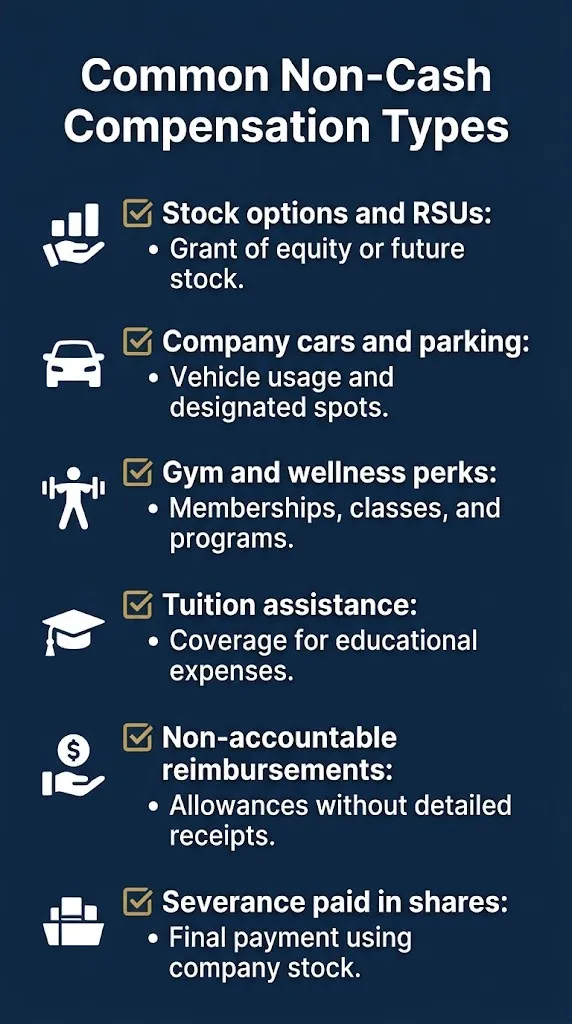
Here’s what commonly falls into the category:
- Equity awards: Stock options, restricted stock units, employee stock purchase plans.
- Health and wellness perks: Gym memberships, wellness stipends, on-site fitness facilities.
- Vehicles and transportation: Company cars, transit subsidies, parking allowances.
- Expense reimbursements: Payments under non-accountable plans are taxable wages .
- Education and training: Tuition assistance above IRS exclusion limits.
- Severance in non-cash form: Company stock issued in lieu of cash severance .
How is non cash compensation taxed in 2026?
Most non-cash compensation is taxed as ordinary wages. The IRS values it at fair market value, withholds income tax and FICA, and reports it on your W-2.
That rule applies broadly. A stock option you exercise, a gym membership your employer pays for, or a reimbursement under a non-accountable plan all flow into your taxable income .
There are exceptions. Employer-provided on-premises health club facilities are not taxable if the facility is on employer premises, operated by the employer, and used substantially by employees and their families . That’s a narrow carve-out.
Accountable plan reimbursements are also not taxable. To qualify, the reimbursement must meet three tests: business connection, adequate accounting, and return of excess . If the plan fails any test, the payment becomes taxable wages.
Key Takeaway: Non-cash compensation is not tax-free just because it isn’t cash. The IRS treats most benefits as wages unless a specific exclusion applies.
Why does non cash compensation matter in employment lawsuits?
Non-cash compensation matters in employment lawsuits because it often represents the largest disputed value. Stock options, ESOP shares, and equity awards can outweigh base salary in high-growth companies.
The 2026 legal landscape shows this clearly. ESOP class actions involving non-cash settlement terms continue to move through courts. The Dallas BBQ ESOP settlement included $10 million in cash plus about $12 million in loan-principal forgiveness and $9.7 million in interest forgiveness, all non-cash terms meant to restore value inside the plan .
Severance disputes also involve non-cash components. A former Twitter employee ERISA case reached a settlement in principle in October 2026, with the exact terms unspecified . And a former employee’s claim against Galway Metals settled for $800,000, split between $500,000 in cash and $300,000 in company shares .
Those are real cases where non-cash compensation is central. But they are individual or class disputes with named parties, not a general “non-cash compensation fund.”
Do stock options count as non cash compensation?
Yes. The Department of Labor explicitly classifies stock options as non-cash compensation, whether or not performance-based .
That classification has practical consequences. For H-1B and E-3 visa holders, employers must offer stock options on the same terms as other workers. Failing to do so can trigger compliance problems.
The IRS treats stock options as taxable when exercised or vested, depending on the option type. Incentive stock options have different tax treatment than non-qualified options, but both represent compensation value that must be reported.
A 2025 Department of Labor advisory opinion addressed a deferred incentive compensation program for financial advisors. The DOL concluded the program was not an ERISA pension plan because awards were contingent on continued employment, not designed for retirement income . That’s a reminder that how a non-cash plan is structured determines which laws apply.
What is the Fair Labor Standards Act rule on non cash compensation?
The FLSA does not directly regulate most non-cash benefits. The Department of Labor states that medical reimbursement accounts, educational assistance, and nonproduction cash bonuses are generally matters of agreement between employer and employee .
The exception is overtime. The FLSA requires bonus payments, with some exceptions, to be included in an employee’s regular rate of pay when computing overtime . That means non-discretionary bonuses can increase your overtime rate.
For non-cash benefits like stock options, the overtime calculation is more complex. The key question is whether the benefit is tied to hours worked or production. Most equity awards are not, which limits their impact on the regular rate.
How do I know if my non cash compensation is being taxed correctly?
You know it’s being taxed correctly when it appears on your Form W-2 with proper withholding. If it doesn’t appear, or if the value looks wrong, you have a question worth asking.
Here’s a practical check:
- Review your W-2 Box 1, 3, and 5. Taxable non-cash compensation should appear in wages, Social Security wages, and Medicare wages.
- Check Box 12 codes. Certain benefits have specific codes (like code C for group-term life insurance over $50,000).
- Compare your final pay stub to your W-2. The year-to-date figures should reconcile.
- Ask HR for the fair market value calculation. Employers must value non-cash benefits, and they should be able to show you how.
- Consult a tax professional if the numbers don’t match. A mismatch could mean an error in your favor or against you.
What happens next if you have a non cash compensation dispute?
The path depends on the type of dispute. A tax question goes to the IRS. A wage dispute goes to your state labor agency or the DOL. An ERISA claim goes to federal court.
Tax issue: File an amended return or contact the IRS if your W-2 is wrong.
Unpaid benefit: Document what was promised and what you received. Many disputes resolve through HR or a demand letter.
ERISA or stock plan dispute: Consult an employment attorney who handles ERISA cases. These are complex and often involve plan documents you haven’t seen.
Severance dispute: Review your severance agreement. Non-cash terms like stock acceleration or continued vesting may be negotiable.
Visa compliance issue: If you’re an H-1B or E-3 worker and your employer offers different benefits to you than to U.S. workers, that’s a potential DOL complaint.
Frequently Asked Questions
Is non cash compensation taxable?
Yes, most non-cash compensation is taxable at fair market value. The IRS requires income tax withholding and FICA, and it must be reported on your W-2.
What are examples of non cash compensation?
Common examples include stock options, company cars, gym memberships, tuition assistance above exclusion limits, and expense reimbursements under non-accountable plans.
Do stock options count as non cash compensation for H-1B workers?
Yes. The Department of Labor explicitly lists stock options as non-cash compensation that must be offered to H-1B workers on the same basis as other employees.
Is there a lawsuit settlement for non cash compensation?
No. Non-cash compensation is a category, not a claim. Individual lawsuits and class actions can involve non-cash compensation, but there is no general fund to claim from.
How do I value non cash compensation for tax purposes?
The IRS generally requires fair market value. Your employer should provide the valuation method, and it should appear in your W-2 reporting.
What is an accountable plan?
An accountable plan is an expense reimbursement arrangement that meets three IRS tests: business connection, adequate accounting, and return of excess. Reimbursements under an accountable plan are not taxable.
Can my employer change my non cash compensation?
Generally yes, unless a contract or plan document says otherwise. Equity plans often reserve the right to modify or terminate benefits.
Do I need a lawyer for a non cash compensation dispute?
Not always. Tax questions can go to a CPA. Wage disputes may resolve through the DOL. But ERISA and equity disputes often require an employment attorney.