Ohio Workers Compensation Attorney 2026: Fees, Settlements, and the One-Year Deadline That Decides Your Case
Quick Answer
- Is it legit? Yes. Ohio workers’ comp lawyers work on contingency and get paid only from what they recover for you.
- How much? Attorney fees are capped at 33.33% of additional compensation, not your entire settlement.
- Key deadline: You must file a notice of injury with the BWC or Industrial Commission within one year of the injury.
If you searched for an Ohio workers compensation attorney, you’re likely hurt, confused about the BWC system, and wondering whether a lawyer is worth the cost. The short answer is that most Ohio workers’ comp attorneys cost you nothing unless they recover money for you.
Ohio runs a monopolistic state fund, which means all claims go through the Bureau of Workers’ Compensation, not private insurers. That structure changes how attorneys work and how fees are approved.
This article breaks down what Ohio attorneys actually charge, what recent settlements paid, how to verify a lawyer’s credentials, and the one-year deadline that can end your case before it starts.
The Facts
| Item | Verified Detail |
|---|---|
| State Agency | Ohio Bureau of Workers’ Compensation (BWC) |
| Attorney Fee Cap | Up to 33.33% of additional compensation recovered |
| Upfront Cost | None in most cases; contingency basis |
| Filing Deadline | One year from injury under ORC 4123.84 |
| Waiting Period | 7 days; retroactive if disability lasts 14+ days |
| Average Settlement (Reference) | Approximately $46,000 for lost-time claims |
| System Type | Monopolistic state fund; all claims through BWC |
| Proof Needed | Medical records and written notice of injury |
How much do Ohio workers compensation attorneys charge?
Ohio workers’ comp attorneys charge no upfront fees and typically take up to 33.33% of the additional compensation they recover for you, subject to approval by the Industrial Commission of Ohio.
The key word is “additional.” The fee isn’t calculated on your entire settlement. It’s calculated on what the attorney recovers beyond what you would have received without representation . That distinction matters because it means a lawyer’s incentive is to increase your recovery, not just process paperwork.
Most Ohio workers’ comp attorneys work on a “no recovery, no fee” basis. If they can’t recover benefits or a settlement, you owe nothing for their services .
Case expenses (medical records, expert fees, deposition costs) may be advanced by the firm and deducted from your recovery. Ask about that at your first consultation.
Do I have to pay an Ohio workers comp lawyer out of pocket?
No. You won’t write a check to start your case, and you won’t owe anything if your claim isn’t successful. That’s how contingency fee arrangements work in Ohio workers’ comp.
Here’s what the fee structure looks like in practice, based on published attorney guidance :
| Recovery Type | Example Amount | Attorney Fee (33.33%) | Your Net |
|---|---|---|---|
| Settlement | $7,500 | $2,500 | $5,000 |
| Past TTD benefits | $15,000 | $5,000 | $10,000 |
Those examples assume the full one-third fee applies. The Industrial Commission reviews fee requests to ensure they’re reasonable.
This is different from a standard personal injury case where the contingency fee is negotiated privately. In Ohio workers’ comp, the fee is regulated and reviewed.
Key Takeaway: Ohio workers’ comp representation is contingent and regulated. You pay nothing upfront, and the fee comes only from additional money your attorney recovers.
What is the average workers comp settlement in Ohio?
There is no single official average, but a commonly cited reference figure for lost-time claims is approximately $46,000, based on NCCI and state board data . Surgical cases settle substantially higher.
That figure is a reference point, not a guarantee. Settlement values depend heavily on the severity of injury, the impairment rating assigned, and whether the claim involves permanent partial disability, permanent total disability, or a scheduled loss.
Here’s what recent Ohio outcomes show, based on settlement data :
| Settlement Amount | Year | Case Type |
|---|---|---|
| $288,000 | 2025 | Scheduled loss, arm amputation (225 weeks) |
| $145,000 | 2024 | 25% PPD, unscheduled back injury with future medical |
| $58,000 | 2024 | PTD claim resolved via lump sum, older worker |
| $18,000 | 2023 | 10% PPD, soft tissue lumbar |
The gap between $18,000 and $288,000 reflects the difference between a soft tissue injury and an amputation. Impairment ratings drive the number in Ohio’s scheduled loss system.
What is the maximum weekly workers comp benefit in Ohio for 2026?
The maximum weekly benefit in Ohio is set by the BWC rate table, and published figures vary by source. The most commonly cited 2026 figure is $1,145 per week at 66.7% of average weekly wage . Some sources cite higher caps, including $1,281 or $1,345, reflecting different rate components or update cycles .
The safest approach is to verify the current rate directly with the BWC before relying on any figure. The rate changes annually and applies based on your injury date.
Ohio pays 72% of your full weekly wage for the first 12 weeks of temporary total disability, then 66.67% of your average weekly wage thereafter . The waiting period is 7 days, but those days are paid retroactively if your disability lasts 14 days or more .
The practical effect: higher earners hit the cap and lose leverage above it. Lower earners receive a percentage of their actual wage.
Reality Check: No one texts you a workers’ comp settlement. No legitimate attorney charges a consultation fee to review your case. And no one can promise a specific payout before seeing your medical records. If any of those three things happen, walk away.
How do I find a good Ohio workers compensation attorney?
You find a good Ohio workers’ comp attorney by checking three things: whether they practice before the BWC and Industrial Commission, whether they handle cases in your region, and whether their fee structure is transparent.
Here is a practical checklist:
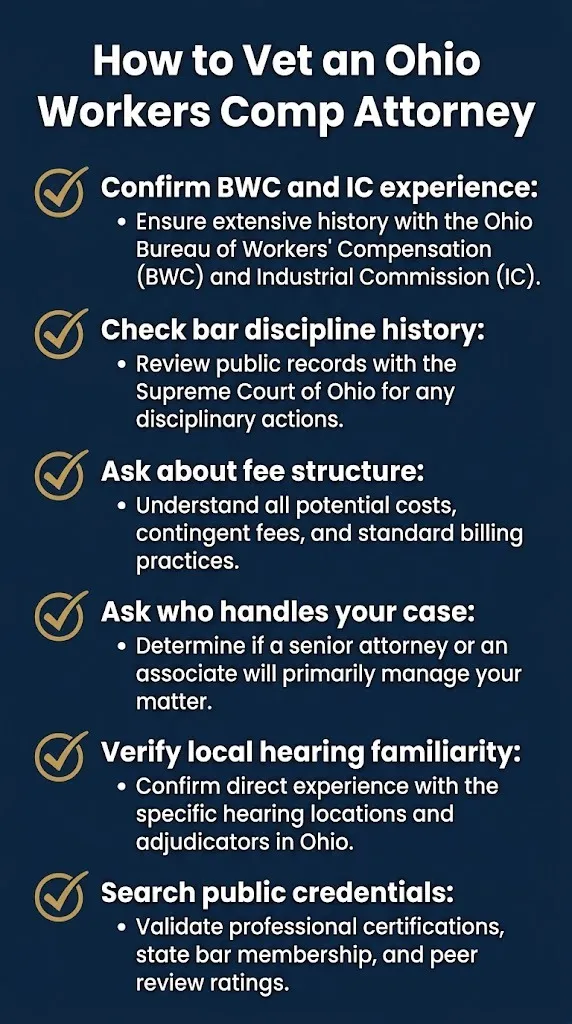
- Confirm BWC and Industrial Commission experience. Workers’ comp in Ohio is a niche practice with its own agency, forms, and hearing process. A general personal injury lawyer may not know the local procedures.
- Check bar status and discipline history. The Ohio Supreme Court maintains public attorney records.
- Ask about fee structure upfront. A legitimate attorney will explain the 33.33% cap and confirm there’s no upfront cost.
- Ask who handles your case. Some firms hand cases to paralegals after the initial meeting. Ask directly.
- Look for local familiarity. If you were hurt in Columbus, Cleveland, or Cincinnati, an attorney who regularly appears at the Industrial Commission hearings in your region knows the process.
- Verify credentials through public listings. The Ohio State Bar Association and local bar associations maintain referral resources.
You can also search the BWC’s public resources for guidance on filing and appeals .
How do I file an Ohio workers compensation claim?
You file by reporting the injury to your employer and, if you miss more than seven days of work, ensuring a claim is submitted to the BWC. The process has specific steps and deadlines.
Here is the sequence:
- Seek medical attention immediately. Tell the doctor this is a work injury.
- Tell your employer about the injury. Ask if they need an internal accident report.
- Provide your MCO name to your doctor. They need it to file the claim.
- Confirm your doctor files the claim within 24 hours. Medical providers have a 24-hour filing window with the MCO .
- File yourself if needed. If your employer or doctor hasn’t filed, you can submit a claim online, by mail, or by phone at 800-644-6292 .
- Watch for your BWC ID card. It arrives by mail a few days after filing and contains your claim number.
- Appeal a denial promptly. If your claim is denied, you have appeal rights through the Industrial Commission.
A medical-only claim applies if you miss seven or fewer days of work. A lost-time claim applies if you miss eight or more days .
What is the deadline to file an Ohio workers comp claim?
You must file written notice of injury with the BWC or Industrial Commission within one year of the injury date under Ohio Revised Code 4123.84 . This is the statute of limitations.
For occupational disease claims occurring on or after September 28, 2021, the deadline is generally one year from the most recent of several triggering dates, including diagnosis or first treatment. For pre-2021 occupational disease claims, a two-year window may apply depending on the triggering event .
Missing the deadline typically bars your claim permanently. That’s the one date you cannot negotiate, and it’s the reason a consultation early is worth more than a consultation later.
A delayed tax refund is a rough comparison: you know money may be coming, but if you miss the filing window, the refund doesn’t arrive late. It doesn’t arrive at all.
What happens next in an Ohio workers comp case?
The path from injury to resolution follows a predictable sequence, though timing varies by case and whether the claim is disputed.
Immediately: Report the injury, get medical treatment, and ensure a claim is filed.
Within days to weeks: The BWC or self-insured employer investigates. You receive a BWC ID card. The MCO manages medical treatment.
If the claim is allowed: Medical bills are paid. If you miss eight or more days, lost-time benefits begin after the waiting period.
If the claim is denied: You can appeal through the Industrial Commission. An attorney can represent you at hearings.
At any point after the claim is established: The case can settle through a lump-sum agreement, often called a Compromise and Release, subject to Industrial Commission approval.
Frequently Asked Questions
How much does an Ohio workers comp attorney cost?
Most charge no upfront fee and take up to 33.33% of additional compensation they recover, subject to Industrial Commission approval. If they recover nothing, you owe nothing.
What is the average workers comp settlement in Ohio?
There is no official average. A commonly cited reference for lost-time claims is approximately $46,000, but actual settlements range from about $18,000 for minor injuries to $288,000 for scheduled losses like amputation.
How long do I have to file a workers comp claim in Ohio?
One year from the injury date under Ohio Revised Code 4123.84. For occupational disease claims, the deadline depends on diagnosis or treatment dates.
Do I need a lawyer for an Ohio workers comp claim?
Not always. Simple medical-only claims can be filed without one. But if your claim is denied, if you miss significant work, or if you face a settlement decision, representation usually increases your net recovery.
Can I get fired for filing a workers comp claim in Ohio?
No. Ohio law prohibits retaliation for filing a workers comp claim. If it happens, you may have a separate legal claim.
What is the maximum weekly workers comp benefit in Ohio for 2026?
Published figures vary by source, with the most commonly cited rate at $1,145 per week. Verify the current rate directly with the BWC, as it changes annually based on your injury date.
What if my employer is self-insured?
You file your claim with your employer instead of the BWC. Self-insured employers pay benefits directly, but the same deadlines and appeal rights generally apply.
How do I check an attorney’s credentials in Ohio?
Use the Ohio Supreme Court’s attorney directory for discipline history, the Ohio State Bar Association for referral resources, and ask directly about the attorney’s experience before the BWC and Industrial Commission.