Crumbl Cookies Lawsuit 2026: The Warner Music Settlement and the Claims People Keep Asking About
Quick Answer
- Is it legit: Yes. Warner Music sued Crumbl in April 2025 for using 159 songs in social media videos without licenses. The case settled in 2026.
- How much: The settlement is confidential. Warner sought up to $23.85 million in statutory damages, but no public figure confirms what Crumbl paid.
- Deadline: None for consumers. This was a business-to-business copyright dispute. No claim form and no administrator exist.
If you searched for “Crumbl Cookies lawsuit,” you probably saw a headline about a cookie chain, Taylor Swift songs, and a multimillion-dollar fight. The story is real, but it ended in a settlement, not a consumer payout. Nobody who bought a Crumbl cookie is owed money from this case.
The lawsuit was filed by Warner Music Group in April 2025 in Utah federal court. Warner claimed Crumbl built its brand on TikTok and Instagram videos soundtracked by unlicensed hit songs. The case settled in May 2026 and was formally closed in June 2026.
What follows is what the court record actually shows, what the settlement does and does not mean for you, and how to spot the scams that always follow a headline like this.
The Facts
| Item | Verified Detail |
|---|---|
| Case Name | Warner Music Group et al. v. Crumbl LLC |
| Court | U.S. District Court, District of Utah |
| Filed | April 22, 2025 |
| Status | Settled and terminated June 22, 2026 |
| Damages Sought | Up to $150,000 per work for 159 works, roughly $23.85 million |
| Settlement Amount | Confidential |
| Consumer Payout | None. No class action, no claim form. |
| Administrator | Not applicable |
Is the Crumbl Cookies Lawsuit Real or a Scam?
The Crumbl lawsuit was real, filed in federal court, and it is now closed. Warner Music Group sued Crumbl LLC on April 22, 2025, in the U.S. District Court for the District of Utah .
The scam risk is separate. Any message claiming you are owed money from the “Crumbl Cookies lawsuit” is false. There was never a class action, never a settlement fund for customers, and never a claims process.
The confusion makes sense. Search results mix the Warner Music case with older Crumbl litigation: a trade secrets fight with Dirty Dough, a service fee class action in California, and a text message spam case in Michigan . None of those produced a consumer payout tied to this headline either.
The Warner case was a copyright dispute between two companies. You were never a party to it.
Key Takeaway: The Crumbl lawsuit is real but closed. No consumer money is available from it, and any website or text saying otherwise is running a scam.
How Much Did Crumbl Pay to Settle the Lawsuit?
Crumbl’s settlement payment is confidential. The exact dollar amount has not been disclosed in court filings or public statements, and it likely never will be.
Warner Music’s original demand was specific. The complaint sought statutory damages of up to $150,000 per infringed work and cited 159 songs. That math produces a maximum exposure of $23,850,000 before attorneys’ fees .
That number was a ceiling, not a bill. Statutory damages in copyright cases are set by a judge or jury within a range, and settlements almost always land below the maximum. Warner also asked for a permanent injunction to stop Crumbl from using its music going forward.
| Financial Item | Verified Figure |
|---|---|
| Statutory maximum sought | $23.85 million (159 works x $150,000) |
| Actual settlement amount | Confidential |
| Attorneys’ fees | Each side paid its own, per court filing |
| Consumer payout | None |
The final court filing in June 2026 confirmed the case was terminated and each company would cover its own legal costs . That is a standard clean break in a settled business dispute.
Reality Check: No one texts you settlement money first. Crumbl’s settlement was a private agreement between two companies. There is no claim form, no administrator, and no fund for customers. If a message asks for your information to “release your Crumbl settlement,” it is fraud.
Can You File a Claim in the Crumbl Cookies Lawsuit?
You cannot file a claim because no claim process exists. The Warner Music case was a private copyright lawsuit, not a class action.
Class actions create claim forms when a court approves a settlement fund and defines who qualifies. The Crumbl case never reached that stage. It settled privately, with no class certification, no public fund, and no eligibility rules.
The other Crumbl lawsuits do not help you either. The California service fee case involved customers who paid hidden fees, but that case has its own docket and its own posture . The Michigan text message case involves alleged TCPA violations from marketing texts, and that is still in discovery . Neither has produced a claims process for the general public.
If you want to know whether any Crumbl-related settlement affects you, the answer lives on official court dockets, not on social media. Check the District of Utah docket for the Warner case. Check the specific district for the other cases. Do not trust a third-party site that asks for a fee to “check your eligibility.”
What Songs Did Crumbl Use Without Permission?
Warner Music claimed Crumbl used at least 159 copyrighted recordings and compositions in promotional videos on TikTok and Instagram without licenses. The list included some of the biggest names in pop.
The complaint named artists including Taylor Swift, Ariana Grande, Beyoncé, Bruno Mars, Dua Lipa, Lizzo, Mariah Carey, Selena Gomez, and Coldplay . Specific songs cited included Beyoncé’s “Single Ladies,” Dua Lipa’s “Levitating,” Bruno Mars’ “Locked Out of Heaven,” and Taylor Swift’s “All Too Well” .
Warner’s theory was not complicated. Crumbl’s marketing strategy relied on short videos set to hit songs. The complaint quoted Crumbl CEO Jason McGowan telling the Wall Street Journal that “our strategy right from the beginning was social media” . Warner argued the music was not background. It was the content.
The willfulness allegation got sharper. Warner said it sent a cease-and-desist letter in 2023. Months later, according to the complaint, Crumbl posted a TikTok saying “legal said we can’t use any trending audios” . Warner treated that post as an admission that Crumbl knew the use was unauthorized.
Key Takeaway: Warner’s case was built on 159 songs, a cease-and-desist letter, and Crumbl’s own social media posts. The evidence of willfulness was a major pressure point toward settlement.
Where Does the Crumbl Lawsuit Stand Now?
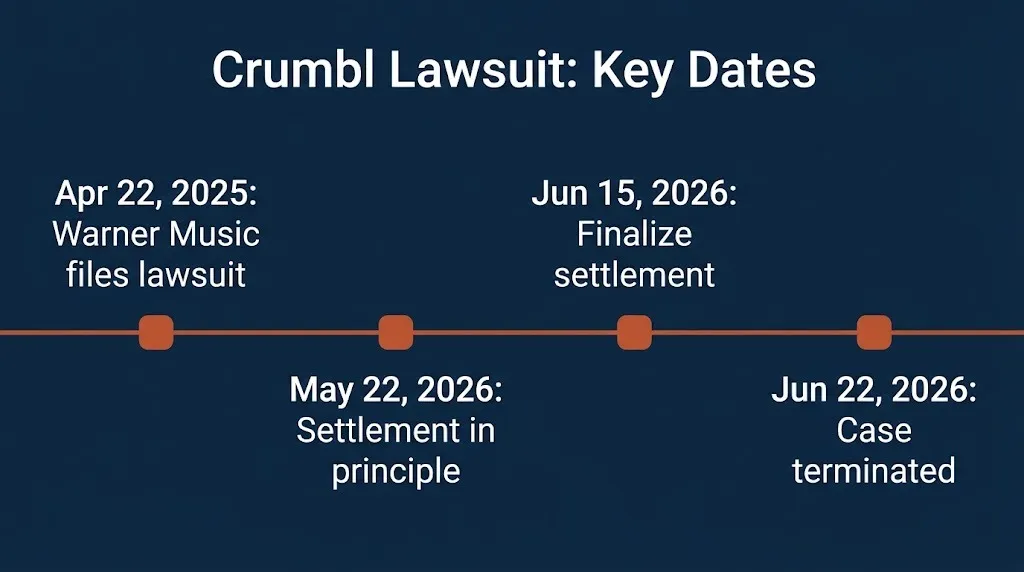
The Crumbl lawsuit is over. The parties reached an agreement in principle on May 22, 2026, finalized the settlement, and the case was terminated on June 22, 2026 .
The sequence is documented in court filings. Warner filed the complaint in April 2025. The parties litigated for about a year. In May 2026, they told the court they had a deal and asked to stay proceedings. The court granted the stay. The settlement was finalized by June, and the case closed.
No trial happened. No judge ruled on whether Crumbl’s use was fair use or infringement. The settlement terms are private. The only public facts are the dismissal and the confidentiality.
This matters for anyone watching the broader issue of brands using music in social media marketing. The Crumbl case did not create a legal precedent. It resolved privately, like most copyright disputes between sophisticated parties. The legal question of how fair use applies to short-form brand videos remains unsettled in the courts.
Why Did Warner Music Sue Crumbl?
Warner Music sued Crumbl because the label believed Crumbl built a national brand on unlicensed music. The complaint described Crumbl’s social media videos as central to its marketing, with music as the “principal and indispensable element” .
Crumbl’s growth depended on virality. The company has millions of followers on TikTok and Instagram. Its videos are short, visually appealing, and soundtracked. Warner’s argument was that Crumbl could not separate its success from the music it used without paying.
The complaint also noted that Crumbl understood intellectual property law well enough to enforce its own rights. Crumbl had sued competitors like Dirty Dough and Crave over trademark and trade secrets issues . Warner pointed to that history to argue Crumbl knew better than to use unlicensed music.
Crumbl’s public response at the time of filing was measured. The company said it was “aware of the legal action” and “respects the rights of artists and creators” . It did not admit wrongdoing. The settlement resolved the dispute without a court finding on the merits.
Key Takeaway: Warner’s complaint was less about one song and more about a business model. Crumbl’s social media strategy was the product, and Warner argued the music was the unpaid ingredient.
What Happens Next After the Crumbl Settlement?
Nothing happens for consumers. The case is closed, the settlement is confidential, and no claim window will open. The next stages apply to the companies, not to the public.
June 22, 2026: Case terminated. This already happened. The court closed the docket after the settlement was finalized .
Ongoing: Crumbl must comply with whatever license or injunction terms are in the private settlement. The public does not know those terms.
Ongoing: Other Crumbl litigation continues separately. The Michigan text message case is in discovery. The California service fee case has its own timeline .
No future date: There is no consumer claim deadline, no fairness hearing, and no payout date. None is scheduled because none is needed.
Frequently Asked Questions
Did Crumbl settle the Warner Music lawsuit?
Yes. The parties reached a settlement in principle in May 2026 and finalized it by June 22, 2026. The terms are confidential.
How much did Crumbl pay Warner Music?
The amount is confidential. Warner sought up to $23.85 million, but no public record confirms the final figure.
Can I get money from the Crumbl Cookies lawsuit?
No. It was a private copyright dispute, not a class action. There is no consumer fund and no claim form.
What was the Crumbl lawsuit about?
Warner Music claimed Crumbl used 159 copyrighted songs in TikTok and Instagram videos without licenses. Crumbl settled without a court ruling on the merits.
Is there a Crumbl class action settlement I can claim?
Not from the Warner Music case. Other Crumbl lawsuits exist, but none has produced a public consumer settlement with an open claim process.
Did Crumbl admit wrongdoing?
No. The settlement was confidential and did not include a public admission of liability. Crumbl’s earlier statement said it respects artists’ rights.
Where can I check if a Crumbl settlement is real?
Check the federal court docket in the District of Utah for the Warner case, or the relevant district for other Crumbl lawsuits. Do not rely on social media posts or third-party claim sites.
The Crumbl Cookies lawsuit is closed. The settlement is private, the case is terminated, and no consumer money is involved. If you see a claim form or a text promising a payout, it is not connected to the real case.
The only date that mattered was June 22, 2026, when the court closed the docket. That door is shut. Watch the court records, not the headlines, for anything else bearing Crumbl’s name.