XRP Lawsuit Update 2026: SEC v. Ripple Case Status, Settlement Odds, and What It Means for Investors
Quick Answer:
- The SEC v. Ripple lawsuit is real, filed in 2020, alleging XRP was sold as an unregistered security.
- No settlement fund or investor payout exists; this is regulatory enforcement, not a class action.
- The next major milestone is the resolution of the SEC’s appeal, with no confirmed date yet.
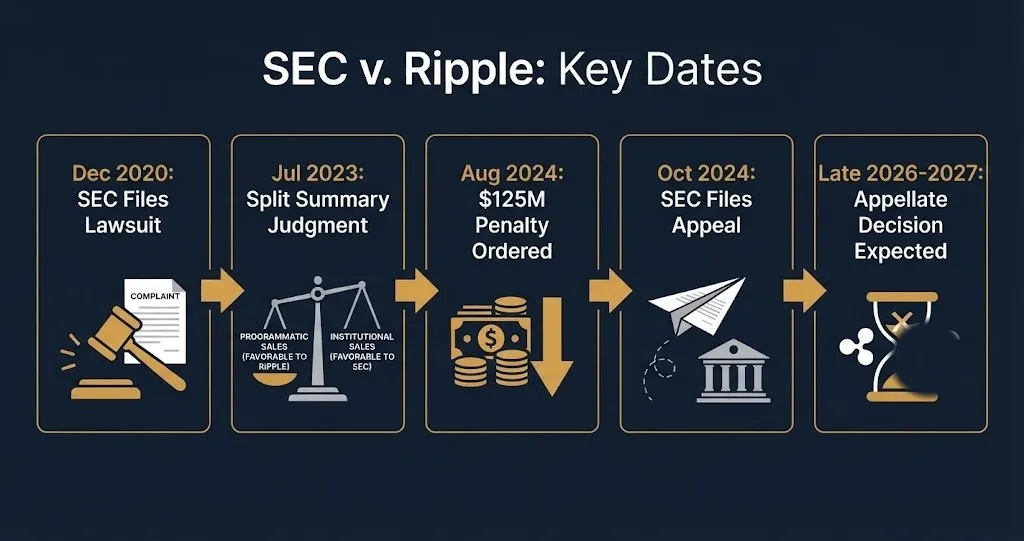
The SEC’s case against Ripple Labs is the most consequential crypto enforcement action in U.S. history. It started in December 2020 and has reshaped how digital assets are classified under federal securities law. Four years in, the case still has not reached its final conclusion.
If you hold XRP or traded it on an exchange that delisted it, you want to know one thing: when does this end, and what does the outcome mean for the token’s value and availability.
This guide covers every verified development in the Ripple lawsuit as of mid-2026. That includes the July 2023 summary judgment, the August 2024 remedies ruling, the SEC’s pending appeal, and the realistic timeline for final resolution. One fact many articles skip: the $125 million penalty Ripple was ordered to pay sits in an escrow account, not in a settlement fund for investors, because this case was never about compensating XRP holders.
The Facts
| Detail | Value |
|---|---|
| Case | SEC v. Ripple Labs Inc. et al. |
| Court | U.S. District Court, Southern District of New York |
| Case Number | 1:20-cv-10832 |
| Judge | Analisa Torres |
| Filed | December 22, 2020 |
| Summary Judgment | July 13, 2023 (partial, split decision) |
| Remedies Ruling | August 7, 2024 ($125 million civil penalty) |
| SEC Appeal Status | Pending, briefs submitted through early 2026 |
| Settlement Fund | None (enforcement action, not a class action) |
| Investor Payout | Not applicable |
| XRP Security Status | Not a security for programmatic sales on exchanges; is a security for institutional sales |
Is the Ripple XRP Lawsuit Real or a Scam?
The SEC v. Ripple lawsuit is real, fully documented, and one of the most heavily litigated enforcement actions the Securities and Exchange Commission has ever brought against a crypto firm. It is not a rumor, not a pump-and-dump narrative, and not a conspiracy theory, though the case has spawned all three across social media.
The SEC filed its complaint on December 22, 2020, in the Southern District of New York before Judge Analisa Torres. The agency accused Ripple Labs, its CEO Brad Garlinghouse, and its co-founder Chris Larsen of conducting an unregistered securities offering worth over $1.3 billion through the sale of XRP tokens. The case docket runs to thousands of pages. Every filing is public on PACER, the federal court records system.
The scam risk around this case is not the lawsuit itself. It is the wave of fake settlement announcements, phishing sites, and social media impersonators who exploit the case’s high profile. You have probably seen headlines claiming a final settlement was reached or that XRP holders are owed compensation. None of those are true as of July 2026. The case has no settlement fund. It has no claims process. Anyone asking you for money or private keys in connection with the Ripple case is running a scam.
How to Spot a Fake Ripple Settlement Post
Scammers exploit the complexity of this case. They post fake press releases designed to look like SEC.gov. They create X (formerly Twitter) accounts with handles that mimic Ripple executives. They promise XRP airdrops or settlement payouts if you connect your wallet. All of it is fake. The SEC does not distribute settlement money to token holders in enforcement actions. Ripple has never announced a holder compensation program. If you see one, it is not real.
Key Takeaway: The lawsuit is real, the settlement rumors are fake, and no one is sending you free XRP because of a court ruling.
Has the Ripple Lawsuit Settled in 2026?
No settlement has been reached in SEC v. Ripple as of July 28, 2026. The case remains in active litigation with the SEC’s appeal of the July 2023 summary judgment ruling still pending. Both sides have filed appellate briefs. No settlement conference or resolution has been announced on the docket.
This surprises many casual observers. After the August 2024 remedies ruling, where Judge Torres ordered Ripple to pay $125 million, a fraction of the SEC’s requested $2 billion penalty, many analysts predicted a settlement within months. That prediction proved wrong. The SEC chose to appeal the portion of Judge Torres’s July 2023 ruling it lost, specifically the finding that programmatic sales of XRP on public exchanges were not securities transactions. Ripple chose not to appeal the $125 million penalty but filed a cross-appeal on other issues.
Settlement remains possible at any point. The SEC under different leadership could choose to drop the appeal. Ripple could agree to terms that resolve the outstanding claims. But as of this writing, no settlement agreement exists. Any headline claiming otherwise should be checked against the court docket.
Think of it like a divorce case where the judge ruled on most issues but one spouse appealed custody. The case is not over just because the trial court finished. The appeal has to run its course, or the parties have to agree to stop fighting. Neither has happened yet.
What Did the July 2023 Summary Judgment Actually Decide?
The July 13, 2023, summary judgment ruling was a split decision that both sides have claimed as a win. Judge Torres ruled on three categories of XRP sales and reached different conclusions for each.
First, programmatic sales. These are sales of XRP on public cryptocurrency exchanges to retail buyers who did not know they were buying from Ripple. Judge Torres ruled that these sales did not constitute investment contracts under the Howey Test. The buyers had no direct relationship with Ripple and no reasonable expectation of profits derived from Ripple’s efforts. This was the headline ruling that sent XRP’s price up roughly 100 percent in a single day.
Second, institutional sales. These are direct sales of XRP to sophisticated investors like hedge funds and venture capital firms under written contracts. Judge Torres ruled that these sales did meet the Howey Test definition of an investment contract. The institutional buyers knew they were buying from Ripple and reasonably expected profits based on Ripple’s efforts to grow the XRP ecosystem.
Third, other distributions. These include XRP given to employees as compensation and distributed through third-party arrangements. Judge Torres ruled these were not securities transactions because no money changed hands.
The court also ruled that Garlinghouse and Larsen were not individually liable for the institutional sales violations. The SEC later dropped the aiding and abetting charges against them entirely.
What the Split Decision Means in Practice
The practical effect is this. If you bought XRP on Coinbase, Kraken, or another exchange, your purchase was not a securities transaction under this ruling. Exchanges that delisted XRP in 2020 and early 2021, including Coinbase and Kraken, relisted it within days of the July 2023 ruling. If Ripple sold XRP directly to an institutional investor under a contract, those sales were unregistered securities transactions. That is the violation the August 2024 remedies ruling addressed.
Key Takeaway: The court drew a line between exchange sales (not securities) and institutional contracts (securities). That line is now the central question on appeal.
What Happened in the August 2024 Remedies Ruling?
On August 7, 2024, Judge Torres issued her remedies order. The SEC had asked for roughly $2 billion in disgorgement, prejudgment interest, and civil penalties. Ripple argued it should pay no more than $10 million. The court landed at $125 million.
The $125 million civil penalty covers the institutional sales the court found to be unregistered securities transactions. Judge Torres declined to order disgorgement, finding that the SEC had not shown actual pecuniary harm to institutional investors, many of whom profited from their XRP purchases. The court imposed no penalty against Garlinghouse or Larsen individually.
The order also included an injunction barring Ripple from future securities law violations. Ripple has since restructured its institutional sales program to comply with the ruling, conducting sales outside the United States or under registration exemptions. The $125 million was placed in an escrow account pending the outcome of the appeal.
This was widely reported as a Ripple victory, and by comparison to the SEC’s ask, it was. But $125 million is still among the larger civil penalties in SEC crypto enforcement history. The only larger crypto penalty at the time was the $4.3 billion settlement with Binance, which included multiple agencies and a criminal plea, making it an imperfect comparison.
How Much Will XRP Holders Get From the Lawsuit?
XRP holders will receive nothing from the SEC v. Ripple case because this is not a class action and does not create a settlement fund for investors. The SEC’s enforcement authority allows it to seek penalties, disgorgement, and injunctions. It does not allow the agency to distribute collected funds to token holders unless Congress specifically authorizes a Fair Fund distribution, and no such authorization has been made here.
This is the single most misunderstood fact about the Ripple case. The SEC enforces securities laws to punish violators and deter future violations. The money it collects goes to the U.S. Treasury, not to investors. A class action is a private lawsuit where plaintiffs seek compensation for their own losses. The SEC case is the government suing a company for breaking the law. Different thing entirely.
Some XRP holders have filed their own class action lawsuits against Ripple, but those are separate cases. One such case, In re Ripple Labs Inc. Litigation, was filed in the Northern District of California. It remains pending with no certified class as of mid-2026. Even if that case settles, only class members who meet specific criteria would potentially receive compensation. The SEC case will produce no payout for anyone.
Reality Check: No government agency, no law firm, and no “claims administrator” is processing XRP holder payouts from the SEC v. Ripple case. Every website, email, or social media post claiming otherwise is a scam designed to steal your crypto or personal information. Filing a claim for the Ripple case is not a thing.
What Is the Current Status of the SEC’s Appeal?
The SEC filed its notice of appeal on October 2, 2024, targeting the portion of the July 2023 summary judgment that found programmatic sales of XRP were not securities transactions. The appeal is pending before the U.S. Court of Appeals for the Second Circuit.
The SEC’s opening brief was filed in early 2025. The agency argues that Judge Torres erred in treating programmatic sales differently from institutional sales, claiming that all XRP buyers, regardless of how they purchased, were investing in a common enterprise with an expectation of profit derived from Ripple’s efforts. The SEC points to Ripple’s public statements, marketing materials, and the company’s control over XRP’s supply as evidence that even exchange buyers were relying on Ripple’s efforts.
Ripple filed its opposition brief in mid-2025. The company argues that Judge Torres correctly applied the Howey Test, which requires an actual contractual or quasi-contractual relationship between the buyer and the promoter. Exchange buyers had no such relationship with Ripple. They bought from anonymous sellers on secondary markets. Ripple also argues that the SEC’s position would turn every crypto token into a security, with consequences far beyond XRP.
The SEC filed its reply brief in late 2025. As of July 2026, the case is fully briefed. The Second Circuit could schedule oral argument at any time, but no date has been set. A decision is expected no earlier than late 2026 and possibly into 2027.
What Happens If the SEC Wins the Appeal?
If the Second Circuit reverses Judge Torres on the programmatic sales issue, exchanges could once again face pressure to delist XRP. That would likely suppress the token’s U.S. market price and reduce liquidity. The case would then return to the district court for further proceedings on remedies related to programmatic sales.
If the Second Circuit affirms Judge Torres, the SEC could seek Supreme Court review, but that is a long shot. The Supreme Court accepts fewer than 2 percent of the cases petitioned to it. An affirmance would solidify the legal distinction between direct institutional sales and secondary market transactions, a precedent that would extend well beyond XRP.
When Will the XRP Lawsuit End? A Realistic Timeline
Nobody knows the exact end date, but the procedural posture allows for a realistic projection. The Second Circuit typically takes 12 to 18 months from full briefing to decision. With briefing complete by late 2025, a decision in late 2026 or early 2027 is the most plausible window.
If the Second Circuit affirms without remand, the case could end at the circuit level unless the SEC petitions for Supreme Court review. If the court reverses and remands, the district court proceedings would resume, potentially adding another year or more. A settlement before the appellate decision remains possible but has not materialized despite years of speculation.
The leadership of the SEC matters here. The 2024 election cycle produced new SEC commissioners. A commission more skeptical of crypto enforcement could vote to dismiss the appeal or settle on terms favorable to Ripple. A commission that maintains the prior chair’s aggressive posture will see the appeal through. As of mid-2026, the SEC has not signaled a change in posture on the Ripple appeal.
Key Takeaway: The case is in its final phase, but “final” in federal litigation still means at least another year, and possibly two.
What Does the Ripple Case Mean for Other Crypto Lawsuits?
The Ripple case has already influenced how courts and regulators approach digital asset classification. Judge Torres’s distinction between direct sales and secondary market transactions has been cited in other cases, including SEC actions against Coinbase and Binance, though with varying degrees of acceptance.
Judge Katherine Polk Failla in the SEC v. Coinbase case, also in the Southern District of New York, reached a different conclusion on related issues, finding that secondary market crypto transactions can be securities when the token’s economic reality ties back to the issuer’s efforts. This circuit split, or at least district court split, increases the odds that the Second Circuit’s Ripple ruling will become the definitive appellate guidance the crypto industry has been waiting for.
Other cases to watch include the SEC’s actions against Binance, Kraken, and Consensys. Each case involves different facts, but all turn on the same core question the Ripple appeal addresses: when is a digital asset a security under U.S. law. The Ripple appellate decision, whichever way it goes, will shape the resolution of every one of those cases.
How to Follow the Ripple Lawsuit Without Getting Scammed
Following a high-profile crypto case without falling for misinformation requires a deliberate approach. Here is how to stay informed safely.
- Check the court docket directly on PACER. This costs a small fee per page but gives you the actual filings, not someone’s interpretation of them.
- Follow the official SEC press release page. The SEC announces major case developments, including settlements and final judgments, through its own website.
- Monitor Ripple’s official company blog and legal statements. The company publishes its own summaries of key rulings and case milestones.
- Avoid Telegram groups, Discord servers, and anonymous X accounts that claim to have inside information about a settlement. They do not. Court cases do not leak through Telegram.
- Treat any website that asks you to connect a wallet or enter personal information to check your eligibility for a Ripple settlement payout as fraudulent. No such payout exists.
- Verify any headline you see about a settlement against at least two established legal news outlets before believing it.
- Remember that SEC enforcement actions do not create investor compensation funds. If you see a claim about a payout, it is fake.
What Legitimate XRP Holder Lawsuits Exist
Separate from the SEC case, several private class action lawsuits have been filed against Ripple. These include In re Ripple Labs Inc. Litigation in the Northern District of California, which alleges securities law violations under state and federal law. This case has not been certified as a class action. No settlement has been reached. No claims process is open.
If and when a private class action settles, a court-approved claims administrator will publish a website, mail notices to potential class members, and establish a formal claims process. That process will never ask for your private keys. It will never ask for upfront payment. It will never contact you exclusively through social media.
What Happens Next: The Road to Final Resolution
- Mid-2026: SEC and Ripple appellate briefs are complete. Case awaits oral argument scheduling by the Second Circuit.
- Late 2026 to Early 2027: Oral argument likely held. A three-judge panel will hear arguments from both sides.
- Mid to Late 2027: Second Circuit decision expected. Affirmance, reversal, or remand are all possible outcomes.
- Late 2027 to 2028: If the SEC petitions for Supreme Court review and cert is granted, the case extends further. If cert is denied, the circuit ruling is final.
- At Any Point: Settlement remains possible. A change in SEC priorities under new leadership could end the case without a final appellate ruling.
This timeline assumes no settlement and no unexpected delays. Federal litigation rarely moves faster than expected and often moves slower. Calendar reminders for late 2026 are reasonable. Expectations of resolution before then are not grounded in procedural reality.
Frequently Asked Questions
Is the XRP lawsuit over?
No. The district court issued its final remedies ruling in August 2024, but the SEC’s appeal is still pending.
The Second Circuit has not yet scheduled oral argument.
The case continues as of July 2026.
Will I get money from the Ripple lawsuit?
No. The SEC case is an enforcement action, not a class action for damages.
There is no settlement fund and no claims process for XRP holders.
Separate private class actions exist but have not settled or been certified.
What was the $125 million penalty for?
The penalty punished Ripple for unregistered institutional sales of XRP.
The court found these sales violated Section 5 of the Securities Act of 1933.
The money goes to the U.S. Treasury, not to investors.
Is XRP a security?
It depends on how it was sold.
Programmatic sales on exchanges are not securities under the district court ruling.
Institutional sales under direct contracts are securities.
The appeal could change this classification.
When will the SEC appeal be decided?
No confirmed date exists, but late 2026 to early 2027 is the most realistic window.
The Second Circuit typically takes 12 to 18 months after full briefing to issue a decision.
Supreme Court review could extend the timeline further.
Can I still buy XRP?
Yes. Major U.S. exchanges including Coinbase and Kraken relisted XRP after the July 2023 ruling.
XRP trades actively with no current U.S. restrictions on secondary market purchases.
Regulatory risk remains, especially if the SEC wins its appeal.
What happens if Ripple loses the appeal?
Programmatic sales of XRP could be classified as securities transactions.
Exchanges might face pressure to delist XRP again.
The case would return to the district court for additional remedies proceedings.
How do I join the class action against Ripple?
There is no certified class action with an open claims process as of July 2026.
If a class is certified and a settlement is reached, court-approved notices will be published.
You cannot join by signing up on a third-party website or paying a fee upfront.
The SEC v. Ripple case is closer to its end than its beginning, but it is not finished. The appellate ruling, whenever it arrives, will be the most important crypto securities decision in a decade. If you hold XRP, the outcome matters, but not because a check is coming. It matters because the ruling will determine whether XRP trades freely on U.S. exchanges or faces a second wave of delistings.
The single most important thing to remember: there is no payout for XRP holders from this case. Anyone who tells you otherwise is lying. Watch the court docket, ignore the social media hype, and let the legal process run its course.