How to Get a Debt Lawsuit Dismissed in 2026: Proven Defenses, Court Steps, and What Works
Quick Answer:
- Debt lawsuits are real legal actions you must respond to, but most can be challenged on standing and proof grounds.
- Dismissal is possible without paying a cent if the debt buyer lacks the paperwork to prove its case.
- Your deadline to respond is 20 to 30 days after service, missing it means automatic loss.
You got served with a summons and complaint. A debt collector or debt buyer is suing you for an old credit card, medical bill, or personal loan. You want to know if this is real, whether you have to pay, and if there is any way to make the whole thing go away without writing a check.
This guide answers every one of those questions with verified legal procedures, not wishful thinking. Debt lawsuits get dismissed every single day. The most common reason is not a technicality. It is that the company suing you cannot prove it owns the debt.
One fact most people do not realize until it is too late: roughly 70 percent of debt collection lawsuits end in default judgment because the defendant never files an answer, according to data from the National Consumer Law Center. The single act of responding, even with a basic denial, immediately moves you out of that losing majority.
The Facts
| Detail | Value |
|---|---|
| Case Type | Civil debt collection lawsuit (breach of contract, account stated, or unjust enrichment) |
| Plaintiff | Original creditor, debt buyer, or third-party collection agency |
| Governing Law | Fair Debt Collection Practices Act (FDCPA), state contract law, state consumer protection statutes |
| Answer Deadline | Typically 20 to 30 days from date of service, varies by state |
| Most Common Grounds for Dismissal | Lack of standing, failure to state a claim, expired statute of limitations |
| Default Judgment Rate | Estimated 70% of debt suits end in default per NCLC data |
| Settlement Rate Among Contested Cases | Significant, many plaintiffs drop cases rather than litigate contested claims |
| No Settlement Fund or Payout | This is defense strategy, not a class action seeking compensation |
Can a Debt Lawsuit Really Be Dismissed?
Yes, debt lawsuits can be dismissed, and they are dismissed every day in courthouses across the country. Dismissal means the case ends without you paying anything on the debt. It does not erase the underlying obligation, but it kills that specific lawsuit. If the statute of limitations has expired, dismissal may be permanent because the creditor loses the legal right to sue again.
Dismissal is not magic. It requires you to take action. You must file a written response with the court before the deadline printed on your summons. You must show up at hearings. You must raise valid legal defenses, not just tell the judge you cannot afford to pay. The people who get their cases dismissed are the ones who engage with the process, not the ones who ignore it.
The debt collection industry operates on volume. Debt buyers purchase charged-off accounts in bulk, sometimes paying pennies on the dollar. They sue thousands of people at once. Their business model assumes most defendants will not respond. When you respond and force them to prove their case, you disrupt that model. Many debt buyers will dismiss a contested case rather than spend resources litigating it.
The Difference Between Dismissal With and Without Prejudice
Dismissal with prejudice means the case is over permanently. The plaintiff cannot refile the same claim. Dismissal without prejudice means the plaintiff can fix the problem and sue again. Your goal is always dismissal with prejudice, but even a dismissal without prejudice buys you time and signals that you will fight. Some plaintiffs never come back.
Key Takeaway: The most reliable way to get a debt lawsuit dismissed is to file an answer raising lack of standing and then demand the plaintiff produce the original contract, chain of assignment, and full account history.
Is a Debt Collection Lawsuit Legit or a Scam?
A debt collection lawsuit is a legitimate legal action, but the summons you received may still be deceptive. Some debt collectors file lawsuits they cannot prove, hoping for a default judgment. Others sue on debts that are too old to enforce. Some even file against the wrong person entirely.
You can verify whether your lawsuit is real in under five minutes. Look up the case number on your county court’s online docket. Every legitimate lawsuit gets a case number and a court filing stamp. If the summons has no case number, or the number does not appear in the court system, you may be looking at a scare tactic rather than a real lawsuit. Some collectors send letters that look like court documents but are not actually filed. The FDCPA prohibits this practice, but it still happens.
If the lawsuit is real, you must respond. The court does not care whether the debt is valid. It only cares whether you filed an answer. No answer means default judgment. A default judgment gives the creditor the right to garnish your wages, levy your bank account, and place liens on your property.
Red Flags That Signal a Weak or Bogus Lawsuit
Some debt lawsuits arrive with obvious weaknesses. The plaintiff is a company you have never heard of suing on an account you do not recognize. The amount includes unexplained fees and interest. The attached documents are generic account statements with no identifying information. The statute of limitations has clearly passed. Any one of these is a defense worth raising.
Reality Check: No legitimate debt collection dismissal service will guarantee results or charge you money before reviewing your case. Companies that promise to get your debt lawsuit dismissed for a flat upfront fee, especially those advertising on social media, are rarely worth the money. You can file an answer yourself for the court filing fee, and you have the right to demand proof from the plaintiff without paying anyone.
How Much Does It Cost to Fight a Debt Lawsuit?
Fighting a debt lawsuit costs less than losing one. If you do nothing, you face a default judgment for the full amount claimed, plus court costs, plus post-judgment interest that can run at 8 to 12 percent annually depending on your state. Over time, a $3,000 debt can become a $5,000 judgment with wage garnishment eating 25 percent of your take-home pay.
Defending the case costs whatever your court charges to file an answer. Filing fees vary widely. Some courts charge under $50. Some waive fees entirely if you qualify as low-income. Many state courts allow you to file a fee waiver application alongside your answer. If your income is below a certain threshold, you pay nothing.
Hiring a consumer defense attorney costs more, typically $500 to $2,500 for a straightforward debt defense case depending on your location and the complexity. That sounds like a lot until you compare it to a judgment that could follow you for years. Some legal aid organizations and nonprofit consumer advocacy groups offer free or sliding-scale representation for debt cases. The National Association of Consumer Advocates maintains a directory of attorneys who handle these cases, many offering free initial consultations.
Think of it like a car repair you cannot afford to skip. Ignoring the check engine light costs more than the diagnostic fee. Ignoring a lawsuit costs more than the filing fee. The math is brutal but simple. A $300 filing fee and a few hours of paperwork can prevent a $4,000 judgment.
Cost Comparison Table
| Action | Approximate Cost | Outcome |
|---|---|---|
| Do nothing (default) | $0 now, but full judgment plus 8 to 12% post-judgment interest | Wage garnishment, bank levy, lien |
| File answer yourself | $0 to $50 (varies, fee waiver possible) | Case contested, plaintiff must prove claim |
| Hire consumer defense attorney | $500 to $2,500 typical flat fee | Professional defense, higher dismissal odds |
| Legal aid representation | Free or sliding scale if income-qualified | Full defense at reduced or no cost |
Key Takeaway: Filing an answer costs little or nothing. Losing by default costs you the full amount sued for, plus interest and court costs, potentially for years.
What Are the Most Effective Defenses to Get a Debt Lawsuit Dismissed?
The defenses that actually work in court fall into specific legal categories. They are not magic words. They are arguments supported by law that shift the burden back to the plaintiff. Here are the ones that produce dismissals most reliably.
Lack of standing is the heavyweight champion of debt lawsuit defenses. Standing means the plaintiff has the legal right to sue you. If a debt buyer purchased your charged-off credit card account, it must prove it owns that specific account. This requires a chain of assignment: a series of documents showing the debt was transferred from the original creditor to each intermediate buyer and finally to the plaintiff. Debt buyers routinely fail to produce this chain. Without it, they have no standing. No standing means dismissal.
Statute of limitations is the second most powerful defense. Every state sets a time limit for filing debt collection lawsuits, typically 3 to 6 years for credit card debt, though some states allow longer. The clock starts from your last payment or charge on the account. If the statute has expired, the lawsuit is time-barred, and you have an absolute defense. Raise it in your answer. If proven, the case gets dismissed with prejudice.
Failure to state a claim means the complaint itself is legally insufficient. A complaint must allege specific facts showing you owe the money. Attaching a generic spreadsheet with your name and a dollar amount, without an account agreement or detailed transaction history, may not satisfy the pleading standard in many states. A motion to dismiss for failure to state a claim attacks the complaint’s legal adequacy before you even get to the evidence stage.
Defense Effectiveness Table
| Defense | What It Means | Dismissal Odds |
|---|---|---|
| Lack of Standing | Plaintiff cannot prove it owns the debt | High, especially against debt buyers |
| Statute of Limitations Expired | Debt is too old to sue on | Very high if proven |
| Failure to State a Claim | Complaint lacks required legal elements | Moderate, depends on judge and state |
| Identity Theft or Mistaken Identity | The debt is not yours | High with supporting evidence |
| Payment Already Made | Debt was satisfied or settled | High with receipts or settlement letters |
| Violation of FDCPA | Collector broke federal debt collection law | Can create counterclaim leverage |
How to Get a Credit Card Lawsuit Dismissed
Credit card lawsuits make up the largest share of debt collection cases. They are typically filed by debt buyers like Midland Funding, Portfolio Recovery Associates, LVNV Funding, and Cavalry SPV. These companies buy charged-off credit card accounts from original creditors such as Citibank, Capital One, Synchrony Bank, and JPMorgan Chase. They pay roughly 4 to 14 cents per dollar of face value, according to Federal Trade Commission reports.
Because debt buyers acquire accounts in bulk, they often lack the original documentation needed to prove their case in a contested proceeding. They may have a spreadsheet with your name, an account number, and a balance. They may have a generic cardholder agreement that does not reference your specific account. They rarely have the original signed application, a complete transaction history from account opening to charge-off, and every assignment document tracing ownership.
Your defense strategy for a credit card lawsuit is straightforward. File an answer denying the allegations. Demand strict proof of the debt. Raise lack of standing. Request the chain of assignment. If the plaintiff is a debt buyer, force it to prove it owns your specific account. Many debt buyers will dismiss rather than litigate.
Step-by-Step Answer Filing
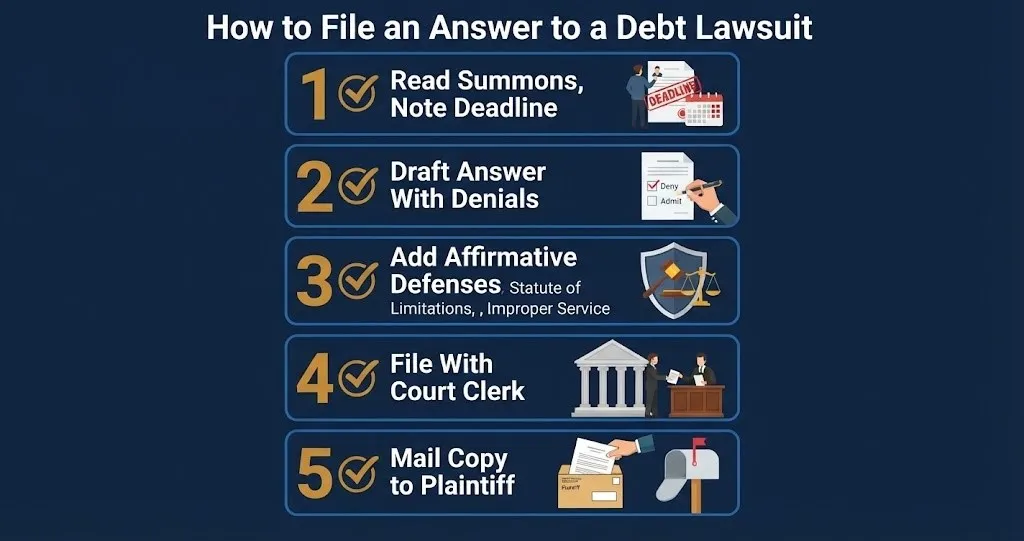
- Read the summons and complaint carefully. Note the case number, court name, and response deadline.
- Draft your answer. Deny each allegation you dispute. Raise affirmative defenses like lack of standing, statute of limitations, and failure to state a claim.
- Attach a verification or affidavit if your state requires one.
- File the answer with the clerk of the court named on the summons.
- Mail a copy to the plaintiff’s attorney at the address listed on the complaint.
- Keep proof of filing and mailing. The court clerk’s date stamp is your evidence of timely response.
- Mark your calendar for any scheduled hearings or discovery deadlines.
Key Takeaway: Credit card debt buyers depend on default judgments. Filing an answer that demands proof of ownership and the chain of assignment removes you from the easy-win category.
How to Get a Debt Lawsuit Dismissed Online
Many state courts now allow electronic filing, often called e-filing, for civil cases including debt collection lawsuits. You can file your answer from your computer without stepping into a courthouse. The e-filing process varies by state and sometimes by county within the same state. Check your local court’s website for the e-filing portal link and instructions.
Some states use unified e-filing systems. For example, the federal courts use PACER, and many state courts use Tyler Technologies’ Odyssey eFileCA or similar platforms. You create an account, select the case type, upload your answer as a PDF, and pay the filing fee by credit card or request a fee waiver. The system generates a date-stamped confirmation. This confirmation is your proof of timely filing.
E-filing does not change the substance of what you must file. You still need a properly drafted answer with denials and affirmative defenses. The convenience of filing online does not reduce the legal requirements. It just saves you a trip to the courthouse and gives you a clear electronic paper trail.
What If Your Court Does Not Offer E-Filing
Some smaller county courts still require paper filing in person or by mail. If e-filing is unavailable, you can mail your answer to the court clerk by certified mail with return receipt requested. The return receipt is your proof of timely mailing. Courts treat the postmark date as the filing date for mailed answers. Make copies of everything before mailing. Keep the certified mail receipt and the return receipt in a folder with your case documents.
How to Answer a Debt Collection Lawsuit Without an Attorney
You have the right to represent yourself. This is called appearing pro se. Courts hold pro se litigants to the same procedural rules as attorneys, but many judges give unrepresented defendants some flexibility on formatting and technicalities. What a judge will not do is ignore a missed deadline or write your defenses for you.
Your answer is the document that responds to each numbered paragraph in the complaint. For each paragraph, you admit, deny, or state that you lack sufficient information to admit or deny. Most pro se defendants deny everything except their name and address. This is acceptable. You are not lying. You genuinely do not know whether the plaintiff’s records are accurate, so you lack sufficient information.
After your denials, you list your affirmative defenses in a separate section. Common defenses include: plaintiff lacks standing to sue, statute of limitations has expired, complaint fails to state a claim upon which relief can be granted, and plaintiff’s claims are barred by the Fair Debt Collection Practices Act. You are not proving these defenses at the answer stage. You are preserving your right to raise them later.
Sample Answer Structure
- Caption: Your name, the plaintiff’s name, case number, court name.
- Body: For each paragraph of the complaint, state “Defendant denies the allegations in Paragraph X” or “Defendant lacks sufficient information to admit or deny Paragraph X.”
- Affirmative Defenses: Numbered list of your defenses.
- Prayer for Relief: Ask the court to dismiss the case with prejudice and award you costs.
- Signature block: Your signature, printed name, address, phone number, and date.
- Certificate of Service: A statement that you mailed a copy to the plaintiff’s attorney.
Key Takeaway: You do not need a lawyer to file an answer. You need to meet the deadline, deny what you dispute, and raise your defenses in writing. The rest is learned along the way.
What Happens After You File Your Answer?
Filing your answer changes the trajectory of the case. The plaintiff can no longer get a default judgment. The case moves into discovery, where both sides exchange evidence. This is where many debt buyers fold.
The plaintiff must produce documents to support its claims. You can request these through formal discovery requests such as requests for production of documents, interrogatories, and requests for admissions. Ask for the original signed contract, the complete account history from zero balance to the amount claimed, every assignment document in the chain of ownership, and proof that the plaintiff is licensed to collect debts in your state if your state requires licensing.
If the plaintiff cannot produce these documents, you can file a motion for summary judgment or a motion to dismiss for lack of standing. A motion for summary judgment asks the court to rule in your favor without a trial because the plaintiff has no evidence to support its case. These motions require proper formatting and legal argument, so this is the stage where consulting an attorney becomes most valuable.
Many cases settle during discovery, often for pennies on the dollar, or get dismissed when the plaintiff realizes it cannot meet its evidentiary burden. Some plaintiffs dismiss cases voluntarily rather than respond to discovery requests, because responding costs them time and legal fees.
What Is the Statute of Limitations on Debt in My State?
The statute of limitations is the deadline for filing a lawsuit. Once it passes, the debt becomes time-barred. A creditor can still ask you to pay, but it cannot use the courts to force you. If it sues anyway, you have a complete defense.
The statute of limitations varies by state and by type of debt. For credit card debt, which is typically treated as an open account or written contract depending on the state, the limit ranges from 3 to 6 years in most states. A few states allow up to 10 years. The clock usually starts from your last payment or last charge on the account.
Making a partial payment on an old debt can restart the statute of limitations in many states. This is a trap. A collector may pressure you to make a small payment, telling you it is a good-faith gesture. What it really does is revive a time-barred debt and expose you to a new lawsuit. Never make a payment on an old debt without understanding whether doing so resets the clock.
Statute of Limitations by State for Credit Card Debt
| State | Statute of Limitations (Years) |
|---|---|
| California | 4 |
| Florida | 5 |
| Georgia | 6 |
| Illinois | 5 |
| Massachusetts | 6 |
| Michigan | 6 |
| New York | 3 (reduced from 6 in 2021 under the Consumer Credit Fairness Act) |
| Ohio | 6 |
| Pennsylvania | 4 |
| Texas | 4 |
This table is a sample. Check your own state’s current statute. State laws change. The CFPB and your local legal aid office maintain updated charts. Confirm the number before relying on it as a defense.
What Are Your Rights Under the Fair Debt Collection Practices Act?
The FDCPA is a federal law that regulates how third-party debt collectors can contact and treat you. It does not apply to original creditors collecting their own debts, but it applies to every debt buyer and collection agency that sues you.
The FDCPA prohibits harassment, false statements, and unfair practices. A collector cannot threaten you with arrest. It cannot call you before 8 a.m. or after 9 p.m. It cannot contact you at work if you tell it not to. It cannot misrepresent the amount you owe or the legal status of the debt. It cannot threaten to sue if it has no intention of doing so or if the statute of limitations has expired.
If a debt collector violates the FDCPA, you can sue it. The FDCPA allows statutory damages of up to $1,000 per case, plus actual damages if you suffered financial harm, plus attorney’s fees. An FDCPA counterclaim can shift the power dynamic in a debt lawsuit. Suddenly the collector is defending itself against your claims. This leverage can lead to a dismissal of the original suit and a small payment to you.
What Happens Next: The Debt Defense Timeline
- Day 1 (Date of Service): Summons received. Calendar your answer deadline immediately. Count the days. Weekends and holidays count in most jurisdictions. Do not miss it.
- Days 1 to 25: Draft and file your answer. Include denials and affirmative defenses. Send a copy to the plaintiff’s attorney.
- Days 30 to 90: Discovery begins. You send requests for documents. The plaintiff must respond. Watch for incomplete responses.
- Days 90 to 180: If the plaintiff fails to produce documents, consider a motion for summary judgment or motion to dismiss. Settlement negotiations may occur.
- Days 180 to 365: Case either settles, is dismissed, or is set for trial. Most cases that are contested never reach trial.
This timeline assumes an active case in a moderately busy court. Some jurisdictions move faster. Some slower. The key is to meet every deadline the court sets. A missed deadline after you have filed your answer is as dangerous as missing the initial answer deadline.
Frequently Asked Questions
Can I ignore a debt collection lawsuit?
No. Ignoring it guarantees a default judgment against you.
That judgment allows wage garnishment, bank levies, and property liens.
Responding is the only way to avoid automatic loss.
What if I actually owe the debt?
Owing the money does not mean the plaintiff wins automatically.
The plaintiff must still prove it owns the debt and the amount is correct.
You may have defenses even if you once had the account.
How do I know if the statute of limitations has expired?
Check your last payment or last charge date on the account.
Compare it to your state’s statute of limitations for credit card debt.
If the gap exceeds the limit, the debt is time-barred.
Do I need a lawyer to get a debt lawsuit dismissed?
No, but a lawyer improves your odds and reduces procedural mistakes.
You can file an answer pro se and handle early stages yourself.
Consider consulting a lawyer if the case proceeds to discovery.
What if I cannot afford the court filing fee?
Most courts offer fee waiver forms for low-income litigants.
You file the fee waiver application with your answer.
If approved, you pay nothing to defend the case.
What is a debt buyer?
A debt buyer purchases charged-off accounts from original creditors.
It pays a fraction of the face value and then sues to collect the full amount.
Debt buyers must prove they own the specific account they are suing on.
Can a debt lawsuit affect my credit score?
Yes. A judgment appears on your credit report for up to seven years.
A dismissed lawsuit does not create a judgment and has less credit impact.
The underlying debt may still appear as a collection account.
What happens if I lose at trial?
A judgment is entered against you for the amount the court determines you owe.
The creditor can then use post-judgment collection tools like garnishment.
You may have a limited time to appeal, typically 30 days.
Getting a debt lawsuit dismissed is not about luck or finding a loophole. It is about filing a response on time, demanding that the plaintiff prove its case, and raising the defenses that apply to your situation. The single act of filing an answer moves you from the losing column into the fighting column.
Check your deadline. File your answer. Demand the paperwork. Most debt buyers do not have it. That is not legal advice. It is the reality of how these cases work, confirmed by decades of court records and consumer outcomes.