Google Lawsuit 2026: Which Settlements Pay, and Which Deadlines Already Closed
Quick Answer
- Multiple Google settlements are real, but they are separate cases with separate rules.
- The $135 million Android settlement pays up to $100 per person, pro rata.
- Claims closed August 27 and September 14, 2026. Nothing new is open.
There isn’t one “Google lawsuit 2026.” There are at least four consumer cases, and the biggest one, Taylor v. Google, won final approval on August 21, 2026.
If you used an Android phone on a cellular network since November 12, 2017, you may be in a class of roughly 100 million people. That case requires no claim form, which is why most people hear nothing and assume they missed it.
This article maps every live Google case, what each pays, and which windows already shut. One detail most coverage buries: two of this year’s claim deadlines passed within the last three weeks.
The Facts
| Case | Taylor v. Google LLC, No. 5:20-cv-07956-VKD (N.D. Cal.) |
| Status | Final approval reported granted August 21, 2026 |
| Fund Size | $135,000,000 |
| Est. Per Person | Pro rata share, capped at $100 per person |
| Claim Deadline | No claim form required |
| Administrator | Court-appointed administrator named in the class notice |
| Proof Needed | None. Notice ID and confirmation code for payment election |
Is the Google lawsuit 2026 news real, or a scam?
The Google settlements circulating in 2026 are real, and each one traces to a docketed federal or state case. What’s fake is any message demanding a fee, a full Social Security number, or banking credentials.
Legitimate class members get contacted by a court-appointed administrator, not by a random text. Filing a claim is always free.
Case numbers you can verify:
- Taylor v. Google LLC, No. 5:20-cv-07956-VKD, Northern District of California
- Csupo v. Google LLC, No. 19CV352557, Santa Clara County Superior Court
- A.B. v. Google LLC, No. 5:23-cv-03101, Northern District of California
- In re Google Assistant Privacy Litigation, Northern District of California
Judge Virginia K. DeMarchi oversees the Taylor case. Judge Charles F. Adams handled Csupo in Santa Clara County.
A settlement notice that can’t name a case number and a court is not a settlement notice.
Which Google lawsuits are actually paying money in 2026?
Only one Google consumer settlement has confirmed final approval and no remaining claim step: the $135 million Taylor case. The rest are either awaiting a judge’s sign-off or already past their claim windows.
Here’s the live scoreboard, which is what most coverage refuses to lay out plainly.
| Case | Fund | Status as of Sept 16, 2026 |
|---|---|---|
| Taylor v. Google (Android data) | $135M | Final approval reported Aug 21, 2026 |
| Google Assistant privacy | $68M | Claims closed Aug 27; hearing Oct 1, 2026 |
| A.B. v. Google (COPPA) | $8.25M | Claims closed Sept 14; hearing Sept 24, 2026 |
| Csupo v. Google (California) | $350M | Final approval hearing held Feb 24, 2026 |
| Play Store antitrust (state AGs) | $630M consumer fund | Payments already issued in rounds |
Approval does not mean money moves tomorrow. Payment follows approval plus the appeal period.
Is there one big Google settlement you can claim right now?
No single Google settlement is accepting new claims as of September 16, 2026. The two that were open this summer both closed within the past three weeks.
That’s the honest answer, and it’s the one most “Google lawsuit 2026” pages avoid. Pages built to collect clicks keep claim buttons live long after the window shuts.
Claim windows that closed:
- Google Assistant privacy settlement: August 27, 2026
- Google Play children’s privacy (COPPA) settlement: September 14, 2026
- Play Store settlement second-round redemption: May 12, 2026
If you filed before those dates, your claim stands. If you didn’t, no late filing option has been announced for any of them.
The Taylor case is different, because it never required a claim form at all.
Key Takeaway: No Google settlement is open for new claims today, and the largest one never needed a claim form.
How much money can you get from the Google settlements?
Payout amounts vary by case, and most are still not yet determined because they depend on how many valid claims were filed. Pro rata means the fund gets divided, so more claimants equals smaller checks.
Only two cases have published figures.
| Case | Reported payout estimate |
|---|---|
| Taylor v. Google | Pro rata, capped at $100 per person |
| Google Assistant | Reported range of $2 to $56 by class type |
| A.B. v. Google (COPPA) | Not yet determined, pro rata |
| Csupo v. Google | Not yet determined |
| Rodriguez v. Google verdict | Roughly $4 per class member |
Attorney fees come out before you do. In the Rodriguez case, class counsel requested roughly $147 million in fees against a $425.7 million verdict.
Think of it like a group refund split at a restaurant. The total sounds big until it’s divided across 98 million people.
How much is the $135 million Android settlement worth per person?
The Taylor settlement pays a pro rata cash share capped at a maximum of $100 per person. With an estimated 100 million class members and a $135 million fund, most payments will land far below that ceiling.
Run the arithmetic yourself. A fund of $135 million spread across 100 million people averages well under two dollars before fees.
What the settlement covers:
- U.S. residents who used an Android device on a cellular network
- Usage from November 12, 2017 through final approval
- Excludes anyone in the California Csupo class
- Injunctive terms requiring Google to update Help Center and setup screens
Google agreed to the deal without admitting wrongdoing. The complaint alleged Android transmitted data over user-paid cellular networks while devices sat idle.
Payment methods reported include Zelle, PayPal, Venmo, ACH transfer, and virtual Mastercard.
What will the Google Assistant settlement pay?
The Google Assistant settlement created a $68 million non-reversionary fund, with reported estimates of $2 to $56 depending on which class you’re in. Final numbers are not yet confirmed, because the court has not granted final approval.
The allocation uses a point system. Device purchasers receive different weighting than people whose conversations were captured through unintended activations.
Two settlement classes:
- Purchaser Class: bought a Google-made device between May 18, 2016 and March 19, 2026.
- Privacy Class: communications recorded through a “False Accept” or shared with a third-party review vendor.
Purchaser claims required device details and proof of purchase. Privacy claims required no receipt.
The final approval hearing is set for October 1, 2026. Google denies that user audio was improperly captured or shared.
Reality Check: Nobody from Google or a settlement administrator will text you first asking for payment to release your money. Filing a class action claim is always free, and third-party “claim helpers” that charge a percentage are unnecessary. Any site charging you to submit a Google settlement claim is taking a cut of a check that may be worth a few dollars.
Do you need to file a claim for the Android settlement?
No claim form is required for the Taylor settlement, which separates it from every other Google case this year. Eligible class members are identified through Google’s own records.
What you can submit is a payment election. That form lets you pick how the money arrives instead of accepting the default method.
Steps if you received a notice:
- Find the notice ID and confirmation code from your email or mailed notice.
- Open the official settlement website named in that notice.
- Enter the ID and code to access your record.
- Choose your payment method from the electronic options offered.
- Confirm the email address and phone number tied to that account.
- Save the confirmation page for your records.
- Watch for payment only after the appeal period closes.
Reporting indicates the administrator may still push payment to an existing PayPal, Venmo, or Zelle account even without an election form.
How do you check whether you already filed or qualify?
Start with your email, including the spam folder, because notice emails are the primary contact method in every one of these cases. Each settlement uses distinct subject lines and a unique ID.
Administrators keep claim lookup tools and helplines. The Taylor administrator published a phone line, reported as 1-844-655-4255, for class membership questions.
What to check, case by case:
- Search your inbox for “Google Assistant Privacy Litigation Settlement”
- Look for a notice ID and confirmation code from the Android case
- Check for a Class Member ID email from the COPPA registration process
- Confirm the email address Google has on file for your account
Never confirm your eligibility through a link in an unsolicited text. Go to the official site named in the court-approved notice instead.
Treat an unexpected “settlement” message like an unexpected bank call. Hang up, then reach the institution yourself.
Key Takeaway: The Android settlement pays without a claim form, while every other 2026 Google case required one before its deadline.
What proof did these Google settlements require?
Proof requirements ranged from none to full purchase documentation, depending on the case and the class. That difference decided how many people could actually file.
Neither of the privacy-side classes demanded receipts. The purchaser side did.
| Case | Proof required |
|---|---|
| Taylor v. Google | None. Notice ID and confirmation code only |
| Assistant, Privacy Class | None. Unique ID and PIN |
| Assistant, Purchaser Class | Device model, serial or IMEI, and receipt |
| A.B. v. Google (COPPA) | Self-attestation plus a registered Class Member ID |
For the Assistant purchaser class, acceptable documentation included Google Store order confirmations, account purchase history, card statements, or retail receipts.
The COPPA claim needed an e-signature. A parent or legal guardian had to sign for any class member under 18.
Which Google claim deadlines have already passed?
Every consumer-facing Google claim deadline in 2026 has now passed. The most recent was September 14, 2026, two days before this update.
Here’s the full closed calendar, since scattered deadlines are exactly how people miss money.
| Deadline | Case | Date |
|---|---|---|
| Objection and opt-out | Play Store settlement | Feb 19, 2026 |
| Second-round redemption | Play Store settlement | May 12, 2026 |
| Exclusion and objection | A.B. v. Google (COPPA) | Aug 4, 2026 |
| Claim, exclusion, objection | Google Assistant | Aug 27, 2026 |
| Claim submission | A.B. v. Google (COPPA) | Sept 14, 2026 |
Missing an opt-out deadline has a consequence people underestimate. Staying in the class means giving up the right to sue separately over the released claims.
What’s the latest Google lawsuit update?
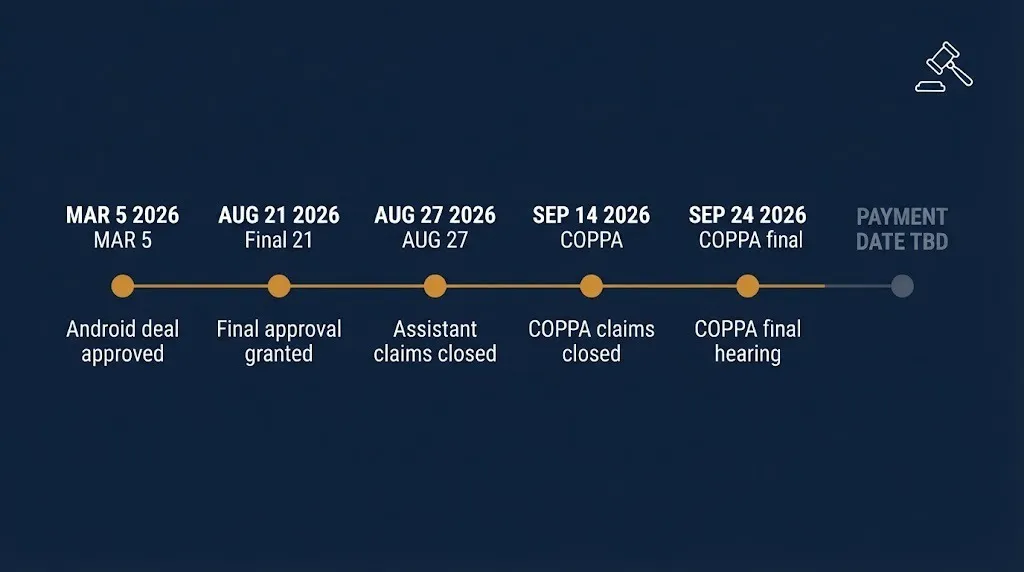
The most recent confirmed development is final approval of the $135 million Taylor settlement, reported on August 21, 2026. Before that, the court held its final approval hearing on June 23, 2026 and granted preliminary approval on March 5, 2026.
Two other cases are waiting on judges right now.
Pending court dates:
- September 24, 2026: final approval hearing in the COPPA settlement
- October 1, 2026: final approval hearing in the Google Assistant settlement
The Taylor and Csupo settlements were negotiated with mediators Kenneth R. Feinberg and Camille S. Biros. Those two designed the September 11th Victim Compensation Fund.
The settlements are cross-contingent. If one collapses, the other can be terminated too.
When will Google settlement payments actually arrive?
Payment timing is not yet confirmed for any of the 2026 Google settlements. Distribution follows final approval plus the resolution of any appeals, which administrators consistently decline to date in advance.
That sequence is why “approved” and “paid” are months apart.
What has to happen first:
- The court enters a final approval order.
- The appeal window runs its course.
- Any filed appeals get resolved.
- The administrator validates claims and calculates pro rata shares.
- Electronic payments go out to elected accounts.
For the COPPA settlement, reporting suggests distribution could fall in late 2026 or sometime in 2027. No administrator has published a confirmed payment date.
It works like a delayed tax refund. The amount is settled, the release date isn’t.
Key Takeaway: Final approval starts the payment clock, and no Google settlement has published a confirmed distribution date.
What happened to the $425 million Rodriguez verdict?
In Rodriguez v. Google, a jury awarded $425.7 million in compensatory damages on September 3, 2025. That verdict is not a settlement, and no money has been distributed to the class.
Plaintiffs alleged Google kept collecting data from third-party apps after users switched off “Web & App Activity.” The jury declined to award punitive damages.
Where the case stands:
- Class size estimated around 98 million users
- Reported value of roughly $4 per person
- Plaintiffs’ $2.36 billion disgorgement request denied
- Class counsel fee motion of about $147 million reported as pending
- With interest, the judgment reportedly exceeds $440 million
Google may still appeal. A verdict under appeal pays nobody, and appellate timelines run in years, not months.
No claim form exists for this case, and none should be expected until a distribution plan is approved.
Where does the $350 million California settlement stand?
The Csupo settlement covers California Android users and sits at $350 million, above the jury’s own verdict. Its final approval hearing was held on February 24, 2026, and the case has been described as awaiting distribution.
Trial began June 2, 2025 in Santa Clara County Superior Court. On July 1, 2025, the jury returned a verdict of $314,626,932 in a 9 to 3 decision.
Why the settlement exceeded the verdict:
- Google avoided an appeal of the jury award
- Class members avoided years of appellate delay
- The deal added roughly $35 million above the verdict figure
- Google agreed to update disclosures and consent materials
California residents are excluded from the federal $135 million Taylor class. You’re in one case or the other, never both.
California Android users have not been asked to file a claim form for this settlement.
Why is Google being sued so much in 2026?
Google faces this volume of litigation because the same business model gets challenged from two directions: data collection and market power. Privacy classes target how information is gathered. Antitrust cases target distribution deals and app store control.
The 2026 consumer cases share one theme. Each alleges data moved or was used in ways users didn’t knowingly authorize.
The core allegations, case by case:
- Taylor and Csupo: Android transferred data over user-paid cellular networks
- Assistant: devices recorded conversations through unintended activations
- A.B.: personal data collected from children under 13 without parental consent
- Rodriguez: app data collected after users disabled activity tracking
Google denies wrongdoing in each settlement and admits no liability. Settling, the company says in court filings, avoids the cost and uncertainty of continued litigation.
The COPPA case named Google’s AdMob subsidiary alongside Google LLC.
Key Takeaway: Every 2026 Google consumer settlement settled without any admission of wrongdoing by the company.
What’s happening with the Google antitrust cases?
The federal search antitrust case is in the appellate phase, and it pays consumers nothing directly. Judge Amit Mehta found in August 2024 that Google unlawfully maintained a search monopoly, then issued remedies on September 2, 2025.
Those remedies rejected a forced Chrome divestiture. A final judgment followed on December 5, 2025.
The appeal track:
- Google filed a notice of appeal on January 16, 2026
- DOJ and state attorneys general appealed in early February 2026
- The case heads to the U.S. Court of Appeals for the D.C. Circuit
- Contractual injunctions took effect February 3, 2026
Separate from that, the Play Store antitrust settlement secured by 53 state attorneys general did put money in consumer hands. California Attorney General Rob Bonta announced the consumer notice process on December 4, 2025.
That distinction matters. Government antitrust enforcement changes rules, while the state AG settlement cut checks.
What happens next in the Google settlements?
September 24, 2026: Final approval hearing in the Google Play children’s privacy settlement.
October 1, 2026: Final approval hearing in the $68 million Google Assistant settlement.
Expected late 2026: Appeal window closes on the $135 million Taylor settlement, clearing the path for distribution.
Expected late 2026 to 2027: Payments distributed in the COPPA settlement if final approval holds.
Expected late 2026 or 2027: D.C. Circuit hears arguments in the search antitrust appeals.
Frequently Asked Questions
Can I still file a Google settlement claim in 2026?
No. Every consumer claim deadline closed, with the last one on September 14, 2026.
The $135 million Android settlement never required a claim form at all.
Will I get money from the $135 million Google settlement automatically?
Eligible class members do not need to file a claim to receive payment.
Payments are capped at $100 per person and distributed pro rata after appeals resolve.
How much is the Google Assistant settlement per person?
Reported estimates run from $2 to $56, depending on your class.
Final amounts are not confirmed until after the October 1, 2026 hearing.
Why didn’t I get a Google settlement notice?
Notices went to email addresses and phone numbers in Google’s records.
Check your spam folder for the case-specific subject line before assuming you were excluded.
Are California residents included in the $135 million settlement?
No. California Android users are excluded and covered by the separate $350 million Csupo settlement.
You cannot collect from both cases.
Did Google admit to anything in these settlements?
No. Google denied wrongdoing in each settlement and agreed to pay to end the litigation.
Courts approve settlements without any finding of liability.
When will the $425 million Rodriguez verdict pay out?
Not yet determined. No money has been distributed, and Google may still appeal.
A fee motion of roughly $147 million was reported as pending.
Does the DOJ antitrust case pay consumers anything?
No. That case seeks structural and behavioral remedies, not consumer compensation.
The separate state attorney general Play Store settlement is the one that paid consumers.
If you filed a claim in the Assistant or COPPA cases, confirm your submission receipt and keep it. Update the email address tied to your Google account so an electronic payment doesn’t bounce.
Nothing new is open to claim today. The next date on the calendar is the September 24, 2026 final approval hearing.