Stairway to Heaven Lawsuit: 2026 Settlement Status, Claim Deadlines, and What It Means for You
Quick Answer:
- The “Stairway to Heaven” lawsuit was a copyright infringement claim over the song’s opening guitar arpeggio.
- Led Zeppelin won the U.S. case. No settlement fund exists for consumers or the general public.
- No claim deadline applies because this was not a class action with consumer payouts.
The “Stairway to Heaven” lawsuit is not a consumer settlement. It is a copyright case between music publishers, estates, and songwriters. If you saw a headline or social post suggesting you can file a claim for money from this case, that claim is false.
This article covers the full timeline of the lawsuit, why it ended the way it did, what the courts actually decided, and how the ruling changed music copyright law. It also addresses the scam posts that still circulate using this famous case name.
The Facts
| Case | Michael Skidmore v. Led Zeppelin et al. |
| Status | Closed. Supreme Court declined review October 2020. No U.S. litigation pending. |
| Fund Size | None. Not a class action. No consumer settlement fund exists. |
| Est. Per Person | Not applicable. No individual payouts. |
| Claim Deadline | None. No claims process. |
| Administrator | None. No settlement administrator was appointed. |
| Proof Needed | Not applicable. |
Is the Stairway to Heaven Lawsuit Real or a Scam?
The lawsuit was real. It was filed in 2014 and litigated for six years.
The confusion comes from scam posts and clickbait that repurpose famous case names. Some posts imply ordinary consumers can claim money. That is false.
This was a dispute between Randy Craig Wolfe’s estate, also known as Randy California of the band Spirit, and Led Zeppelin. Wolfe’s estate argued the opening guitar line of “Stairway to Heaven” copied Spirit’s 1968 instrumental “Taurus.”
The case was real. The damages claim was real. But it had nothing to do with consumers, class members, or public claim forms.
Key Takeaway: No consumer claim form, no payout, and no deadline exists for this case. Any post saying otherwise is not accurate.
What Was the Stairway to Heaven Lawsuit About?
The lawsuit alleged copyright infringement over a short musical passage.
The opening acoustic arpeggio in “Stairway to Heaven” descends chromatically over an A minor chord progression. Spirit’s “Taurus” uses a similar descending line. The estate of Randy Wolfe argued this was copied.
Led Zeppelin’s defense said the passage was a common musical building block. It appears in hundreds of older works and public domain compositions.
The case turned on two legal questions. First, whether the 1909 Copyright Act protected the sheet music deposit for “Taurus” or the sound recording. Second, whether the two passages were substantially similar enough to infringe.
The jury and appeals court both sided with Led Zeppelin.
How Much Money Was at Stake in the Stairway to Heaven Case?
The potential damages were large. Estimates ran into the tens of millions.
“Stairway to Heaven” has generated hundreds of millions in revenue since 1971. The Wolfe estate sought a share of past and future royalties. Some estimates placed the claim’s value above $40 million.
The estate also sought a songwriting credit for Randy California. That credit would have triggered ongoing royalty payments.
However, the estate lost. It recovered nothing. No damages were paid by Led Zeppelin or their publishers.
| Claim Element | Status |
|---|---|
| Past royalties sought | Denied |
| Future royalties sought | Denied |
| Songwriting credit for Randy California | Denied |
| Attorneys’ fees for Led Zeppelin | Initially awarded, later reversed |
| Final payout to Wolfe estate | Zero |
Who Was Involved in the Stairway to Heaven Copyright Case?
The key parties were the Wolfe estate, Led Zeppelin, and their publishers.
Michael Skidmore served as trustee for the Randy Craig Wolfe Trust. The trust held the rights to Randy California’s music.
The defendants were James Page, Robert Plant, John Paul Jones, and the estate of John Bonham, collectively Led Zeppelin, plus Warner Music Group and Super Hype Publishing.
The case also drew in musicologists on both sides. Each offered competing analysis of the two songs’ similarities.
| Party | Role |
|---|---|
| Michael Skidmore | Plaintiff, trustee of Wolfe Trust |
| Randy Craig Wolfe Trust | Rights holder for “Taurus” |
| James Page | Defendant, Led Zeppelin guitarist |
| Robert Plant | Defendant, Led Zeppelin vocalist |
| Warner Music Group | Defendant, publisher |
| Super Hype Publishing | Defendant, publishing entity |
What Did the Courts Decide in the Stairway to Heaven Lawsuit?
The courts ruled for Led Zeppelin at every stage.
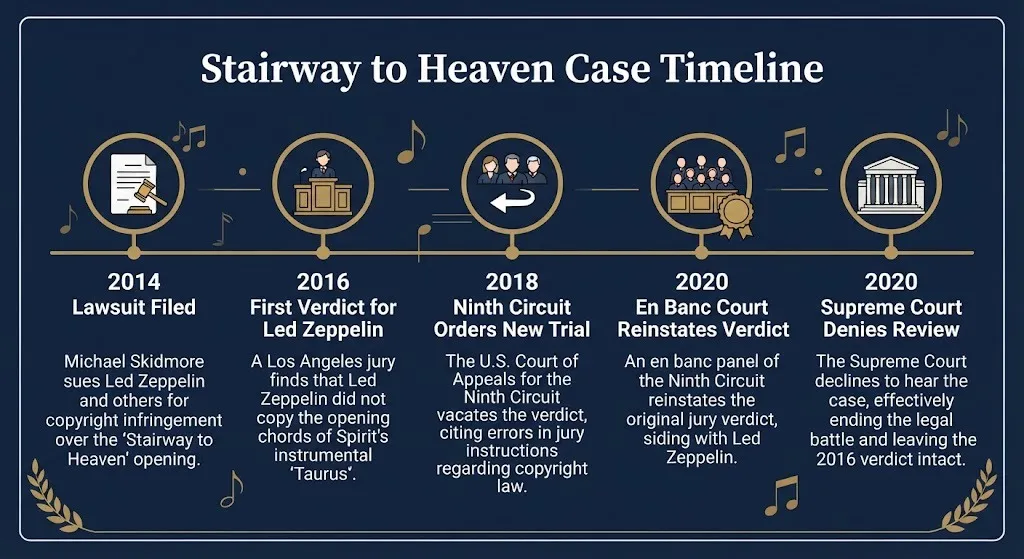
The first jury trial in 2016 returned a verdict for Led Zeppelin. The jury found no substantial similarity between “Taurus” and “Stairway to Heaven.”
The Ninth Circuit Court of Appeals overturned that verdict in 2018. The panel said the trial judge gave faulty jury instructions. A new trial was ordered.
The full Ninth Circuit then reheard the case en banc. In March 2020, the en banc panel reinstated the jury verdict. The court held that the jury instructions were adequate and the verdict stood.
The Supreme Court declined to hear the appeal in October 2020. That ended the U.S. case.
Key Takeaway: Led Zeppelin won the case outright. The Wolfe estate received no payment and no songwriting credit.
Could the Stairway to Heaven Lawsuit Be Reopened?
The U.S. case is closed. Reopening it would require extraordinary circumstances.
The Supreme Court’s denial of certiorari ended the federal litigation. The Wolfe estate has no remaining appeals in U.S. courts.
International claims are theoretically possible. Copyright law varies by country. Some nations have different standards for musical similarity.
However, no new filing has been confirmed as of September 2026. The estate’s public statements have not announced any new action.
How Did the Stairway to Heaven Case Change Music Copyright Law?
The Ninth Circuit’s 2020 en banc decision narrowed the scope of copyright protection for older songs.
The case established that for songs registered under the 1909 Copyright Act, protection covers only the sheet music deposit, not the sound recording. That matters because the “Taurus” deposit did not include many of the flourishes heard on the recording.
The decision also limited the “inverse ratio rule.” That rule had allowed a finding of infringement with weaker similarity if access to the original work was strong. The en banc court said the rule does not apply at the summary judgment stage.
This made it harder for plaintiffs to win music copyright cases in the Ninth Circuit. The Ninth Circuit covers California and most of the entertainment industry.
Reality Check: No one can get you a payment from this case. It was never a consumer class action. Any service offering to “recover your Stairway to Heaven settlement” for a fee is a scam.
What Happened to Randy California and Spirit?
Randy California died in 1997. He drowned while rescuing his son in Hawaii.
He founded Spirit with his stepfather, drummer Ed Cassidy. The band released “Taurus” on their 1968 debut album.
California reportedly mentioned the similarity between “Taurus” and “Stairway to Heaven” in interviews before his death. He never filed a lawsuit.
His mother, Bernice Wolfe, later pursued the claim. She died in 2009. The trust continued the litigation after her death.
Why Did People Think Led Zeppelin Copied Stairway to Heaven?
The similarity claim rested on a short descending arpeggio.
Both songs use a similar fingerpicking pattern over a descending chromatic bass line. The chord progression and tempo are also similar.
Led Zeppelin opened for Spirit on a 1968 U.S. tour. That gave the members of Led Zeppelin access to “Taurus” before writing “Stairway to Heaven.”
The jury heard this evidence. The jury still found no infringement.
The similarity is real enough to hear. The legal question was whether it rose to protectable expression. The courts said no.
How to Check the Status of the Stairway to Heaven Lawsuit
The case is closed. Checking the status takes two minutes.
The official court docket is available through PACER. The case number is 2:14-cv-04062 in the U.S. District Court for the Central District of California.
The Ninth Circuit opinion is public. Search for “Skidmore v. Led Zeppelin, 952 F.3d 1051 (9th Cir. 2020).”
The Supreme Court docket shows the cert denial from October 2020.
Here is a simple checklist if you want to verify the current status:
- Search PACER for case number 2:14-cv-04062.
- Look for the final judgment entry from July 2020.
- Check the Ninth Circuit en banc opinion filed March 9, 2020.
- Check the Supreme Court cert denial order from October 5, 2020.
- Confirm no new filings appear in 2025 or 2026.
Key Takeaway: The docket is public and closed. Anyone can confirm the outcome in minutes.
What Are People Asking About the Stairway to Heaven Lawsuit Online?
The same questions keep appearing on forums and search engines.
People want to know if they can get money. They can’t. They want to know if the case is still active. It isn’t. They want to know if Led Zeppelin paid anything. They didn’t.
Some posters confuse this case with other music copyright cases. Cases like the “Blurred Lines” dispute produced actual damage awards. This one produced none.
Others ask about the song’s royalty split. That was never changed. The writing credit remains Jimmy Page and Robert Plant.
Did Led Zeppelin Win or Lose the Stairway to Heaven Lawsuit?
Led Zeppelin won. The victory was complete.
The 2016 jury verdict was the original win. That verdict was vacated. Then the en banc Ninth Circuit reinstated it.
The final result: no infringement, no damages, no credit for Randy California.
The defendants also sought attorneys’ fees. The district court awarded some fees to Led Zeppelin. The Ninth Circuit reversed that award in 2020. So Led Zeppelin won the copyright claim but did not collect fees from the plaintiff.
| Year | Event |
|---|---|
| 2014 | Lawsuit filed in Pennsylvania, later transferred to California |
| 2016 | First jury verdict for Led Zeppelin |
| 2018 | Ninth Circuit panel vacates verdict, orders new trial |
| 2019 | Full Ninth Circuit agrees to hear case en banc |
| 2020 | En banc court reinstates Led Zeppelin verdict |
| 2020 | Supreme Court denies certiorari |
| 2026 | No new filings confirmed |
What Is the Stairway to Heaven Lawsuit Settlement Amount?
There is no settlement amount. The case went to verdict, not settlement.
Some readers may have seen articles discussing a “settlement” between the parties. Those are inaccurate. The parties did not settle.
The case ended by court decision. The Wolfe estate lost. No payment changed hands.
This is the key fact to remember. This was not a class action. It was not a mass tort. It was not an FTC case. There is no fund, no administrator, no claim form, and no payout.
What Does This Mean for Consumer Claims?
It means nothing for consumer claims. The case has no consumer-facing component.
If you received a text, email, or social media message about a “Stairway to Heaven settlement,” delete it. Block the sender.
Legitimate settlements come from official court notices or administrator websites. They never ask for payment to file. They never reach out through random text messages.
The same scam pattern appears with other famous cases. Bad actors use recognizable names to trick people into sharing personal information.
What Happens Next in the Stairway to Heaven Case
Nothing is expected to happen next in U.S. courts.
Here is the anticipated timeline:
- October 2020: Supreme Court denied review. U.S. litigation ended.
- 2021 to 2025: No new filings in U.S. courts.
- 2026: Case remains closed. No further action confirmed.
- Future international claims: Not confirmed. Watch official court filings only.
The case is over. The only activity you should trust is a new filing visible on PACER or an official court press release.
Frequently Asked Questions
Is the Stairway to Heaven lawsuit a class action?
No. It was a copyright infringement case between specific parties.
No consumer class existed. No class was ever certified.
Can I get money from the Stairway to Heaven lawsuit?
No. There is no settlement fund and no payout program.
Any offer claiming otherwise is fraudulent.
What was the Stairway to Heaven lawsuit about?
It was about whether Led Zeppelin copied a guitar passage from Spirit’s “Taurus.”
The courts ruled Led Zeppelin did not infringe.
Who won the Stairway to Heaven lawsuit?
Led Zeppelin won. The jury verdict was reinstated by the Ninth Circuit.
The Supreme Court declined to review the case.
Did Led Zeppelin pay Randy California’s estate?
No. The estate received no damages and no royalties.
The verdict for Led Zeppelin meant zero payment.
Is the Stairway to Heaven lawsuit still active?
No. The case closed after the Supreme Court’s cert denial in October 2020.
No new filings have been confirmed as of September 2026.
What was the deadline to file a claim in the Stairway to Heaven case?
There was no claim deadline. The case never involved consumer claims.
No administrator was ever appointed.
How much was the Stairway to Heaven lawsuit worth?
Estimates placed the claim’s potential value above $40 million.
The estate recovered nothing due to the verdict.
The Bottom Line
The “Stairway to Heaven” lawsuit was a real copyright case that ended in a complete Led Zeppelin victory. No settlement fund exists. No consumer can file a claim. No deadline applies.
If you see any post suggesting otherwise, treat it as misinformation. The official court record is clear. The case is closed.