Workers Compensation Lawyer Atlanta 2026: Settlements, Fees, and How to Find the Right Attorney
Quick Answer
- What it is: A lawyer who represents injured workers in claims against employers and their insurance carriers.
- How much: Moderate injury settlements typically range from $40,000 to $120,000. Catastrophic cases can exceed $500,000.
- Fee: Georgia caps attorney fees at 25% of the settlement, subject to State Board approval.
If you were hurt on the job in Atlanta and your claim was denied, delayed, or undervalued, a workers compensation lawyer is the person who levels the playing field. The insurance company has attorneys and adjusters working every day to minimize what they pay you. You should not face that system alone.
Georgia’s workers’ compensation system is a no-fault insurance program. You give up the right to sue your employer in civil court in exchange for guaranteed benefits, regardless of who caused the accident. But “guaranteed” does not mean automatic. Insurers deny claims, dispute medical treatment, and make low settlement offers to unrepresented workers every day.
This article covers what an Atlanta workers’ compensation lawyer actually does, how settlement values break down by injury type, what the 25% fee cap means for your payout, the key deadlines you cannot miss, and how to choose the right attorney for your case.
What does a workers compensation lawyer in Atlanta actually do?
A workers compensation lawyer in Atlanta represents injured workers in claims against employers and their insurance carriers before the Georgia State Board of Workers’ Compensation. The attorney handles everything from filing the initial claim to negotiating settlement or arguing your case at a hearing.
Most claims never go to trial. The lawyer’s primary job is to build a record that forces the insurer to pay full value. That means documenting the injury, securing medical evidence, calculating lost wages, and negotiating with the adjuster.

When a claim is disputed, the lawyer files a WC-14 Notice of Claim with the State Board and may request a hearing before an Administrative Law Judge. If mediation fails, the case proceeds to a hearing, which operates like a simplified trial.
The Workers’ Compensation Research Institute found that injured workers with attorneys received 15% to 20% more in benefits than those without representation. That gap often exceeds the 25% attorney fee.
How much is a workers compensation settlement worth in Atlanta?
Workers’ compensation settlements in Atlanta vary widely based on injury severity, lost wages, and future medical needs. There is no single average that applies to every case.
Here is how settlement values break down by injury type in Georgia:
| Injury Severity | Typical Settlement Range | Examples |
|---|---|---|
| Minor injuries | $15,000 to $35,000 | Sprains, strains, minor fractures without surgery |
| Moderate injuries | $40,000 to $120,000 | Back injuries with surgery, shoulder injuries, significant lost time |
| Catastrophic injuries | $500,000 and above | Spinal cord injuries, traumatic brain injuries, amputations |
A warehouse worker in Brookhaven with a herniated disc requiring surgery received an initial offer of $20,000. After his attorney compiled medical records and secured an independent medical examination, the case settled for $110,000. The difference came from documenting future medical costs and the worker’s inability to return to his previous job.
The maximum weekly temporary total disability rate in Georgia is $850 for injuries occurring on or after July 1, 2025. Your weekly benefit is typically two-thirds of your average weekly wage, capped at that maximum.
Key Takeaway: The settlement value of your case depends on the severity of your injury, your average weekly wage, and whether the insurer believes you have an attorney who will fight.
How are attorney fees calculated in Georgia workers comp cases?
Georgia caps attorney fees at 25% of the settlement or awarded benefits, and the State Board of Workers’ Compensation must approve the fee before any money is distributed. This is different from many other states where fees can vary more widely.
Here is a simplified example of how a $20,000 settlement breaks down:
| Item | Amount |
|---|---|
| Total settlement | $20,000 |
| 25% attorney fee | $5,000 |
| Case expenses | $500 |
| Net to injured worker | $14,500 |
Case expenses can include medical record retrieval, expert witness fees, and administrative filing costs. These are typically deducted from the settlement proceeds after Board approval.
If you change lawyers during your claim, the total fee cannot exceed the 25% cap. The State Board determines how the fee is divided between the attorneys based on the work performed.
Most Atlanta workers’ comp attorneys offer a free initial consultation. There is no upfront cost to hire a lawyer, and you only pay if there is a recovery.
Reality Check: If a lawyer asks for money upfront to handle your workers’ comp case, walk away. Georgia’s fee structure means attorneys are paid from the settlement after State Board approval. Legitimate firms do not charge retainers for workers’ compensation claims.
What are the key deadlines for a Georgia workers compensation claim?
Georgia workers’ compensation claims have strict deadlines, and missing one can bar your claim entirely. The two most important are the 30-day reporting deadline and the one-year statute of limitations.
The 30-day reporting deadline: Under O.C.G.A. § 34-9-80, you must give notice of your injury to your employer within 30 days. The notice must include the time, place, and nature of the injury. Verbal notice to a supervisor may satisfy the requirement, but written notice is stronger evidence if the employer later denies receiving it.
The one-year filing deadline: You generally have one year from the date of injury to file a WC-14 Notice of Claim with the State Board. If your employer provided medical treatment, the deadline may run one year from the last remedial treatment. If you received weekly income benefits, you may have up to two years from the last benefit payment.
Here is the documentation that protects your claim:
- Written notice sent to your supervisor and HR on the day of injury
- Copies of all medical records from authorized treating physicians
- Pay stubs from the 13 weeks before your injury to verify your average weekly wage
- Notes on any work restrictions or job duties assigned after the injury
A clean paper trail from day one is harder for an insurer to challenge than a verbal account recalled weeks later.
How do you choose the right workers compensation lawyer in Atlanta?
Choosing the right workers compensation lawyer in Atlanta means looking for specific experience, not just a familiar name. Workers’ comp is a specialized area of law, and not every personal injury attorney handles these claims effectively.
Here is what to look for:
- Georgia workers’ comp focus. Ask how many workers’ comp cases the firm handles per year and whether they appear regularly before the State Board.
- State Board experience. Attorneys who know the Administrative Law Judges and mediators in your region have an advantage.
- Medical network. A good firm has relationships with doctors who understand workers’ comp and can provide credible impairment ratings.
- Communication. You should know who is handling your case and how to reach them. Delays in communication can cost you deadlines.
- Fee transparency. The 25% cap applies to all Georgia attorneys, but ask about case expenses and how they are handled.
- Free consultation. Most Atlanta workers’ comp lawyers offer a free initial case review.
- Trial capability. Even if your case settles, the insurer needs to know your attorney can take it to a hearing.
Atlanta has a deep bench of experienced workers’ comp attorneys, including firms that have handled cases resulting in multi-million dollar settlements. The best choice for you depends on your injury, your employer, and the specific disputes in your case.
What happens if your workers comp claim is denied in Georgia?
If your Georgia workers’ comp claim is denied, you have the right to appeal. The denial is not the end of your case, but the clock is running.
The first step is filing a WC-14 Notice of Claim with the State Board if you have not already done so. This form initiates the formal dispute process. You must file within the statute of limitations, which is generally one year from the injury.
Once the WC-14 is filed, the State Board typically schedules a mediation session between you and the employer’s insurance carrier. Mediation is a confidential, non-binding process where a neutral third party helps both sides reach an agreement.
If mediation fails, the case proceeds to a hearing before an Administrative Law Judge. At the hearing, both sides present evidence and testimony. The judge issues a decision, which can be appealed to the Appellate Division of the State Board and then to Superior Court.
Common reasons for denial include failure to report the injury promptly, missing medical records, disputes about whether the injury is work-related, and inconsistencies in witness statements.
What should you do after a workplace injury in Atlanta?
What you do in the first 30 days after a workplace injury in Atlanta often determines whether your claim succeeds or fails. The documentation you create now will be the foundation of your case.
Here are the steps to protect your claim:
- Report the injury in writing within 30 days. Send an email to your supervisor and HR stating the date, time, location, and nature of the injury.
- Seek medical treatment from your employer’s posted panel. Georgia law requires you to choose a doctor from the panel of at least six physicians your employer must post.
- Document everything. Keep copies of all medical records, work restrictions, and communications with your employer.
- Gather wage records. Collect pay stubs from the 13 weeks before your injury. The insurer uses these to calculate your average weekly wage.
- Do not give a recorded statement to the insurer without legal advice. What you say can be used to reduce or deny your benefits.
- Consult an attorney before accepting any settlement offer. The initial offer is rarely the final value of your case.
- Watch the one-year deadline. If your claim is denied or benefits stop, you have one year from the injury to file a WC-14 with the State Board.
The workers’ comp system moves slowly, but the deadlines for you are strict. A delayed tax refund eventually arrives. A missed workers’ comp deadline can end your claim permanently.
What happens next in your Atlanta workers compensation case?
The timeline for a Georgia workers’ compensation case depends on whether the claim is accepted or disputed. Most accepted claims settle within six months to a year. Disputed claims that go to a hearing can take 18 months to two years or more.
Here is the expected sequence for a disputed claim:
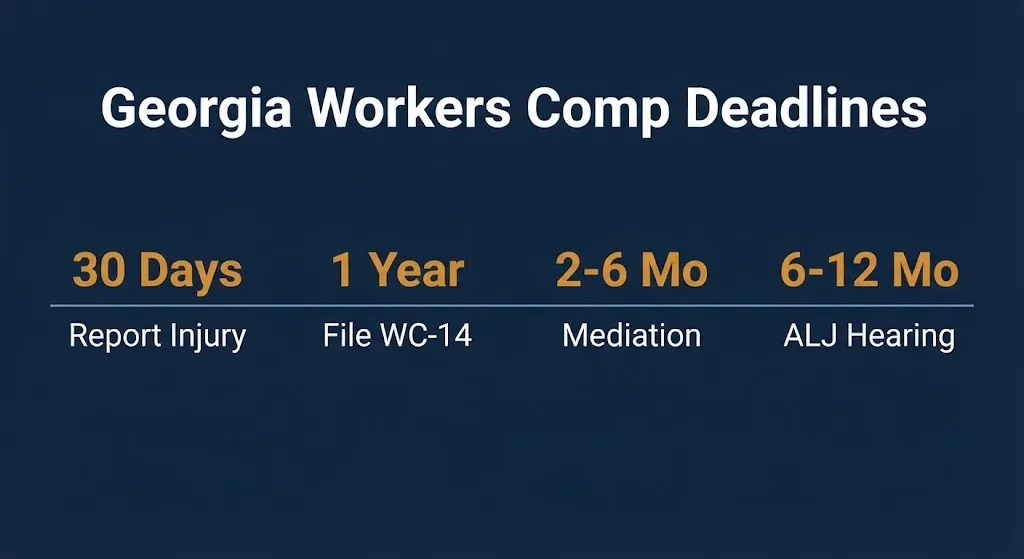
Within 30 days of injury: Report the injury to your employer and seek authorized medical treatment.
Within one year of injury: File the WC-14 Notice of Claim if benefits are denied or disputed.
Expected 2 to 6 months after filing: Mediation at the State Board. A neutral mediator helps both sides negotiate.
Expected 6 to 12 months after filing: Hearing before an Administrative Law Judge if mediation fails.
After hearing: The ALJ issues a decision. Either side can appeal to the Appellate Division.
After settlement agreement: The State Board reviews and approves the settlement. Payment issues within weeks of approval.
The $850 maximum weekly benefit for 2026 injuries sets the baseline for lost wage compensation. Your average weekly wage determines your actual benefit rate.
Frequently Asked Questions
How much does a workers compensation lawyer cost in Atlanta?
Georgia caps attorney fees at 25% of the settlement or awarded benefits. The State Board of Workers’ Compensation must approve the fee. Most Atlanta firms offer a free initial consultation and charge no upfront costs.
What is the average workers compensation settlement in Georgia?
Settlements for moderate injuries involving surgery and lost wages typically range from $40,000 to $120,000. Minor injuries may settle for $15,000 to $35,000. Catastrophic injuries can exceed $500,000.
How long do I have to report a work injury in Georgia?
You must give notice to your employer within 30 days of the injury under O.C.G.A. § 34-9-80. Written notice sent to your supervisor and HR creates the strongest record.
Do I need a lawyer for a workers compensation claim in Georgia?
You are not required to have a lawyer, but unrepresented workers typically receive 15% to 20% less in benefits. An attorney can document future medical costs and lost earning capacity that adjusters often undervalue.
What is the maximum weekly workers comp benefit in Georgia for 2026?
The maximum temporary total disability rate is $850 per week for injuries occurring on or after July 1, 2025. Your actual benefit is two-thirds of your average weekly wage, capped at that amount.
Can I sue my employer for a work injury in Georgia?
No. Workers’ compensation is the exclusive remedy for workplace injuries in Georgia. You cannot sue your employer in civil court, but you can pursue a third-party claim if someone other than your employer caused the injury.
What happens if my workers comp claim is denied?
You have the right to appeal. File a WC-14 Notice of Claim with the State Board, then participate in mediation. If mediation fails, your case goes to a hearing before an Administrative Law Judge.
How much does a back injury settlement pay in Georgia?
Back injury settlements in Georgia typically range from $40,000 to $80,000 for moderate cases. Cases requiring surgery with significant lost wages can settle higher. The value depends on your impairment rating, medical costs, and future treatment needs.
The Bottom Line for Atlanta Workers Compensation Claims
A workers compensation lawyer in Atlanta can make the difference between a lowball offer and a settlement that covers your future medical needs and lost income. The 25% fee cap means the cost is predictable, and most firms charge nothing upfront.
The most important deadline is the 30-day reporting requirement. Report your injury in writing today, even if you think it is minor. The second most important date is the one-year filing deadline if your claim is denied.
If you are facing a denied claim or a settlement offer that feels too low, consult an Atlanta workers’ comp attorney before you sign anything. The initial offer is rarely the final number.