Social Media Addiction Lawsuit: 2026 Settlement, Claim Deadlines, and Payout Updates
Quick Answer
- The lawsuits are real: over 1,400 cases are consolidated in federal MDL 3047 in the Northern District of California, plus hundreds of state and school district actions.
- No nationwide settlement fund exists yet. Individual school district settlements have been reached but amounts remain confidential.
- There is no claim form to file right now. Affected families should preserve evidence and watch for updates from their state attorney general.
If you or your child developed anxiety, depression, an eating disorder, or self-harm behaviors tied to heavy social media use, you may have a future claim. But right now, there is no open settlement to join. This is the factual landscape, without the spin that Meta or TikTok would prefer you read.
What this article covers: every verified detail about the social media addiction litigation as of July 2026, including which platforms are being sued, what the science actually shows, how school districts are recovering funds, and when individual claims might open. One surprising verified detail: Meta internal documents, unsealed in early 2026, showed the company knew Instagram worsened body image issues in teen girls and continued to promote the platform to that demographic anyway.
The Facts
| Case | In re: Social Media Adolescent Addiction/Personal Injury Products Liability Litigation, MDL No. 3047 |
| Status | Discovery ongoing; bellwether trials expected 2027 |
| Fund Size | No global fund established |
| Est. Per Person | Not yet determined |
| Claim Deadline | None set |
| Administrator | Not yet appointed |
| Proof Needed | Medical records, usage logs, expert testimony expected when claims open |
Is the Social Media Lawsuit Real or a Scam?
Yes, the social media addiction litigation is real. It is not a class action settlement you can join today, but it is one of the most significant product liability MDLs in U.S. history. As of July 2026, over 1,400 individual cases are consolidated before Judge Yvonne Gonzalez Rogers in the U.S. District Court for the Northern District of California under MDL 3047. These cases are proceeding through discovery with plaintiffs including individual families, school districts, and multiple state attorneys general.
The cases allege that Meta (Facebook and Instagram), ByteDance (TikTok), Snap Inc. (Snapchat), Alphabet (YouTube), and in some filings, Roblox and Discord, designed their platforms to be addictive to minors. The lawsuits claim the companies knowingly used algorithms that maximize engagement at the expense of adolescent mental health.
The litigation is being led by the Plaintiffs’ Steering Committee, which includes prominent mass tort firms like Seeger Weiss, Motley Rice, and Lieff Cabraser. These are established firms with track records in major product liability cases, including the opioid litigation and the JUUL settlements. This is not a fly-by-night operation sending unsolicited texts.
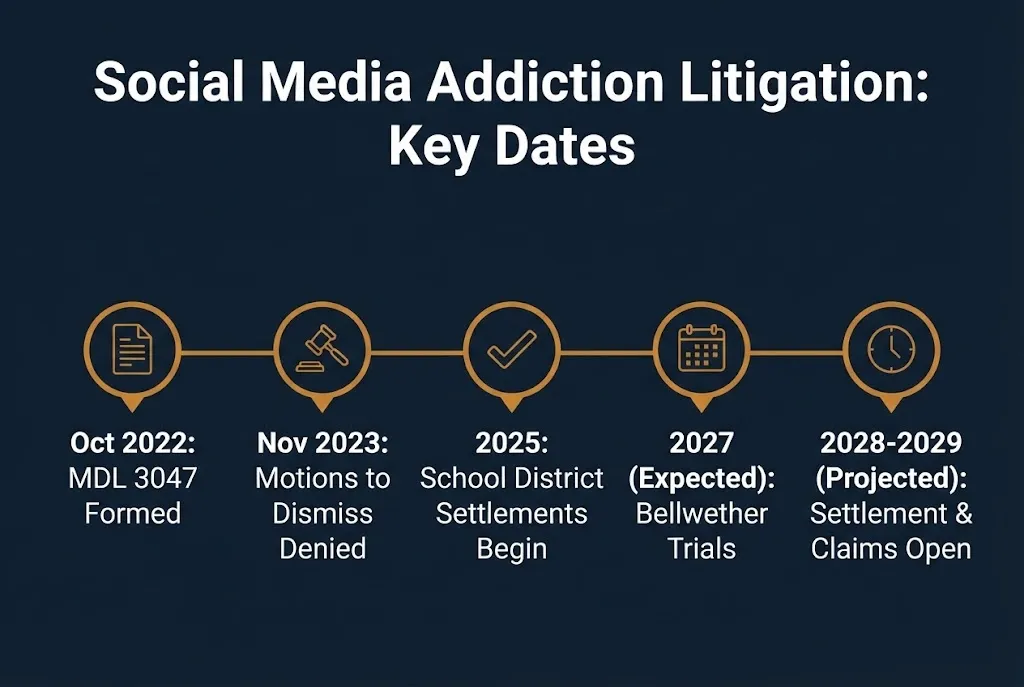
The Judicial Panel on Multidistrict Litigation consolidated the federal cases in October 2022. Since then, Judge Gonzalez Rogers has ruled on multiple motions to dismiss. In November 2023, she largely denied the platforms’ motions, allowing most claims to proceed. In 2024 and 2025, discovery produced millions of pages of internal documents. As of July 2026, the MDL is in advanced discovery with bellwether trial selections expected in early 2027.
Key Takeaway: This litigation is genuine, court-supervised, and moving forward. But there is no settlement to claim from yet. Anyone texting you about a “social media settlement payout” today is likely running a scam.
Social Media Settlement: What’s Been Resolved So Far?
No global settlement covering all plaintiffs exists as of July 2026. That is the straightforward answer. What does exist are early, confidential resolutions in a subset of cases, primarily those brought by school districts.
In 2024 and 2025, several school districts reached confidential settlements with Meta, Snap, and TikTok. The exact dollar figures remain under seal, but court filings confirm that at least 15 school district cases have been resolved. These districts alleged that social media addiction among students forced them to divert resources toward mental health services, disciplinary responses, and crisis interventions. The settlements reimburse districts for some of those costs.
For individual plaintiffs, families suing on behalf of injured children, no settlements have been announced. This is not unusual in a mass tort of this scale. In the JUUL litigation, the first individual settlements did not materialize until roughly four years after the MDL was formed. The opioid litigation took even longer. Social media addiction cases are complex, involving novel legal theories about product design and Section 230 defenses that are still being litigated at the appellate level.
The attorneys general cases are also proceeding separately. In October 2023, 33 states filed a joint federal lawsuit against Meta. That case is in the same MDL but operates on its own track. A settlement in the AG case could create a framework that accelerates individual resolutions, but nothing has been announced.
Key Takeaway: Confidential school district settlements show the platforms are willing to pay. But individual family settlements are still down the road, and no amounts are public yet.
Social Media Addiction Lawsuits: Who Is Suing and Why?
The core allegation across all complaints is that social media platforms designed their products to be addictive, specifically to minors, and that this addiction causes measurable harms. The lawsuits target several platform features: infinite scroll, algorithmically curated content feeds, push notifications timed to maximize engagement, and “likes” and follower counts that exploit adolescent social validation needs.
The legal theories fall into a few categories. Product liability claims argue that social media platforms are defective products because their design foreseeably causes addiction and associated mental health injuries. Negligence claims assert the companies knew about the risks and failed to act. Consumer protection claims, brought primarily by state AGs, allege deceptive marketing practices around safety claims.
The evidence supporting these claims has grown substantially. In 2024, unsealed internal Meta documents revealed that the company’s own research, dating back to 2019, found that 32% of teen girls said Instagram made them feel worse about their bodies, and the platform’s own researchers recommended changes that leadership rejected. Similar internal documents from TikTok showed the company knew its algorithm drove users toward content promoting eating disorders and self-harm.
In 2025, a study published in JAMA Pediatrics, partially funded through discovery in this MDL, found that adolescents who spent more than three hours daily on social media faced double the risk of anxiety and depression symptoms compared to those with limited use. That study is expected to be central at trial.
The Surgeon General’s 2023 advisory on social media and youth mental health, updated in 2025, has also been cited extensively in the litigation. The advisory noted that social media use is nearly universal among teens, with 95% of 13-to-17-year-olds reporting use of at least one platform, and over a third saying they use social media “almost constantly.”
School districts argue a different theory of injury: that social media addiction among students has forced schools to become de facto mental health providers, diverting budget from education to counselors, crisis teams, and disciplinary responses to social-media-fueled incidents. This theory has proven viable enough to produce the early confidential settlements mentioned above.
Key Takeaway: The evidence base supporting these lawsuits is expanding. The combination of internal company documents, independent research, and government advisory findings gives plaintiffs a strong factual foundation heading toward bellwether trials.
Social Media Harm Lawsuit: What Injuries Qualify?
The lawsuits define harm broadly, but the strongest claims fall into specific categories. Understanding what qualifies matters because if individual settlements eventually open, injury type will likely determine compensation tiers.
The primary injuries claimed in the MDL include clinical depression diagnosed in adolescence, anxiety disorders requiring treatment, eating disorders including anorexia and bulimia, self-harm behaviors and suicidal ideation, and in the most severe cases, completed suicide. Secondary injuries include sleep deprivation leading to academic decline, social withdrawal, and family disruption.
Courts have allowed claims based on these categories to proceed. The key legal hurdle plaintiffs must clear is causation: showing that social media addiction was a substantial factor in causing the injury, not merely one of many background conditions. Expert testimony, medical records, and platform usage data will all be central to proving that link.
Usage intensity matters. The litigation focuses on heavy users, generally defined as three or more hours of daily social media use. Plaintiffs with documented usage below that threshold may face steeper causation challenges. The JAMA Pediatrics study and other research consistently show that harm correlates with usage duration and engagement patterns.
Pre-existing conditions do not necessarily bar a claim, but they complicate it. A plaintiff with a family history of depression may still recover if social media use materially worsened the condition. Courts will evaluate each case on its specific facts.
If you believe your child has suffered one of these injuries tied to social media use, document everything now. Keep screenshots of usage logs if available. Maintain medical records showing diagnosis and treatment timelines. Write a timeline connecting usage patterns to symptom onset. This documentation may become essential if and when claims open.
Reality Check: The platforms’ legal teams are not going to concede causation easily. They will argue that teenage mental health challenges have multiple causes, that parents bear responsibility for monitoring usage, and that correlation is not causation. These are not frivolous defenses. The outcome of bellwether trials will tell us how well those defenses hold up before juries.
Lawsuits Against Social Media: Which Platforms Are Named?
Not all social media platforms face equal legal exposure. The MDL primarily targets four companies, and the strength of the evidence varies by platform.
Meta Platforms Inc., which owns Facebook and Instagram, is the lead defendant in the vast majority of cases. This is not accidental. Meta has produced the most damning internal documents, including the 2019 Instagram body image study and subsequent decisions documented in the “Facebook Papers” revelations of 2021. Meta faces the most cases, the most attorney general actions, and the steepest potential liability.
ByteDance’s TikTok ranks second in legal exposure. TikTok’s algorithm is uniquely aggressive: the platform’s “For You” page uses real-time engagement data to drive content recommendations with no need for user follow relationships. This algorithmic intensity is a central focus of the addiction claims. Internal TikTok documents, partially unsealed in 2025, showed the company studied how its algorithm could detect and amplify emotional vulnerability in teen users.
Snap Inc., parent of Snapchat, faces a smaller docket but significant claims related to specific features. Snapchat’s “Snapstreaks” feature, which counts consecutive days of mutual messaging and penalizes breaks with visual indicators, is alleged to create compulsive use patterns. Snapchat’s disappearing-message design is also cited as enabling bullying and harassment without leaving a record.
Alphabet’s YouTube and YouTube Shorts are named in a subset of cases. The claims against YouTube focus on its recommendation algorithm, which plaintiffs allege drives minors toward increasingly extreme content to maintain watch time. The strength of evidence against YouTube is considered weaker than against Meta and TikTok, but YouTube’s sheer reach among young users keeps it in the litigation.
Other platforms face scattered claims. Roblox is named in a smaller number of suits alleging that its in-game social features and monetization design exploit minors. Discord faces claims related to grooming and exploitation facilitated by its platform design. Neither Roblox nor Discord is a primary target of the MDL, but both remain defendants in individual cases.
How Much Could a Social Media Addiction Payout Be?
No payout amounts are set, and anyone giving you a specific dollar figure is guessing or lying. But based on analogous mass torts and the size of the plaintiff pool, some rough boundaries can be sketched.
The JUUL vaping settlement, finalized in 2024, provides a reasonable comparison. That litigation involved product design causing youth addiction, with similar legal theories. The global JUUL settlement totaled roughly $1.7 billion. Individual payments to personal injury claimants ranged from a few thousand dollars for moderate claims to over $100,000 for serious, well-documented injuries. Attorneys’ fees and administrative costs consumed roughly 30% of the fund.
The opioid litigation, while different in some respects, shows what happens when thousands of public entities and individuals pursue product liability claims against major corporations. Total opioid settlements across manufacturers, distributors, and pharmacies exceeded $50 billion, but individual payments to personal injury claimants were modest, often under $10,000.
For social media addiction, the potential settlement pool is enormous. The number of affected minors could run into the millions, given near-universal social media use among teens. If a global settlement eventually totals $5 billion to $10 billion, which is within the range of what the platforms could pay, and millions of claimants file, individual payouts will be modest unless injuries are severe and well-documented.
| Potential Payout Tier | Injury Severity | Estimated Range (Speculative, Not Confirmed) |
|---|---|---|
| Tier 1 | Mild anxiety or sleep disruption, limited treatment | Low hundreds to low thousands |
| Tier 2 | Diagnosed depression, outpatient treatment | Several thousand |
| Tier 3 | Eating disorder, self-harm, hospitalization | Tens of thousands |
| Tier 4 | Suicide or permanent disability | Potentially six figures |
This table is entirely speculative. No tier structure has been proposed or approved. It reflects how mass tort settlements typically distribute funds, not any specific plan for this litigation.
Attorneys’ fees in these cases typically range from 25% to 40% of any recovery, depending on whether the case settles early or proceeds toward trial. Most plaintiffs’ firms handling these cases work on contingency, meaning they only get paid if you recover.
Key Takeaway: Do not expect life-changing money unless the injury is catastrophic and well-documented. Do expect that any eventual payout will be reduced by attorneys’ fees and divided among a very large claimant pool.
How to File a Social Media Addiction Claim in 2026
Right now, there is no claim form to file. No settlement exists, no administrator has been appointed, and no deadline has been set. What you can do now is prepare. When claims eventually open, having your documentation ready will put you at the front of the line.
Here are the steps to take now, so you are ready when a claim process is announced.
- Gather all medical records showing diagnosis and treatment of the mental health condition you believe is linked to social media use.
- Collect any available screen time or app usage data from your child’s devices showing daily social media usage duration and patterns.
- Write a detailed timeline connecting heavy social media use periods to symptom onset, diagnosis dates, and any hospitalizations or crises.
- Keep all receipts for out-of-pocket treatment costs, including therapy, medication, and hospitalization.
- Document any school impacts: grades, disciplinary actions, attendance records, and communications with school counselors.
- If you have not already, consult a medical professional to evaluate and document the condition.
- Watch the official MDL 3047 website and your state attorney general’s consumer protection page for settlement announcements.
- When a settlement is announced, verify the official claims administrator website before entering any personal information.
A crucial warning: you do not need a paid “claims consultant” to file. When a settlement opens, the administrator will provide a free claim form. Third-party services charging fees are not necessary and often provide nothing of value.
If you want to explore filing an individual lawsuit rather than waiting for a class settlement, contact a firm on the Plaintiffs’ Steering Committee or a mass tort attorney with experience in product liability cases against technology companies. Most offer free consultations.
Social Media Addiction Lawsuit Update: What Happened in 2025 and 2026?
The litigation has accelerated significantly since 2024. Here are the key developments that matter for potential claimants.
In March 2025, Judge Gonzalez Rogers issued a major discovery ruling compelling Meta, TikTok, and Snap to produce additional internal research documents related to teen mental health impacts. The ruling covered communications between engineering teams and executive leadership about algorithm design choices known to increase compulsive use. This ruling produced a wave of new evidence now being analyzed by plaintiffs’ experts.
In June 2025, the Supreme Court declined to hear interlocutory appeals from the platforms on Section 230 preemption arguments. The platforms argued that Section 230 of the Communications Decency Act shields them from liability for content recommendations. The district court and Ninth Circuit rejected that argument, and the Supreme Court’s denial means the cases will proceed to trial on the product design theories rather than dying on legal technicalities.
In September 2025, the first bellwether case selections were announced. Bellwether trials are test cases, picked by both sides to represent typical plaintiff profiles. The outcomes of these trials will heavily influence settlement negotiations. The first bellwether trial is expected to begin in mid-2027.
In February 2026, the Plaintiffs’ Steering Committee filed a motion for partial summary judgment on the issue of whether the platforms had a duty to design their products to avoid foreseeable addiction harms in minors. A ruling is expected in late 2026.
In April 2026, a new wave of school district settlements was disclosed in court filings, though amounts remain sealed. The pace of these resolutions suggests the platforms are selectively settling with institutional plaintiffs while continuing to fight individual claims.
Key Takeaway: The litigation is past the motion-to-dismiss phase and into the evidence phase. The platforms have lost their most important early legal arguments. The next 12 to 18 months will determine whether the case resolves through settlement or proceeds to jury trials.
Who Qualifies for a Social Media Addiction Settlement?
Since no settlement criteria have been published, eligibility is not yet defined. But the contours of who the litigation covers are clear from the complaints and court rulings.
You may be in the covered group if you were under 18 during the period of heavy social media use at issue, used one or more of the defendant platforms (Instagram, Facebook, TikTok, Snapchat, YouTube) regularly, and were diagnosed with a mental health condition such as depression, anxiety, an eating disorder, or self-harm behaviors during or following the period of heavy use.
You may be in the covered group if you are the parent or guardian of a minor who meets those criteria and you incurred medical expenses, therapy costs, or other financial losses as a result.
You are probably not covered if your social media use was moderate (under two hours daily) and did not result in a clinical diagnosis, or if your injury is purely economic with no health impact.
The school district cases cover a different category: public school districts that can show they diverted resources to address student mental health issues caused or worsened by social media addiction. If you are a school administrator or school board member, watch for guidance from national education associations on any future global district settlement.
Key Takeaway: The likely eligibility categories are minors with diagnosed mental health conditions tied to heavy social media use, plus their families. No official criteria exist yet. Preserve your documentation and check for updates from the MDL 3047 Plaintiffs’ Steering Committee.
What Evidence Do I Need for a Social Media Claim?
When claims eventually open, you will need to prove two things: that the plaintiff used the defendant platforms heavily during the relevant period, and that the plaintiff suffered a qualifying injury with a plausible connection to that use.
Platform usage data is the foundation. Apple Screen Time and Android Digital Wellbeing logs show daily app usage. Request download of your data from each platform through their privacy settings. Instagram, TikTok, and YouTube all provide account data exports that include usage history. Do this now, before any data retention periods expire.
Medical records are equally important. You need documentation of diagnosis, treatment, and dates. A therapist’s session notes, a psychiatrist’s medication records, and hospital discharge summaries all carry weight. The records should show the timeline clearly, so the connection between heavy use and symptom onset is documented.
School records can support a claim. Declining grades, increased absences, disciplinary incidents, and counselor referrals that align with the period of heavy social media use help paint the full picture. Request these from the school district now.
Financial records matter if you are claiming out-of-pocket costs. Keep receipts for therapy copays, medication costs, hospitalization bills, and any other treatment-related expenses. If a parent reduced work hours to care for an affected child, document the income loss.
Expert testimony will likely be required for serious injury claims. In mass tort practice, plaintiffs with documented injuries backed by treating physicians and, in some cases, forensic experts receive higher settlement offers. This is not cheap, but plaintiffs’ firms typically advance these costs against any eventual recovery.
What Happens Next: Timeline Through 2028
Below is the expected sequence of events based on the current case schedule and standard mass tort timelines.
- Late 2026: Ruling on plaintiffs’ motion for partial summary judgment regarding the platforms’ duty of care.
- Early 2027: Final bellwether trial selections and completion of expert discovery.
- Mid to Late 2027: First bellwether trials begin. Outcomes will signal settlement value.
- 2028: If bellwether outcomes favor plaintiffs, expect global settlement negotiations to accelerate. A master settlement agreement could emerge.
- 2028 to 2029: If a settlement is reached, a claims administrator will be appointed, a claim form published, and a filing deadline set, typically 6 to 12 months after settlement approval.
These dates are projections based on the MDL’s current pace. Litigation timelines routinely slip. The single most important thing you can do is check the official MDL 3047 website periodically and preserve your documentation now, not when a settlement is announced.
Frequently Asked Questions
Is there a social media addiction class action settlement I can join right now?
No. There is no certified class, no settlement, and no claim form for individuals as of July 2026.
The lawsuits are consolidated as a multidistrict litigation, not a class action, and they are still in discovery.
How much will I get from a social media lawsuit payout?
No payout amounts have been set. Any specific dollar figure you see online is speculation.
If a settlement eventually materializes, payments will depend on injury severity, documentation quality, and the total number of claimants.
What social media platforms are being sued for addiction?
Meta (Instagram, Facebook), ByteDance (TikTok), Snap Inc. (Snapchat), and Alphabet (YouTube) are the primary defendants.
Roblox and Discord are named in a smaller number of cases.
Can I still join the lawsuit if my child was affected?
You can contact a firm on the Plaintiffs’ Steering Committee to discuss filing an individual case.
When a global settlement is reached, there will be a process for filing claims that does not require pre-registration.
Do I need a lawyer to file a social media addiction claim?
Not yet, because there is no claim to file. When a settlement opens, you can typically file a claim form without a lawyer.
If you are considering an individual lawsuit rather than waiting for a class settlement, you will need an attorney.
How long will the social media lawsuit take?
The bellwether trials are expected in 2027. A global settlement, if it happens, likely would not produce payments until 2028 or 2029.
Mass tort litigation of this scale routinely takes five to seven years from filing to resolution.
Will social media settlements affect my child’s privacy?
Court filings in cases involving minors are typically sealed or use initials.
Settlement administrators for youth cases usually have protocols to protect minor claimants’ identities in public records.
How do I know if a settlement notice is real or a scam?
A real notice will direct you to a .gov court website or an independent settlement administrator’s site.
It will never ask for money upfront. Filing a legitimate claim is always free. Unsolicited texts or calls offering “guaranteed” payouts are scams.
The social media addiction litigation is real, active, and potentially the largest product liability action against technology companies in U.S. history. But the key word is “potentially.” No settlement has been reached for individuals. No claim form exists. No deadline has been set.
What you can do now is straightforward: if your child developed a mental health condition tied to heavy social media use, document it. Medical records, usage logs, school records. Talk to your doctor. Watch for updates from the MDL 3047 court and your state attorney general. The documentation you gather today will be the foundation of any claim you file tomorrow. The official court docket and the Plaintiffs’ Steering Committee remain the only sources you should trust until a settlement administrator is appointed.