United Settlement 2026: Is It Legit, What Debt Relief Costs, and Real Customer Reviews
Quick Answer:
- United Settlement is a legitimate, for-profit debt settlement company, not a scam or a lawsuit payout.
- Fees range from 15 to 25 percent of your total enrolled debt, paid only after a settlement is reached.
- No fixed deadline exists; the program lasts 24 to 48 months on average depending on your debt amount and ability to save.
If you searched “united settlement” because you saw an ad, got a mailer, or heard someone mention a payout, you need to know this upfront: United Settlement is not a class action settlement. It is not a government program. It is not a check arriving in the mail.
It is a private company that promises to negotiate down your credit card, medical, and personal loan debts for less than you owe. This article covers what United Settlement actually does, what it costs, what real reviews say, and how it compares to alternatives like bankruptcy, credit counseling, or doing nothing. One verified detail most articles omit: debt settlement companies cannot charge upfront fees before settling a debt, per the FTC’s Telemarketing Sales Rule, a rule that reshaped the entire industry in 2010.
The Facts
| Case | Not a lawsuit or class action; a debt settlement company |
| Status | Active and enrolling clients as of 2026 |
| Fund Size | No settlement fund; savings depend on individual negotiations |
| Est. Per Person | Clients typically settle for 50 to 80 percent of the enrolled debt, before fees |
| Claim Deadline | No deadline; enrollment is open but not guaranteed to work |
| Administrator | No claims administrator; client accounts managed internally by United Settlement |
| Proof Needed | Account statements, creditor names, balances, and proof of financial hardship |
Is United Settlement Legit or a Scam
United Settlement is a legitimate debt settlement company, not a scam. It is accredited by the Better Business Bureau with an A+ rating as of 2026. The company is also a member of the American Association for Debt Resolution, or AADR, the industry’s main trade group that requires members to follow certain standards. It has been in business since 2011, which gives it a track record longer than many competitors in an industry where companies routinely appear and disappear within a few years.
That said, legitimate does not mean risk-free. Debt settlement as an industry has a high complaint volume. The Consumer Financial Protection Bureau, or CFPB, has flagged the entire debt settlement sector for aggressive marketing, hidden fees, and misleading success-rate claims. United Settlement is not immune from those industry-wide criticisms. Some complaints on the Better Business Bureau website and consumer forums cite poor communication, fees that surprised clients, and settlements that took longer than promised. Others report successfully settling debts and feeling relieved. The experience varies significantly.
One thing that separates United Settlement from outright scams: it does not charge upfront fees. Under the FTC’s Telemarketing Sales Rule, debt settlement companies cannot collect a fee from you until they have successfully renegotiated, settled, or otherwise resolved at least one of your debts. If a company asks for a large upfront payment before any debt is settled, that is a red flag and likely a violation of federal law. United Settlement’s fee structure, which is performance-based, aligns with this rule.
Key Takeaway: United Settlement is a real, regulated company, not a scam, but debt settlement carries financial risks you need to understand before enrolling.
What Is United Debt Settlement
United debt settlement is a service where the company negotiates with your creditors to accept a lump sum payment that is less than the full balance you owe. You stop paying your creditors directly. Instead, you deposit money into a dedicated savings account each month. Once that account builds enough to make a realistic offer, United Settlement contacts the creditor and tries to negotiate a reduced payoff.
The process only works for unsecured debts. That means credit card debt, medical bills, personal loans, and some private student loans in default. It does not work for secured debts like mortgages, auto loans, or federal student loans. If your debt is backed by collateral, the creditor has little incentive to settle because they can repossess the asset.
United Settlement markets itself as a middle-ground option. It is not bankruptcy, which destroys your credit for 7 to 10 years. It is not credit counseling, which typically requires you to repay 100 percent of your debt over time through a debt management plan. Settlement aims for a middle outcome: you pay less than you owe, your credit takes a hit but recovers faster than bankruptcy, and you avoid court. The trade-off is uncertainty. Creditors are not required to settle. Some may refuse. Others may sue you before you save enough to make an offer.
How Much Does United Settlement Cost
United Settlement charges a fee of 15 to 25 percent of your total enrolled debt. The fee is taken only after a debt is settled, in compliance with the FTC rule. If you enroll $30,000 in credit card debt and settle it for $15,000, you would owe United Settlement a fee of roughly $4,500 to $7,500 based on the percentage in your contract. Your total cost would be the settlement amount plus the fee, so $19,500 to $22,500, compared to the original $30,000. The net savings in this example ranges from $7,500 to $10,500.
That math looks appealing on paper. The problem is what happens during the months or years before settlement. Your enrolled debts go unpaid. Interest and late fees continue to accrue. Your credit score drops, often by 100 points or more. Some creditors sell your debt to collection agencies. Others file lawsuits and obtain judgments, which can lead to wage garnishment or bank levies. United Settlement does not prevent any of that. The company negotiates when you have saved enough, but it cannot stop a creditor from suing you in the meantime.
There are also tax implications. The IRS generally considers forgiven debt above $600 as taxable income. If you settle $10,000 of debt for $4,000, you may receive a 1099-C form for the $6,000 difference. That $6,000 gets added to your taxable income for the year. You can potentially exclude it if you are insolvent at the time, meaning your total debts exceed your total assets, but that requires filing IRS Form 982 and may require a tax professional’s help. The tax bill can eat into the savings you thought you were getting.
Key Takeaway: Settlement fees of 15 to 25 percent are only part of the cost; credit damage, potential lawsuits, and a possible tax bill all factor into the true price.
United Settlement Reviews: What Customers Report
United Settlement reviews across multiple platforms show a mixed picture, which is common for the debt settlement industry. On the Better Business Bureau website, the company holds an A+ rating and an average customer review score of roughly 4.5 out of 5 stars based on several hundred reviews as of mid-2026. On Trustpilot, reviews average around 4.7 stars. On consumer complaint forums and Reddit, the tone shifts, with recurring themes of slow communication, unexpected fees, and settlements that took far longer than initial estimates.
The positive reviews tend to cite a few specific things. Customers who completed the program often report feeling relieved and describe the staff as professional during the negotiation phase. Several reviews mention that the company settled debts for 40 to 60 percent of the enrolled balance, which is within the industry norm. Repeat praise goes to clarity around the initial consultation and the absence of upfront fees.
Negative reviews cluster around three pain points. First, the timeline. Many customers say the program took far longer than the 24 to 48 months originally quoted. When savings are slow to accumulate, creditors do not wait. Second, communication gaps. Some clients describe months of silence from their account manager, followed by sudden demands for more money in the savings account before a settlement could be attempted. Third, creditor lawsuits. Several reviews describe being sued by a creditor during the program and feeling that United Settlement offered little practical help beyond referring them to a network attorney.
A pattern worth noting: the most satisfied reviewers tend to be those who completed the program. The most frustrated tend to be those still in the middle of it, watching their credit score fall and their savings build more slowly than expected. This is the structural reality of debt settlement. The hard part comes first. Relief comes later, if it comes at all.
Reality Check: Debt Settlement Is Not a Magic Eraser
No company, including United Settlement, can guarantee that every creditor will settle or that you will save a specific percentage. Creditors have no legal obligation to negotiate. Some, notably American Express and Discover, are known within the industry for being less willing to settle than others. If a salesperson promises you will save 50 percent or more across all your debts, they are guessing, not quoting a contract term. The decision to settle rests entirely with the creditor, not with United Settlement. All the company can do is make the offer and negotiate on your behalf.
How Does United Settlement Compare to Other Debt Relief Options
Debt settlement occupies one corner of a landscape that includes four main paths for dealing with unmanageable unsecured debt. Each has different costs, timelines, and credit consequences. Understanding the differences is the only way to decide if United Settlement fits your situation.
| Option | How It Works | Cost | Credit Impact | Timeline |
|---|---|---|---|---|
| Debt Settlement (United Settlement) | Negotiate lump sums for less than owed | 15 to 25 percent of enrolled debt | Severe drop during program; recovers after | 24 to 48 months |
| Debt Management Plan (Credit Counseling) | Agency negotiates lower interest; you repay full principal | $25 to $50 monthly fee | Moderate temporary dip | 36 to 60 months |
| Chapter 7 Bankruptcy | Discharge unsecured debts entirely | $1,500 to $3,500 in legal fees | Severe; stays on report 10 years | 3 to 6 months |
| Do Nothing / Default | Stop paying; wait for charge-offs | None upfront; possible judgments and garnishment | Severe drop; recovery takes years | Indefinite |
Debt management plans, run by nonprofit credit counseling agencies, are the most overlooked option. They do not reduce your principal. Instead, they negotiate lower interest rates and waived fees with your creditors. You make one monthly payment to the agency, which pays each creditor. You repay 100 percent of what you owe, but over a longer period and at lower cost. Credit scores usually dip at first, then recover as balances shrink. This option works best if you have steady income and can afford reduced payments but not the full minimums.
Chapter 7 bankruptcy eliminates most unsecured debts in about three to six months. The credit score damage is severe and long-lasting. But for people with no realistic ability to repay, even through settlement or a debt management plan, bankruptcy is sometimes the cleanest path. It stops creditor lawsuits immediately through the automatic stay. It provides a definitive end date. United Settlement and other settlement companies rarely discuss bankruptcy as an alternative, for obvious reasons.
What Are the Risks of Using United Settlement
The risks of using United Settlement are the same risks inherent in any debt settlement program. The company cannot eliminate them. It can only help you navigate them, and results depend heavily on which creditors you owe, how fast you can save, and whether you get sued before a settlement is reached.
The most immediate risk is credit score damage. Once you stop paying your creditors and start saving in the settlement account, your payment history, the largest factor in your credit score, turns negative. Late payments appear at 30, 60, and 90 days. Accounts eventually charge off. The settlement itself appears on your credit report as “settled for less than full balance,” which is a negative mark that stays for seven years from the original delinquency date.
The second risk is creditor lawsuits. Nothing prevents a creditor from suing you while you are in the settlement program. If a creditor obtains a judgment, they may be able to garnish your wages or levy your bank account, depending on your state’s laws. United Settlement cannot provide legal representation. Some clients report being referred to a network attorney for an additional fee, but that fee is separate from the settlement program fee.
The third risk is the tax bill on forgiven debt. As noted above, the IRS treats forgiven debt as income. If you settle $20,000 of debt for $8,000, you may owe taxes on $12,000. At a 22 percent marginal tax rate, that is $2,640 in federal tax alone, plus any state tax. The insolvency exclusion can help, but it requires documentation and possibly professional tax preparation, another expense.
The fourth risk is that the program fails entirely. You save for months, pay fees on the debts that do get settled, but one or more major creditors refuse to settle. You leave the program with depleted savings, damaged credit, and the same debts still outstanding. United Settlement, like all debt settlement companies, cannot guarantee outcomes.
Key Takeaway: Credit damage, lawsuits, tax liability, and program failure are all real risks that no settlement company can eliminate.
How Do I Enroll in United Settlement
Enrolling in United Settlement follows a multi-step process that begins with a free consultation. The company evaluates your debts, your income, and your financial hardship to determine if you might benefit from the program. Not everyone is a good candidate. If your debts are too small, your income too low to save, or your creditors are known to rarely settle, the company may decline to enroll you, or at least should.
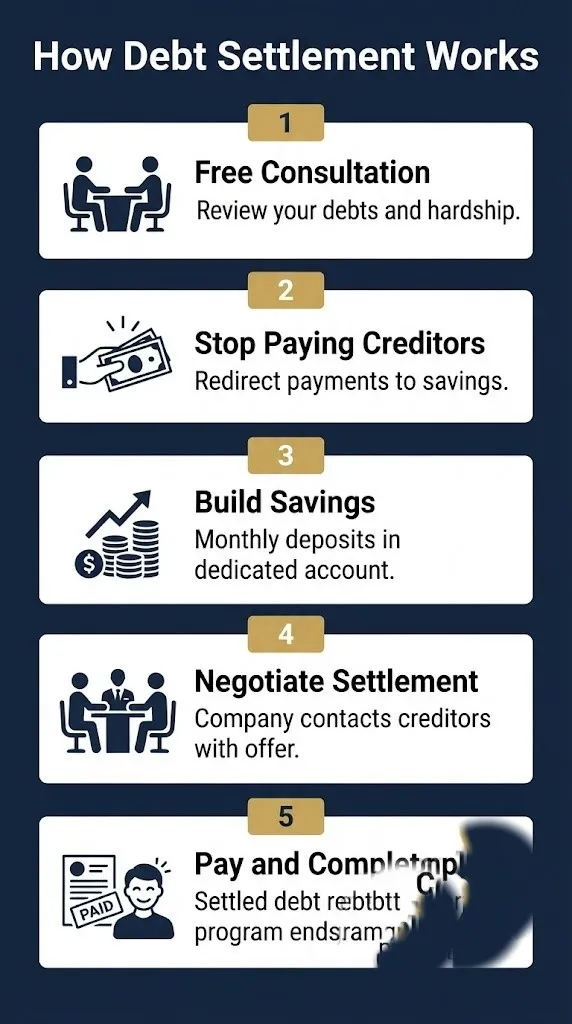
- Contact United Settlement by phone or through its website to schedule a free debt consultation.
- Provide a list of your unsecured debts: credit cards, medical bills, personal loans, and their approximate balances.
- Discuss your financial hardship with the consultant. Job loss, medical issues, divorce, and reduced income are common qualifying hardships.
- Receive a proposed monthly savings target and an estimated program length based on your total debt and budget.
- Review and sign the client agreement, which should clearly state the fee percentage and that fees are charged only after a settlement is reached.
- Open a dedicated savings account, often through a third-party bank partnered with the program, in your name and under your control.
- Begin making monthly deposits into that account instead of paying your creditors directly.
- Once enough savings accumulate for a realistic settlement offer, United Settlement contacts creditors to negotiate on your behalf.
The enrollment process itself is straightforward. The harder part is what comes after: months of saving while dodging creditor calls, watching your credit score drop, and hoping no one sues you. Understand that timeline before you sign.
What Debts Can United Settlement Help With
United Settlement works exclusively with unsecured debts. The most common types enrolled are credit card balances, medical bills, personal loans from banks or online lenders, and certain private student loans that are in default. Unsecured means there is no collateral backing the debt. The creditor’s only recourse if you do not pay is to sue you or sell the debt to a collection agency.
Secured debts are not eligible for the program. This includes mortgages, home equity lines of credit, auto loans, boat loans, and any debt where the lender can repossess an asset. Federal student loans are generally not eligible for private debt settlement, though they have their own government-run forgiveness and income-driven repayment programs. Tax debt is also outside the scope of United Settlement’s service. The IRS has its own settlement process, called an Offer in Compromise, which requires a different type of professional help.
Some creditors are known in the industry to be more settlement-friendly than others. Large banks like Chase, Citibank, and Bank of America settle regularly, often for 40 to 60 percent of the balance. American Express and Discover are widely reported to be more aggressive about litigation and less willing to discount debt. Store credit cards and medical debts tend to settle more readily than major bank cards. United Settlement will know which of your creditors are historically easier or harder to negotiate with, but that historical pattern is not a guarantee.
What Happens Next
If you are considering United Settlement, here is the expected timeline of what happens after enrollment, based on the company’s own disclosures and client reviews.
- Month 1: Your first deposit into the dedicated savings account. You stop paying creditors. Collection calls begin.
- Months 2 to 6: Savings accumulate. Accounts go 30, 60, and 90 days past due. Credit score drops significantly during this window.
- Months 6 to 12: First settlement offers may be made for smaller debts if savings are sufficient. United Settlement contacts creditors and begins negotiations.
- Months 12 to 24: Most settlements occur during this period for the average client. Larger debts take longer because they require larger savings balances.
- Months 24 to 48: Program completion. Remaining debts are settled or the client exits the program. Credit recovery begins once all settlements are complete and no new delinquencies occur.
The timeline is not guaranteed. Lawsuits from creditors can disrupt it. Job loss or unexpected expenses can slow savings. Some clients complete the program faster. Some take longer. Some never complete it.
Frequently Asked Questions
Does United Settlement hurt your credit score
Yes, debt settlement through United Settlement will damage your credit score.
Your score typically drops 100 points or more during the savings phase.
The “settled” notation remains on your credit report for seven years from the original delinquency.
Can creditors still sue me while I am in the United Settlement program
Yes, creditors can sue you at any time during the program.
United Settlement cannot stop a lawsuit or provide legal representation.
If sued, you may need to hire an attorney separately, adding to your total cost.
Does United Settlement charge upfront fees
No, United Settlement does not charge upfront fees.
Under federal law, debt settlement companies cannot charge fees before settling a debt.
You pay only after a settlement is reached and you agree to it.
Will I owe taxes on the settled debt
Yes, the IRS generally treats forgiven debt over $600 as taxable income.
You may receive a 1099-C from the creditor for the forgiven amount.
The insolvency exclusion may reduce or eliminate the tax if your debts exceed your assets at the time.
How long does the United Settlement program take
Most clients complete the program in 24 to 48 months.
The timeline depends on your total debt, how fast you can save, and which creditors you owe.
Some debts settle in under a year; others take longer if the savings target is high.
Can I cancel United Settlement at any time
Yes, the savings account is in your name and under your control.
You can withdraw your funds and exit the program at any time.
You will owe fees only on debts that were already settled before cancellation.
Is United Settlement better than bankruptcy
Debt settlement is less damaging to your credit than bankruptcy in the long term.
Bankruptcy provides faster relief and stops lawsuits immediately.
The right choice depends on your debt amount, income, and whether you can afford to save for settlements.
What is the minimum debt to qualify for United Settlement
United Settlement typically requires at least $7,500 to $10,000 in unsecured debt.
Debts below that threshold may not generate enough savings to make the fees worthwhile.
The company evaluates each case individually during the free consultation.
United Settlement is a real company offering a real service, but the outcome depends entirely on factors outside the company’s control: which creditors you owe, how fast you save, and whether anyone sues you first. Before enrolling, get a free consultation with a nonprofit credit counseling agency to compare a debt management plan. Talk to a bankruptcy attorney if your debts exceed what you could reasonably save for settlement. The debt settlement sales pitch sounds clean on the front end. The middle part, the months of collection calls and falling credit scores, is where most people get shaken out.
Check United Settlement’s Better Business Bureau profile and Trustpilot page for recent reviews. Check the CFPB’s website for general guidance on debt settlement risks.