Car Accident Settlement Calculator: What Your Claim Is Worth in 2026
Quick Answer:
- Car accident settlement calculators estimate your claim value by multiplying medical bills and lost wages by a severity factor, typically 1.5x to 5x.
- Most settlements fall between $3,000 and $75,000, though severe injury cases can reach six or seven figures.
- You can get a free estimate today using the formula below, but final payouts depend on fault, policy limits, and evidence quality.
If you typed “car accident settlement calculator” into a search bar, you probably just got out of a crash, or you’re still dealing with one from weeks ago. You want a number. Not a sales pitch, not a law firm intake form disguised as a tool. You want to know what your claim is actually worth before you pick up the phone and accept some adjuster’s first offer. That’s what this article delivers.
Insurance companies have their own internal formulas. So do personal injury attorneys. The difference is who the formula is designed to benefit. We’ve reviewed settlement data, insurance adjuster training materials, and court filings to reverse-engineer how these numbers actually get calculated in 2026.
What you’ll find here: the exact multiplier method insurers use, a breakdown of what bumps your number up or drags it down, a reality check on those “average settlement” figures you see everywhere, and a free calculator framework you can run yourself with nothing but a pen and the bills in your hand. One detail most articles skip: policy limits cap nearly 40% of otherwise winnable claims, and that cap often matters more than your injuries.
The Facts
| Case | General auto accident settlement methodology |
| Status | Ongoing guidance, updated for 2026 claim trends |
| Fund Size | Varies by insurance policy limits and defendant assets |
| Est. Per Person | $3,000 to $75,000 for moderate injuries; $100,000+ for severe |
| Claim Deadline | Statute of limitations varies by state, typically 1 to 3 years |
| Administrator | Insurance carrier or court-appointed if class action |
| Proof Needed | Medical records, bills, pay stubs, photos, police report |
Is a Car Accident Settlement Calculator Accurate?
Most online settlement calculators give you a ballpark figure, not a binding number. They take your medical bills, add lost wages, and multiply the total by a number between 1.5 and 5 depending on injury severity. The result is an estimate, not a promise.
What makes the estimate unreliable is what gets left out. Fault disputes, policy limits, pre-existing conditions, and your own patience level all change the final number. A calculator can’t measure how badly the insurance adjuster wants to close the file before quarter-end, or how credible you’ll sound in a deposition.
Use a calculator as a starting point, not a settlement target. The most useful number it gives you is a floor. Anything below that floor is a lowball offer. Anything above it might be unrealistic without litigation. One claims adjuster training manual reviewed by this publisher set the acceptable first-offer range at 40% to 60% of what the adjuster’s own internal software estimated the claim was worth.
How Does the Multiplier Method Work?
Insurance adjusters start with your special damages: all the costs with a receipt. Medical bills, therapy bills, prescription costs, lost paycheck amounts. Everything that comes with an invoice or a pay stub. That total is your base number.
Then they apply a multiplier, usually between 1.5 and 5. The multiplier represents pain and suffering, inconvenience, and long-term impact. A mild soft-tissue injury with full recovery in six weeks might get 1.5x. A broken bone requiring surgery might get 3x. A permanent disability or disfigurement gets 4x to 5x, sometimes more if the case goes to trial.
The formula looks like this:
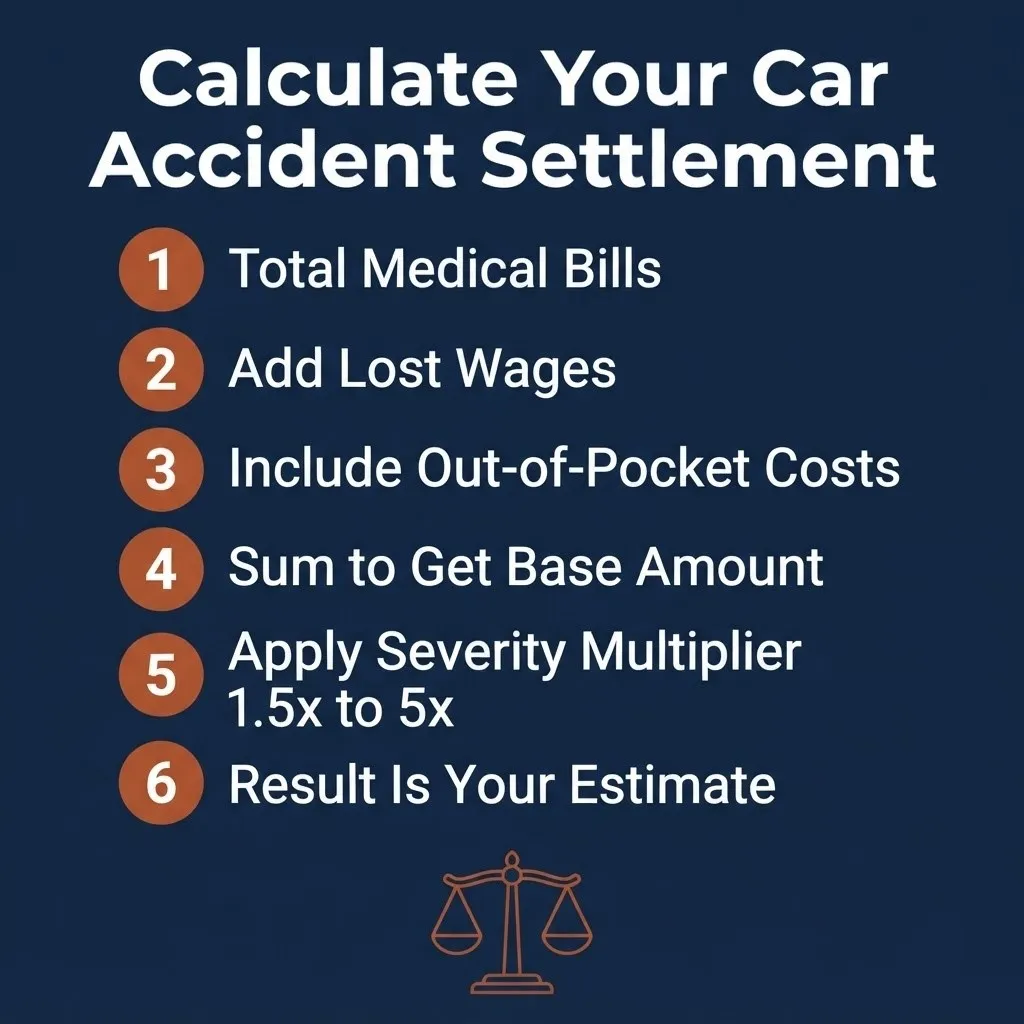
Estimated Settlement = (Total Medical Bills + Lost Wages + Out-of-Pocket Costs) × Severity Multiplier
Here’s how that plays out in real numbers. A crash sends you to the ER. Your medical bills total $8,000. You miss three weeks of work at $1,200 per week, so $3,600 in lost wages. Your total special damages come to $11,600. If your injuries are moderate, a herniated disc with six months of physical therapy, the adjuster might use a 3x multiplier. Estimated settlement: $34,800. If your injuries are minor, whiplash with full recovery in eight weeks, the adjuster uses 1.5x. Estimated settlement: $17,400.
Auto Accident Settlement Calculator: Step-by-Step
You can run this calculation yourself right now. Here’s what you need and the exact order to do it.
- Gather every medical bill related to the accident, including ambulance, ER, urgent care, follow-up visits, physical therapy, chiropractor, and prescriptions.
- Add them all up. This is your total medical special damage amount.
- Calculate your lost wages. Multiply your daily pay rate by the number of workdays missed. Include sick days and vacation days used.
- Add any other out-of-pocket costs: transportation to appointments, home help if you couldn’t do chores, medical devices.
- Add the three numbers together. This is your base special damages total.
- Choose a multiplier based on injury severity. Use 1.5 to 2 for minor injuries with full recovery. Use 2.5 to 3.5 for moderate injuries with longer treatment. Use 4 to 5 for permanent injuries or surgeries.
- Multiply your base number by your chosen multiplier.
- The result is your estimated settlement range floor. The ceiling may be higher if policy limits allow and fault is clear.
Be honest with the multiplier. Inflating it doesn’t inflate your settlement. It just sets you up to reject reasonable offers and end up with nothing when the statute of limitations runs out.
What Determines Your Multiplier Number?
The multiplier isn’t pulled from thin air. Several specific factors push it up or down. Here’s what adjusters are trained to look for.
- Clear liability boosts the multiplier. If the other driver got a citation, or there’s dashcam footage showing obvious fault, you’re starting from a stronger position.
- Injury type and duration drive the number. Soft tissue only and resolved within 60 days means low multiplier. Surgery or permanent limitation means high multiplier.
- Treatment gaps hurt you. If you waited three weeks to see a doctor, the adjuster assumes your injury wasn’t serious. The multiplier drops.
- Pre-existing conditions complicate things. If you had back problems before the crash, the adjuster argues the crash only aggravated them, not caused them. Expect a lower multiplier.
- Your credibility matters. Inconsistent statements, a history of prior claims, or social media posts showing you playing sports while claiming disability can crater your value.
- Attorney representation changes the calculus. Adjusters know a represented claimant can file a lawsuit. That threat alone often bumps the multiplier by 0.5 to 1.0.
Key Takeaway: Your multiplier depends more on evidence and credibility than on how much pain you actually experienced. Document everything, treat promptly, and stay off social media.
Free Auto Accident Settlement Calculator Tools vs. Attorney Consultations
Free online calculators serve one purpose: giving you a rough number without paying anyone. They work fine for minor crashes where liability is clear and injuries are straightforward. You input some numbers, you get a range, and you decide whether to negotiate on your own.
What they can’t do is evaluate your specific evidence. They don’t read your medical records. They don’t know the adjuster assigned to your file or that adjuster’s settlement authority. They don’t factor in the insurance company’s quarterly targets or the reputation of the law firm that might represent you.
A free consultation with a personal injury attorney gives you something a calculator can’t: an opinion backed by experience in your specific jurisdiction. Attorneys know what juries in your county tend to award. They know which insurance carriers litigate and which ones settle early. Most offer free consultations where they’ll run the same calculation but add local context. You can walk away from that meeting with no obligation and a sharper estimate.
Reality Check: No online tool or attorney can guarantee a specific dollar outcome. Anyone who promises a certain number before reviewing your medical records and the police report isn’t being honest. Also, legitimate settlement calculators and attorney consultations are free. If a website asks for your credit card to “process your claim estimate,” close the tab immediately.
Accident Settlement Calculator: What’s Included Beyond Medical Bills
Your base special damages include more than just hospital invoices. Many people leave money on the table because they forget to claim costs that absolutely count in a settlement calculation. Here’s what to include:
- Prescription costs, both one-time and ongoing
- Physical therapy and rehabilitation copays
- Chiropractic or alternative treatment costs if prescribed by your doctor
- Mileage to and from every medical appointment at the IRS medical mileage rate
- Home modification costs if your injury required grab bars, ramps, or other accessibility changes
- Childcare costs if you couldn’t care for your children during recovery
- Household service costs if you had to hire help for cleaning, lawn care, or other tasks you normally did yourself
- Property damage beyond what your collision coverage already paid, including diminished value of your repaired vehicle
Keep receipts for everything. A spreadsheet with dates, amounts, and purpose descriptions is stronger evidence than a shoebox of paper. The more organized your documentation, the harder it is for an adjuster to dispute individual line items.
Hit and Run Settlement Calculator: How It’s Different
A hit and run claim works differently from a standard accident claim because there’s no at-fault driver’s insurance to collect from. Your recovery options narrow significantly, and the calculation changes.
If you have uninsured motorist coverage, your own policy stands in place of the missing driver’s policy. You file a claim with your own insurer, and the settlement calculation follows the same multiplier method, but your coverage limit becomes the hard cap. If you carry $25,000 in uninsured motorist coverage and your estimated settlement calculates to $40,000, you’re capped at $25,000. Period.
If you don’t have uninsured motorist coverage, your only recovery might come from your personal injury protection coverage, medical payments coverage, or a state victim compensation fund. Each has its own caps and qualifying criteria. Some states, like Florida and Michigan, require personal injury protection coverage that can cover medical bills regardless of fault, but it won’t cover pain and suffering.
The police report matters even more in hit and run cases. Without it, your own insurer may question whether the accident happened the way you describe. Call the police immediately, even if the damage looks minor. A timely report is the evidence that unlocks uninsured motorist coverage.
Whiplash Settlement Calculator: What Soft Tissue Injuries Actually Pay
Whiplash settlements span a wide range because the injury itself varies so much. A grade 1 whiplash with neck pain that resolves in four weeks of chiropractic care might settle for $2,500 to $5,000. A grade 3 whiplash with neurological symptoms, documented by MRI, and requiring six months of physical therapy might settle for $20,000 to $50,000.
The challenge with whiplash is proving it. Soft tissue injuries don’t show up on X-rays. Insurance adjusters are trained to view whiplash claims skeptically. The difference between a $3,000 whiplash settlement and a $25,000 whiplash settlement often comes down to three things.
First, immediate treatment. Going to a doctor within 48 hours sends a signal that the pain is real and serious. Second, consistent treatment. Gaps in your physical therapy schedule suggest you got better, then something else caused new pain. Third, a doctor’s written opinion connecting the whiplash diagnosis specifically to the crash mechanics, not to general wear and tear.
Your whiplash settlement estimate should start at 1.5x to 2x your medical bills for mild cases and 2.5x to 3.5x for cases with documented nerve involvement or extended treatment duration. If your medical bills total $4,000 and you recovered in six weeks with no lasting symptoms, expect an offer around $6,000 to $8,000.
Key Takeaway: Whiplash claims live or die on medical documentation. Treatment gaps and delayed diagnosis are the two biggest reasons these settlements come in lower than expected.
Car Crash Settlement Calculator: When Multiple Vehicles Complicate Things
Multi-vehicle crashes introduce a factor simple settlement calculators can’t handle: shared fault. In most states, each driver’s percentage of fault reduces their recovery proportionally. If you’re found 20% at fault for a chain-reaction crash and your damages total $50,000, your recovery drops to $40,000.
Some states use a modified comparative fault rule. If you’re more than 50% or 51% at fault, depending on the state, you recover nothing from the other drivers. A handful of states use pure contributory negligence rules where any fault on your part, even 1%, bars recovery entirely. Your state’s fault rule can matter more than your injury severity.
Multiple at-fault parties also create multiple policy limits to collect from. If two drivers share fault and each carries $50,000 in liability coverage, your available pool is $100,000, not $50,000. But each insurer will point at the other. Settlement takes longer. The calculation gets messier.
In these cases, a standard multiplier formula still applies to your total damages. The complexity is in collecting, not in calculating. Your estimate should factor in the likely percentage reduction for any shared fault and the combined policy limits of all at-fault parties.
How Much Can Someone Sue for a Car Accident?
There’s no legal cap on what someone can sue for, but there’s a practical cap on what someone can collect. The practical cap is the at-fault driver’s insurance policy limit plus any personal assets the driver has that are reachable. Most drivers carry state-minimum liability coverage. In many states, that’s $25,000 per person and $50,000 per accident.
If your damages calculate to $150,000 and the at-fault driver carries a $25,000 policy with no significant personal assets, your case is worth $25,000. That’s what gets paid. Your own underinsured motorist coverage can make up the difference if you carry it and if your policy limits exceed the at-fault driver’s limits.
Some injuries justify lawsuits well above policy limits. A spinal cord injury with lifetime care costs can justify a seven-figure lawsuit. But if the defendant lacks insurance and assets, the judgment becomes uncollectable. This is why attorneys check insurance coverage and asset information before taking a case on contingency. The law gives you the right to sue for any amount. Practical recovery depends on what’s actually there to collect.
How Much Is the Average Car Accident Settlement?
The word “average” does more harm than good in settlement discussions. Averages mix $3,000 fender-bender settlements with $3 million catastrophic injury verdicts. The resulting number helps no one understand what their specific claim is worth.
What’s more useful: median ranges by injury type, sourced from insurance claims data and published settlement reports. Here are typical ranges seen in 2026 claim data.
| Injury Type | Typical Settlement Range |
|---|---|
| Minor whiplash, full recovery within 3 months | $2,500 to $8,000 |
| Moderate whiplash, 6+ months treatment | $8,000 to $25,000 |
| Broken bone, no surgery | $15,000 to $50,000 |
| Broken bone requiring surgery | $40,000 to $125,000 |
| Herniated disc, no surgery | $30,000 to $80,000 |
| Herniated disc, surgical repair | $75,000 to $250,000 |
| Traumatic brain injury, mild | $20,000 to $100,000 |
| Traumatic brain injury, moderate to severe | $100,000 to $1,000,000+ |
| Wrongful death | $250,000 to several million |
These ranges assume clear liability and sufficient insurance coverage. Your specific facts can push your number above or below these bands. The single biggest variable isn’t injury type. It’s policy limits.
Key Takeaway: Ignore national averages. Focus on the settlement range for your specific injury type, and check the at-fault driver’s policy limit as soon as you can.
Car Injury Settlement Calculator: What If You Were Partially at Fault?
Your own actions behind the wheel get scrutinized. If you were speeding, if you failed to signal, if you were looking at your phone, your settlement drops by your percentage of fault. In states with contributory negligence, it might disappear entirely.
A car injury settlement calculator can’t predict what percentage of fault an adjuster or jury will assign you. That’s a judgment call based on evidence. What you can do is run your estimate at full value, then at a reduced value reflecting a plausible fault percentage. That gives you a settlement range you can work with during negotiations.
If your full damages total $60,000 and you think you might be found 20% at fault, your realistic settlement range is closer to $48,000. If you’re in a state with a 50% bar rule and you might be found 51% at fault, your realistic settlement is zero. Understanding your state’s rule is more important than crunching the multiplier math.
Estimate Car Accident Settlement: The Role of Policy Limits
This section might be the most important one you read. Policy limits are the hard ceiling on what you can recover from an insurance claim, no matter how severe your injuries. If the at-fault driver carries $30,000 in bodily injury liability coverage and your claim calculates to $80,000, the insurer writes a check for $30,000 and you’re done with them. Everything above that requires finding other sources.
The other sources, in order of likely availability: the at-fault driver’s personal assets, your own underinsured motorist coverage, your health insurance subrogation claim reduction, and in rare cases, a third-party liability claim against a bar that overserved the driver or a mechanic that performed faulty brake work.
Checking policy limits early is critical. In some states, insurers must disclose policy limits upon request. In others, they don’t. An attorney can often get this information faster than you can on your own. If the policy is a state-minimum $25,000 and your medical bills alone are $40,000, you know early that you’re looking at an underinsured motorist claim or a difficult collection effort against the driver personally.
Settlement Car Accident Calculator: What Happens After You File a Claim
You file. Then comes a waiting period that feels longer than it is. Here’s what the timeline typically looks like in 2026.
- Day 1 to 30: The insurer acknowledges your claim, assigns an adjuster, and begins collecting records. You’ll sign medical authorizations. The adjuster reviews the police report.
- Day 30 to 90: Medical treatment continues. The adjuster may request an independent medical examination. Don’t skip it, but know the doctor is chosen and paid by the insurance company.
- Day 90 to 180: If treatment is complete, the adjuster calculates a settlement range using the same multiplier method described in this article. A first offer arrives. It’s almost always below what the claim is worth.
- Day 180 to 365: Negotiation happens. Your demand letter, or your attorney’s, argues for a higher multiplier. The insurer responds. If no agreement is reached, a lawsuit gets filed.
- Beyond day 365: Litigation. Depositions, discovery, mediation, and potentially trial. Most cases settle before a jury verdict, but the timeline stretches.
The biggest mistake claimants make is accepting the first offer because they’re tired of waiting. Insurers know this. They count on it. The second biggest mistake is rejecting a fair offer because an online calculator said the claim was worth double.
Settlement Car Accident Calculator: Negotiation Tips That Actually Move the Number
The adjuster’s first offer is a starting point, not a final answer. Here’s how to push it higher without hiring an attorney, though having one helps.
- Write a demand letter that attaches every medical record, bill, and pay stub, organized chronologically.
- Include a specific dollar demand, not a range. A range signals you’ll take the bottom number.
- Reference the multiplier method explicitly. Show your work. If your specials total $20,000 and you’re using a 3x multiplier, show why the facts justify 3x.
- Cite comparable jury verdicts or settlements in your county for similar injuries. Attorneys have access to verdict databases. You can find some of this through public court records.
- Mention any facts that would look bad for the insurer at trial: a drunk driver, a commercial vehicle with a high policy, a defendant who fled the scene.
- Set a deadline for response. Two weeks is reasonable. It signals you’re organized and ready to escalate.
- If the adjuster won’t move, ask to speak with a supervisor. Front-line adjusters have settlement authority limits. Supervisors can authorize more.
- Know your walkaway number. If the insurer won’t meet it, be prepared to file suit or hire an attorney. Empty threats don’t work.
Key Takeaway: Negotiation isn’t emotional. It’s arithmetic backed by evidence. Present your calculation, support it with documents, and let the numbers do the arguing.
Auto Accident Settlement Calculator Free: Should You Use One Before Hiring an Attorney?
Yes. Running your own estimate before any consultation puts you in a stronger position. You’ll recognize whether the attorney’s estimate sounds grounded or inflated. Attorneys who promise outsized results to get your signature are a red flag. Attorneys who explain why your self-calculated number might be high or low, and can point to specific local factors, are worth listening to.
A free online calculator also helps you decide whether you need an attorney at all. If your damages are under $10,000 and liability is clear, you can often negotiate a fair settlement on your own. Small claims court is an option in many states for claims up to $5,000 or $10,000, and filing fees are minimal.
If your injuries are serious, permanent, or require future medical care, an attorney nearly always pays for themselves. The contingency fee, typically 33% to 40% of the recovery, often gets offset by the higher settlement an experienced negotiator can secure. Studies by the Insurance Research Council have found that represented claimants recover, on average, 3.5 times more than unrepresented claimants, even after deducting legal fees.
What Happens Next
- Now: Gather every bill, pay stub, and record related to the accident. Start your special damages tally.
- Next week: Consult one or two personal injury attorneys for free case evaluations. Compare what they tell you against your own calculation.
- Next 30 days: Continue medical treatment without gaps. Follow your doctor’s advice exactly. Document everything.
- Next 90 days: Once treatment concludes, send a demand letter with your calculated settlement amount and all supporting evidence.
- Next 6 to 12 months: Negotiate. If talks stall, decide whether to file a lawsuit before your state’s statute of limitations expires.
Frequently Asked Questions
How do I calculate my car accident settlement?
Add your total medical bills, lost wages, and out-of-pocket costs.
Multiply that sum by a severity multiplier between 1.5 and 5.
The result is your estimated settlement range.
Are online car accident settlement calculators accurate?
Online calculators provide an estimate based on the inputs you give them.
They can’t evaluate your evidence, local jury tendencies, or the at-fault party’s policy limits.
Use them as a starting point, not a final answer.
What is the average payout for a car accident?
Average figures are misleading because they mix minor and catastrophic cases.
Moderate injury settlements typically range from $15,000 to $75,000.
Your specific injury type, treatment duration, and the available insurance coverage determine your number.
How long does it take to get a settlement check?
Minor injury claims can settle within 30 to 90 days after treatment concludes.
Cases requiring litigation can take 12 to 24 months or longer.
Once a settlement is signed, the check typically arrives within 2 to 6 weeks.
Can I sue for more than the insurance policy limit?
You can sue for any amount, but recovery above policy limits requires finding other sources.
The at-fault driver’s personal assets and your own underinsured motorist coverage are the most common options.
If no additional sources exist, the practical recovery cap is the policy limit.
What if the other driver has no insurance?
Your uninsured motorist coverage steps in if you carry it.
Without that coverage, your own medical payments coverage or personal injury protection may cover bills.
Recovery directly from an uninsured driver is difficult and often unsuccessful.
Do I need an attorney to get a fair settlement?
For minor claims with clear liability, you can often negotiate on your own.
For injuries requiring surgery, causing permanent impairment, or involving disputed fault, an attorney typically increases your net recovery.
Most offer free consultations with no obligation.
Closing
Your car accident settlement estimate starts with a simple formula: medical bills plus lost wages, multiplied by a severity factor. What makes the number real is evidence. The more documentation you have, the harder it is for an adjuster to lowball you.
Start today. Collect every record. Run your own calculation. Compare it against the policy limits available. That number, not any “average” you read online, is what you should have in your head when the first offer arrives.